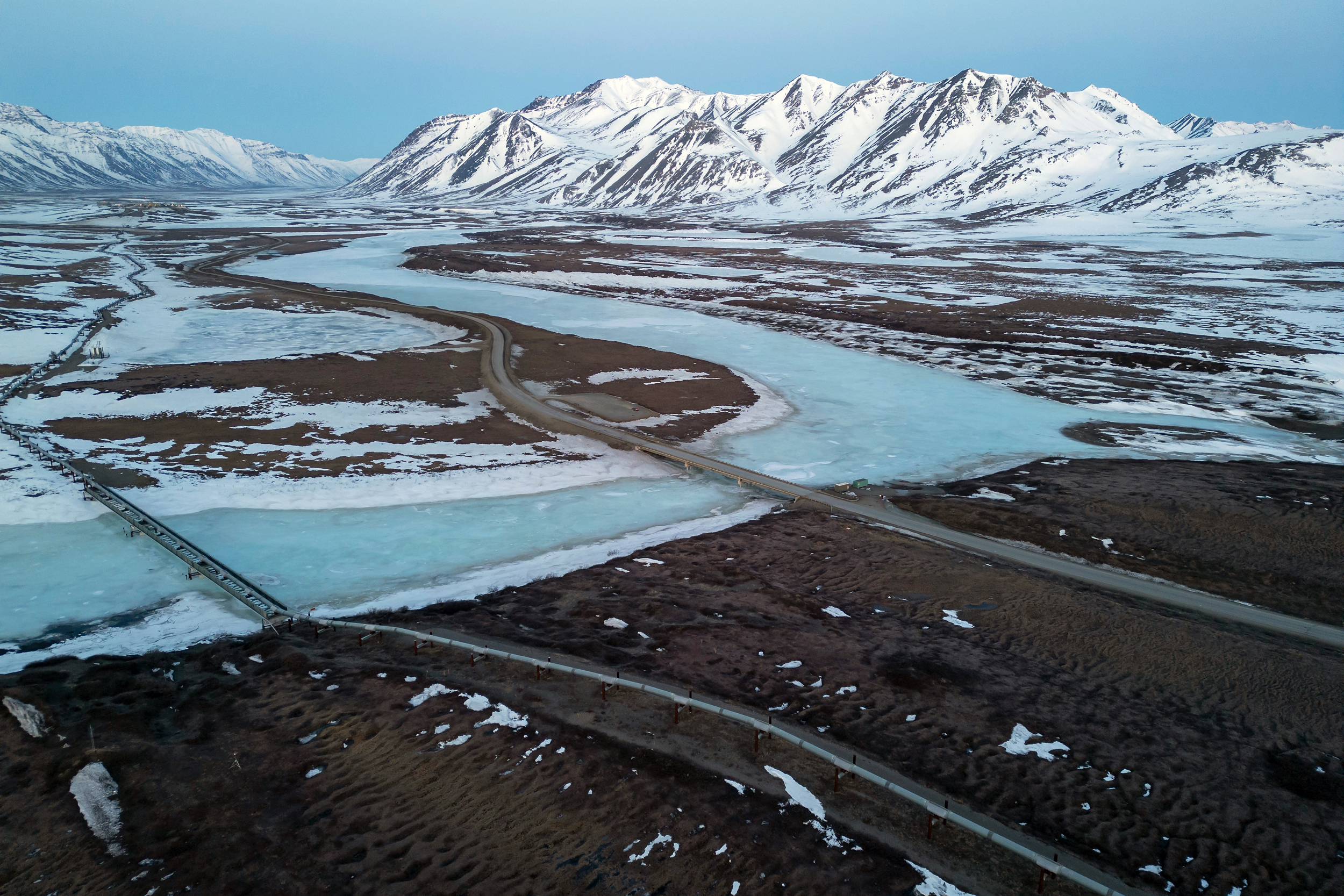


Oil companies will no longer be required to conduct environmental reviews before exploring for fossil fuel reservoirs in the Western Arctic, the largest tract of federally managed public land in the United States.
The Bureau of Land Management announced a categorical exclusion under the National Environmental Policy Act for winter oil and gas exploration in the National Petroleum Reserve-Alaska, also known as the Western Arctic. Published Friday in the Federal Register, the exemption comes as the Trump administration moves to accelerate oil and gas drilling in Alaska.
The categorical exclusion will allow developers to “more nimbly locate energy resources in the Petroleum Reserve,” increasing domestic energy supply and lowering costs for the public, said Kevin Pendergast, Alaska State Director for the Bureau of Land Management. The agency said its decision reflects a “long history” of exploration in the region without “significant or lasting environmental impact.”
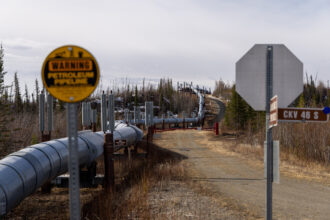
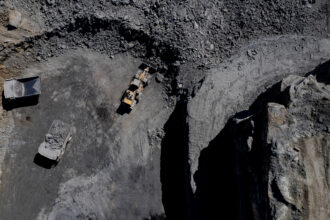
During Arctic exploration, oil and gas firms construct temporary roads, drill test wells and conduct seismic surveys, in which “thumper trucks” weighing up to 45 tons send shock waves through the ground to detect oil deposits. The activities are mostly limited to winter, when heavy machinery can travel over frozen ground without sinking into the delicate tundra and permafrost below.
Even then, exploration activities pose a significant risk to residents and an already threatened ecosystem.
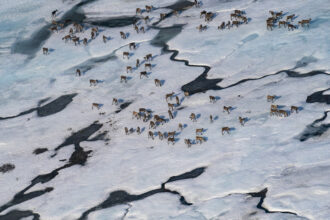
The Western Arctic is the traditional land of the Iñupiat people and serves as a critical wildlife habitat for hundreds of thousands of caribou across three major herds. According to the National Oceanic and Atmospheric Administration’s 2024 Arctic Report Card, caribou populations in the region have fallen by more than half since their historic highs in the 1990s.
Industrial development in the Arctic directly interferes with seasonal migration routes and the areas where herds return year after year to calve. United States Geological Survey research has documented changes in Arctic caribou behavior even at low vehicle traffic volumes.
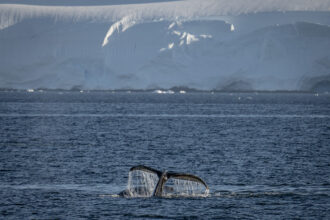
The petroleum reserve is also home to millions of migratory birds, as well as polar bears and seals threatened by habitat loss due to rapidly melting sea ice.
The Arctic is warming at two to four times the global average rate. As snow and ice melt in the polar region, they expose a darker surface that absorbs more sunlight and drives further warming in a feedback loop scientists have dubbed “ice-albedo” feedback. Critics of the exemption say that signing off on oil exploration without any environmental review process further harms a fragile ecosystem.
“It is no secret that the Trump administration will ignore impacts to public lands and our nation’s laws if it benefits resource extraction corporations, but recent efforts to remove any and all public review of Arctic oil extraction are particularly egregious,” said Andy Moderow, senior director of policy for the Alaska Wilderness League in a statement by the organization. “This drill first and discover the impacts later approach puts Arctic lands, waters, and wildlife at risk.”
Opponents also question the legality of the categorical exclusion.
“The administration finalized this new approach with zero public input,” said Janet Bering, an Alaska-based attorney with the environmental law organization Earthjustice. “Combined with a similar proposal that rubber stamps new oil production, this is a one-two punch. It’s bad policy, and it is unlawful.”
Last month, the Bureau of Land Management proposed a rule to expedite all oil and gas drilling across the Western Arctic by cutting environmental review and public input for projects beyond the exploration phase.
The rule stemmed from a petition by the Alaska Oil and Gas Association, a trade group representing oil and gas firms exploring and producing offshore and in Alaska’s northernmost reaches, including the National Petroleum Reserve. The association did not respond immediately to requests for comment on Friday’s decision.
This story is funded by readers like you.
Our nonprofit newsroom provides award-winning climate coverage free of charge and advertising. We rely on donations from readers like you to keep going. Please donate now to support our work.
Donate NowThe Trump administration’s push to accelerate oil extraction in the Arctic has drawn mixed responses from Alaska Natives. Some Iñupiat communities in the region say they stand to benefit economically from drilling and corporate investments. Others see the development as a blow to already imperiled lands critical for subsistence hunting and, with it, their traditions and culture.
Rosemary Ahtuangaruak, a former mayor of the majority-Iñupiat community of Nuiqsut and founder of the organization Grandmothers Growing Goodness, said caribou have been pushed farther away from Nuiqsut as ConocoPhillips expands drilling operations in the area.
The community is located just four miles outside the petroleum reserve. For years, Nuiqsut residents have fought for stronger environmental mitigation measures in pending drilling permits. Ahtuangaruak has advocated for practices that would reduce air pollution from gas flares and protect caribou migration to their seasonal calving grounds.
By eliminating the environmental review process, Nuiqsut residents will have even fewer opportunities to weigh in through public comment, she said.
“We should not let the greed of profiteering lead our tables of decision-making over the cost of people and the life, health and safety of the generations to come,” Ahtuangaruak said.
First designated as a petroleum reserve for the U.S. Navy in 1923, the Department of the Interior assumed authority for oil and gas leasing in the region in 1976. Yet the 36,000-square-mile tract of wild Arctic tundra, wetlands and coastline was largely preserved as wilderness until the turn of the 21st century.
In 1998, during the Clinton administration, 87 percent of the reserve was opened to oil and gas leases. Still, lease sales over the years involved only a small fraction of available acres; even fewer of those acres were actually developed.
In 2023, the Biden administration approved the controversial Willow Project, a massive ConocoPhillips venture that proposed drilling up to 199 wells in the reserve. Yet, the following year, the administration restricted the overall number of acres available for leasing, designating nearly half the territory as “special areas” subject to heightened regulations.
In 2025, on the first day of his second term, President Donald Trump signed an executive order directing agencies to rescind the Biden-era regulations. Since then, his administration has reopened up to 82 percent of the region to oil and gas leasing.
About This Story
Perhaps you noticed: This story, like all the news we publish, is free to read. That’s because Inside Climate News is a 501c3 nonprofit organization. We do not charge a subscription fee, lock our news behind a paywall, or clutter our website with ads. We make our news on climate and the environment freely available to you and anyone who wants it.
That’s not all. We also share our news for free with scores of other media organizations around the country. Many of them can’t afford to do environmental journalism of their own. We’ve built bureaus from coast to coast to report local stories, collaborate with local newsrooms and co-publish articles so that this vital work is shared as widely as possible.
Two of us launched ICN in 2007. Six years later we earned a Pulitzer Prize for National Reporting, and now we run the oldest and largest dedicated climate newsroom in the nation. We tell the story in all its complexity. We hold polluters accountable. We expose environmental injustice. We debunk misinformation. We scrutinize solutions and inspire action.
Donations from readers like you fund every aspect of what we do. If you don’t already, will you support our ongoing work, our reporting on the biggest crisis facing our planet, and help us reach even more readers in more places?
Please take a moment to make a tax-deductible donation. Every one of them makes a difference.
Thank you,

Anika Jane Beamer
Reporter, Iowa
Anika Jane Beamer covers the environment and climate change in Iowa, with a particular focus on water, soil and CAFOs. A lifelong Midwesterner, she writes about changing ecosystems from one of the most transformed landscapes on the continent. She holds a master’s degree in science writing from the Massachusetts Institute of Technology as well as a bachelor’s degree in biology and Spanish from Grinnell College. She is a former Outrider Fellow at Inside Climate News and was named a Taylor-Blakeslee Graduate Fellow by the Council for the Advancement of Science Writing.