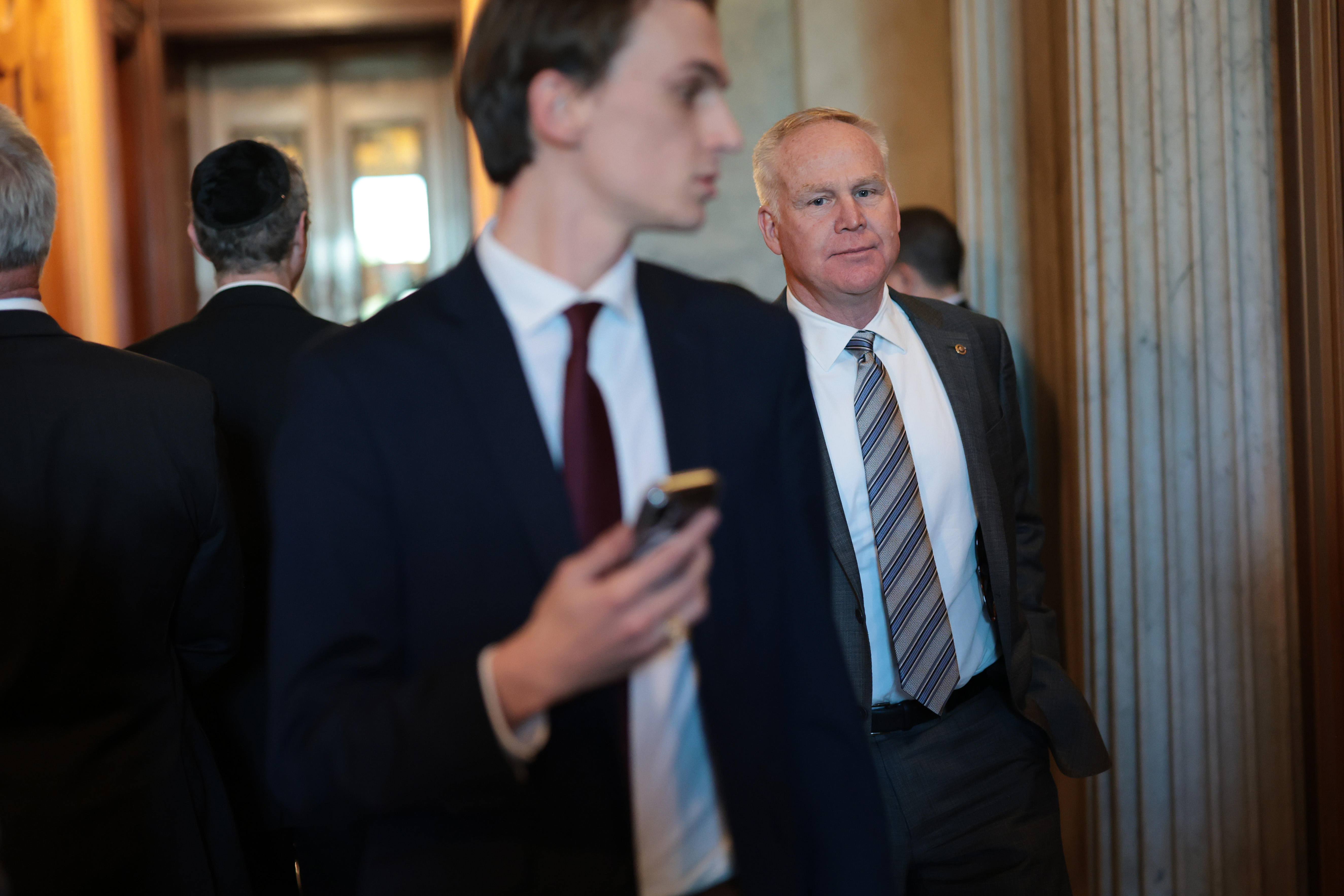


When U.S. Sen. Alan Armstrong of Oklahoma started work this year on legislation to speed approval for infrastructure projects, he hired the chief lawyer at one of the nation’s largest gas pipeline developers to lead his Senate office.
Armstrong had previously led the Williams Companies, stepping down before entering public office. But his new chief of staff, T. Lane Wilson, maintained his position at the company even while serving in the Senate.
During his nearly three-month stint in the Senate, Wilson kept the title of senior vice president and general counsel at Williams, a company spokesperson said. That means Wilson’s colleagues at Williams were lobbying his new colleagues in the Senate on pipeline permitting reform.
A chief of staff is typically second-in-command in a Senate office, supervising staff and advising on policy. While a Williams spokesperson said Wilson did not take his corporate salary while serving on the Senate staff, he maintained a significant financial stake in the company.
Delaney Marsco, director of ethics at the nonpartisan Campaign Legal Center, said it is highly unusual for such a high-level staffer to maintain outside employment. She said the fact that Armstrong was working on legislation that would affect Wilson’s company raised “serious questions.”
Wilson’s 89-day tenure may have allowed him to avoid restrictions that generally prohibit Senate staffers who serve 90 days or more from serving as an officer at, or affiliating with, corporations.
Craig Holman, the government affairs lobbyist for watchdog group Public Citizen, called the arrangement “an obvious conflict of interest,” even if Senate ethics rules did not prohibit it.
Armstrong, a Republican, was appointed in March by Oklahoma Gov. Kevin Stitt to finish the Senate term of Markwayne Mullin, who was tapped to lead the U.S. Department of Homeland Security. At the time, Armstrong was serving as executive chairman of Williams and had previously served as the company’s chief executive. Oklahoma law barred Armstrong from running for a full term and he is now slated to serve until Nov. 30, when the newly elected Republican Kevin Hern will be sworn in.
As soon as he took office, Armstrong touted his experience leading Williams as an asset in advancing permitting legislation through the Senate.
“I am retired from the industry,” Armstrong said in his first Senate speech. “I am here because I have seen how this system strangles our great country.”
Armstrong introduced a bill in June with provisions that would have restricted the ability of states, tribes and others to challenge pipelines. While the legislation never came to a vote, it drew 20 cosponsors. Armstrong celebrated the inclusion of similar provisions in the Bipartisan American Affordability and Jobs Act, the permitting bill that cleared an initial Senate vote on Monday.
The bill includes a range of measures to accelerate permitting, including provisions that would limit states’ authority to reject or impose conditions on planned interstate gas pipelines and transmission lines. Williams stands to benefit from those provisions.
Wilson was Armstrong’s chief of staff from April 13 to July 10, according to Blake Jackson, a Williams spokesperson. Jackson said Wilson did not receive a salary from the company during this period. Wilson also shifted his responsibilities and communications to avoid potential conflicts of interest, Jackson said, including separating himself from the company’s government affairs team and recusing himself from any meetings between that team and Armstrong or his staff.
A spokesperson in Armstrong’s Senate office declined to comment.
Upon entering the Senate, he held more than $20 million in company stock, according to a securities filing. Wilson also continued making regularly scheduled stock sales under a pre-arranged broker agreement, selling nearly $450,000 worth of stock from May through July. Since leaving the Senate, Wilson has sold an additional $1.5 million in Williams shares, including nearly $1 million in two transactions made outside the pre-arranged agreement, according to a securities filing.

Experts said it is unclear whether Wilson’s dual employment violated Senate ethics rules. One provision prohibits outside “employment for compensation which is inconsistent or in conflict with the conscientious performance of official duties.” Wilson may have complied with this rule by not taking a salary from Williams while working in the Senate.
Wilson did not file a financial disclosure report. A Williams spokesperson said he was not obligated to do so. Senate rules say all staff with annualized salaries of at least $151,661 must file reports. Williams did not disclose Wilson’s salary there, and staff salaries for the period have not yet been published. But a Congressional Research Service report said the minimum salary for a Senate chief of staff last year was just over $163,000.
Experts say another key question is whether the Senate Select Committee on Ethics approved the terms of Wilson’s employment. Jackson, the Williams spokesperson, said the committee had signed off, but he declined to provide a copy of any advisory letter. Such letters generally remain confidential unless a recipient makes them public.
Neither the Ethics Committee nor the office of Republican Sen. James Lankford, the committee chairman and Oklahoma’s senior senator, replied to questions for this article. The office of the committee’s vice chairman, Sen. Christopher Coons (D-Delaware), also did not reply to inquiries.
“Everything might be, by the letter of the law and the Senate rules, totally above board, but it doesn’t solve the problem of looking really bad,” said Marsco, with the Campaign Legal Center. “And in the ethics world, that’s just as bad.”
The Ethics Committee website says it has long interpreted its rule on outside employment “as applying to both actual conflicts of interest and the appearance of a conflict of interest.”
Marsco said appearances are important because democracy relies on public trust. “If a reasonable person can draw these conclusions that something might be a conflict of interest,” she said, “it calls into question in the mind of the public whether or not these people are actually working on the public’s behalf or if they’re working for their own bottom line or the bottom line of a special interest.”
From 2007 to 2025, the Senate’s Ethics Committee received reports of over 2,000 alleged ethics violations. None led to sanctions, according to its records.
Donald Sherman, chief executive of the nonprofit government watchdog organization Citizens for Responsibility and Ethics in Washington, said in an email that “Armstrong’s ability to appoint T. Lane Wilson to his staff is emblematic of why the Senate Ethics Committee needs reform.”
He called for the Senate to establish an independent ethics body to investigate issues like Wilson’s employment, following the House of Representatives’ example.
“The results of the recent midterms have made clear that the American people are overwhelmingly tired of government corruption,” Sherman said. “These kinds of revolving door arrangements should be impermissible; [the] potential for conflicts of interest are obvious to anyone paying attention.”
About This Story
Perhaps you noticed: This story, like all the news we publish, is free to read. That’s because Inside Climate News is a 501c3 nonprofit organization. We do not charge a subscription fee, lock our news behind a paywall, or clutter our website with ads. We make our news on climate and the environment freely available to you and anyone who wants it.
That’s not all. We also share our news for free with scores of other media organizations around the country. Many of them can’t afford to do environmental journalism of their own. We’ve built bureaus from coast to coast to report local stories, collaborate with local newsrooms and co-publish articles so that this vital work is shared as widely as possible.
Two of us launched ICN in 2007. Six years later we earned a Pulitzer Prize for National Reporting, and now we run the oldest and largest dedicated climate newsroom in the nation. We tell the story in all its complexity. We hold polluters accountable. We expose environmental injustice. We debunk misinformation. We scrutinize solutions and inspire action.
Donations from readers like you fund every aspect of what we do. If you don’t already, will you support our ongoing work, our reporting on the biggest crisis facing our planet, and help us reach even more readers in more places?
Please take a moment to make a tax-deductible donation. Every one of them makes a difference.
Thank you,

Lauren Dalban
Reporter, New York City
Lauren Dalban is a New York City-based reporter with a background in local journalism. A former ICN fellow, she now covers environmental issues in all five boroughs. Originally from London, she earned a B.A. in History and English from the University of Virginia, and an M.S. from Columbia Graduate School of Journalism.