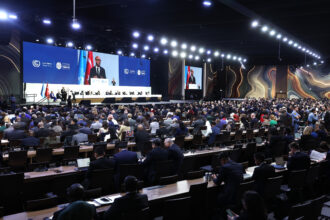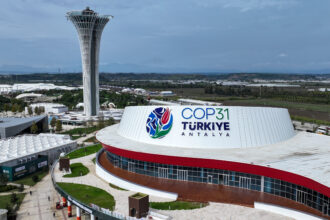
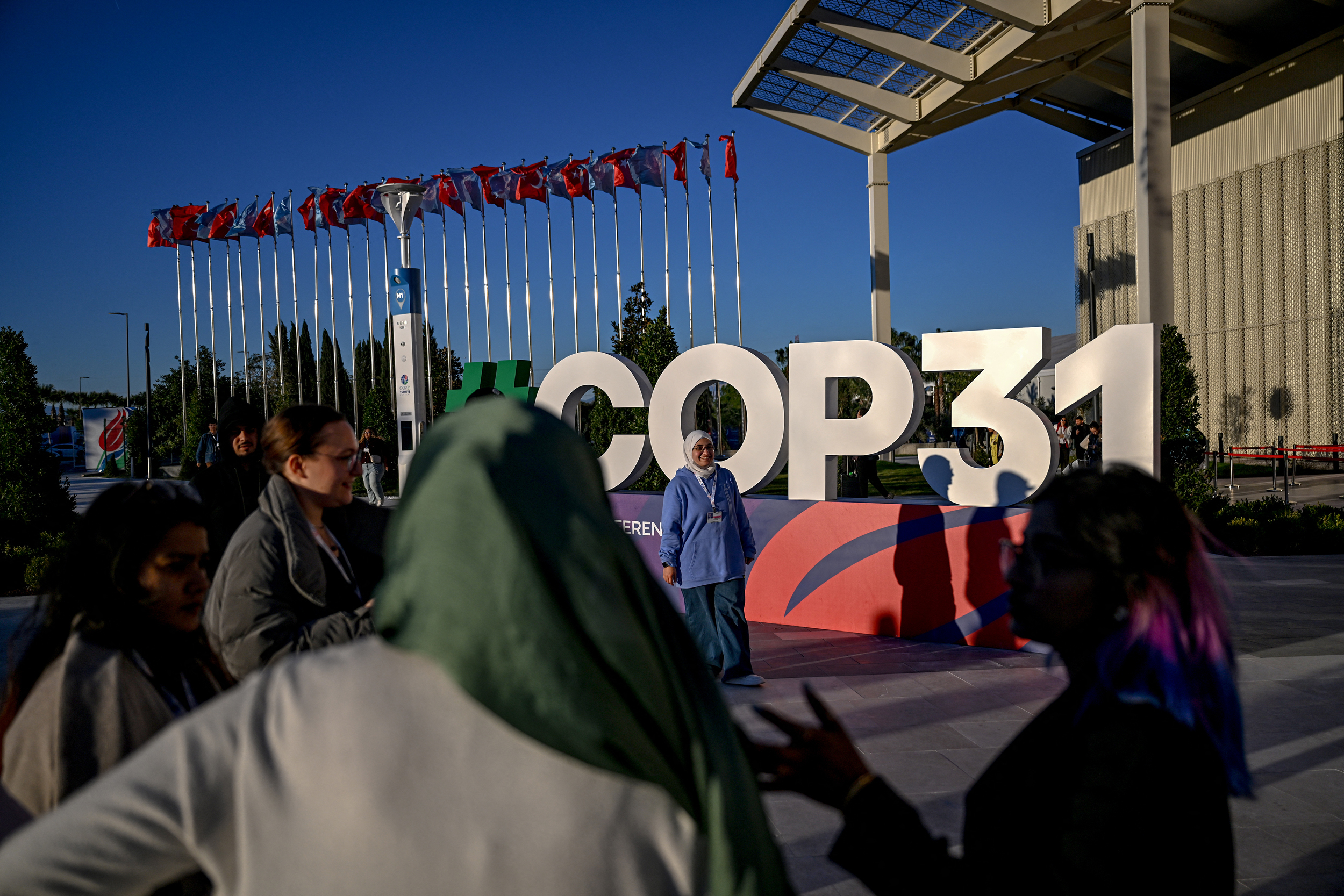


Yesterday, delegates from about 200 countries arrived in Antalya, a resort city on Turkey’s Mediterranean coast, for the 31st United Nations climate summit. It is the first “Conference of Parties” or “COP” to open since the UN’s own scientists said, in effect, that we’ve missed a key target for holding climate change in check.
Last month, the UN Environment Programme’s annual Emissions Gap Report concluded that warming will overshoot 1.5 degrees Celsius above pre-industrial levels, the limit that countries agreed to aim for in the 2015 Paris Agreement to avoid the worst climate impacts. Its best-case scenario now peaks at 1.7 to 1.8 degrees around mid-century, before drifting back down by 2100. That scenario requires global emissions to fall 45 percent below 2025 levels by 2035. Shocker: They’re not falling 45 percent by then.
If the world is going to miss its warming target anyway, why keep showing up? Delegates could skip two weeks of indoor negotiations and enjoy the Turkish Riviera. Right?
Wrong. Annually at COP, nearly every country negotiates three things by consensus: how fast to cut emissions, how to adapt to impacts already here and who pays for both. Much of the money on the table at COP31 doesn’t pay for curtailing emissions. It helps vulnerable countries brace for floods and heat waves and recover when they hit. Overshoot means more of both, so the bill goes up every year.
Every tenth of a degree above 1.5 C can lead to more floods, heat waves and failed harvests. A UN report released Wednesday found that even if rich countries meet last year’s call to at least triple adaptation finance by 2035, that would only bring in $85 billion to $120 billion a year. Developing countries need an estimated $305 billion annually, Climate Home News reports.
UK climate minister Katie White told Carbon Brief the latest science is “really scary.” Asked about the cut to its climate finance for developing countries, she acknowledged the money falls short of what’s needed and pointed to new financing tools, such as Brazil’s proposed rainforest fund. The fund was developed to help guide countries to halt and reverse deforestation by 2030.
Developing countries have heard this before. India’s environment minister, Bhupender Yadav, has said India will push for “predictable” climate finance and technology transfer in Antalya. During the pre-summit talks in Fiji last month, he put it more plainly: If developing countries are asked to cut emissions faster, that ambition should be “matched by climate finance,” technology and training.
In other words, the overshoot era is not a reason to spend less. It’s the invoice for having spent too little.
The cheapest idea on the table: Electricity. Turkey is asking countries to sign a voluntary pledge to raise electricity’s share of global energy use to 35 percent by 2035, up from just over 20 percent today. China, the world’s largest emitter, signaled its support in October. It’s an easy yes for a country whose electricity share is already near 30 percent.
Chris Bowen, the Australian minister running the negotiations at COP, has experience with electrifying energy: Since July, Australia has required retailers in three states to offer households three free hours of power at midday, when rooftop solar floods the grid. However, the pledge doesn’t require clean power. And Australia keeps approving coal and gas projects. Current policies get the world to only 28 percent, per Climate Action Tracker
And more: The summit’s mascot is the loggerhead sea turtle. Antalya built a pavilion in the shape of one. Loggerheads are living thermometers: the sex of sea turtle hatchlings is determined by sand temperatures. Warmer sand produces more females. As delegates debate who pays for overshoot, the host’s mascot has already started paying, one generation of disproportionate populations at a time.
But hey, at least the COP31 site has a tropical butterfly garden! The president of COP31, Murat Kurum, said that “we’re fluttering wings towards a green future.”
The Latest on Earth
Last week’s midterms handed Democrats control of both chambers of Congress, a batch of new statehouse trifectas and even the Texas governor’s mansion. That gives them a real shot at slowing President Donald Trump’s climate rollbacks.
Here are some stories that stood out beyond the elections:
- The UN Food and Agriculture Organization hosted the first Global Pollinator Conference from Nov. 5-6, laying the groundwork for a worldwide effort to protect bees, butterflies and other pollinators. The conference highlighted how critical pollinators are for the wellbeing of people and nature, that better coordination would make action on pollinators more effective and that sustainable and consistent funding is essential.
- Microplastics from the Great Pacific Garbage Patch could be changing the color of the ocean by making the blues and greens of the water brighter. While it’s not directly proven yet, researchers are fairly confident that microplastics are the culprit for the neon-ifying of the ocean.
- Solar panels are showing up on wedding registries in Nigeria, according to reporting from The Los Angeles Times. The grid serving the nation is so weak that in order to keep the lights on and appliances running, most Nigerians produce power at home. Solar energy has gotten so popular that there are hundreds of shops dedicated to it in Lagos, and panels now appear on wedding registries among bed linens and microwaves.
This story is funded by readers like you.
Our nonprofit newsroom provides award-winning climate coverage free of charge and advertising. We rely on donations from readers like you to keep going. Please donate now to support our work.
Donate NowFrom Our Bureaus: Bob Berwyn on COP31
Bob Berwyn has been reporting on COPs for more than 10 years, since the Paris Agreement was signed in 2015. He’s been attending them in person since 2022. Last week, he reported on how the scientific organization COP relies on to guide their decisions is short on funds. I asked him about what is in store for this year’s summit, and if any solutions will actually come out of it.
KATE WAXMAN: What was the first day of COP31 like?
BOB BERWYN: One of the things we heard this morning was that right now, as of today, the global average temperature is more than two degrees Celsius or 3.6 degrees Fahrenheit above the pre-industrial average. And as at every COP, [there are] very clear warnings that this is a huge danger for communities, for ecosystems, and that the folks who are here to talk about this should really figure out a way to get a grip on it.
WAXMAN: What’s been the energy like from the crowd?
BERWYN: Some people, I think, are just optimistic. All the people that are here in good faith want to do something. They want to reach some kind of agreement, whether it’s more finance to protect forests or to help developing countries with the extreme climate impacts that they’re facing, and the challenge is really when all those 195 countries are in the same room is to get them to agree.
WAXMAN: What do you think is going to be the outcome?
BERWYN: I don’t expect any new major agreements. I think my biggest hope is that the process doesn’t completely fall apart. In a best-case outcome, I would hope that there are subsets of countries working on agreements or on ways to tackle this, where you don’t need every single country’s agreement.
WAXMAN: What would you say has been the biggest thing that you’ve learned from reporting on COPs throughout the years?
BERWYN: In the context of the ultimate goal, which is to limit warming so that more people don’t get hurt and killed by extreme climate impacts, the main thing I’ve learned is that I think each country needs to really look at itself. I think we’re really at a point where we’re realizing that we’re probably never going to get a binding agreement that would specify or mandate each country to do something. So it’s really up to national governments, to people in countries, to make it happen in their own countries, and then to somehow bring that all together under this international umbrella.
WAXMAN: Do you have a story from reporting on COPs that really sticks out in your brain?
BERWYN: The COP in Egypt in Sharm El-Sheikh. It went two days into overtime because of discussions about loss and damage, but all the food stands closed down. I was wandering around, and I looked outside and I saw a group of people sitting around eating and laughing and I poked my head out to say hi; it was a group of workers at the COP, local workers who had their own barbecue set up. They were cooking rice and skewers, and they invited me and a couple of other people to eat with them. We had a great conversation outside of any formal negotiations. We were all just waiting for the closed negotiations to finish. I’m still in touch with one of the people that I met out there. He lives in Alexandria, Egypt, and went to Sharm El-Sheikh to work at the conference. And we still exchange messages occasionally, especially around the time of COP each year, we check in. It’s little things like that that I think make it a human experience too.
News From Us and Our Partners
The aftermath of the Maui fires: The road to recovery after the Lahaina fires three years ago has been arduous. My colleague Keerti Gopal reported on a wildfire exposure study that found elevated levels of heavy metals linked to heart and lung problems and cancer risk in a group of more than 1,200 survivors, and a family that has finally started to rebuild after the devastating fires. Listen to the latest episode of Inside Climate to hear more about Keerti’s reporting.
Why it matters: The costs of a climate disaster keep piling up for years after the fire is out. That’s the kind of loss and damage COP31 is arguing over who pays for.
The loss and damage fund: The UN’s loss and damage fund voted to set aside $20 million for Nepal, where flooding killed some 1,500 people earlier this year, Nicholas Kusnetz reports for ICN. It’s the first time the fund has moved in direct response to a climate disaster. Still, the money would cover less than 1 percent of Nepal’s estimated $2.69 billion in initial losses.
Why it matters: It’s the overshoot bill in miniature. One hundred and nineteen countries have asked the fund for a total of $2.8 billion, but its first funding round has only about $350 million to hand out.
Osprey populations declining: Chesapeake Bay ospreys just had their worst breeding season on record, and scientists and the fishing industry disagree about why, Aman Azhar and Johnny Sturgeon report for ICN. Researchers point to a shortage of menhaden, a small fish the birds depend on. The industry says poor breeding numbers don’t prove commercial fishing is to blame.
Why it matters: Ospreys’ health is an early warning for the bay’s food web, and the fight over what’s starving them is really a fight over who gets the fish.
Thanks for reading this edition of Today’s Climate, a newsletter dedicated to highlighting the latest essential climate news.
Loved (or hated) this new edition? Tell me so at [email protected]
For conversations with ICN reporters about the stories behind the headlines, you can listen to Inside Climate on YouTube, Spotify, Apple Podcasts, Amazon Music and iHeart.
About This Story
Perhaps you noticed: This story, like all the news we publish, is free to read. That’s because Inside Climate News is a 501c3 nonprofit organization. We do not charge a subscription fee, lock our news behind a paywall, or clutter our website with ads. We make our news on climate and the environment freely available to you and anyone who wants it.
That’s not all. We also share our news for free with scores of other media organizations around the country. Many of them can’t afford to do environmental journalism of their own. We’ve built bureaus from coast to coast to report local stories, collaborate with local newsrooms and co-publish articles so that this vital work is shared as widely as possible.
Two of us launched ICN in 2007. Six years later we earned a Pulitzer Prize for National Reporting, and now we run the oldest and largest dedicated climate newsroom in the nation. We tell the story in all its complexity. We hold polluters accountable. We expose environmental injustice. We debunk misinformation. We scrutinize solutions and inspire action.
Donations from readers like you fund every aspect of what we do. If you don’t already, will you support our ongoing work, our reporting on the biggest crisis facing our planet, and help us reach even more readers in more places?
Please take a moment to make a tax-deductible donation. Every one of them makes a difference.
Thank you,

Kate Waxman
Fellow
Kate Waxman is a Florida-based Outrider fellow at Inside Climate News, where she covers climate injustice across the state. She earned her M.S. in journalism from Columbia Journalism School and her B.A. in environmental science from Barnard, with reporting focused on coral reefs, climate science, and the communities closest to the water.