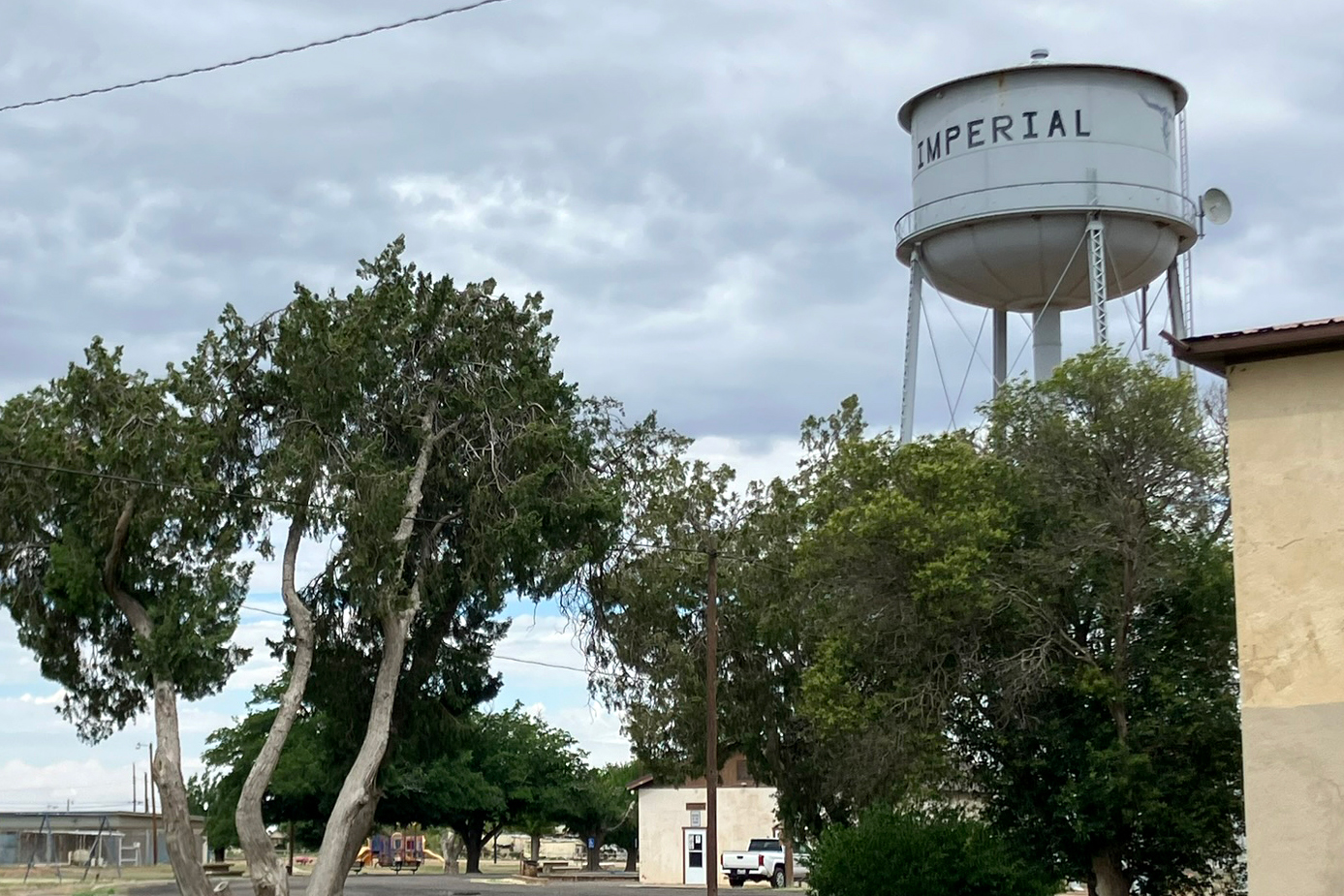


IMPERIAL, Texas—Many residents of this small town drive long distances to buy bottled water instead of opening up the tap.
Pecos County Fresh Water, a county-operated utility, provides drinking water for 800 people in Imperial and the surrounding area. The utility routinely violates safe drinking water standards set by the Environmental Protection Agency for “combined radium” and “gross alpha,” two metrics of radioactivity in water. The culprit is naturally occurring radioactive material in the aquifer.
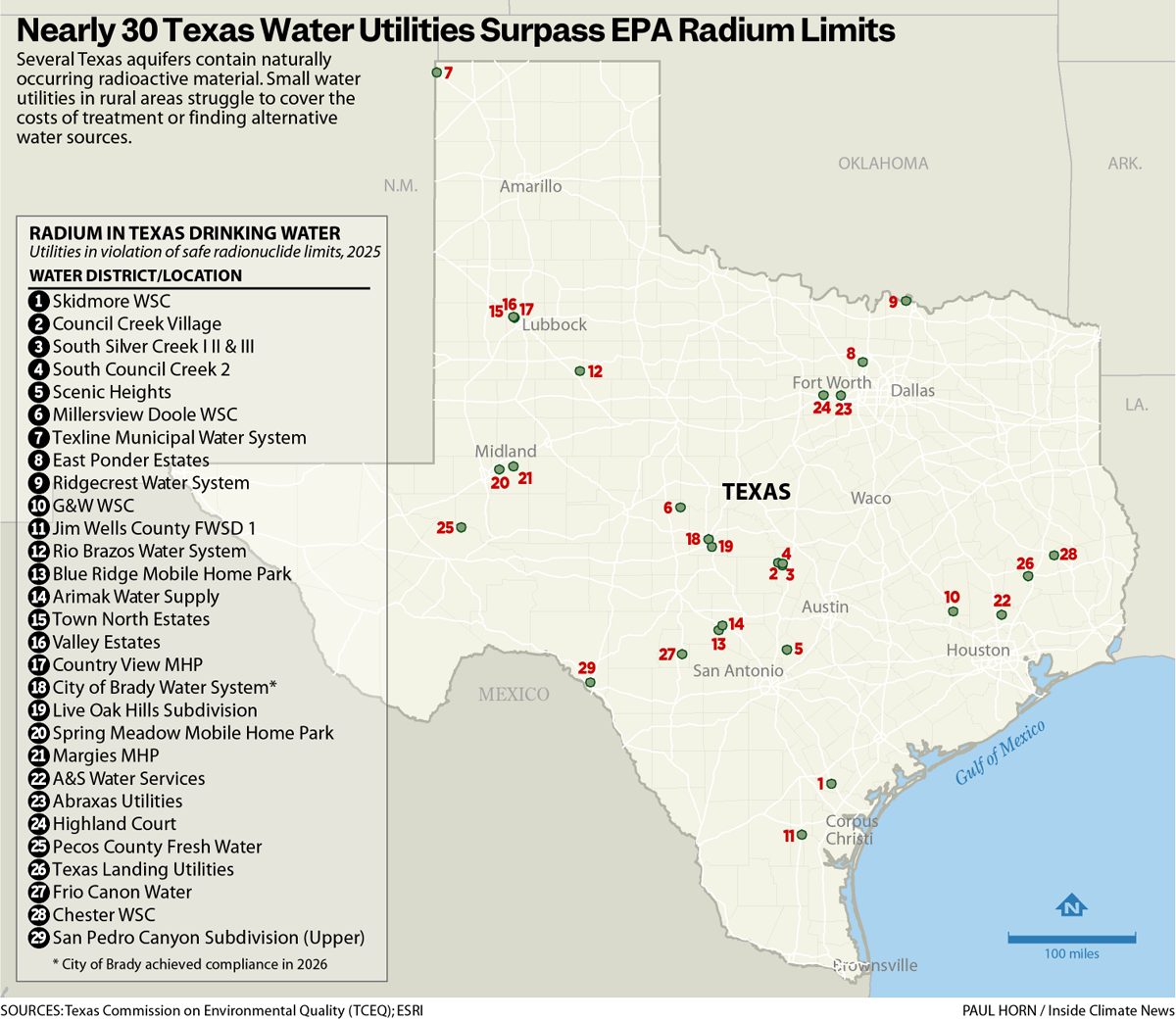
Imperial is one of many rural communities in Texas where deposits of radioactive materials dissolve into the groundwater. But small communities often struggle to pay for costly treatment technology or alternative water sources that could fix the problem. During 2025, 29 public water systems that serve more than 22,000 people in Texas violated maximum levels of radionuclides. That’s down slightly from 2018, when a report by the non-profit Environmental Working Group found that 38 Texas utilities exceeded legal limits for radionuclides.
“It needs to be fixed,” said Pecos County Commissioner Nathan Reeves, who represents Imperial. “It’s a problem that should have been dealt with a long time ago.”
Reeves said the county has been rejected for several grants to address the problem, but recently obtained some funding. Pecos County is evaluating alternatives including blending with another water source or drilling a new well. In the meantime, residents rely on purchasing drinking water 30 miles away in Fort Stockton.
“[Radiation] is especially an issue for these smaller systems that only have a limited number of wells they can rely on,” said Tasha Stoiber, an environmental chemist and senior scientist at the Environmental Working Group. “It’s a huge inequity and disparity of who is being exposed more.”
“This Is Not an Emergency”
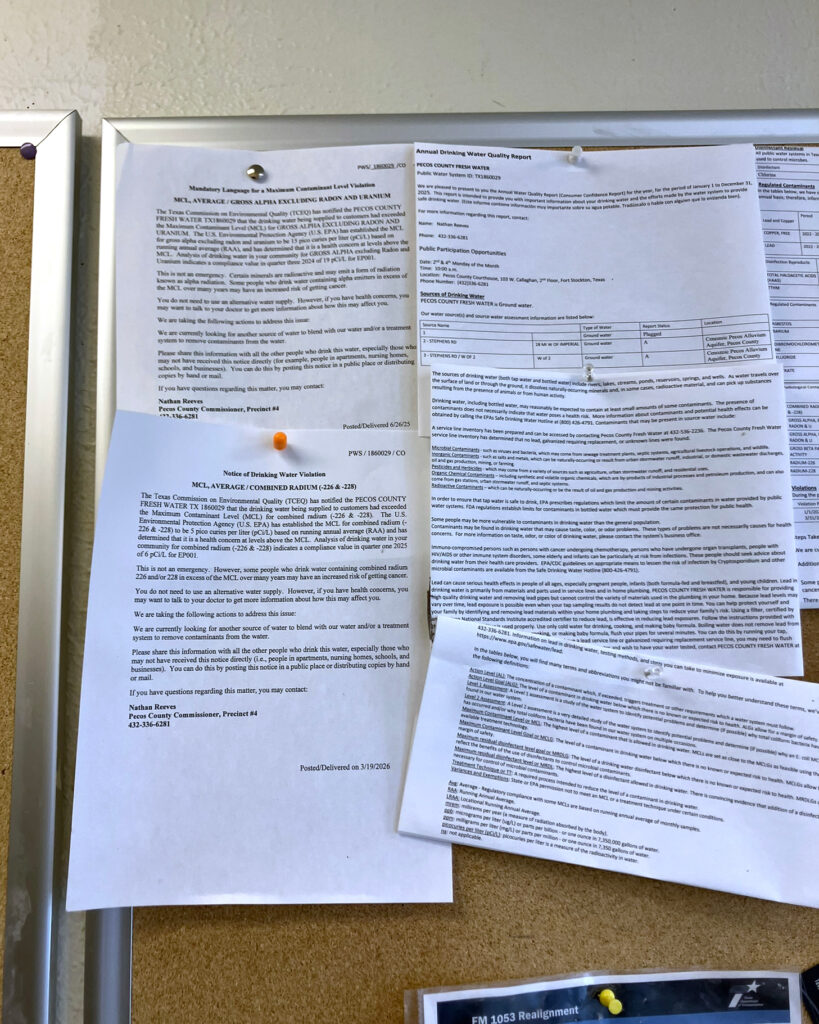
In August 2025, Pecos County Fresh Water once again notified its customers that the utility had exceeded the EPA’s maximum level for radionuclides in drinking water.
“This is not an emergency,” the notice pinned in the Imperial post office and mailed to water customers declared, explaining that some radioactive minerals in water emit alpha radiation. “Some people who drink water containing alpha emitters in excess of the [Maximum Contaminant Limit] over many years may have an increased risk of getting cancer.”
To comply with the Safe Drinking Water Act, utilities that violate drinking water standards must inform their customers with standard language. While Texas officials say Imperial’s water does not pose an immediate health risk, many Imperial residents have stopped drinking it and buy bottled water for drinking and cooking.
Claudia Pinedo serves burritos and tacos at Panchita’s Mexican Restaurant in Imperial. Much of her business comes from oilfield workers who drive through Imperial on their way to work.
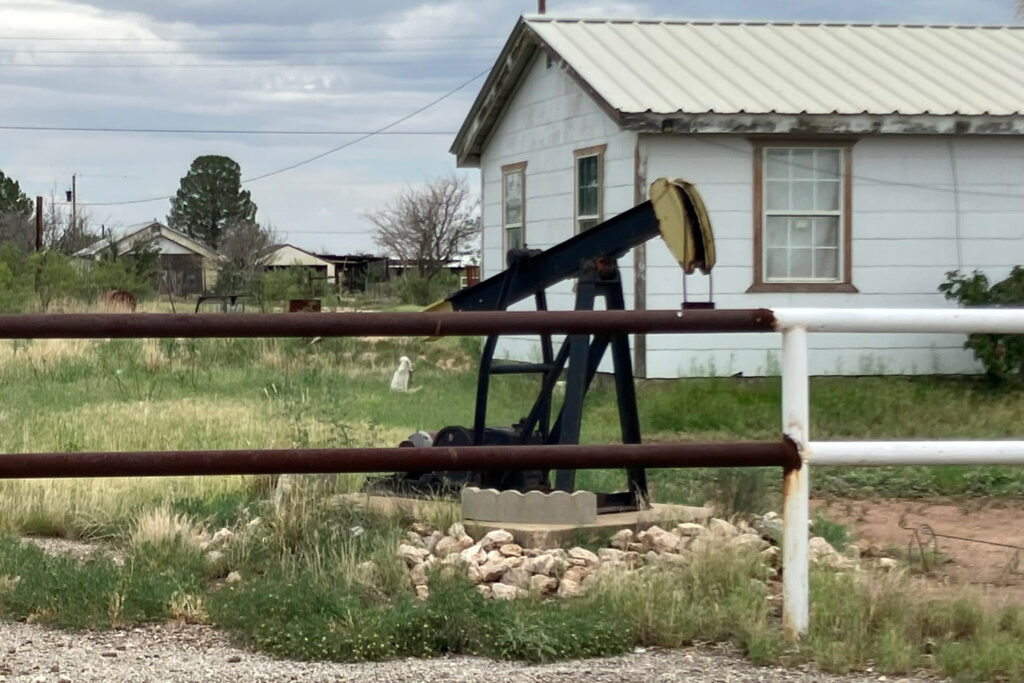
The working class town, where many residents are Latino and speak Spanish at home, is a crossroads of the Permian Basin, about 50 miles south of Odessa. Irrigation from the nearby Pecos River once drew farmers to Imperial. Now the oil and gas industry is the economic engine in town.
Pinedo said she only uses bottled water at home and at the restaurant. She drives to Fort Stockton to fill 5-gallon jugs with fresh water, at $1.75 apiece. The additional expense of buying bottled water for the restaurant and her household with three children adds up.
Pinedo said her children grew up drinking bottled water and many other residents avoid the tap water in town.
“If customers have health concerns, they may want to talk to a health care professional to get more information about [how] the water quality may affect them,” TCEQ spokesperson Richard Richter told Inside Climate News.
Richter said that the EPA sets maximum limits based on a person drinking about a half gallon of water daily for 70 years. He said the limits are designed to protect susceptible groups including children and the elderly.
Imperial and surrounding Pecos County face more than their fair share of environmental challenges. Aging and plugged oil and gas wells have leaked on several ranches in the area. Less than five miles from Imperial, an abandoned well has leaked toxic water for years and formed a hazardous body of water known as Lake Boehmer.
The area’s abundant natural gas and large ranch properties have drawn data center developers. Ten miles as the crow flies from Imperial, Pacifico Energy has obtained permits to build a massive gas power plant, known as GW Ranch, to supply data centers. Amazon recently acquired the site to build a data center, as reported by the organization Cleanview.
Pacifico Energy’s website says it will not require “major external water sources” for the development. Large industrial facilities like GW Ranch could install treatment systems to remove contaminants that are common in area aquifers. Pacifico Energy did not respond to requests for comment. Cleanview reported that Amazon plans to use brackish water at the site.
But for small communities, those treatment costs can be prohibitive. Reeves, the county commissioner, explained that Fort Stockton, the county’s largest city with 8,000 residents, has a reverse osmosis treatment system.
But, for places like Imperial, he said, “In these small towns, there’s no money and no help to throw at it.”
Violations Pile Up in Texas Communities
Radionuclides in drinking water typically come from naturally occurring radioactive material that dissolves into aquifers. In Texas, this problem is most acute in the Hickory Aquifer in Central Texas, the Ogallala Aquifer in North Texas and the Gulf Coast Aquifer. In Pecos County, the excess radium levels are from the Cenozoic Pecos aquifer.
In 1976, the EPA added radionuclides to its drinking water standards. Water is sampled quarterly and compliance is measured by the annual average of the samples. The maximum contaminant level (MCL) for combined radium, which is the sum of Radium-226 and Radium-228, two naturally occurring isotopes of the element radium, is 5 picocuries per liter (pCi/L). For gross alpha radiation, excluding radon and uranium, the MCL is 15 pCi/L.
According to quarterly water testing data provided by TCEQ, Pecos County Fresh Water has violated the combined radium limits 19 times since Jan. 2020. On five occasions, testing found the combined radium levels below the legal limit. The highest combined radium reading since 2020 was 6.53 pCi/L in Oct. 2021. Gross alpha radiation concentrations have been in violation of the maximum level less frequently.
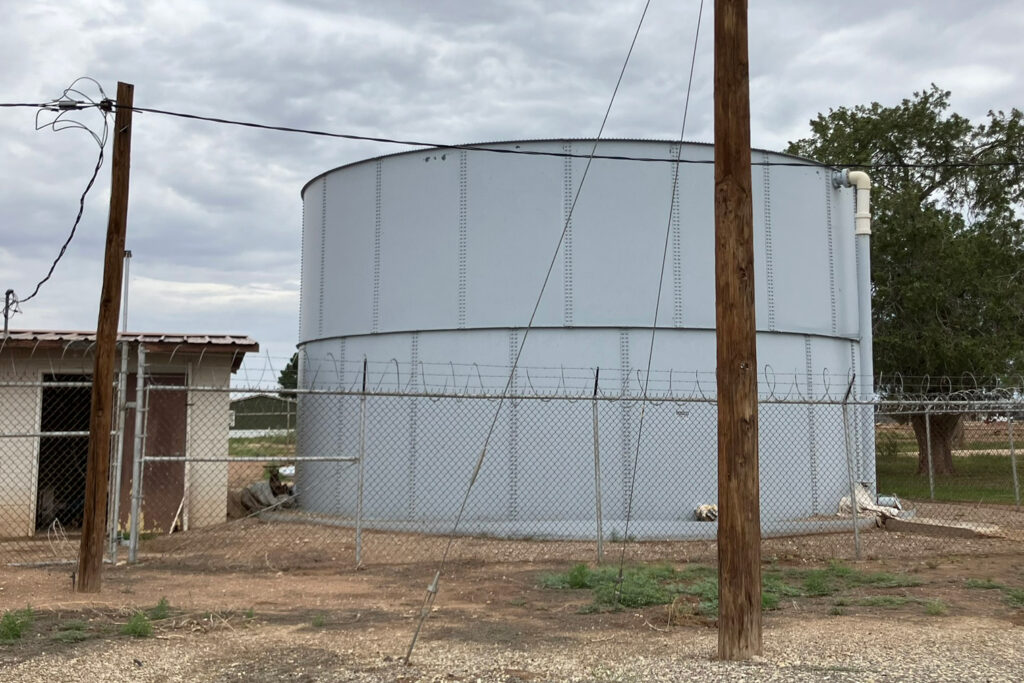
Stoiber, of the Environmental Working Group, said that people who are pregnant or immunocompromised can be at increased risk when exposed to radioactivity. She added that people can be exposed not just from drinking the water but also when bathing or showering.
Sheldon Landsberger, a professor of nuclear and radiation engineering at the University of Texas, Austin, said that cancer risk from radionuclides in drinking water depends on the amount of water an individual drinks and the concentration of radionuclides in the water.
While the water in Imperial is slightly above EPA limits, other utilities in Texas have water with far higher levels of radionuclides. The Millersview-Doole water utility, which serves nearly 4,000 residents of Concho County that relies on the Hickory Aquifer, reported combined radium levels of 64 pCi/L in 2025, almost 13 times the EPA limit.
This story is funded by readers like you.
Our nonprofit newsroom provides award-winning climate coverage free of charge and advertising. We rely on donations from readers like you to keep going. Please donate now to support our work.
Donate NowOther counties where water utilities recorded excess radionuclides in 2025 include Lubbock, Midland, Burnet and Parker.
After years of violations, the city of Brady, population 5,000, celebrated bringing its drinking water into compliance with EPA radionuclide standards this April. The city obtained $31.4 million in funding from the Texas Water Development Board (TWDB) for a treatment plant and other infrastructure. After years of violations, the city is now providing safe drinking water to its residents.
Landsberger emphasized that technologies to remove radionuclides are complex and costly.
“It’s not a simple thing to get rid of radium or any other type of toxic element or chemical that is already water soluble,” he said. “You need some very sophisticated chemical engineering processes to get rid of it.”
The Texas Water Infrastructure Coordination Committee centralizes information about funding for water utilities. TWDB’s Drinking Water Revolving Fund loan program prioritizes projects that address compliance with drinking water standards. A TWDB spokesperson said Pecos County Fresh Water has not applied for funding.
Groundwater will play a bigger role in Texas’ water supply in the years to come, as access to surface water dwindles. Communities such as Corpus Christi that are seeking new groundwater supplies may contend with excess radionuclides in the state’s aquifers. A test well drilled last year as a potential alternative water source for Corpus Christi has several times the EPA limit of gross alpha radiation, according to KRISTV.
TCEQ has come under scrutiny for its past enforcement of radionuclide levels in drinking water. A 2011 investigation by KHOU in Houston found that TCEQ for years had subtracted the margin of error, or counting error, in radium water testing results, despite EPA guidance against this practice. This resulted in fewer water utilities being found in violation of federal standards.
The TCEQ spokesperson said that the agency currently uses the EPA’s Safe Drinking Water Information System to calculate compliance. He said the system “only utilizes the reported value when determining compliance, neither adding nor subtracting the counting error.”
The agency did not respond to questions about when it changed its methods for calculating compliance.
Local Official Seeks Solutions
Nathan Reeves, the Pecos County commissioner, remembers being taken aback the first time he received a notification letter about the radionuclides.
“Who would want to eat and drink with that water when you’ve gotten a letter like that?” he asked.
The problem has dragged on for years. TCEQ violation notices require the utility to submit a plan of how to get back in compliance. Reeves said that in the past, the county would submit a plan but significant progress was never made. Since becoming county commissioner four years ago, he has sought funding for a solution.
The county has contracted with a groundwater hydrologist to explore alternative water options for the utility and continues to seek grant funding.
“The main deal is to get better water, where we don’t have to send these letters,” he said. “The citizens deserve better.”
About This Story
Perhaps you noticed: This story, like all the news we publish, is free to read. That’s because Inside Climate News is a 501c3 nonprofit organization. We do not charge a subscription fee, lock our news behind a paywall, or clutter our website with ads. We make our news on climate and the environment freely available to you and anyone who wants it.
That’s not all. We also share our news for free with scores of other media organizations around the country. Many of them can’t afford to do environmental journalism of their own. We’ve built bureaus from coast to coast to report local stories, collaborate with local newsrooms and co-publish articles so that this vital work is shared as widely as possible.
Two of us launched ICN in 2007. Six years later we earned a Pulitzer Prize for National Reporting, and now we run the oldest and largest dedicated climate newsroom in the nation. We tell the story in all its complexity. We hold polluters accountable. We expose environmental injustice. We debunk misinformation. We scrutinize solutions and inspire action.
Donations from readers like you fund every aspect of what we do. If you don’t already, will you support our ongoing work, our reporting on the biggest crisis facing our planet, and help us reach even more readers in more places?
Please take a moment to make a tax-deductible donation. Every one of them makes a difference.
Thank you,

Martha Pskowski
Reporter, El Paso, Texas
Martha Pskowski covers climate change and the environment in Texas from her base in El Paso. She was previously an environmental reporter at the El Paso Times. She began her career as a freelance journalist in Mexico, reporting for outlets including The Guardian and Yale E360. Martha has a B.A. in Environmental Studies from Hampshire College and a master’s degree in Journalism and Latin American Studies from New York University. She is a former Fulbright research fellow in Mexico. Martha can be reached on Signal at psskow.33.