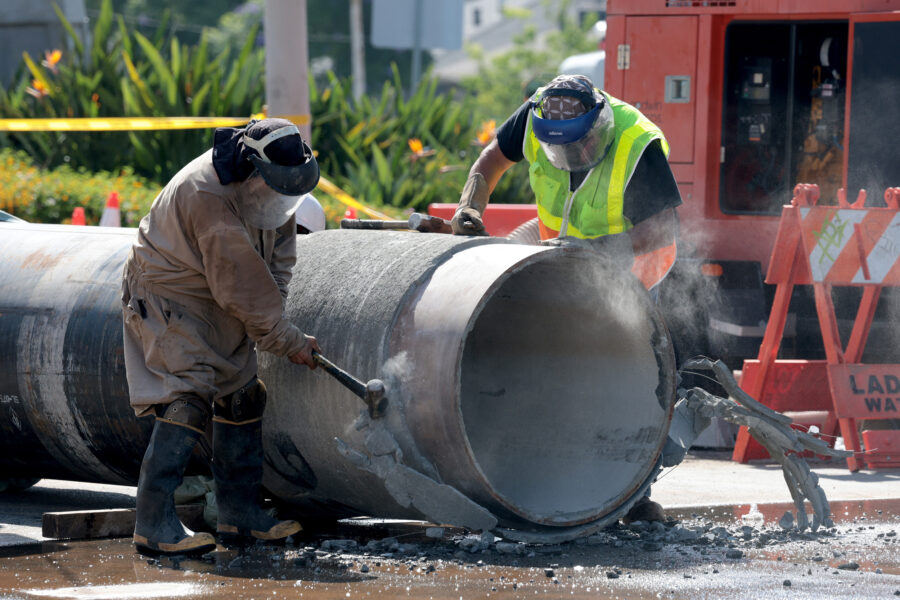
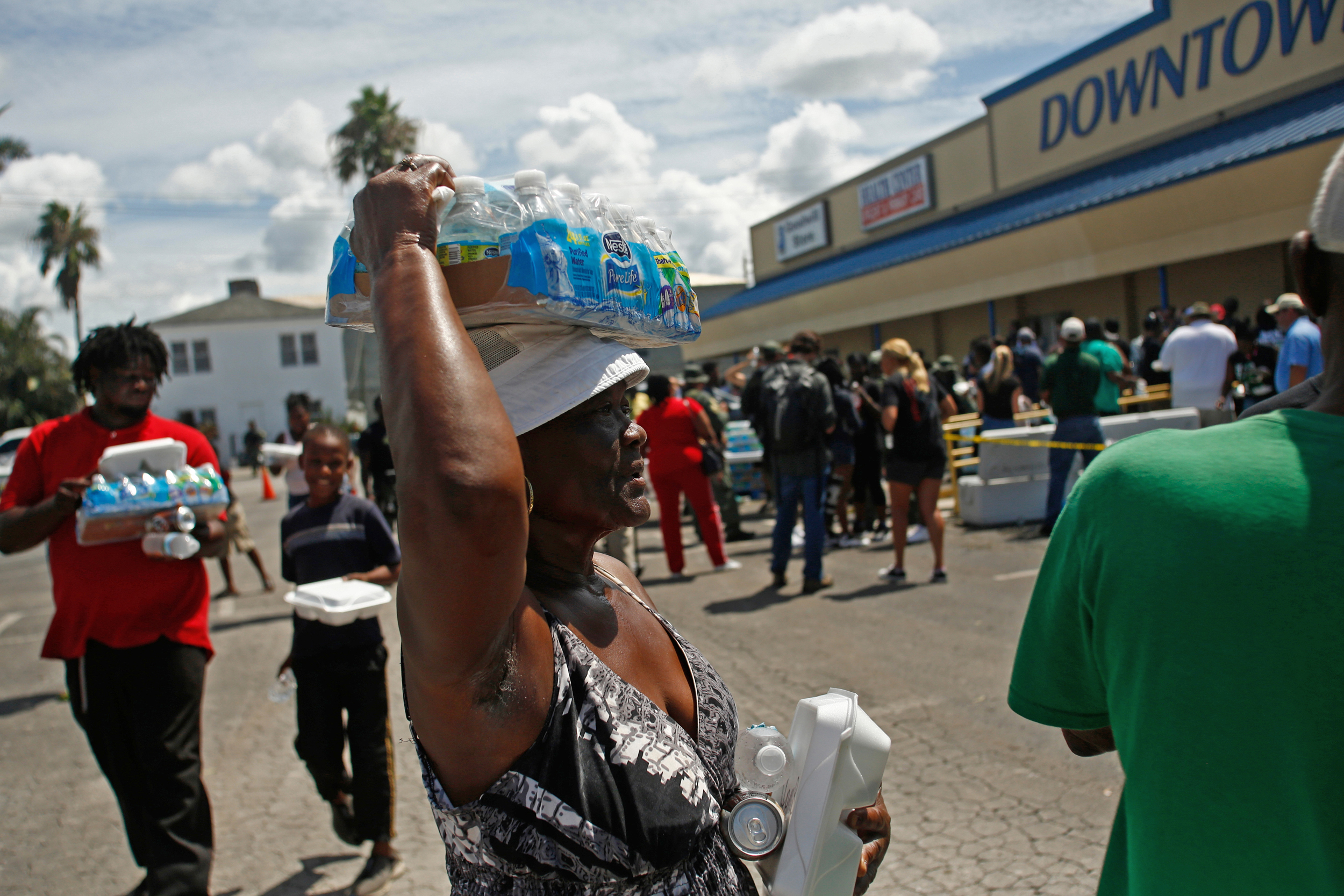


Belle Glade is one of the poorest cities in Florida, a majority-Black farmworker community on the southern rim of Lake Okeechobee, where clean and reliable drinking water has never been a given. But when Belle Glade looked to the largest source of federal money for fixing drinking water systems, it ran into an obstacle that has nothing to do with how poor it is.
Under Florida’s rules, the deepest form of federal drinking water aid—principal forgiveness, essentially a loan that never has to be repaid—is reserved for communities that are both home to fewer than 10,000 people and low income, which the state defines as a median household income below Florida’s average.
Belle Glade, with a population of 17,386, clears the income bar easily, but it fails the size test. A town of 9,000 with the same poverty level could have up to 90 percent of a water project’s costs forgiven. Larger poor communities like Belle Glade are capped at 20 percent, and funded only after every qualifying small town in the state has been served.
That distinction traces back to a landmark law and a quiet decision about who counts as “disadvantaged.”
The 2021 Bipartisan Infrastructure Law (BIL) poured $30.7 billion into the Drinking Water State Revolving Fund, the largest investment in water infrastructure in U.S. history, and required that nearly half of certain money reach “disadvantaged communities.” But Congress left one crucial detail to the states: the definition of a disadvantaged community itself.
Florida’s answer is among the most restrictive. To qualify for full principal forgiveness, a system must serve a “financially disadvantaged small community”—poor and under 10,000 residents. The framework long predates the infrastructure law: Florida built its current disadvantaged-community structure in a 2017 rewrite of its water-fund rules and did not broaden it when the BIL passed.
The state Department of Environmental Protection (DEP) said the one change it made afterward, in 2022, was procedural—adjusting how a community documents and how often the state reviews its disadvantaged status.
In the 2023–24 funding cycle, every community at or above 10,000 people that received principal forgiveness got exactly 20 percent—including North Miami, a majority-Black city with a population of 60,000 residents where the median household income, about $57,000, runs roughly 23 percent below the state’s.
Twenty percent forgiveness is the ceiling for a community that size. Smaller places routinely received far more, up to the 90 percent forgiven for Wauchula, Madison and tiny Taylor County. Those recipients tended to be deeply poor—Wauchula’s poverty rate approaches 40 percent—but so is North Miami by the income measure Florida uses. What separated them was size.
The Florida DEP confirmed that structure in written responses to questions. Financially disadvantaged small communities “can receive principal forgiveness,” the department said, while larger disadvantaged communities are limited to “up to 20 [percent] principal forgiveness for construction if funds are available.”
Eligibility, the department representative added, is assessed by a water system’s full service-area population—not town by town. That means the roughly 30,000-person county system, known as The Glades, serving Belle Glade, Pahokee and South Bay is weighed as one, so even Pahokee and South Bay, each home to fewer than 6,000 people, are too big to count as small. The office of Belle Glade did not respond to requests for comment by the time of publication.
Asked how much of its forgiveness reaches communities under 10,000 people, the department said it does not track the money that way.
Water experts were surprised by how Florida chose to distribute the money.
“That would be an extremely limited [definition] that is excluding a lot of communities that should probably be considered as disadvantaged,” said Janet Pritchard, director of water infrastructure policy at the Environmental Policy Innovation Center, after reviewing Florida’s criteria.
A Stanford University study published last month in the journal Nature Communications puts Florida’s choice in national context. Examining how all 50 states redrew their disadvantaged-community definitions after the BIL, researchers found that the communities newly swept under the “disadvantaged” label were, on average, whiter, higher-income and more urban than those already on the rolls—the predictable result of broadening a definition to take in more places.
Low-income and minority-serving systems were no more likely to receive funding after the law than before, the study found—the communities shut out earlier remained shut out. The money did follow need on one measure: Systems with the most health violations tended to get funded.
“We can’t just throw money at the problem,” said Samyukta Shrivatsa, the study’s lead author and a doctoral candidate in civil and environmental engineering at Stanford.
This story is funded by readers like you.
Our nonprofit newsroom provides award-winning climate coverage free of charge and advertising. We rely on donations from readers like you to keep going. Please donate now to support our work.
Donate NowMany systems that gained eligibility, she said, “didn’t necessarily have the ability to apply for it”—daunted by the cost and complexity of the engineering reports, applications and audits that qualifying can demand. In Florida, that structure caps the largest disadvantaged communities regardless of need—funding them last, and never above 20 percent.
Why leave so much to the states? In part by design. Khalid Osman, a Stanford engineering assistant professor and the study’s corresponding author, said federal officials wrote the requirements loosely to head off lawsuits. “The federal government dictating to states would have raised so many legal barriers,” he said.
The result is that Washington has little leverage. The U.S. Environmental Protection Agency “can’t force Florida to change their disadvantaged communities definition,” said Julian Gonzalez, senior legislative counsel at Earthjustice. Strict population caps, he said, likely reflect “the politics in certain states where people are probably leery of too much grant-like funding going to cities as opposed to rural communities.”
In a written statement, the EPA said its oversight ensures that states establish affordability criteria “that have undergone public notice and comment”—a check on process, not on how narrow or broad a state’s definition is. The agency noted that the Safe Drinking Water Act defines a disadvantaged community as one meeting “affordability criteria established after public review and comment by the State.”
The agency did not claim the power to reject a state definition it considered too narrow, nor did it say it lacked that power. The statute it cited gives EPA the authority to ensure a state sets affordability criteria through public comment, but is silent on whether the agency can judge those criteria as too restrictive.
Water-policy experts have long questioned hard size limits. “Community size is not always well correlated with financial capacity,” said Becky Hammer, a senior attorney at the Natural Resources Defense Council, noting that large cities can hold deep pockets of poverty. Her organization, she said, has urged states to move away from strict population caps.
Florida’s rules are not the only squeeze. The federal money itself is about to shrink. The fiscal year ending Oct. 1 is the last one for the BIL’s supplemental water funding. And Congress has increasingly diverted dollars from the state revolving funds—both the clean water and safe drinking water programs—to earmarked projects.
Those diversions cut the principal forgiveness available to Florida’s disadvantaged communities by as much as $70 million between 2022 and 2026, according to the Environmental Policy Innovation Center (EPIC).
Florida actually came out about $30 million ahead over those years, because the earmarks it received outran cuts to its regular formula funding—but earmarks are one-time grants that don’t cycle back into the revolving fund the way loan repayments do. So the long-run picture reverses: Florida faces a projected 65 percent drop in federal money for the two funds next year, steeper still if the earmarks continue.
Over two decades EPIC estimates the diversions will cost the state $546 million in funding capacity.
For Belle Glade, the timing is unforgiving. Its sole treatment plant recently drew $10 million of a nearly $16 million state resilience grant—from a different pot of money—to guard against flooding.
In its 2026 federal agenda, Palm Beach County reported that as much as 40 percent of the water produced by the Glades’ treatment plant is lost to leaks in aging, undersized pipes that struggle to hold pressure for firefighting, infrastructure it says needs urgent replacement to protect public health.
The state has designated the Glades a Rural Area of Opportunity for its socio-economic distress. Yet under Florida’s rules, the same communities are too large to qualify for the deepest federal help fixing it.
About This Story
Perhaps you noticed: This story, like all the news we publish, is free to read. That’s because Inside Climate News is a 501c3 nonprofit organization. We do not charge a subscription fee, lock our news behind a paywall, or clutter our website with ads. We make our news on climate and the environment freely available to you and anyone who wants it.
That’s not all. We also share our news for free with scores of other media organizations around the country. Many of them can’t afford to do environmental journalism of their own. We’ve built bureaus from coast to coast to report local stories, collaborate with local newsrooms and co-publish articles so that this vital work is shared as widely as possible.
Two of us launched ICN in 2007. Six years later we earned a Pulitzer Prize for National Reporting, and now we run the oldest and largest dedicated climate newsroom in the nation. We tell the story in all its complexity. We hold polluters accountable. We expose environmental injustice. We debunk misinformation. We scrutinize solutions and inspire action.
Donations from readers like you fund every aspect of what we do. If you don’t already, will you support our ongoing work, our reporting on the biggest crisis facing our planet, and help us reach even more readers in more places?
Please take a moment to make a tax-deductible donation. Every one of them makes a difference.
Thank you,

Kate Waxman
Fellow
Kate Waxman is a Florida-based Outrider fellow at Inside Climate News, where she covers climate injustice across the state. She earned her M.S. in journalism from Columbia Journalism School and her B.A. in environmental science from Barnard, with reporting focused on coral reefs, climate science, and the communities closest to the water.