

NEWHALEM, Wash.—More than a century ago, Seattle City Light broke ground for a massive hydroelectric project here in a remote gorge of the North Cascades. Three dams soon powered the rise of what would become one of America’s richest and most liberal cities.
The Skagit River dams, the first of which was completed in 1926, have enabled Seattle’s citizen-owned utility to brag that it “has delivered carbon-free hydropower for over 100 years.” It claims to be the first utility in the nation to be carbon neutral.
While flattering itself for being “really green,” the city did not trumpet its longtime claim that the high-mountain dams had no significant effect on migrating salmon. Since Calvin Coolidge was in the White House, City Light has quietly insisted that the upper Skagit—before the dams were built—was too swift and gnarly for salmon. It contends that the wild river itself, not dams, is to blame for the absence of upriver salmon.
This fishy denial—long challenged by biological evidence, Indigenous oral history and investigative reports on local television and in online publications—is now biting the utility and its half-million ratepayers in their pocketbooks.
Mayor Katie B. Wilson signed a settlement Tuesday that authorizes what a City Light manager says is by far the largest payout in American history from a utility to Indigenous tribes as part of a dam relicensing. With the settlement, City Light expects to secure a third 50-year license for its Skagit dams from the Federal Energy Regulatory Commission.
The deal commits the utility to pay compensation of about $1.35 billion to the tribes, which will require significant increases in electricity rates. (City Light’s total relicensing commitment is about $4 billion over 50 years, nearly half of it for operation and maintenance.)
The winners in this settlement are three small Skagit River tribes. Their livelihoods, culture and religion had for hundreds of years revolved around healthy salmon runs in a free-flowing river. Much of their existence for the last dammed-up century has been infected by poverty, dislocation and anger for being ignored by a greener-than-thou utility.
Nearly $1 billion will go to the creation of a fish passage system. Young migrating salmon will likely be sifted out of the upper Skagit and trucked around City Light’s dams, allowing them to swim out to the Pacific. Adult salmon returning from the ocean will be trucked above dams to spawn. Most of the rest of the money will go to the tribes for various reservation projects, cash payments to individuals and habitat restoration in the Skagit River delta. The Skagit is the third-largest river on the West Coast, flowing 120 miles from British Columbia to Puget Sound.

Seattle Decides to Make a Deal
The story of why Seattle settled with the tribes is a case study in how powerlessness in Indian Country can be transformed into real-world negotiating muscle. Keys to the transformation are outspoken tribal leadership, tribal casino money, world-class legal talent and a seismic change in public attitudes toward Indigenous people.
But even with that newfound muscle, the settlement with City Light was bitterly fought, took nearly a decade to get done and continues to generate mistrust.
“Nothing was easy,” said Scott Schuyler of the Upper Skagit Indian Tribe. He had a heart attack in 2022, when he was 59, that he attributes to the stress, sleeplessness and repression of rage that were part of his job as a principal negotiator in the settlement.
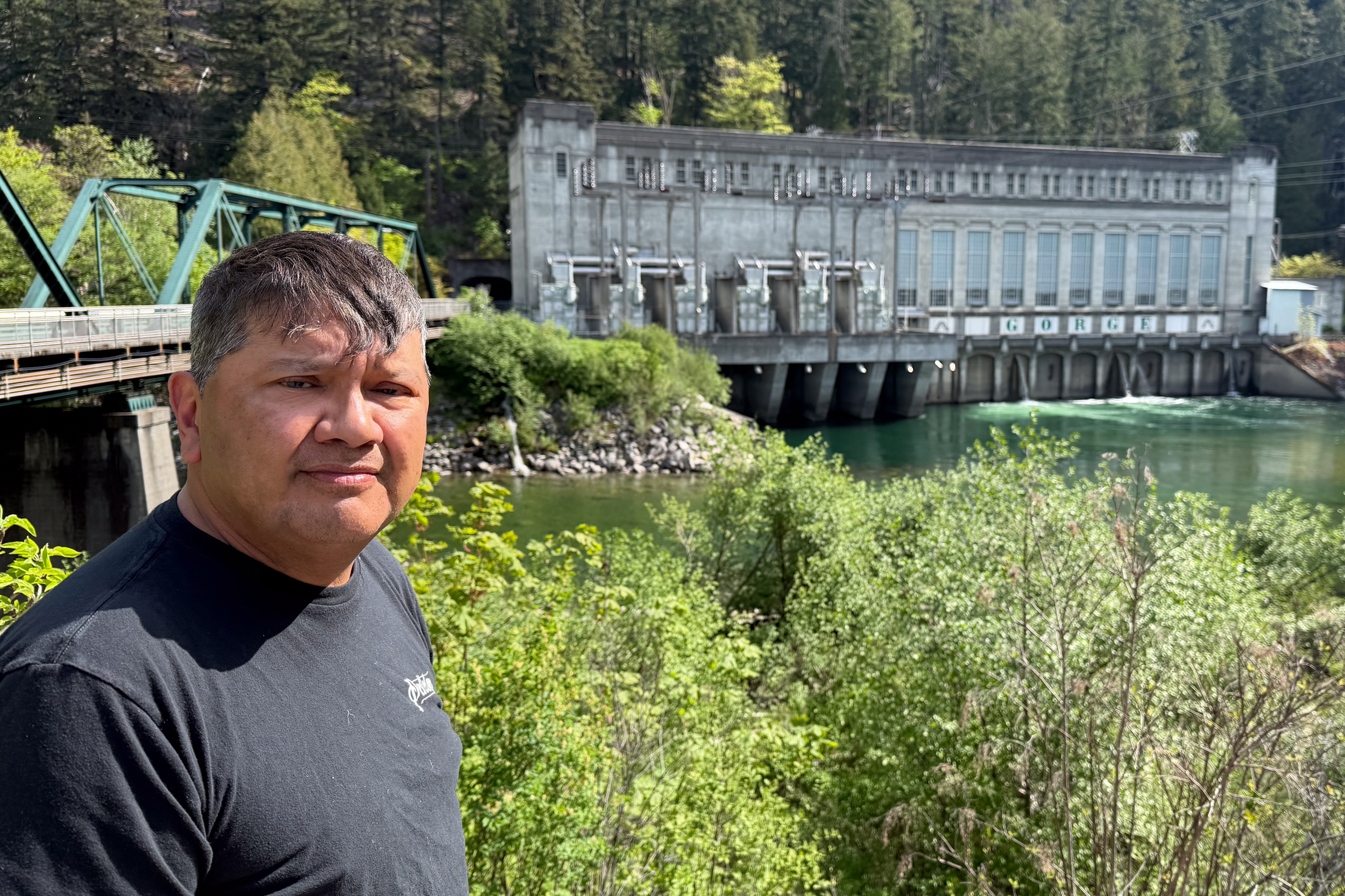
“City Light didn’t roll over,” said Schuyler, as he stood in front of the City Light General Store in Newhalem, where the utility erected a tidy company town in the early 1920s for the white men constructing and operating its dams.
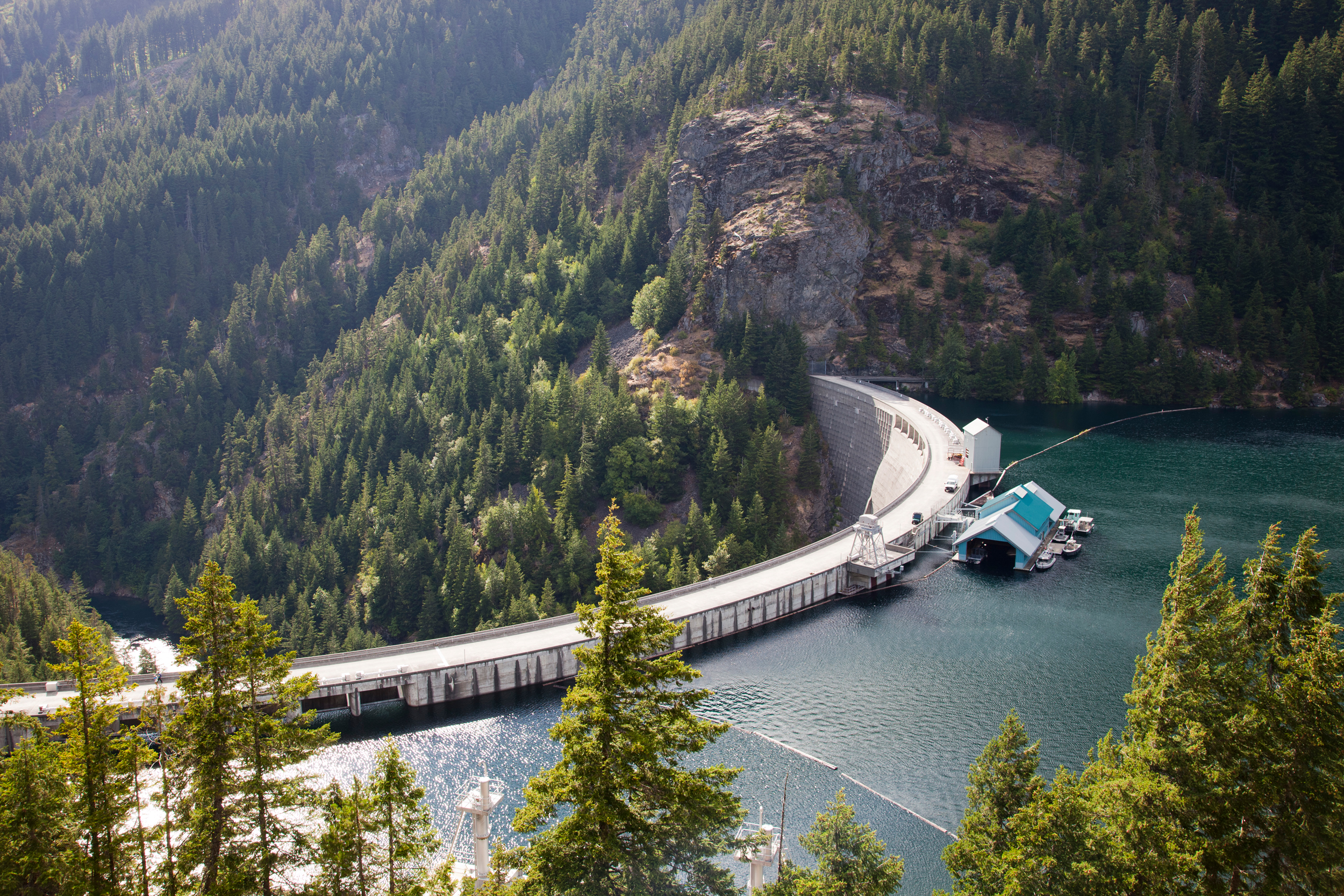
That company town—now with high-speed EV charging stations and manicured ballfields—still occupies the most hallowed place known to the Upper Skagit people. It’s the tribe’s traditional gathering ground and the gateway to the “spirit valley” where they locate their origin myths. Hulking concrete dams and vast reservoirs now drown much of that valley.
“This place has been annihilated by the dams,” Schuyler said. “We fought because we knew our ancestors were looking over our shoulders.”
City Light still refuses to concede that its dams block upriver salmon migration, even while committing hundreds of millions of dollars to truck salmon upstream and downstream around all three of them. The utility’s agreement acknowledges the financial and cultural harm dams have done to the tribes, but it does not include a formal apology.
“The tribes have been very aggressive,” said Chris Townsend, director of natural resources and hydro licensing for City Light. “They are resourced now, and they have some of the best legal strategists in the country, and they were very successful in getting a robust agreement.”
“This Is Not Your Battery”
When City Light obtained approval in 1917 for hydropower dams on the Skagit from the U.S. Department of Agriculture, the utility didn’t need to trouble itself with the rights, resources or legal talent of members of the Upper Skagit Indian Tribe, the Sauk-Suiattle Indian Tribe or the Swinomish Indian Tribal Community.
They had none.
An 1855 treaty had taken nearly all their traditional land, which encompassed 2,656 square miles of the Skagit River Basin. Their right to vote would not come until 1924. The Endangered Species Act that now lists Skagit River Chinook salmon and steelhead as threatened wasn’t passed until 1973. Federal courts did not affirm the tribes’ treaty-reserved rights to half the catch in salmon rivers until 1974.
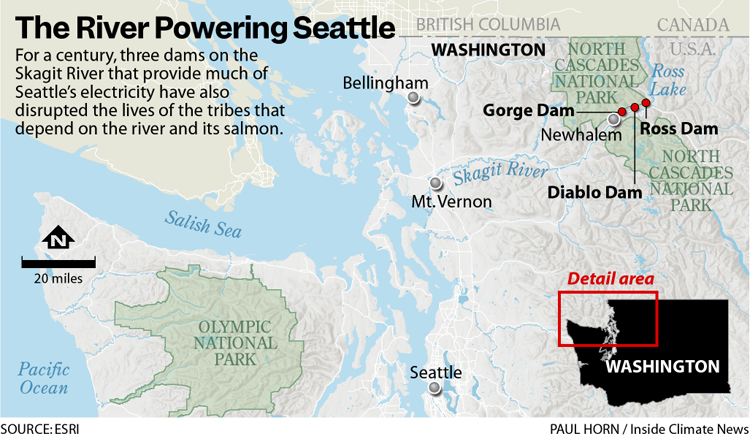
The Swinomish tribe had a small reservation on an island in Puget Sound. The other two tribes were considerably worse off, with fractured leadership, no reservation and no federal recognition until deep into the second half of the 20th century. The Upper Skagit Indian Tribe dwindled to 300 people.
For most of the decades that dams have throttled the Skagit, the three tribes had no influence on the utility. When City Light commissioned a consulting report in 1988 on the impacts of its dams on fish, nothing in the report reflected the point of view of Indigenous people from the Skagit region.
“They never talked to us,” Schuyler said. “We were in survival mode. We were just worried about, you know, how am I going to feed my kids tomorrow and the day after that? We didn’t have any ability to go on offense.”
When Schuyler and the tribes finally confronted City Light, he says he did not “intend to pick a fight.” But he couldn’t help himself.
It happened nine years ago here in Newhalem, in a former dance hall for dam workers turned public auditorium, at an event marking the start of City Light’s campaign to win a third 50-year federal license for the Skagit dams. After lunch was served, a City Light official delivered a “project overview,” praising the superb engineering of the dams, which he said had transformed the Skagit River into “a battery” powering prosperity in Seattle.
When Schuyler heard the word “battery,” he says he lost his self-control.
“I got up and basically said this: That’s the most offensive thing I’ve ever heard. You do not call our namesake river a battery. This is not your battery. It’s part of our culture, part of our history. We’re connected to this river. It’s not your resource to be exploited by the city of Seattle. You, in fact, are exploiting us.”
People in the former dance hall that day remember Schuyler’s outburst as a tipping point—the moment when Skagit tribes began to feel their power. His words angered and confused many white people in the audience; others looked ashamed. Since that day, managers and public relations staff at City Light say they have been at pains not to refer to the Skagit River as a battery.
“Those statements that Scott Schuyler made showed we had arrived at a different time,” said Thomas O’Keefe, who attended the meeting and is director of policy and science at American Whitewater, an environmental group. “What changed was that there was much more respect for the opinion of tribes and their standing in making decisions.”
Money Is Power
To squeeze concessions out of City Light, however, the tribes would need enough cash to lawyer up.
They got a significant injection of it from casinos, which all three tribes now operate and which have provided seed capital for other profitable enterprises, including hotels and self-service storage.
With some of their cash, the Upper Skagit tribe hired Richard Roos-Collins, a Berkeley-based attorney sometimes described as the “professor” because of his expertise in federal dam relicensing and dam removal. Roos-Collins (who declined an interview for this story) was the primary strategist behind the recent removal of four dams on the Klamath River in Oregon and California, the largest dam removal project in history.
“With the help of Roos-Collins, we could make it clear to City Light that if they weren’t accountable, we would not settle,” said Schuyler. That would mean no new federal license to milk power from the Skagit.
This story is funded by readers like you.
Our nonprofit newsroom provides award-winning climate coverage free of charge and advertising. We rely on donations from readers like you to keep going. Please donate now to support our work.
Donate NowA negotiator from City Light agreed that Roos-Collins’ participation in the settlement gave the tribes leverage they’d never had before.
Also important in the outcome of the negotiations was the attitude change inside City Light itself and in the thinking of Seattle’s elected leadership. The city that had long ignored the tribes—while congratulating itself for being green—showed a new empathy and willingness to listen.
“The city of Seattle was built on cheap power from the Skagit,” said Townsend, at City Light. The city now gets a fifth of its power from Skagit dams, but they were the city’s primary electricity source for much of the 20th century.
“We exported a lot of power and didn’t return value for that entire period,” Townsend added. “We do very much recognize the fact that our dams have harmed the tribes, harmed the environment they rely on—economically, spiritually and culturally. The agreements we negotiated with the tribes were, in part, to make good on past harm.”
Rewatering a River
For a century, a high-mountain, two-mile stretch of the upper Skagit River has largely run dry. A manmade curiosity, it’s a waterless jumble of rock and gravel at the bottom of the gorge where the river should be.
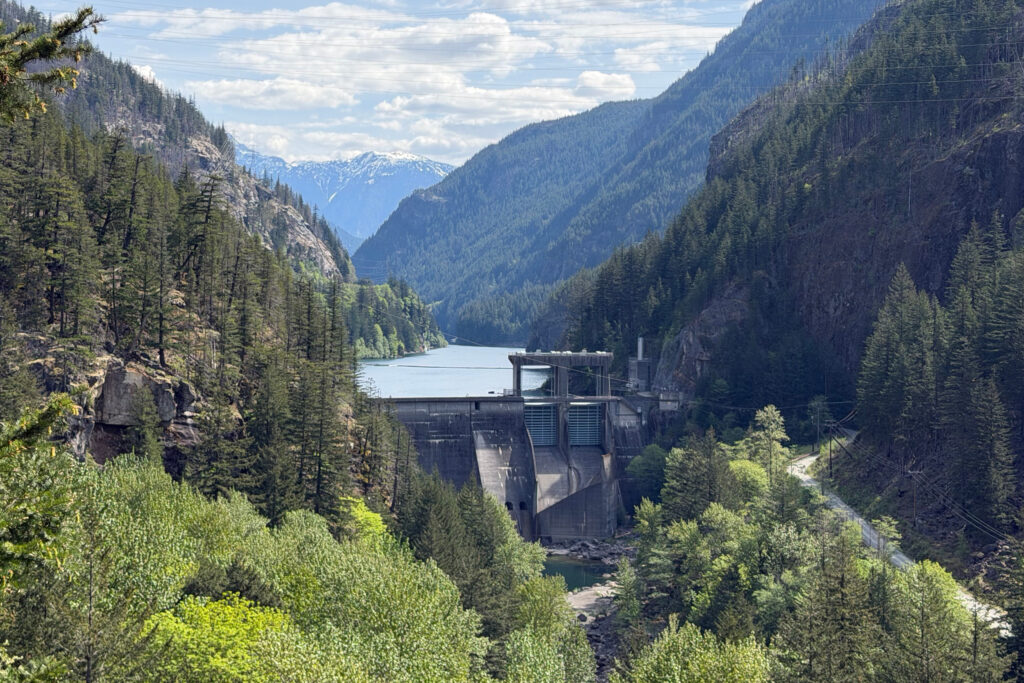
This erstwhile bit of river was intentionally dewatered by City Light to maximize electricity production at Gorge Dam, the first hydro facility built on the Skagit. In constructing the dam, engineers located the powerhouse holding turbines and generators two miles downstream from the actual dam, a 300-foot-high hunk of concrete that blocks the river.
In between, City Light dug a tunnel and lined it with concrete to channel the entire Skagit River to the powerhouse and its turbines, leaving the riverbed on the surface above dry except on a few days a year when snowmelt and high water require that some of the river be spilled over the dam into the drained waterway. Signs along the dry riverbed warn tourists to be careful of a sudden flood.
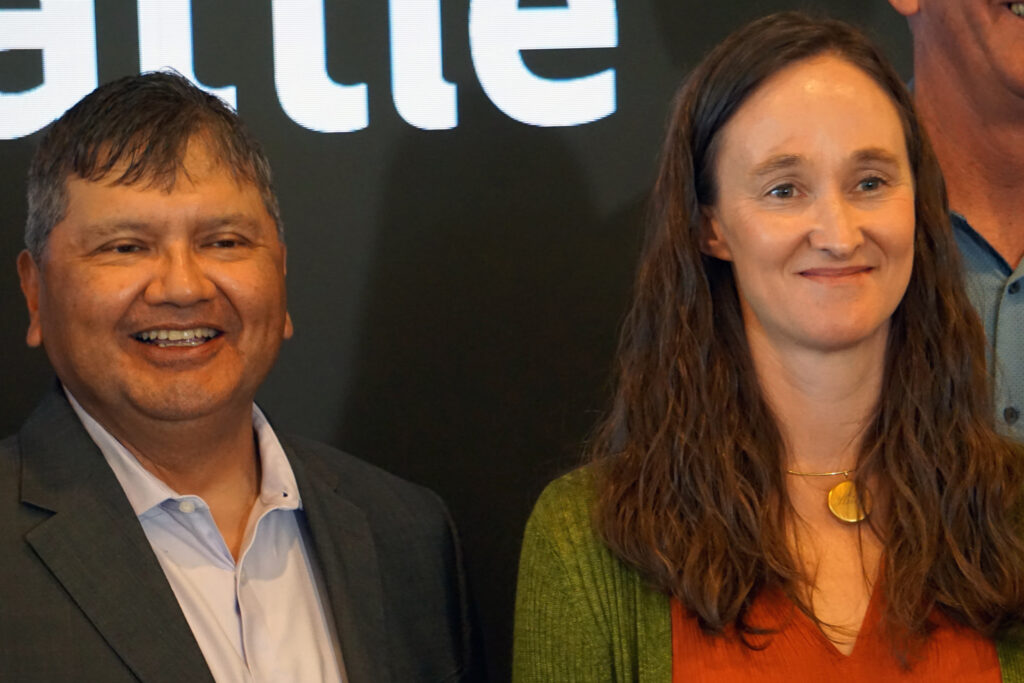
Schuyler, now 62, first walked along this weirdly waterless part of the Skagit when he was a boy.
“I looked at it, and I said, ‘Well, there’s something very wrong here.’”
The dewatered river, he said, has become “a source of cultural trauma for my people.”
In his years of negotiating with City Light, Schuyler and others from the Upper Skagit tribe have insisted that a significant amount of water from the river be allowed to flow again all year round on the dry riverbed—for the sake of salmon, for the sake of sanity.
City Light, as part of the settlement, has agreed.
About This Story
Perhaps you noticed: This story, like all the news we publish, is free to read. That’s because Inside Climate News is a 501c3 nonprofit organization. We do not charge a subscription fee, lock our news behind a paywall, or clutter our website with ads. We make our news on climate and the environment freely available to you and anyone who wants it.
That’s not all. We also share our news for free with scores of other media organizations around the country. Many of them can’t afford to do environmental journalism of their own. We’ve built bureaus from coast to coast to report local stories, collaborate with local newsrooms and co-publish articles so that this vital work is shared as widely as possible.
Two of us launched ICN in 2007. Six years later we earned a Pulitzer Prize for National Reporting, and now we run the oldest and largest dedicated climate newsroom in the nation. We tell the story in all its complexity. We hold polluters accountable. We expose environmental injustice. We debunk misinformation. We scrutinize solutions and inspire action.
Donations from readers like you fund every aspect of what we do. If you don’t already, will you support our ongoing work, our reporting on the biggest crisis facing our planet, and help us reach even more readers in more places?
Please take a moment to make a tax-deductible donation. Every one of them makes a difference.
Thank you,