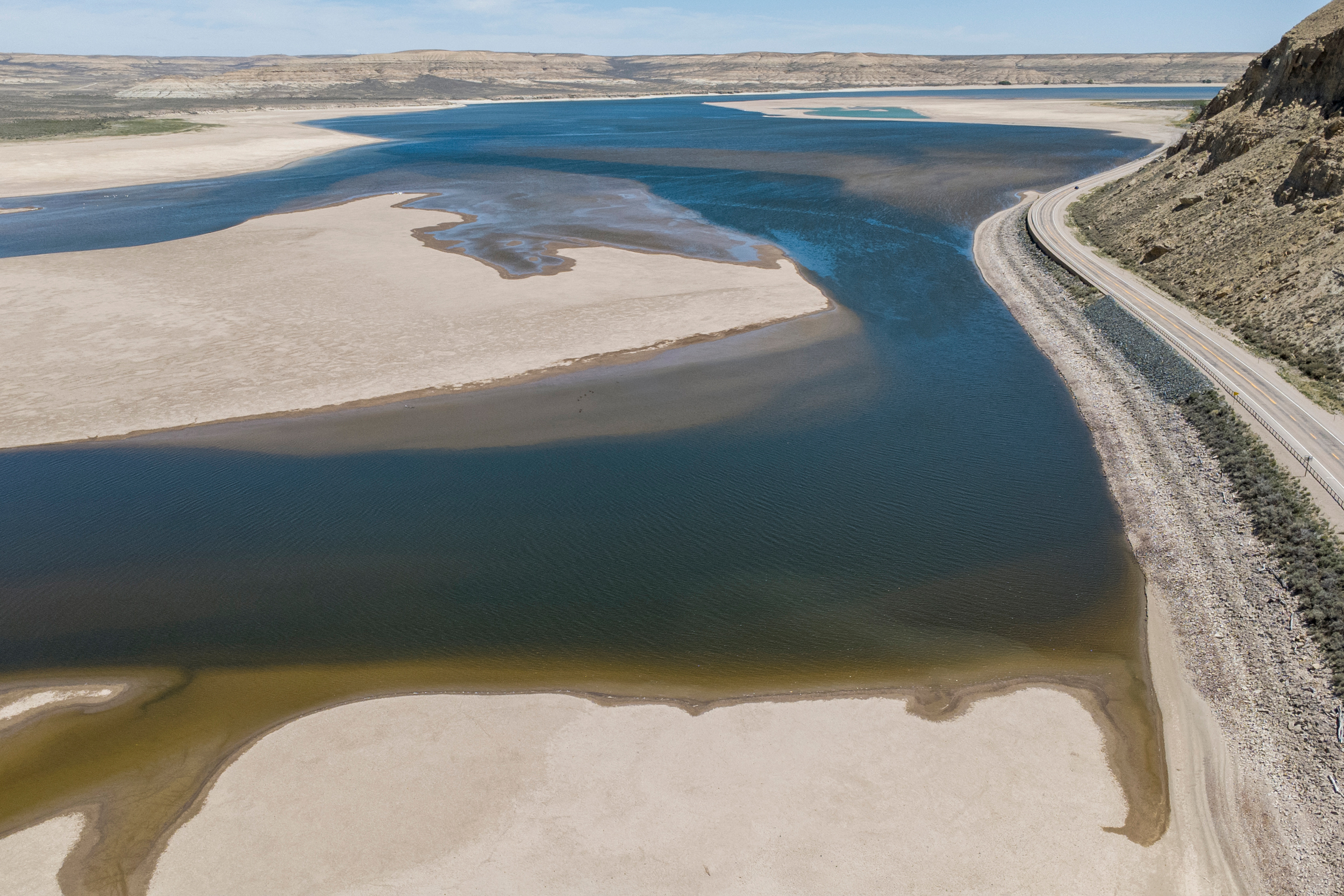


Wyoming has shelved a state-funded project to measure water use in the Green River and Little Snake River basins after it could not get enough data to create a basin-wide estimate of water lost during irrigation.
At a meeting in the Cowboy State capitol of Cheyenne last month, members of the Wyoming Water Development Commission (WWDC) reported that difficulty gaining access to landowners’ ditches coupled with unexpected costs prevented the contractor from securing access to all 20 irrigation ditches the company planned to survey.
With only 12 ditches measured, the company’s data did not produce “statistical significance for larger basin characterization,” said Chace Tavelli, the project’s manager with the Wyoming Water Development Office.
“All data is good data to have,” he added. “We learned about challenges, and there are some ditches that appear to have information that could be very valuable.”
Wyoming water managers said the measuring efforts could one day resume as part of a coordinated effort with Colorado, New Mexico and Utah to gauge water consumption in each state’s portion of the Upper Colorado River Basin, which includes the Green and Little Snake rivers in Wyoming.
The project was part of Wyoming’s ongoing efforts to account for the water it uses in its portion of the basin, where every drop used, lost or saved must be meticulously accounted for amid a punishing drought and difficult negotiations over how to split the river’s dwindling flows.
“Wyoming’s got studies galore going on on irrigation efficiencies,” said Michael Henn, district manager of the Sublette County Conservation District in the Green River Basin. “This was just one piece of trying to make sure that we have an understanding of how the water in Wyoming’s portion of the basin is getting used, and any potential impacts to that.”
In 2023, the Wyoming legislature appropriated $500,000 to study water lost to irrigation in the Green and Snake River basins. The next year, the Wyoming Water Development Commission awarded just over $400,000 to Stantec Consulting Services to measure water in 20 irrigation ditches in the region. The company held two public meetings that April, one in Baggs and another in Pinedale, and “that’s when the project started experiencing some challenges,” Tavelli said.
“It was difficult to get ditches that were good examples of the basin and obtain access and get landowner participation there—to no fault of landowners or the consultant,” Tavelli said.
Henn, who attended the meeting in Pinedale, remembered some landowners being split on the idea of measuring water lost in their ditches. “Some people don’t necessarily care to have government of any level on their property working, and some do,” he said. “Especially with water.”
Tavelli echoed that sentiment in his presentation at the WWDC meeting. “You’re accessing and you’re potentially interrupting their irrigation system,” he said, adding that landowners aren’t to blame for the project falling through.
This story is funded by readers like you.
Our nonprofit newsroom provides award-winning climate coverage free of charge and advertising. We rely on donations from readers like you to keep going. Please donate now to support our work.
Donate NowThe geography of the basins may have also complicated the state’s efforts. Farmers and ranchers so close to the basin’s headwaters do not always have mile-long ditches with no diversions in them, a condition required by the study, said Mike Vickery, a rancher in the Upper Green River basin.
“We just [have more diversions] ‘cause we’re so close to the river system,” he said, and as a result, ditches can be smaller with several diversion points branching off.
Tavelli said some ditches did not have water measurement devices, called flumes, installed at the head of the system. This meant Stantec Consulting Services had to install a flume at each end of the ditch, increasing the project’s costs.
Despite the lack of a basin-wide estimate of water loss, gathering data on water losses in the basin is valuable for Wyoming.
“It’s good to understand when you divert water where it’s going. That helps landowners with conservation practices,” Henn said, adding that it better prepares his organization to apply for grant funding for water conservation projects.
The data is also important for Wyoming as it navigates the broader upheaval in the Colorado River Basin, home to roughly 40 million people across seven states, 30 tribes and Mexico.
The agriculture industry is by far the largest water user in the Colorado River Basin.
As a member of the Upper Basin, along with Colorado, New Mexico and Utah, Wyoming has been developing a conservation program within its borders in response to declining flows in the Colorado River, which scientists attribute in part to climate change. Such a program would also help the Upper Basin show Arizona, California and Nevada, the Lower Colorado River Basin states, that it can conserve a meaningful amount of water voluntarily—a major negotiating point across the basin. For such conservation efforts to generate credit for the water they save, Wyoming and other Upper Basin states would need to show they know how much water is lost during transportation.
In Wyoming, “the data is important so we can prove how much water we’re really using, and where it’s going,” said Vickery, who is a member of Wyoming’s Colorado River advisory committee.
“Whatever comes out of my ditch, there’s a strong likelihood it ends back up in the river,” he said. “Those are also things we want to be able to prove.”
At the Cheyenne meeting, WWDC Director Jason Mead said the Upper Colorado River Commission has started an Upper Basin-wide study to measure the difference between water entering ditches and the amount that returns to the river—also known as “incidental use.”
“We’re hoping that will be more successful,” he said.
About This Story
Perhaps you noticed: This story, like all the news we publish, is free to read. That’s because Inside Climate News is a 501c3 nonprofit organization. We do not charge a subscription fee, lock our news behind a paywall, or clutter our website with ads. We make our news on climate and the environment freely available to you and anyone who wants it.
That’s not all. We also share our news for free with scores of other media organizations around the country. Many of them can’t afford to do environmental journalism of their own. We’ve built bureaus from coast to coast to report local stories, collaborate with local newsrooms and co-publish articles so that this vital work is shared as widely as possible.
Two of us launched ICN in 2007. Six years later we earned a Pulitzer Prize for National Reporting, and now we run the oldest and largest dedicated climate newsroom in the nation. We tell the story in all its complexity. We hold polluters accountable. We expose environmental injustice. We debunk misinformation. We scrutinize solutions and inspire action.
Donations from readers like you fund every aspect of what we do. If you don’t already, will you support our ongoing work, our reporting on the biggest crisis facing our planet, and help us reach even more readers in more places?
Please take a moment to make a tax-deductible donation. Every one of them makes a difference.
Thank you,

Jake Bolster
Reporter, Wyoming and the West
Jake Bolster reports on Wyoming and the West for Inside Climate News. Previously, he worked as a freelancer, covering climate change, energy, and the environment across the United States. He holds a Masters in Journalism from Columbia University.