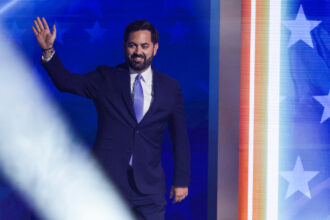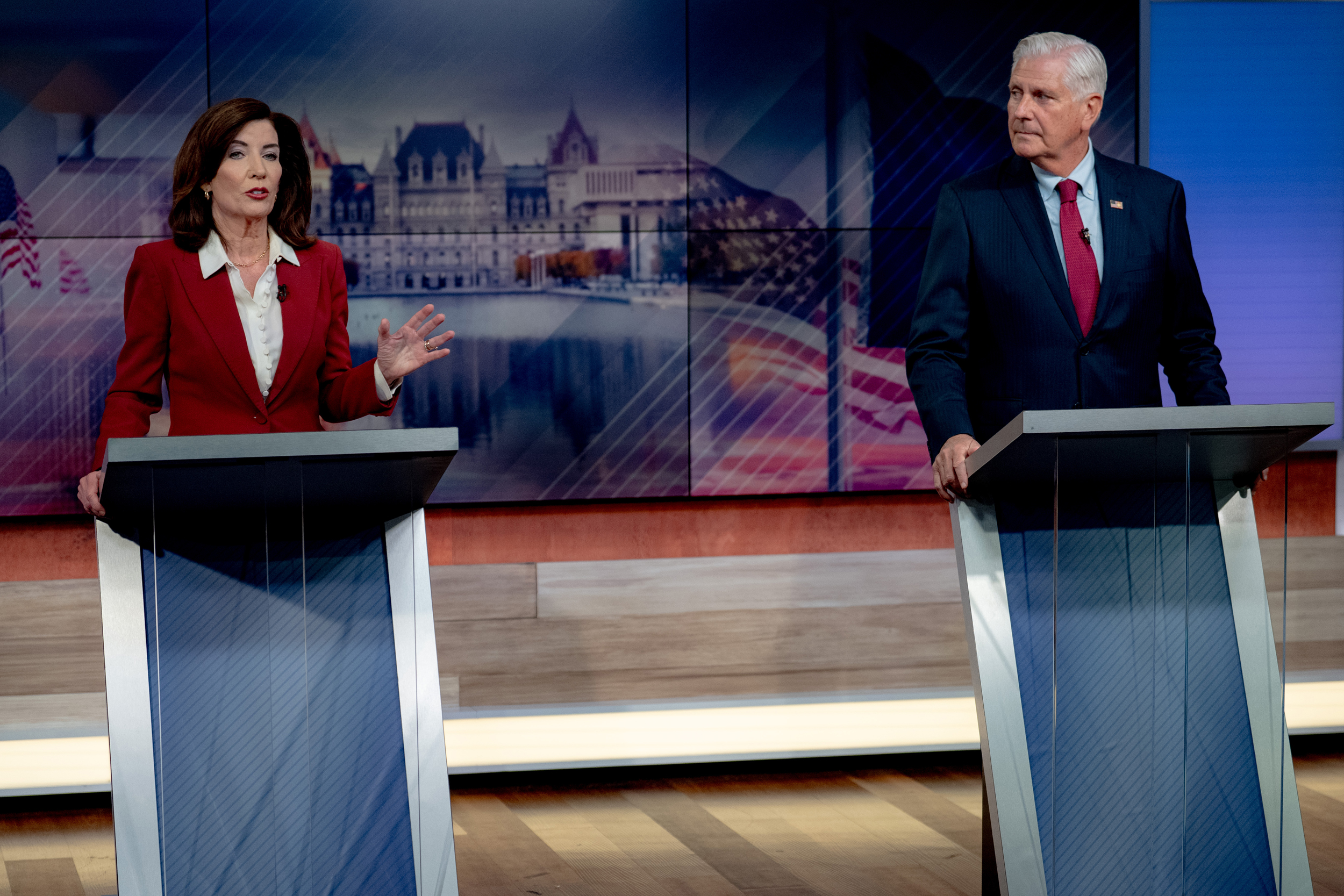


Incumbent New York Gov. Kathy Hochul and Republican challenger Bruce Blakeman clashed over high energy costs in the state’s only gubernatorial debate, offering sharply different visions for how to keep electricity affordable as demand rises.
Average residential electricity bills in New York rose 10 percent from 2024 to 2025, outpacing the national average. The state has the eighth-highest residential electricity prices in the country, which has made affordability a central issue in the governor’s race.
With less than three weeks until Election Day, recent polling data suggests Hochul leads Blakeman by around 12 percentage points. Blakeman has served as Nassau County executive since 2022.
During the debate, Hochul touted her “all of the above” energy strategy, which includes developing renewable energy and expanding nuclear power. Blakeman blamed the state’s high utility bills in part on clean energy programs, calling them a “slush fund” for “science projects,” such as offshore wind farms and solar panels that he claimed were “ruining agriculture.”
But state data shows that decarbonization programs account for only a portion of residential electricity costs. A 2025 Public Service Commission report found that measures mandated by New York’s Climate Act made up between 5 and 9.5 percent of a typical monthly residential electric bill in 2024.
Most of the bill reflects the cost of buying and delivering electricity. Rate increases in the state are often linked to surging electricity demand, which raises prices, as well as an over-reliance on gas-fired power generation, which in turn is tied to the natural gas market.
Utilities are also investing more in expanding electrical infrastructure to accommodate new power generators—and new customers.
The candidates also shared different visions of how to generate more power. Wind and solar projects, paired with battery storage, can typically be built at cheaper costs than fossil fuel infrastructure, potentially helping to meet rising electricity demand while supporting the state’s climate goals.
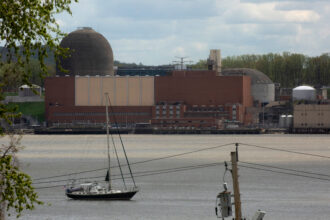
Hochul emphasized her push to build more nuclear power in the state, though she did not say whether she would reopen Indian Point, a nuclear plant north of New York City that closed in 2021.
Nuclear power remains a controversial topic in New York, with activists and critics raising concerns about costs, public health and possible environmental impacts linked to the long-term storage of “spent fuel,” which is extremely radioactive.
Blakeman has offered few details about his energy policy beyond attacking renewable energy initiatives. To lower energy bills, he has pledged to bring fracking back to New York, though the practice was banned statewide more than a decade ago over public health concerns.
The statewide debate over energy costs comes as New York faces growing electricity demand, driven partly by data centers, building electrification and manufacturing. The state’s grid operator faces a growing backlog of applications from proposed data centers, which could put even more pressure on the power supply.
Hochul touted her executive order for a yearlong statewide moratorium on data centers and pledged to require new facilities to “bring their own power.” In other states, meeting data centers’ rising electricity demands has led to plans for a buildout of polluting natural gas plants. Environmental advocates have called for greater public input on the state’s proposed data center policy.
Hochul also described herself as “laser-focused on affordability” and pointed to her administration’s energy rebate policy, which will send checks of up to $200 to 8.2 million households to offset rising costs. She did not answer a question about whether the rebates would become an annual benefit.
Blakeman has aligned himself with President Donald Trump, recently praising him at a rally in Syracuse. During the debate, Hochul challenged Blakeman over Trump administration policies, including tariffs and the Iran war, which have contributed to higher prices. In response, Blakeman said he and Trump have “significant policy differences.”
Hochul became governor in 2021 after Andrew Cuomo resigned amid a sexual harassment scandal. In 2022, she defeated current Environmental Protection Agency Administrator Lee Zeldin, a former congressman from Long Island.
About This Story
Perhaps you noticed: This story, like all the news we publish, is free to read. That’s because Inside Climate News is a 501c3 nonprofit organization. We do not charge a subscription fee, lock our news behind a paywall, or clutter our website with ads. We make our news on climate and the environment freely available to you and anyone who wants it.
That’s not all. We also share our news for free with scores of other media organizations around the country. Many of them can’t afford to do environmental journalism of their own. We’ve built bureaus from coast to coast to report local stories, collaborate with local newsrooms and co-publish articles so that this vital work is shared as widely as possible.
Two of us launched ICN in 2007. Six years later we earned a Pulitzer Prize for National Reporting, and now we run the oldest and largest dedicated climate newsroom in the nation. We tell the story in all its complexity. We hold polluters accountable. We expose environmental injustice. We debunk misinformation. We scrutinize solutions and inspire action.
Donations from readers like you fund every aspect of what we do. If you don’t already, will you support our ongoing work, our reporting on the biggest crisis facing our planet, and help us reach even more readers in more places?
Please take a moment to make a tax-deductible donation. Every one of them makes a difference.
Thank you,

Lauren Dalban
Reporter, New York City
Lauren Dalban is a New York City-based reporter with a background in local journalism. A former ICN fellow, she now covers environmental issues in all five boroughs. Originally from London, she earned a B.A. in History and English from the University of Virginia, and an M.S. from Columbia Graduate School of Journalism.