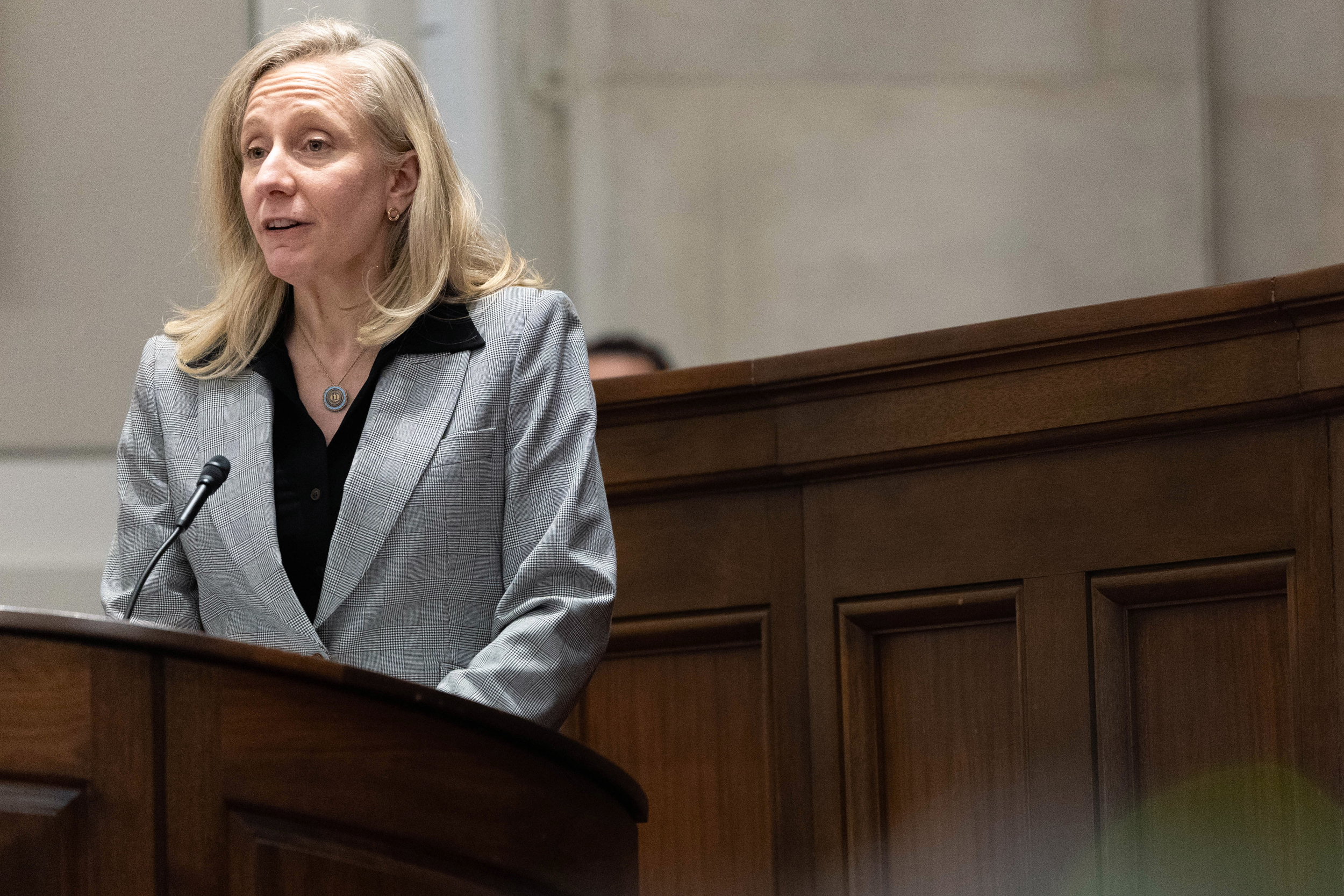


RICHMOND, Va.—Gov. Abigail Spanberger on Thursday signed legislation that directs regulators to assign electricity costs to data centers and allows Dominion Energy to spend $900,000 a mile burying local distribution lines.
The bills from Senate President Pro Tem Louise Lucas, D-Portsmouth, and Del. Destiny LeVere Bolling, D-Henrico, could have also required data centers to cover the costs of buying electricity from the capacity market through PJM Interconnection, the regional grid operator for Virginia, 12 other states and the District of Columbia. But that requirement was removed by Spanberger and replaced with more regulatory authority to allocate costs.
Those capacity market costs, used when there’s peak strain on the grid, ballooned from about $28 per megawatt-hour in 2023 to $329 in 2025, contributing to a 1.5 to 5 percent increase in all customers’ bills. The pace at which data centers want to connect to the grid and the lack of new power generation have caused a supply-and-demand imbalance, raising costs.
The provision on underground cables would allow Dominion to spend up to $900,000 a mile for a strategic undergrounding program. The program allows the utility to recover its costs and maintain its profit margin by burying the local distribution lines that deliver power to homes underground. Those lines are less prone to storm damage that causes outages. The program was set to expire in 2028.
This change drew the ire of ratepayer advocates because the undergrounding program has added a $4.88 monthly fee to the bill of a typical residential customer.
Spanberger added several amendments during the recently concluded legislative session that gave the State Corporation Commission (SCC), which regulates utilities, greater discretion to reject the line-underground program. But the legislature rejected that language while accepting other amendments from Spanberger, a Democrat who took office in January.
One of the accepted amendments removed the language that would have required Dominion to ask regulators to have data centers to pay for capacity market costs, as well as substation financing costs. Since regulators previously rejected those requests, the amendment directs the SCC to more broadly take “all steps necessary” to ensure that residential customers do not pay electricity generation and distribution costs to serve data centers.
“I appreciate that the General Assembly accepted my amendments directing the SCC to make sure that data centers are paying their fair share for energy generation and distribution, to make sure those costs are not being unfairly allocated to residential customers,” Spanberger said in a statement Friday. “I look forward to continuing to work with the General Assembly, the SCC, consumer advocates, and utilities to move forward energy policies that prioritize reliability, fairness, transparency, and lower costs for working families.”
Despite less scrutiny from the SCC, Spanberger said she received a “commitment” from Dominion to “limit undergrounding projects to help contain costs” by serving the areas most prone to extreme weather threats to local lines. Spanberger said Dominion wouldn’t seek more work than was previously mandated by the 2018 Grid Transformation Security Act through early 2033.
Another Spanberger amendment also gave the SCC more authority to determine “in its sole discretion” if a request to finance fuel costs is in the public interest when approving or rejecting a utility’s proposal. The original bill required that the commission simply accept or reject the proposal.
The amendment giving the SCC broader discretion means it remains to be seen what actual bill savings residential ratepayers will see. Steve Haner, a senior fellow at the Thomas Jefferson conservative think tank, credited the legislature, with many new members, for its work on the bills.
Compared to years past, Haner said lawmakers are “paying closer attention” to what Dominion asks for and what it means.
About This Story
Perhaps you noticed: This story, like all the news we publish, is free to read. That’s because Inside Climate News is a 501c3 nonprofit organization. We do not charge a subscription fee, lock our news behind a paywall, or clutter our website with ads. We make our news on climate and the environment freely available to you and anyone who wants it.
That’s not all. We also share our news for free with scores of other media organizations around the country. Many of them can’t afford to do environmental journalism of their own. We’ve built bureaus from coast to coast to report local stories, collaborate with local newsrooms and co-publish articles so that this vital work is shared as widely as possible.
Two of us launched ICN in 2007. Six years later we earned a Pulitzer Prize for National Reporting, and now we run the oldest and largest dedicated climate newsroom in the nation. We tell the story in all its complexity. We hold polluters accountable. We expose environmental injustice. We debunk misinformation. We scrutinize solutions and inspire action.
Donations from readers like you fund every aspect of what we do. If you don’t already, will you support our ongoing work, our reporting on the biggest crisis facing our planet, and help us reach even more readers in more places?
Please take a moment to make a tax-deductible donation. Every one of them makes a difference.
Thank you,

Charles Paullin
Charles Paullin is a Richmond, Virginia-based reporter focusing on energy and environment issues. He’s won several awards for his previous work covering state policy with the Virginia Mercury and local news with the Northern Virginia Daily in the Northern Shenandoah Valley. His first reporting gig was with the New Britain Herald in Connecticut, a couple years after attending the University of Hartford, where he first studied sports journalism.