

PARIS—By the time Cléo made it to Greek class, she had gone completely pale. It was a Wednesday in June during France’s second consecutive heat wave this year, and the 16-year-old was struggling to cope with the rising temperatures.
She pushed through, thinking she was just tired. But the following day at her sweltering high school on the eastern edge of Paris, nausea and a desperate thirst gripped her. The school nurse, recognizing the signs of heat exhaustion, told her to go home.
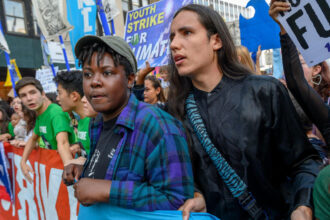
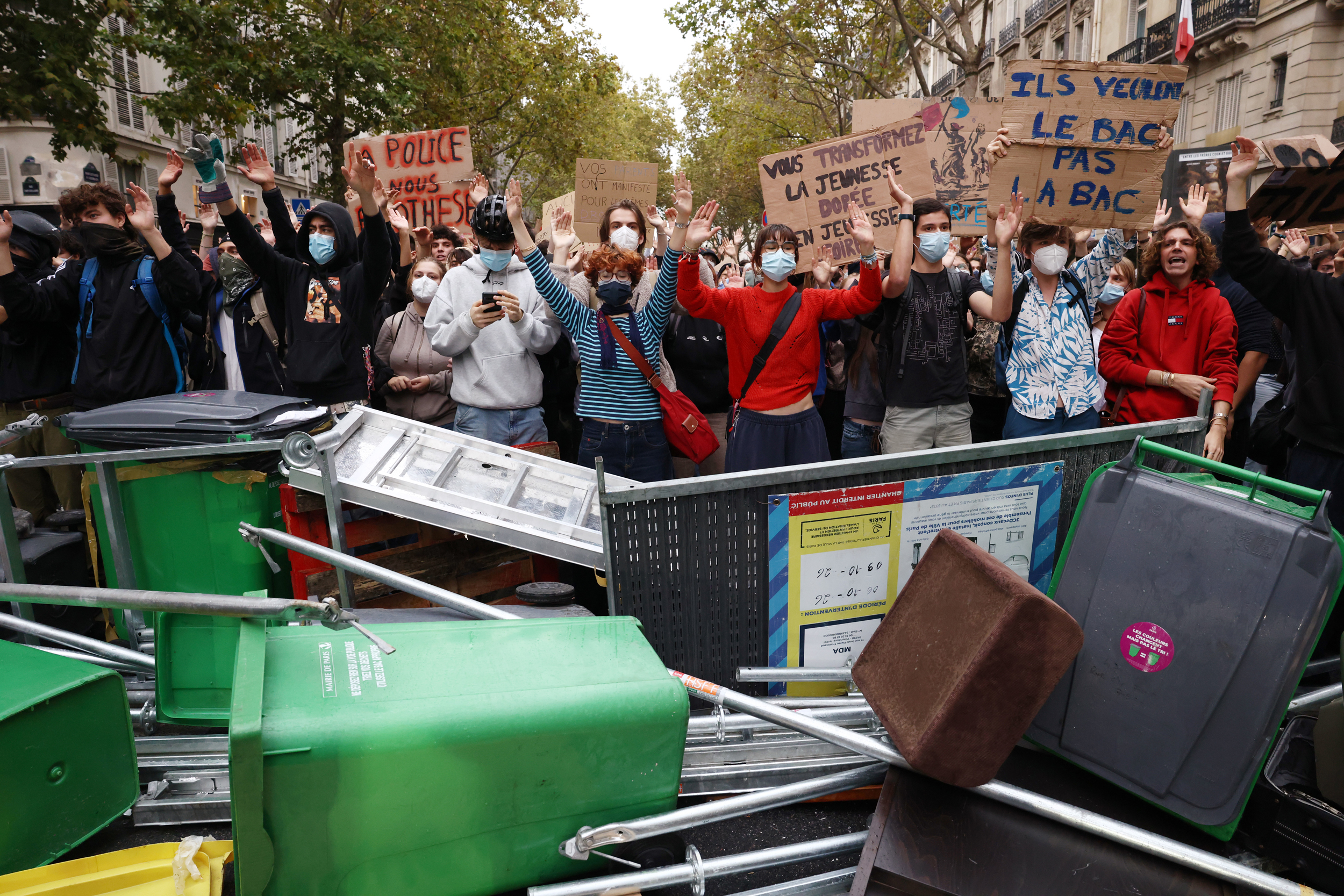
This week, as she recalled the experience and worried about more heat waves to come, Cléo and her friends stood by a pile of green garbage cans, blocking their school’s entrance. For the past four weeks, scenes like this have multiplied at thousands of schools across France, where students are protesting to demand better learning conditions and more investment in public education.
These student protests have become one of the most significant social movements in the country’s recent history. They’ve been met with a heavy-handed police crackdown; Roughly 8,000 arrests have been made in three weeks, 85 percent of them minors. Fearing repercussions, Cléo and other underage students who talked to Inside Climate News asked to be quoted using only their first names.
The students’ demands are far-ranging: more teachers, smaller class sizes, a shortened school day and an overhaul of the post-secondary college application system. But the heart of the revolt is indignation over crumbling school infrastructure—a problem laid bare by climate-change-fueled heat waves.
This year was France’s hottest on record, and the country counted 8,000 excess deaths during the summer’s heat waves. In June alone, deaths spiked 11 percent compared to the same month in 2025.
France’s schools, meanwhile, were not built for the hotter world the students have inherited after generations of fossil fuel use have warped the climate. Many buildings were designed to hold onto heat; air conditioning is rare. As classrooms recorded temperature peaks above 100 degrees Fahrenheit this spring, schools reported incidents from fainting to nosebleeds.
Students protesting this week outside high schools in the Paris area described a raft of problems in their buildings that made them feel abandoned by their government, including falling ceilings, moldy walls, out-of-service bathrooms, chair shortages and pest infestations. For many, this year’s record heat waves were a breaking point that highlighted their schools’ inability to keep students safe in a warming climate.
“We’re here to claim our rights, we’re here to make ourselves heard because we’re fed up with this government, we’re fed up with this country and we’ve had enough,” said Koumba, a 16-year-old student at a high school in Montreuil, on the outskirts of Paris.
Schools Built for an Outdated Climate
Marie-Hélène Azam is a professor of engineering science at the National Institute of Applied Sciences and leads a project studying how France’s primary school buildings can be adapted to withstand heat waves.
“We’re realizing that, until now, we’ve designed buildings for energy efficiency in winter,” she said. “We need to find a way to reconcile comfort in winter with comfort in summer, and that means designing buildings a little differently.”
“As soon as the temperature of the building starts to drop, another even more intense heat wave arrives.”
— Marie-Hélène Azam, National Institute of Applied Sciences professor
Traditionally, French schools have large windows to maximize sunlight and warmth. That backfires when temperatures rise, turning classrooms into greenhouses.
And like many older buildings in France, schools are typically heavy structures with “high thermal inertia,” absorbing, storing and then releasing heat. This is beneficial during winter, but it can make classrooms hotter inside than out on high-heat days.
The issue isn’t just extreme temperatures. The way they’re hitting makes it worse.
“With heat waves becoming more intense and lasting longer, we no longer have enough time to cool these buildings down at night or between two heat waves,” Azam said. “As soon as the temperature of the building starts to drop, another even more intense heat wave arrives.”
Among potential solutions: exterior shutters to prevent the sun from heating up windows, ceiling fans to cool students and evaporative cooling technologies that use water to zap heat.
A spokesperson for the Île-de-France region, which oversees public high school infrastructure in the Paris area, said it allocated $1.2 billion to school construction and renovations this year, including upgrades to roofs and windows. During the heat waves, the regional government spent $1.1 million to open additional exam centers and purchase misting devices and fans.
In France, air conditioning has so far been treated as a last resort for climate adaptation. Many worry that widespread installation will worsen the “urban heat island” effect that makes cities hotter than rural areas: AC units push hot air outside, increasing temperatures on the streets. Cost is another barrier, with energy prices in Europe among the highest in the world.
This story is funded by readers like you.
Our nonprofit newsroom provides award-winning climate coverage free of charge and advertising. We rely on donations from readers like you to keep going. Please donate now to support our work.
Donate NowClimate Anxiety Beyond the Classroom
The protesting students aren’t focused on air conditioning. Instead, many say they know the heat doesn’t start and end in the classroom, and it will follow them long after they graduate.
Many of them cite climate change as a source of anxiety about their future, alongside concerns about the economy and how artificial intelligence will affect their job prospects.
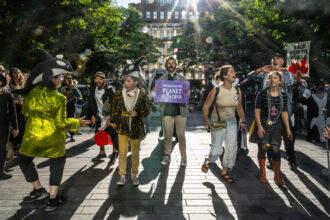
On Tuesday, Margaux Levy and Raphaëlle Richard marched alongside hundreds of thousands of protesters across France. The two are among the many university students joining high schoolers, hoping leaders will listen to the younger generation’s concerns.
They sat on a patch of grass, holding signs, as other protesters flooded the Place Vauban in Paris’ 7th arrondissement.
Heat waves “are unpleasant,” said Levy, a second-year university student. “That said, I think the problem can be addressed primarily through environmental measures. I don’t think installing air conditioning in high schools is a good long-term solution, because it only makes the problem worse.”
She added, “It’s pretty unsettling to see that we’re living in a world where we’re going to die out because of our own actions. We’re making no effort, and I’m not trying to be pessimistic about this, but everything seems pretty bleak. I feel like nobody is going to make an effort, and political parties aren’t making it a priority.”
Raised on warnings about climate change, the protesters are watching the crisis as it unfolds.
“We’ve talked about [climate change] a lot, but we weren’t really seeing the consequences firsthand yet. Now, after the major heat waves we’ve experienced, we’re seeing the deaths it causes,” said Richard, a second-year student in medical school. “The awareness is growing, but it needs to be accompanied by necessary political measures.”
Earlier that day, Swedish environmental and social activist Greta Thunberg joined students protesting in Paris, visiting a school on the northern edge of the city.
“This generation is one that has been growing up with a sense of hopelessness,” she told The Associated Press. “We can see our future and our rights taken from us in front of our very eyes. What do they expect? Of course people are going to fight back.”
About This Story
Perhaps you noticed: This story, like all the news we publish, is free to read. That’s because Inside Climate News is a 501c3 nonprofit organization. We do not charge a subscription fee, lock our news behind a paywall, or clutter our website with ads. We make our news on climate and the environment freely available to you and anyone who wants it.
That’s not all. We also share our news for free with scores of other media organizations around the country. Many of them can’t afford to do environmental journalism of their own. We’ve built bureaus from coast to coast to report local stories, collaborate with local newsrooms and co-publish articles so that this vital work is shared as widely as possible.
Two of us launched ICN in 2007. Six years later we earned a Pulitzer Prize for National Reporting, and now we run the oldest and largest dedicated climate newsroom in the nation. We tell the story in all its complexity. We hold polluters accountable. We expose environmental injustice. We debunk misinformation. We scrutinize solutions and inspire action.
Donations from readers like you fund every aspect of what we do. If you don’t already, will you support our ongoing work, our reporting on the biggest crisis facing our planet, and help us reach even more readers in more places?
Please take a moment to make a tax-deductible donation. Every one of them makes a difference.
Thank you,

Mathilde Augustin
Fellow
Mathilde Augustin is a business journalist passionate about the intersection of climate and finance. She is a graduate of Columbia University in New York, where she received an M.A. in business and economics journalism and covered topics such as Canada’s logging industry and migrant workers building Paris Olympics facilities. She is French and Canadian and previously earned her B.A. in Political Science from McGill University.