

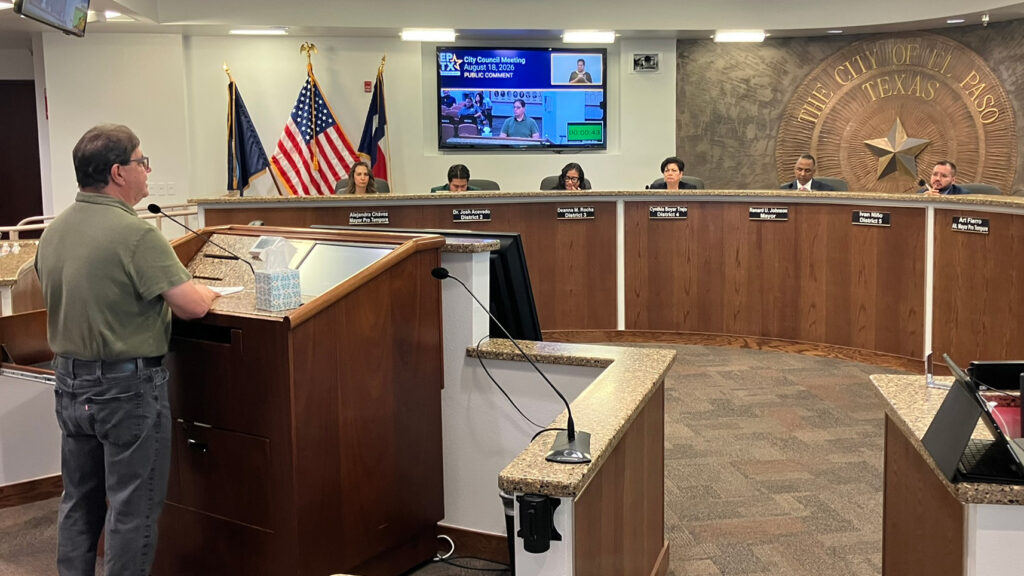
EL PASO, Texas—Gilbert Morales struggled to compose himself before addressing the El Paso City Council on Tuesday morning.
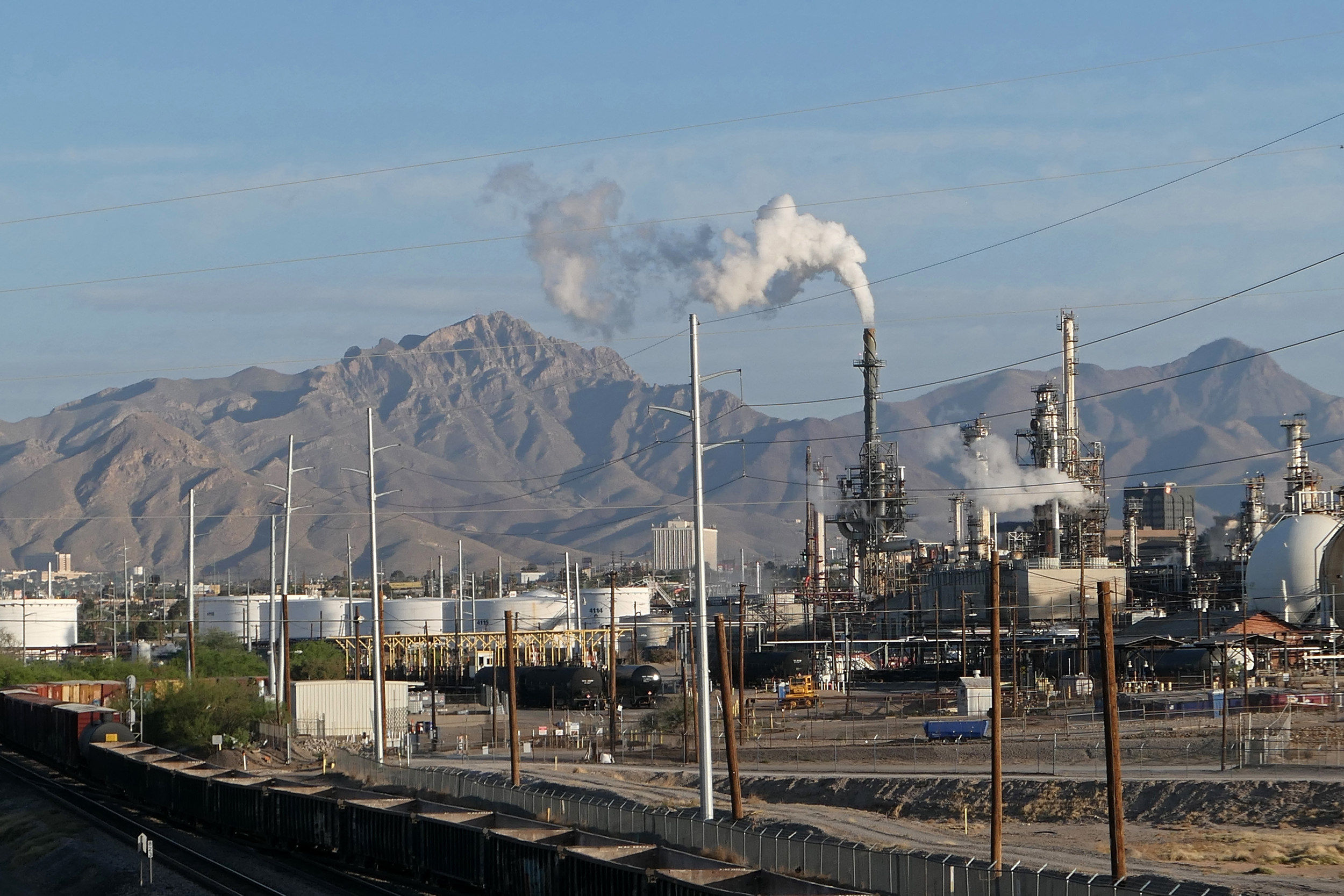
Morales fought back tears as he recounted how his wife died of lung cancer in June, despite never being a smoker. He lives next to Marathon Petroleum’s El Paso Refinery, which is one of the largest sources of air pollution in the city and has come under recent scrutiny for flaring hazardous compounds.
Morales said that when flares burn off gases at the refinery, he and other family members suffer from headaches and nausea.
“How many more loved ones do we have to lose to get the refinery accountable for our health?” he asked the City Council.
During the night of Aug. 4 into the early morning hours of Aug. 5, Marathon released 13 compounds into the air that were in excess of allowable amounts in its air permits, according to reports the company filed with TCEQ. Residents reported experiencing nausea and headaches that night.
On Tuesday, El Paso City Council was set to vote on sending formal requests to state and federal environmental regulators to hold a public meeting with Marathon Petroleum to provide a detailed accounting of recent flaring events. U.S. Rep. Veronica Escobar, a Democrat who represents El Paso, has also called on the Environmental Protection Agency to investigate recent incidents at the refinery.
Marathon is in the process of renewing its air permit with the Texas Commission on Environmental Quality (TCEQ). El Paso County has protested the permit renewal and TCEQ commissioners granted the hearing request in June, though a date has not yet been scheduled.
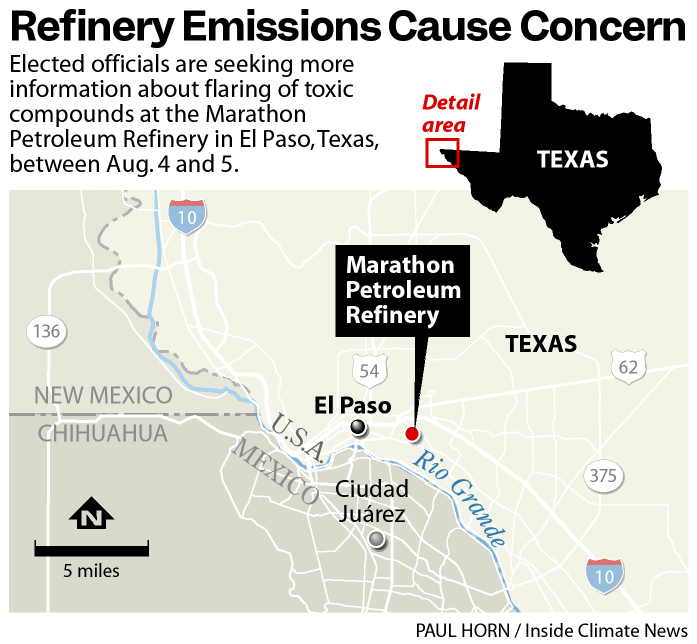
The refinery released over 10,000 pounds of the flammable gas propylene, 15 pounds of hydrogen sulfide and over 1,400 pounds of the volatile organic compound isopentane, among other hazardous compounds between Aug. 4 and 5, according to its filing with TCEQ. Marathon reported ongoing emissions until Aug. 7, including levels of hydrogen cyanide, nitrogen oxides and carbon monoxide beyond its permit allowances.
The El Paso Refinery is located in a residential neighborhood in south-central El Paso. Nearby residents urged the City Council on Tuesday to do what is in its power to rein in the refinery’s pollution.
“In the past a lot of our city leaders, county leaders, looked the other way,” said Fred Borrego, president of the San Juan Neighborhood Improvement Association. “Please do not look the other way.”
TCEQ did not respond to requests for comment by deadline.
“We share the goals behind these requests—transparency, air monitoring, public information, timely notification, and protection of public health,” a Marathon spokesperson said. “Safe and reliable operations are core principles of Marathon Petroleum, and we never want our operations to negatively impact our neighbors, and we are sorry for the disturbance residents experienced.”
A spokesperson for EPA Region 6, which includes Texas, said that TCEQ is the delegated authority for the Clean Air Act and the lead agency for responding to the Marathon incident.
“Entirely Unacceptable”
Marathon’s El Paso Refinery was originally two facilities, one built by Chevron in 1928 and the other by Texaco in 1931. The two sites later combined. After being operated by a company called Western Refining, Marathon purchased the refinery in 2018.
While the refinery was originally on the eastern edge of El Paso, the city grew around it. Residential developments filled in, and houses dot its fenceline. The zip code where the refinery is located is 93 percent Hispanic, and more than 44 percent of residents live in poverty—more than four times the national average, according to U.S. Census data.
This story is funded by readers like you.
Our nonprofit newsroom provides award-winning climate coverage free of charge and advertising. We rely on donations from readers like you to keep going. Please donate now to support our work.
Donate NowCounty Commissioner David Stout, whose district includes the refinery, called Marathon’s handling of the incident on Aug. 4 and 5 “entirely unacceptable.” Stout said that Marathon only provided information about the incident after he directly contacted the company. He said Marathon representatives said that no health risks had been detected.
Stout said when he saw the subsequent TCEQ reports that detailed large amounts of toxic compounds being released in his district, he was “aghast and felt completely misled.”
City Representative Josh Acevedo, whose council district includes the refinery, added the agenda item to the Aug.18 council meeting to request a formal meeting with Marathon, TCEQ and the EPA.
“El Pasoans deserve clear answers about what happened, what they may have been exposed to and what is being done to protect public health,” Acevedo said.
Marathon wrote in its report to TCEQ that the estimated emissions represent total emissions and “do not reflect ground-level concentrations at or beyond the facility’s fence line, which are relevant for assessing community exposure.” The report states that monitoring through Aug. 10 indicated that air quality levels were below “established community exposure guidelines.”
According to the updated report Marathon filed with TCEQ on Aug. 18, the company’s ongoing investigation has found that an electrical issue caused the fluid catalytic cracker to shut down on Aug. 4. While the cracker was restarting, hydrocarbons escaped through an external floating roof tank. The report states that intermittent flaring continued through Aug. 7.
Verónica Carbajal, an organizer with the Sembrando Esperanza Coalition in El Paso, said that dozens of residents have responded to a questionnaire her organization sent out about health effects experienced during the flaring event. She said that residents reported headaches, throat irritation and nausea. She said that several reported leaving their homes because the odors became overwhelming.
Carbajal said that Marathon must provide more information to residents and set up an emergency alert system.
“When the air was unsafe to breathe, none of us got an alert,” she said.
The Marathon spokesperson said the company “supports the idea” of a better community notification system.
The recent events have renewed attention to Marathon’s application to renew its permit with TCEQ. After the agency granted El Paso County standing to contest the permit in June, Marathon filed a motion to appeal that decision in July. However, Stout, who initiated the county’s permit protest, said the case is still set to go to a hearing.
About This Story
Perhaps you noticed: This story, like all the news we publish, is free to read. That’s because Inside Climate News is a 501c3 nonprofit organization. We do not charge a subscription fee, lock our news behind a paywall, or clutter our website with ads. We make our news on climate and the environment freely available to you and anyone who wants it.
That’s not all. We also share our news for free with scores of other media organizations around the country. Many of them can’t afford to do environmental journalism of their own. We’ve built bureaus from coast to coast to report local stories, collaborate with local newsrooms and co-publish articles so that this vital work is shared as widely as possible.
Two of us launched ICN in 2007. Six years later we earned a Pulitzer Prize for National Reporting, and now we run the oldest and largest dedicated climate newsroom in the nation. We tell the story in all its complexity. We hold polluters accountable. We expose environmental injustice. We debunk misinformation. We scrutinize solutions and inspire action.
Donations from readers like you fund every aspect of what we do. If you don’t already, will you support our ongoing work, our reporting on the biggest crisis facing our planet, and help us reach even more readers in more places?
Please take a moment to make a tax-deductible donation. Every one of them makes a difference.
Thank you,

Martha Pskowski
Reporter, El Paso, Texas
Martha Pskowski covers climate change and the environment in Texas from her base in El Paso. She was previously an environmental reporter at the El Paso Times. She began her career as a freelance journalist in Mexico, reporting for outlets including The Guardian and Yale E360. Martha has a B.A. in Environmental Studies from Hampshire College and a master’s degree in Journalism and Latin American Studies from New York University. She is a former Fulbright research fellow in Mexico. Martha can be reached on Signal at psskow.33.