

Democrats’ electoral sweep has shaken the ground beneath a permitting reform bill in Congress, raising doubts about whether the measure has enough support to advance in an initial Senate vote scheduled for Monday.
House Minority Leader Hakeem Jeffries (D-N.Y.) said on Thursday in a statement to POLITICO that he opposed the bipartisan bill in its current form, joining some fellow Democrats and environmental groups in raising concerns that the legislation would revise federal laws such as the National Environmental Policy Act.
Even before Jeffries’ statement, mounting evidence showed support for the bill was wavering.
The legislation, called the Bipartisan American Affordability and Jobs Act, or BAAJA, has support from business groups tied to renewable energy and fossil fuels. They tout its potential to reduce consumer energy costs by bringing new supplies online. The measure would ease regulatory barriers to build energy projects of just about every type—clean and dirty—and it would weaken the Clean Water Act, the Endangered Species Act, the National Environmental Policy Act and the National Historic Preservation Act.
And a new report by Kevin Kircher, a mechanical engineering professor at Purdue University, attempts to quantify the proposal’s broader emissions consequences, identifying potential harms that previous analyses may have missed by examining only parts of the bill.
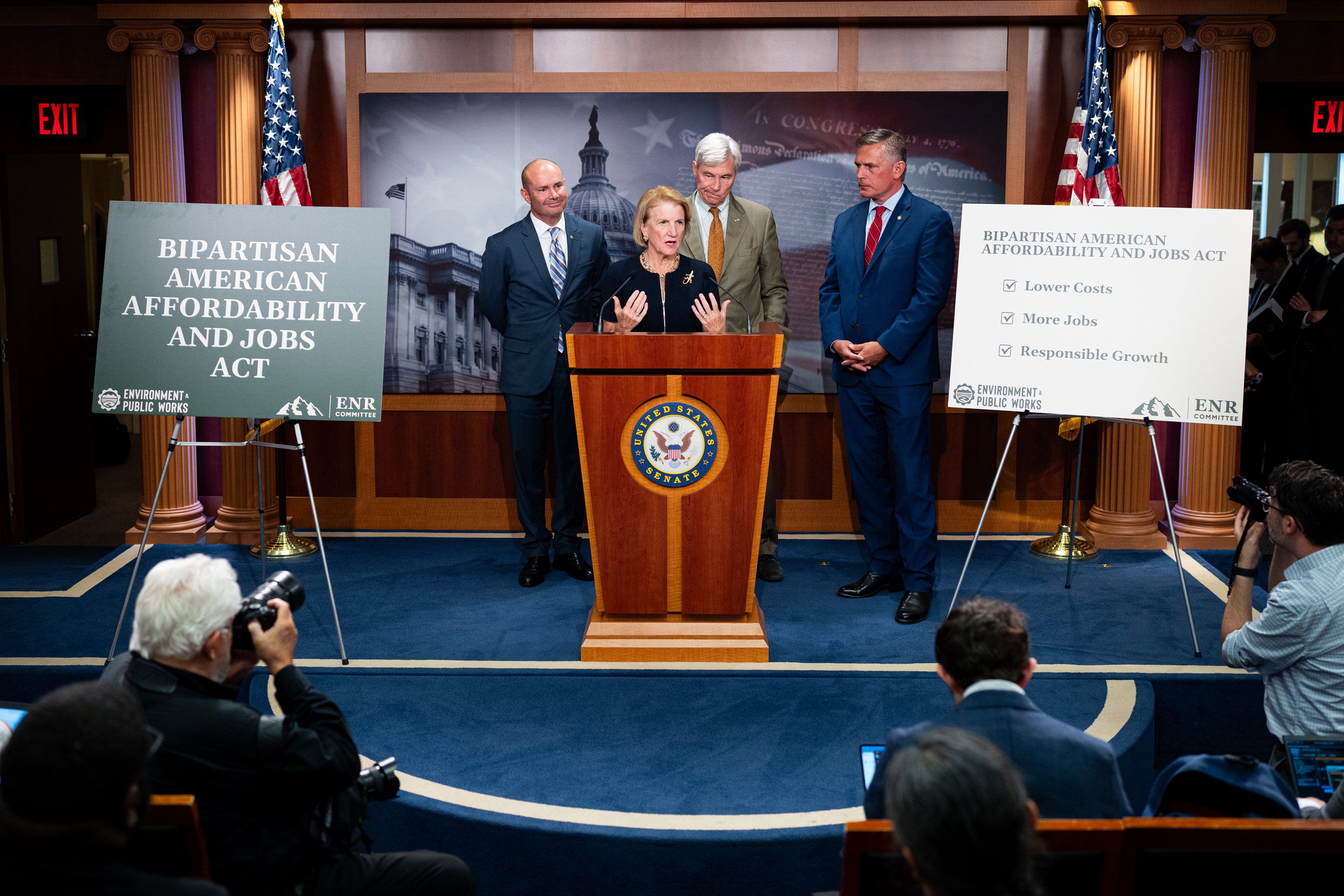
The Senate is scheduled to vote Monday on whether to begin debate on the bill. Its co-sponsors are Sens. Shelley Moore Capito (R-W.V.), Martin Heinrich (D-N.M.), Mike Lee (R-Utah) and Sheldon Whitehouse (D-R.I.)
Lobbyist Chris Moyer, founder of Echo Communications Advisors, said Democrats’ overwhelming wins in the midterm elections have changed the landscape for the bill. He previously hoped Congress would pass it in the lame-duck session, which begins next week, but has since changed his mind.
“The numbers we’re looking at in the House and Senate are just massive and Democrats will have a ton of leverage,” Moyer said in an interview. He previously worked on Capitol Hill as an aide to the late Senate Majority Leader Harry Reid.
Republicans will control the House and Senate in the lame-duck session, but Democrats will have comfortable majorities when the 120th Congress begins in January. Democrats will soon have more clout to address crucial clean energy roadblocks, like long queues for interconnection to the electric grid, without the trade-offs currently in the legislation that could speed the building of fossil fuel infrastructure in sensitive areas, Moyer said.
“If there’s a way to address some of the concerns that are being raised from the environmental and public lands standpoint and from the Tribal standpoint, and also preserve a lot of the good things that have been negotiated already, that’s something it seems there should be interest in this Congress in working on,” Moyer said. “It can be part of the affordability agenda that the incoming majorities are going to focus on.”
Scott Segal, a longtime environmental policy expert with the Washington, D.C., law and lobbying firm Bracewell, which represents both fossil fuel and renewable energy interests, sees little chance that the legislation will pass by the end of the year.
“In a situation where one side has won a tremendous landslide, they are usually not set to do a lot of lame-duck production,” he said in a post-election webinar. “With something like permitting reform, the Democrats might rightly say that they’d like to negotiate their own version of it.”
Although it might be difficult to imagine Democrats finding common ground with Trump on the issues, Segal noted that some of the most significant U.S. environmental and energy laws have been enacted during periods of divided government in Washington: for example, the National Environmental Policy Act and the original Clean Air Act in 1970, the big Clean Air Act amendments in 1990, and the Energy Independence and Security Act of 2007.
“When there’s a distribution of leverage, you can create the conditions for advancing legislation, provided that people on both sides of the aisle don’t let the perfect be the enemy of the good,” Segal said. “Almost every major environmental statute occurred under exactly these circumstances, with Dems controlling both houses of Congress and a strong Republican in the White House.”
Rep. Sean Casten (D-Ill.) said Wednesday that he is waiting to see an amendment drafted by the bill’s Senate co-sponsors before deciding whether he supports the legislation. The amendment, whose text has not been disclosed, responds to some of the objections, including that the bill may tie the hands of a future president’s ability to oppose projects.
“There were some pretty significant structural problems with the first version that came out,” Casten said in a conference call that primarily focused on election results.
Costs and Benefits
Kircher, the Purdue mechanical engineering professor, published his report on the bill this week, aiming to provide a more comprehensive assessment than previous analyses, which focused largely on the power sector provisions and overlooked other parts of the legislation with potential emissions implications.
Kircher built a model that calculates the bill’s potential effects, comparing a baseline of 2025 data with a hypothetical 2025 in which the measure was law. He found the bill would increase revenue and jobs in both fossil fuel and clean energy industries, with larger increases for fossil fuels. The bill also would likely increase energy-related greenhouse gas emissions and deaths attributable to air pollution from fossil fuels.
He weighed the trade-offs between negative effects, such as air pollution deaths, and positive ones, such as accelerating renewable energy construction. For example, he found that clean electricity revenue would increase by $2.1 million per life lost due to additional pollution from fossil fuels. This is much less than the roughly $12 million per-life cost standard that the U.S. Environmental Protection Agency has used to evaluate environmental policies, he said.
“I am for making reasonable compromises to get the good things we want out of our energy system, such as accelerating renewable energy development,” Kircher said in an interview. “That said, I don’t think the compromises in this version of BAAJA are reasonable, and I have a hard time seeing that changing without a major overhaul of the bill.”
This story is funded by readers like you.
Our nonprofit newsroom provides award-winning climate coverage free of charge and advertising. We rely on donations from readers like you to keep going. Please donate now to support our work.
Donate NowOther analyses have found a net emissions benefit, with lower emissions under the bill than a baseline scenario. Much of the benefit comes from provisions that make it easier to build transmission lines and connect more renewable energy projects to the grid. But by focusing solely on power-sector benefits, the analyses miss some of the bill’s most concerning parts, Kircher said.
Opposition to the permitting bill has grown as environmental advocates have scrutinized it. One concern is the bill’s “permit certainty” provision, designed to protect renewable projects from the kind of moves the Trump administration has made to stall already approved projects. But environmentalists warn the provisions also could make it tougher to challenge fossil fuel projects, even when new evidence emerges of harm to water or land resources.
Environmental groups praised Jeffries’ criticism of the bill.
“We’re grateful that Leader Jeffries made a very wise move that sends a good faith signal that he’s accounting for the full range of interests in the Democratic caucus and is rightly cautious about sparking a bloody factional fight days after a historic political victory,” said Erik Schlenker-Goodrich, executive director of the Western Environmental Law Center.
Meanwhile, clean energy business groups have not wavered in their support for the bill, even as criticism has intensified. They are highlighting the potential to reduce consumer prices after an election in which affordability was a top issue.
“BAAJA is the best opportunity Congress has to lower prices right now, and they should not delay action on that,” said Dylan Reed, managing director of federal and political affairs for Advanced Energy United, a trade group, in a Thursday conference call. “We support passage of that bill and getting it done before the end of this Congress.”
About This Story
Perhaps you noticed: This story, like all the news we publish, is free to read. That’s because Inside Climate News is a 501c3 nonprofit organization. We do not charge a subscription fee, lock our news behind a paywall, or clutter our website with ads. We make our news on climate and the environment freely available to you and anyone who wants it.
That’s not all. We also share our news for free with scores of other media organizations around the country. Many of them can’t afford to do environmental journalism of their own. We’ve built bureaus from coast to coast to report local stories, collaborate with local newsrooms and co-publish articles so that this vital work is shared as widely as possible.
Two of us launched ICN in 2007. Six years later we earned a Pulitzer Prize for National Reporting, and now we run the oldest and largest dedicated climate newsroom in the nation. We tell the story in all its complexity. We hold polluters accountable. We expose environmental injustice. We debunk misinformation. We scrutinize solutions and inspire action.
Donations from readers like you fund every aspect of what we do. If you don’t already, will you support our ongoing work, our reporting on the biggest crisis facing our planet, and help us reach even more readers in more places?
Please take a moment to make a tax-deductible donation. Every one of them makes a difference.
Thank you,

Dan Gearino
Reporter, Clean Energy
Dan Gearino covers the business and policy of renewable energy and utilities, often with an emphasis on the midwestern United States. He is the main author of ICN’s Inside Clean Energy newsletter. He came to ICN in 2018 after a nine-year tenure at The Columbus Dispatch, where he covered the business of energy. Before that, he covered politics and business in Iowa and in New Hampshire. He grew up in Warren County, Iowa, just south of Des Moines, and lives in Columbus, Ohio.

Marianne Lavelle
Bureau Chief, Washington, D.C.
Marianne Lavelle is the Washington, D.C. bureau chief for Inside Climate News. She has covered environment, science, law, and business in Washington, D.C. for more than two decades. She has won the Polk Award, the Investigative Editors and Reporters Award, and numerous other honors. Lavelle spent four years as online energy news editor and writer at National Geographic. She spearheaded a project on climate lobbying for the nonprofit journalism organization, the Center for Public Integrity. She also has worked at U.S. News and World Report magazine and The National Law Journal. While there, she led the award-winning 1992 investigation, “Unequal Protection,” on the disparity in environmental law enforcement against polluters in minority and white communities. Lavelle received her master’s degree from Columbia University Graduate School of Journalism, and is a graduate of Villanova University.