

ANTALYA, Turkey—The final days of the United Nations COP31 climate talks are shaping up as a test of whether countries can move beyond incremental progress toward the goal of curbing global warming.
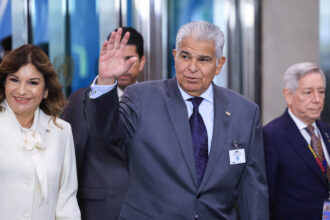
Panama, which negotiates as a member of a Latin American coalition of developing countries, is threatening to block the adoption of any final agreement that does not establish a clear path to transition away from fossil fuels. The path, Panama argues, should include a cap on oil production as “a first verifiable step in the transition away from fossil fuels.”
In a letter to Simon Stiell, the executive secretary of the United Nations Framework Convention on Climate Change, Juan Carlos Navarro, Panama’s minister of the environment, wrote Thursday that the country will not join any consensus “that does not lead to an outcome satisfactory to our principles and values.”
Panama’s stance muddies the outlook for a final agreement. If a significant number of countries object to the text, the conference could end without a decision document, which would leave other important elements like electrification goals in limbo. It’s not clear if the entire Latin American coalition is unified on this point.
And consensus is not the same as unanimity. At the Dubai conference in 2023, the presidency approved the final document over the objection of some countries, while others were not in the room during the final moments.
Panama’s letter came as the Conference of the Parties co-presidency released a new draft of the cover decision which did not mention fossil fuels. The letter lists eight elements the decision document needs to consider before Panama agrees to sign on, starting with science as a foundation.
“Every decision must be based on the best available science and follow the findings of the Intergovernmental Panel on Climate Change. The IPCC must be fully funded and supported,” Navarro wrote.
The international science panel provides periodic climate science assessments to guide the climate talks, but a handful of countries with fossil fuel-dependent economies have disrupted its work in recent months.
Panama argued that the United Nations process must be reformed to allow decisions to pass by a simple majority vote when consensus cannot be reached, “so that the will of a few cannot paralyze the action of all.” The country will “object to any decision that fails to reform the current failed rules of engagement,” Navarro wrote.
Panama is also insisting that the final decision document for the Antalya conference spells out that developed countries that have emitted the most climate-harming greenhouse gases must live up to their financial obligations to developing countries.
Beautiful speeches alone won’t save the planet, he added, writing that “while we listen to endless oratory, the planet is being destroyed … Outside this room and this Conference, the world needs and expects radical change from us, and we are not delivering it.”
Threatening to reject a COP31 agreement is not a new negotiating tactic, but governments rarely follow through when major decisions are at stake, said Joanna Depledge, a climate diplomacy expert at Cambridge University.
Panama might not have enough clout to make the threat stick on its own. A larger country, like China or India, would have considerably more leverage, Depledge said.
Navarro may also have weakened his position by including demands that Depledge described as “utterly fantastical.” Had he focused on more realistic proposals, he might have been taken more seriously, she added.
Still, Panama’s protest could pose a problem “if [Navarro] really does stand up to object,” especially if other countries join him. “But at least now the presidencies are warned, and can start to engage with him to try to defuse that.”
The United Nations Framework secretariat and the conference’s Turkish and Australian co-presidents, who lead the negotiations to finalize the language of the decision document, did not immediately respond to requests for comment on the letter.
A spokesperson for Germany’s delegation declined to comment directly on other parties and added that Carsten Schneider, the country’s minister for the environment, climate action, nature conservation and nuclear safety, held a joint press conference on Wednesday with Navarro about global electrification targets.
At a separate Wednesday press conference, Navarro was even more blunt than he was in the letter, calling the climate talks “an exercise in hypocrisy and futility.”
“We are facing corrupt behavior which is unacceptable,” he said, “particularly, producers of fossil fuels who are blocking every single step of these processes.”
Jiwoh Emmanuel Abdulai, Sierra Leone’s minister of the environment and climate change, also criticized developed countries during the press conference. He compared the negotiations to a scenario in which someone “rams a bulldozer into your house and then asks you, ‘So what would you give for me to fix your house?’”
About This Story
Perhaps you noticed: This story, like all the news we publish, is free to read. That’s because Inside Climate News is a 501c3 nonprofit organization. We do not charge a subscription fee, lock our news behind a paywall, or clutter our website with ads. We make our news on climate and the environment freely available to you and anyone who wants it.
That’s not all. We also share our news for free with scores of other media organizations around the country. Many of them can’t afford to do environmental journalism of their own. We’ve built bureaus from coast to coast to report local stories, collaborate with local newsrooms and co-publish articles so that this vital work is shared as widely as possible.
Two of us launched ICN in 2007. Six years later we earned a Pulitzer Prize for National Reporting, and now we run the oldest and largest dedicated climate newsroom in the nation. We tell the story in all its complexity. We hold polluters accountable. We expose environmental injustice. We debunk misinformation. We scrutinize solutions and inspire action.
Donations from readers like you fund every aspect of what we do. If you don’t already, will you support our ongoing work, our reporting on the biggest crisis facing our planet, and help us reach even more readers in more places?
Please take a moment to make a tax-deductible donation. Every one of them makes a difference.
Thank you,

Bob Berwyn
Reporter, Austria
Bob Berwyn is an Austria-based reporter who has covered climate science and international climate policy for more than a decade. Previously, he reported on the environment, endangered species and public lands for several Colorado newspapers, and also worked as editor and assistant editor at community newspapers in the Colorado Rockies.