

After Texas regulators said Tesla’s lithium refinery near Corpus Christi wasn’t violating its permits by discharging what local officials reported as black wastewater into a drainage ditch, independent water testing there this month found two toxic metals and other contaminants.
Eurofins Environment Testing, an accredited lab with locations across the globe, reported traces of hexavalent chromium, a well-known carcinogen, and arsenic, an environmental poison. Nueces County Drainage District No. 2, which manages the ditch, commissioned the test.
Neither hexavalent chromium nor arsenic is included as an allowable discharge pollutant in Tesla’s wastewater permit.
“The results are quite disturbing,” wrote Frank Lazarte, an attorney representing Nueces County Drainage District No. 2, in a cease and desist letter to Tesla’s associate general counsel last week. The district is asking Tesla to stop discharging wastewater into the ditch until they can discuss the lab results.
Jason Bevan, senior manager of site operations for Tesla’s plant, in the small municipality of Robstown, said the company remains in complete compliance with all requirements of its state-issued wastewater discharge permit, including applicable water quality standards.
“Tesla routinely monitors and tests its permitted wastewater discharge,” Bevan said in an emailed statement to Inside Climate News. “Tesla is currently reviewing the letter from Nueces County Drainage District #2 and looks forward to working cooperatively with the district to address their concerns.”
The Texas Commission on Environmental Quality sampled and tested Tesla’s wastewater discharge in February and confirmed that the company is in compliance with its permit, Bevan said.
But the state environmental regulator, known as TCEQ, didn’t look for heavy metals in February. Its water sample tested for dissolved solids, oil and grease, chlorides, sulfates, temperature and oxygen—all of which were within the bounds of Tesla’s permit.
Victoria Cann, a spokesperson for TCEQ, said Tesla’s facility was required to conduct initial sampling of the wastewater discharged from its outfall pipe for conventional and non-conventional pollutants, including metals used at the facility and toxic pollutants believed to be present in discharge.
The TCEQ industrial permits team reviewed those initial submitted results and had no concerns, Cann stated. Therefore, it didn’t require an amendment to the permit to include additional wastewater limitations or monitoring requirements.
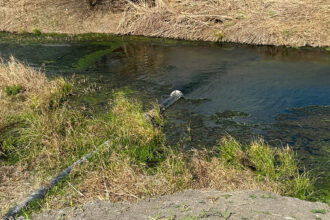
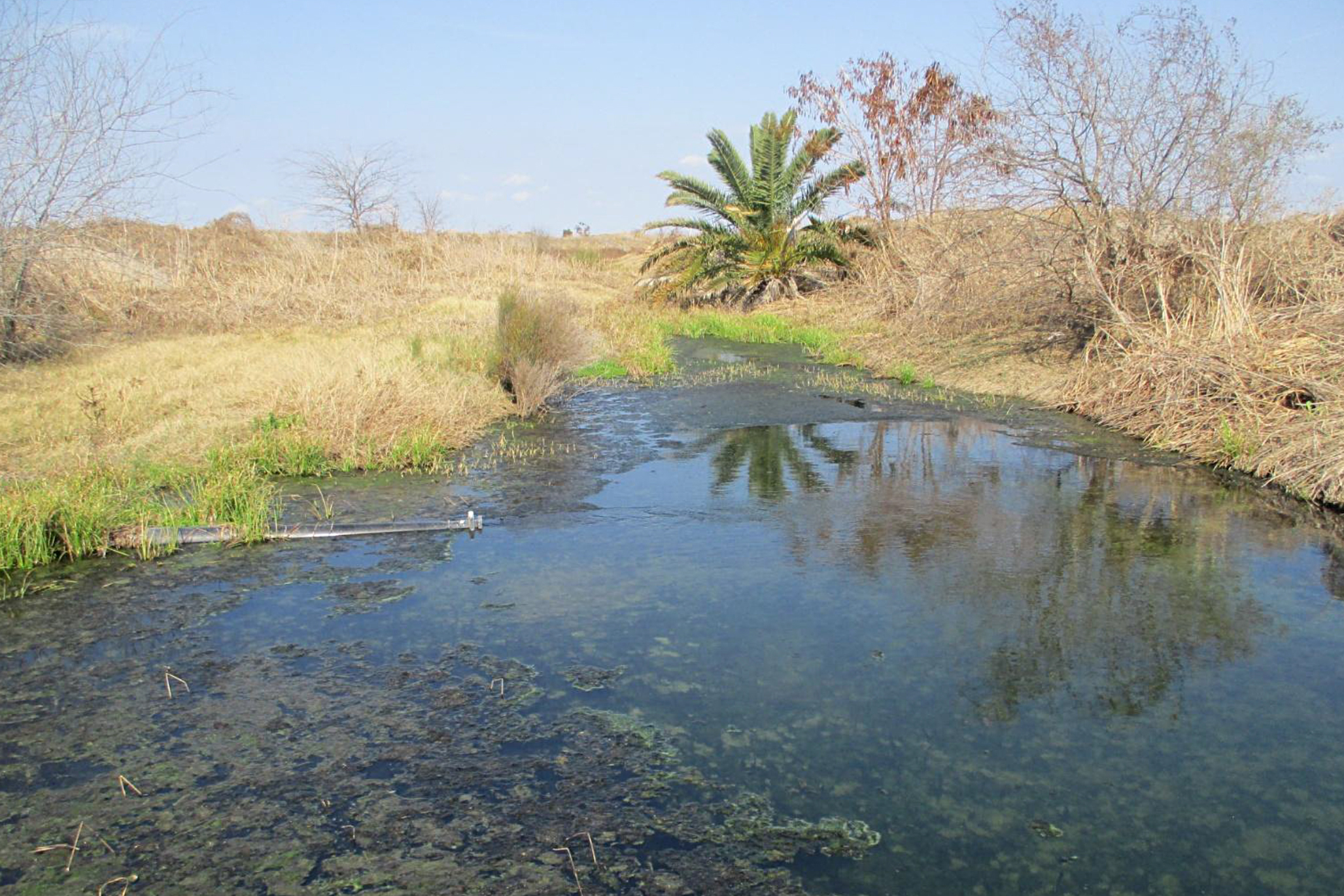
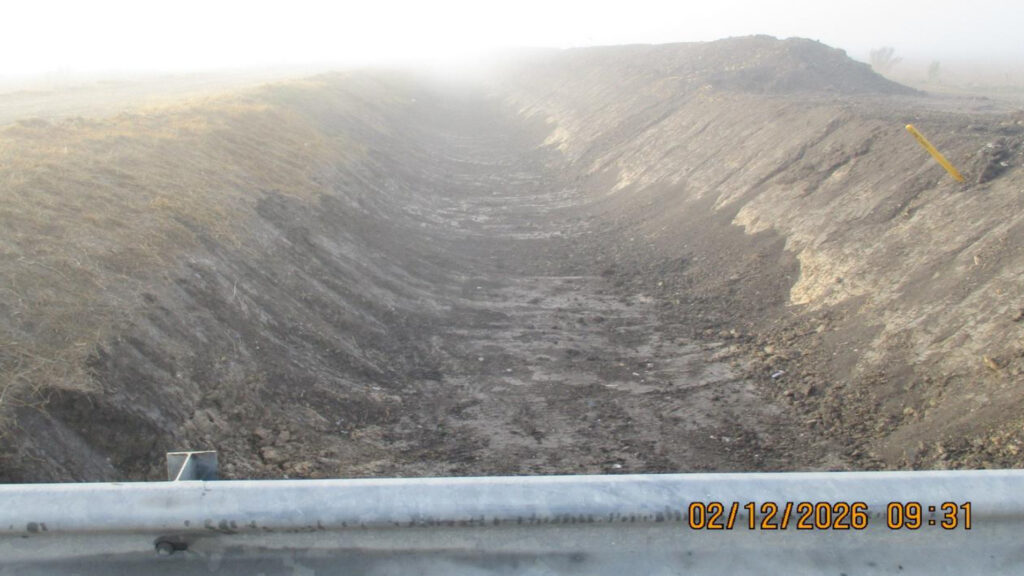
TCEQ initiated its February investigation after workers for the drainage district found an unfamiliar pipe stretched across its easement. The workers reported black liquid expelling into the ditch. The drainage district, which manages the ditch area, was unaware that the state gave Tesla permission to use it.
District officials were confused how the state could allow Tesla to discharge an average of 231,000 gallons of lithium refinery wastewater each day into the district’s ditch without notification. TCEQ said it doesn’t communicate directly with local drainage districts as part of the permitting process.
Volunteer drainage district engineer Aref Mazloum said TCEQ didn’t test for heavy metals in its compliance investigation because that hadn’t been part of the district’s complaint filed earlier this year. When the investigation concluded, he said he requested the results and commissioned the third-party wastewater testing to see what else might be in the water.
Eurofin conducted its testing earlier this month, according to its report. It placed a sampling machine in the wastewater for 24 hours to monitor and collect the discharge, then sent the results to its San Antonio lab on April 7.
The state’s wastewater permit requires that sampling be conducted at the outfall pipe. The third-party report sampled water from the drainage ditch, Cann stated, which is inappropriate for use by TCEQ for permitting decisions.
As soon as district staff saw the lab results, they notified a raft of local elected officials, said Mazloum, who also recently started working as an engineer in the water supply division at TCEQ and is a mechanical engineering assistant professor at Texas A&M University-Corpus Christi.
Mazloum doesn’t want to be known as the guy who gave Tesla such a hard time he drove them out of Robstown, but he said the heavy metals must be remediated from the county’s wastewater. He said he wouldn’t be able to sleep if he were to keep quiet about this information.
“Public safety is my highest priority,” Mazloum said. “Secondly would come the economy.”
To safely manage its hyper-saline and toxic discharges, the electric vehicle company should design and fund an on-site multi-stage wastewater treatment plant, Mazloum said. The process Mazloum recommended Tesla take on would remove heavy metals and use industrial reverse osmosis technology. Then, Mazloum said, Tesla could use district infrastructure to dispel wastewater again.
“The resulting clean water will then be discharged and nothing will happen to the infrastructure, the ditches, the plants, the fish, the frogs, the animals, the people, from that water,” Mazloum said.
Mazloum added that the concentrated brine solution created by that on-site treatment would need to be hauled to a hazardous waste facility or processed through a zero-liquid discharge system.
While water in the ditch does not reach the drinking supply, people can be affected in other ways, such as by eating fish caught nearby or by facing increased flood risk if the ditch infrastructure erodes, Mazloum said. The wastewater pooling in the drainage ditch flows to Petronila Creek and ultimately to Baffin Bay, a longtime fishing spot suffering from decades of deteriorating ecosystem health.
Nueces County groundwater is known to contain some arsenic, said Chris Cuellar, a retired chemical plant worker who spent 10 years managing wastewater operations at one of the region’s largest industrial facilities. Eurofins tested the wastewater from the ditch, rather than from Tesla’s outfall pipe, so it’s possible there was residual arsenic from a nearby pond overflow that leached into the ditch, for example, rather than coming from the industrial process itself, Cuellar said.
The metallic particles of arsenic in the sample measured 0.0025 milligrams per liter, a fraction of the federal limit for drinking water, 0.01 milligrams per liter.
The Eurofins sample is good to have, Cuellar added, but offers a one-time baseline of that day. “It’s not what it always is or what it has been,” he said.
In the wastewater sample Eurofins tested, the concentrations of lithium, strontium and vanadium were abnormally high compared to levels in rainwater or groundwater, according to Lazarte, the attorney. “The three metals/chemicals act like a chemical signature pointing back to the battery processing facility,” he wrote.
Lithium is the active material inside rechargeable batteries. Tesla is seeking to increase the domestic supply of battery-grade lithium hydroxide at its nearly $1 billion lithium refinery plant in Robstown. It processes spodumene, an often yellowish mineral and a commercially important source of lithium.
A report written by Mazloum that’s been distributed to legislators and will soon be discussed with Robstown residents calls the traces of lithium a “fingerprint at a crime scene.”
The electric vehicle company’s wastewater permit does not monitor for lithium and wasn’t tested for in the TCEQ’s February investigation. In the first 60 days of the facility’s operation, Tesla had to test for a variety of metal and chemical pollutants not listed in its permit. Lithium was not among them.
This story is funded by readers like you.
Our nonprofit newsroom provides award-winning climate coverage free of charge and advertising. We rely on donations from readers like you to keep going. Please donate now to support our work.
Donate NowWhen the permit was being considered and public comments expressed concern about how the facility would affect the environment, Kelly Keel, TCEQ’s executive director, said the wastewater wasn’t expected to contain any residual lithium, chemical runoff or other harmful pollutants.
No surface water intake for domestic drinking water supplies is located within five miles downstream of the wastewater discharge point, and so there would be no impact on water wells or drinking water, Keel said at the time.
Before the permit was issued, TCEQ determined that Tesla’s wastewater discharge plan would meet state requirements and protect the environment, water quality and human health.
Mazloum’s report noted that Eurofins detected 1.17 milligrams of strontium per liter of water in the sample and said long-term exposure could affect bone density and kidney function in humans and wildlife.
His report also flagged heightened levels of several chemicals consistent with industrial discharge, including manganese, iron, phosphorus, calcium, magnesium and potassium. Manganese, a battery process tracer, can have neurological effects at chronic doses, the report stated. Too much iron can stain the ditch’s infrastructure and too much phosphorus can cause algae blooms that starve waterways of oxygen.
The risk of algal growth is amplified by ammonia, which the lab results found in the form of nitrogen at 1.68 milligrams per liter of water. “At this level,” Mazloum’s report said, it is “directly toxic to fish and aquatic invertebrates. Imagine a slow-acting suffocant for anything that lives in the water.”
The high sodium concentrate, combined with elevated calcium, magnesium and potassium, creates a near-brackish water condition that’s 10 to 20 times saltier than normal surface water, according to Mazloum’s report.
“This directly threatens the drainage ditch’s ability to protect the neighborhoods,” Lazarte wrote. “Plants hate salt the same way you’d hate drinking ocean water when you’re thirsty.”
As salt draws out the moisture of plant roots, it kills the grass and ground cover lining the walls of the ditch. Then the bare soil washes away in rain, Mazloum said, and as the drainage ditch walls collapse, the channel loses the capacity to carry stormwater away from homes and raises the risk of floods during heavy rains.
When a state investigator went to test the wastewater in February, it appeared clear as it flowed downstream, according to state records. Along the banks and in the ditch, there was a heavy growth of algae and vegetation.
News of the contaminants Eurofin found in the wastewater sample comes as South Texas faces a serious water crisis. Corpus Christi is in the midst of developing groundwater projects to try to stave off imminent deletion of its dwindling reservoirs, and it expects to enact emergency water-use restrictions in September if weather patterns don’t change.
Robstown is 16 miles west of Corpus Christi. The Tesla situation is the first time the drainage district has had to deal with discharge water quality, said Steve Ray, a consultant for the district. The drainage district typically focuses on maintaining the integrity of its ditches and flood preparedness, he said.
“We want to make sure that this is environmentally safe for our citizens and for our employees who have to work in those ditches,” Ray said. “We also want to make sure it’s environmentally safe and sound for the future—for our kids, our grandkids.”
Mazloum recommended that Robstown residents stay away from the ditch. It’s off U.S. 77 and County Road 28.
This article was updated April 21, 2026, with comments from the Texas Commission on Environmental Quality.
About This Story
Perhaps you noticed: This story, like all the news we publish, is free to read. That’s because Inside Climate News is a 501c3 nonprofit organization. We do not charge a subscription fee, lock our news behind a paywall, or clutter our website with ads. We make our news on climate and the environment freely available to you and anyone who wants it.
That’s not all. We also share our news for free with scores of other media organizations around the country. Many of them can’t afford to do environmental journalism of their own. We’ve built bureaus from coast to coast to report local stories, collaborate with local newsrooms and co-publish articles so that this vital work is shared as widely as possible.
Two of us launched ICN in 2007. Six years later we earned a Pulitzer Prize for National Reporting, and now we run the oldest and largest dedicated climate newsroom in the nation. We tell the story in all its complexity. We hold polluters accountable. We expose environmental injustice. We debunk misinformation. We scrutinize solutions and inspire action.
Donations from readers like you fund every aspect of what we do. If you don’t already, will you support our ongoing work, our reporting on the biggest crisis facing our planet, and help us reach even more readers in more places?
Please take a moment to make a tax-deductible donation. Every one of them makes a difference.
Thank you,

Arcelia Martin
Reporter, Texas Renewables
Arcelia Martin is an award-winning journalist at Inside Climate News. She covers renewable energy in Texas from her base in Dallas. Before joining ICN in 2025, Arcelia was a staff writer at The Dallas Morning News and at The Tennessean. Originally from San Diego, California, she’s a graduate of Gonzaga University and Columbia University Graduate School of Journalism.