

LINZ, Austria—A summer-long series of heatwaves that has been blistering much of Europe since June has turned political.
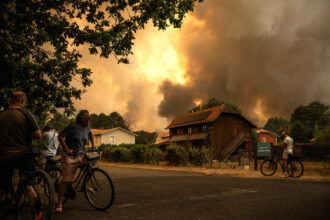
Elected leaders are facing growing scrutiny for their lackluster response to the deadly consequences of climate extremes, even as their parties continue to pursue policies that worsen the crisis.The extreme temperatures, along with drought, have drained rivers, parched crops and turned fields and forests to tinder and flames, prompting Green parties and citizen groups to call for heat summits and stronger government action.
And in some countries, far-right nationalists are weaponizing the heat and fires by blaming governments they oppose for failing to protect people from the impacts of global warming, while denying that human activity is driving it.
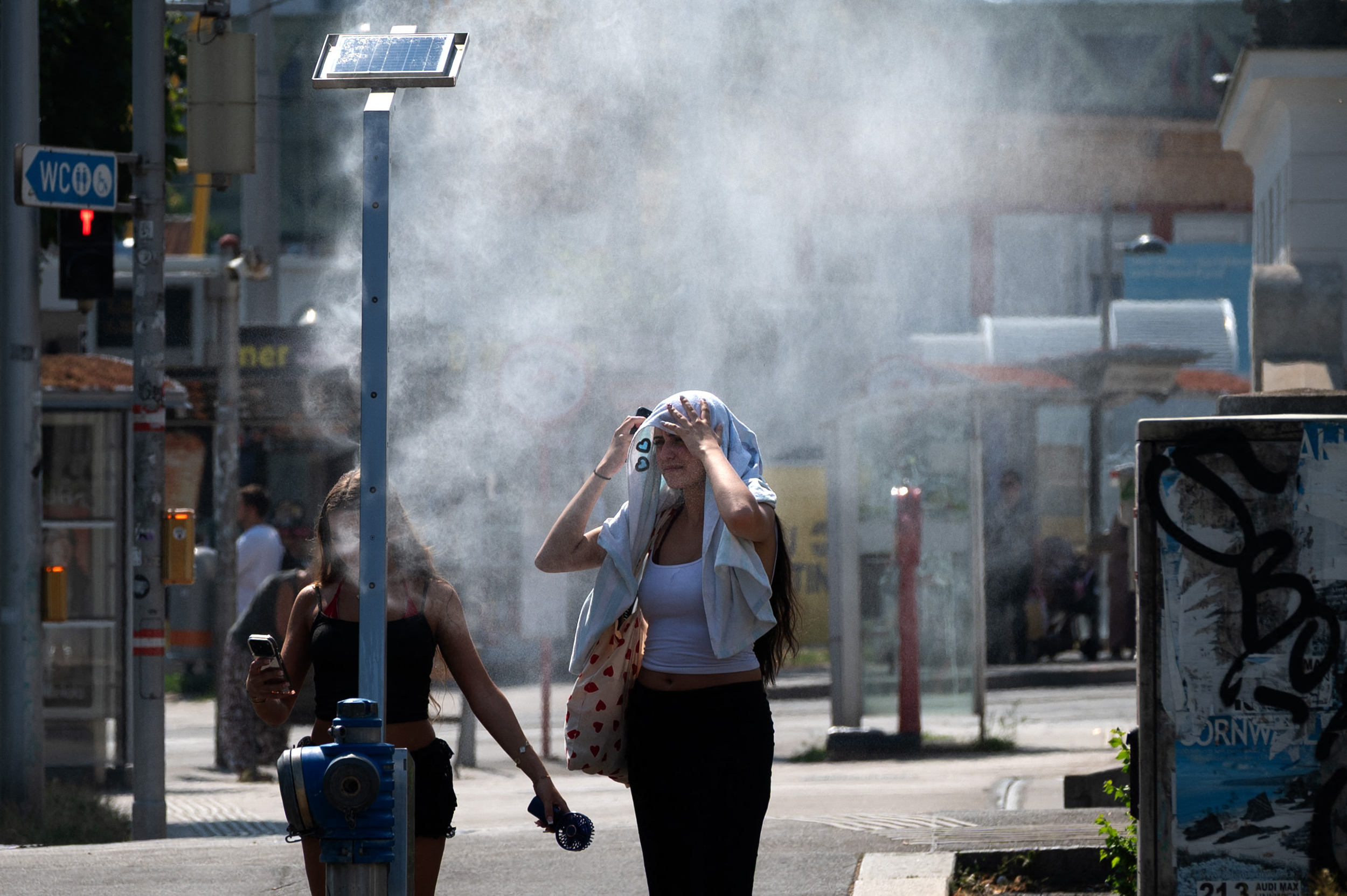
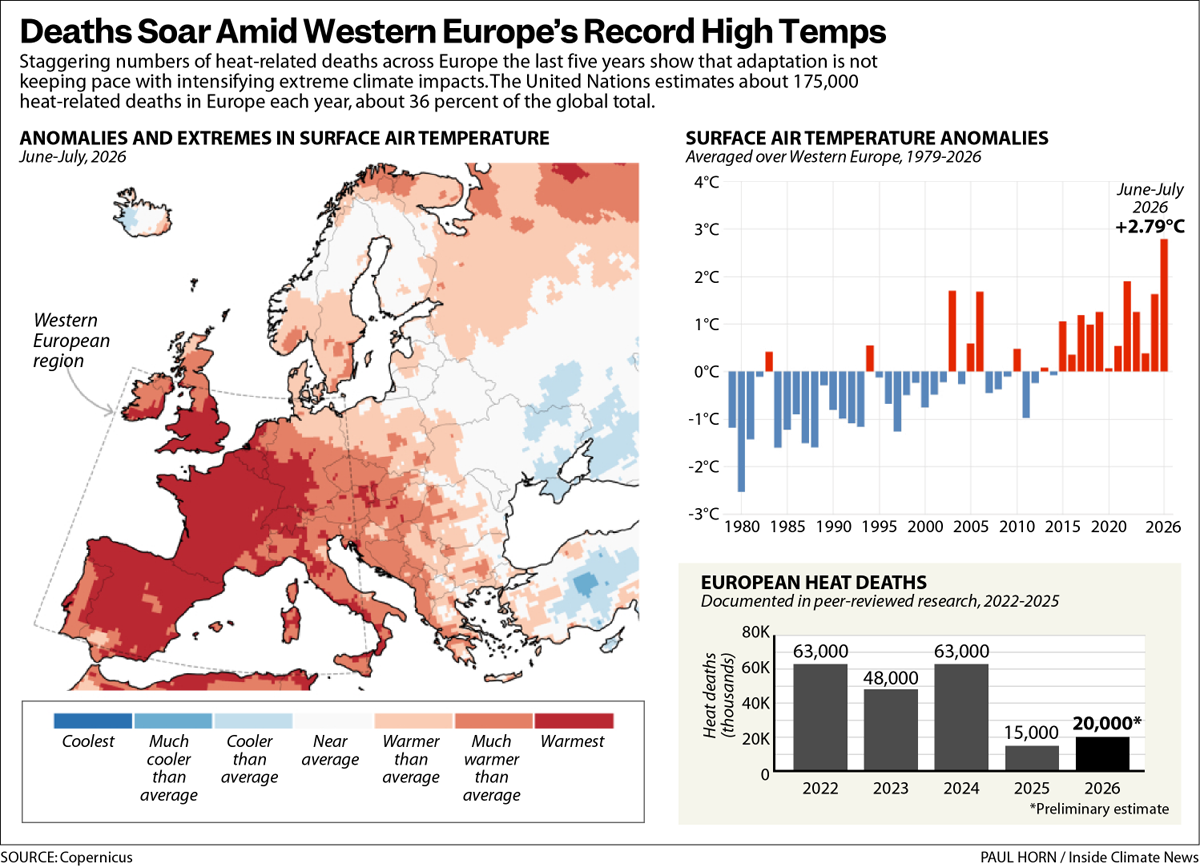
The first surge of blistering temperatures in June caused about 10,000 heat-related deaths across Europe. The total included an estimated 395 mortalities in Austria, where the Green Party called on the government to host a national heat summit.
In Linz, Green Party City Councilwoman Eva Schobesberger is also formally requesting a special session of the city’s legislature to consider immediate steps to protect vulnerable people.
“We know what we need to do,” she said, explaining that Europe can forecast extreme heat increasingly well, and public-health experts know what measures can reduce deaths.
And yet, extreme temperatures in Europe have repeatedly caused tens of thousands of heat-related deaths, beginning with an estimated 70,000 in a 2003 heatwave. Political leaders say they’ve learned from that, but a 2025 study in the journal Nature Medicine found that heat mortality remains high, with an estimated 68,000 heat-related deaths in 2022, about 51,000 in 2023 and 63,000 in 2024.
This year’s heat and wildfire deaths mark another “dark summer” for Europe, European Green party leaders said in July, adding that the casualties are the result of political decisions.
“We simply cannot and must never accept that this will become a new normal,” Vula Tsetsi, co-chair of the European Green Party, said in a July 18 statement. “There is a widening gap between the scale of Europe’s heatwaves, literally hitting every EU country, and the absence of decisive European action,” she said, urging the European Council to convene a heat summit.
Tsetsi said the EU Commission, the executive arm, planned to unveil a heat and cooling plan back in April, but has not delivered it due to political gridlock.

In Linz, Schobesberger said that urgency and speed are required because global warming is outpacing the institutions built to respond to climate extremes. Heat plans are still largely organized around assumptions that are no longer true, and communities need to review and update the plans regularly based on the latest climate projections, she said.
The number of heat-related deaths in Linz this summer isn’t known yet, but she said Austria’s third-largest city has already taken significant steps toward heat resilience. Appointing an urban climatologist in 2020 laid the groundwork for a detailed urban heat map that shows where people are underserved by cooling infrastructure and public cooling spaces.
The map also helps the city plan projects to moderate urban temperatures, such as adding trees and water-absorbent parks. And Linz is expanding district cooling systems for hospitals and other public facilities right now, she said. The biggest threat to continued improvement in heat adaptation isn’t a lack of knowledge about what to do or technological limitations—it’s political, she added.
The Climate “Blame Game”
Much of the city’s progress on climate action has happened since 2021, when the Green Party captured about 16 percent of the municipal vote. Schobesberger said the massive Fridays for Future climate demonstrations across Europe in 2019, sparked by Greta Thunberg’s activism, showed politicians that there is widespread public support for climate action. In Linz, the wave of citizen activism motivated the other parties in the city government to support adaptation and resilience projects, she added.
“Politicians across parties wanted to demonstrate that they wanted to do something on climate,” she said, adding that the Green Party used the political window of opportunity to launch infrastructure projects that would be hard to roll back later—knowing that political support for environmental measures is tenuous. Since then, political attention has shifted toward near and distant wars, inflation and other concerns that seem more immediate than the climate crisis, she said.
In Linz, the mayor’s office downgraded a prominent climate coordination position and even removed the word “climate” from the name of the department tasked to make the city more resilient to climate shocks. And politicians from conservative and far-right populist parties are grumbling that newly greened areas have taken away needed road and parking spaces, hinting that they could simply reverse the projects.
She said the conservative parties have actively opposed some adaptation measures, particularly tree-planting projects. And over the objections of the Green Party, the city administration approved an urban highway corridor that will make the city hotter. Hundreds of trees have already been chopped down to make way for more asphalt and cars.
On the national level, she said the far-right populist Austrian Freedom Party (FPÖ) runs an ongoing propaganda campaign to confuse the public about the causes of the climate crisis and to undermine the transition to renewable energy, especially wind power.
But the current summer of extreme heat has temporarily dispelled the fog of climate disinformation and pierced the political apathy, Schobesberger said. Against that backdrop, she said national and local heat summits may yield results if elected officials are brought together with heat experts and scientists under public scrutiny.
Reinhard Steurer, a professor of climate politics at Vienna’s BOKU University, said he personally experienced how right-wing populists tried to use the extreme heat to increase their own popularity by attacking the government.
During the first surge of extreme heat, which arrived unusually early in June, he said that producers with ServusTV, an Austrian media company aligned with right-wing populist parties, asked him via email to appear on a news program and criticize the Austrian government for failing to take adaptation seriously.
Steurer said his first reaction was disbelief, because for years, he said, ServusTV denied human-caused global warming and downplayed its impacts, similar to Fox in the United States. He said it’s part of a broader political strategy to acknowledge the suffering caused by extreme heat, while shifting responsibility to the current government to gain political advantage for the parties the company supports.
This story is funded by readers like you.
Our nonprofit newsroom provides award-winning climate coverage free of charge and advertising. We rely on donations from readers like you to keep going. Please donate now to support our work.
Donate NowThe approach follows a blame-game playbook that populist parties around the world have used to spread climate disinformation, he added. Instead of acknowledging that human-caused warming worsens wildfire conditions, for example, the disinformation narrative shifts responsibility to migrant campfires.
ServusTV did not immediately respond to questions from Inside Climate News about the interview it requested with Steurer and its climate programming.
Limits to Adaptation
The politics of climate extremes don’t have to follow that path, said Aaron Thierry, a researcher at Cardiff University in Wales who studies the role of scientists and scientific research in the climate crisis. He pointed to Spain’s Prime Minister Pedro Sánchez, who is using the worsening disasters to make the case for action rather than simply assigning blame.
Sánchez has spoken bluntly about the connection between extreme weather and global warming. As wildfires swept across Spain this summer, he called the climate emergency a threat to lives and ecosystems and argued that governments need to address both its causes and consequences.
It’s too early to measure the effect of this summer’s extremes, but overall, public and media climate discourse is still way off target, Thierry said, citing several recent studies showing a sharp decline in climate coverage in recent years that takes the pressure off governments to act.
“It feels like the climate issue is actually getting less attention and I find that deeply concerning,” he said. Recent reports from the Intergovernmental Panel on Climate Change show that addressing the root causes of the climate crisis is the only way to prevent mass casualties during the even-hotter summers projected for the decades ahead, Thierry said. The rising heat-related death tolls across Europe show that even wealthy, developed countries are reaching the limits of climate adaptation.
“We can’t lose sight of the fact that we have to phase out fossil fuels because that’s ultimately what’s driving extreme heat,” he said. “The science is trying to tell us this is super-urgent. It’s transformational change that is needed, and our politics are not at that place yet.”
About This Story
Perhaps you noticed: This story, like all the news we publish, is free to read. That’s because Inside Climate News is a 501c3 nonprofit organization. We do not charge a subscription fee, lock our news behind a paywall, or clutter our website with ads. We make our news on climate and the environment freely available to you and anyone who wants it.
That’s not all. We also share our news for free with scores of other media organizations around the country. Many of them can’t afford to do environmental journalism of their own. We’ve built bureaus from coast to coast to report local stories, collaborate with local newsrooms and co-publish articles so that this vital work is shared as widely as possible.
Two of us launched ICN in 2007. Six years later we earned a Pulitzer Prize for National Reporting, and now we run the oldest and largest dedicated climate newsroom in the nation. We tell the story in all its complexity. We hold polluters accountable. We expose environmental injustice. We debunk misinformation. We scrutinize solutions and inspire action.
Donations from readers like you fund every aspect of what we do. If you don’t already, will you support our ongoing work, our reporting on the biggest crisis facing our planet, and help us reach even more readers in more places?
Please take a moment to make a tax-deductible donation. Every one of them makes a difference.
Thank you,

Bob Berwyn
Reporter, Austria
Bob Berwyn is an Austria-based reporter who has covered climate science and international climate policy for more than a decade. Previously, he reported on the environment, endangered species and public lands for several Colorado newspapers, and also worked as editor and assistant editor at community newspapers in the Colorado Rockies.