


The World Cup is well underway across North America, where millions have traveled from around the world in recent weeks to watch their favorite soccer teams hit the pitch. This year’s matches could break records—but maybe not the ones fans are hoping for.
At least two games so far—in Miami and Monterrey, Mexico—were played amid what experts say are unsafe wet-bulb temperatures of 82 degrees or above, according to an analysis from the Guardian. And separate scientific reports suggest this year’s tournament could be one of the hottest ever by mid-July. Another weather-related record was already broken during Monday’s match in Philadelphia, as torrential rain and lightning forced a 131-minute delay—the longest in World Cup history.
In response to heat risks, FIFA, the World Cup governing body, implemented mandatory hydration breaks midway through each half to prevent heat-related illness among players, regardless of temperatures in each city. But critics question whether these breaks are enough—or if financial incentives played a larger part in the decision than health concerns.
And with the event on track to be the most emissions-heavy World Cup in history by some estimates, experts say organizers, players and fans must better prepare for hotter tournaments in the future while working to prevent them.
Soccer in the Elements
The United States last hosted the men’s FIFA World Cup in 1994, which was largely regarded as one of the most heat-stressed tournaments in history. During one match in Orlando, 160 fans were treated for heat-related illnesses as temperatures reached roughly 90 degrees Fahrenheit.
Things could be worse this year, according to a report from World Weather Attribution that my colleague Gabriel Matias Castilho covered in advance of the event. The authors forecast that five games will take place with conditions meeting or exceeding 82 degrees Fahrenheit in wet bulb globe temperature, which incorporates additional factors such as humidity and direct sunlight.
Though this threshold is cooler than the point at which FIFA will consider postponing the game, the players’ union said these conditions are unsafe. Research shows such temperatures can cause light-headedness, fatigue and heat stress, and even impair players’ decision-making or focus.
The expected number of dangerously hot games is up from three in similar conditions in 1994, an increase that is significantly more likely due to climate change, the report said.
Heat can also increase the risk of wildfires, which can worsen air quality, threatening fans and players alike. FIFA does not currently have a clear plan if the air quality worsens during a game, Grist recently reported.
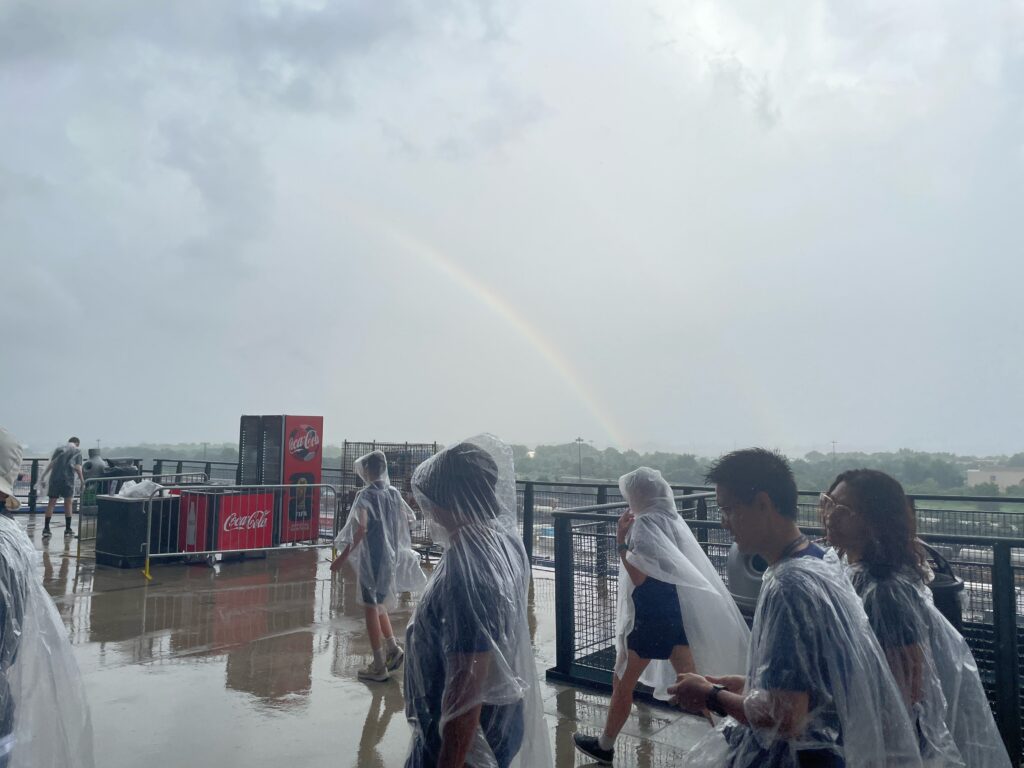
Inside Scoop: So far, rain seems to be the most logistically disruptive weather to hit the games. My colleague Jake Bolster attended the France vs. Iraq match in Philadelphia on Monday amid a downpour that deposited more than an inch of rain over a roughly two-hour delay in play. But the storm didn’t bring down the fans too much, he said.
“When the rain did eventually come, it brought thunder and lightning with it, forcing the sold-out crowd into the bowls of the stadium,” Jake told me. “You wouldn’t have known anything other than a party was happening in there. During the prolonged halftime break, Iraq fans gathered in the concourse, drums banging and chanting. People sat on the floor eating Philly cheesesteaks and fries.”
My colleague Steven Rodas visited Mexico City last week to attend the Colombia vs. Uzbekistan match and a few watch parties, which are ubiquitous in bars, parks and restaurants across the 16 host cities in Canada, Mexico and the U.S. He said temperatures that hovered around the mid-70s made for nice conditions at the open-air stadium last Wednesday. But concentrated rainfall two days later pummeled the city.
“Low-lying areas around Mexico City became small—some large—pools of water that cars navigated around or plowed right through,” he told me. “It was hazardous—and downright dangerous for any toddlers out with parents.”
World Cup organizers, players and fans have been forced to reckon with the event’s climate vulnerability in recent decades. The 2022 World Cup in Qatar was hosted five months later than usual to avoid punishingly hot summer conditions. Organizers also implemented an array of cooling interventions, such as air conditioning and shaded areas.
Some players from countries with consistently warm climates may have a slight advantage in the heat because their bodies are more acclimatized to it, though European teams have started using special technology to train in balmy conditions to prepare, as ESPN reports. But no amount of training can help players avoid the effects of heat once certain temperatures and humidity levels are reached, experts say.
In December, FIFA announced that matches will include three-minute “hydration breaks” midway through each half to help combat the heat. The new rule applies regardless of temperatures or whether stadiums are equipped with air conditioning, which has drawn ire from critics who say the breaks mess with the flow of the game.
Others told the BBC that they believe the breaks are primarily a financial tool to promote extra TV advertising, with a single 30-second ad slot estimated to cost at least $200,000. Fans at several games have booed during water breaks, though Steven told me that some spectators at the game he attended took that time to hydrate themselves and refuel with snacks.
And HEATED’s Emily Atkin recently wrote that “even if FIFA is exploiting the climate rationale for ad money, the climate rationale still exists. The world is getting hotter, and it is threatening the safety of World Cup players and spectators.”
The World Cup itself is contributing to this risk. A June assessment published by global carbon accounting platform Greenly estimates the event could generate 7.8 million metric tons of carbon dioxide, which is equivalent to the yearly emissions of 1.7 million cars. That’s largely due to the widespread air and car travel associated with the event.
On the upside, this travel boosts local economies in host cities and introduces people around the world to new cultures—and new foods, which has been providing endless entertainment for me on social media.
Jonathan Casper, who studies the environmental impact of sports at North Carolina State University, said in a statement that this type of global event can “expose fans to sustainable behaviors in ways that feel normal, social and practical,” such as encouraging the use of public transit. In Philadelphia, the city’s bike-share program reported that June 19—the day Brazil’s team took on Haiti—was the highest ridership day in the system’s history.
But Casper stressed that these sustainable practices will only stick if people have access to them in their daily lives.
“Composting at a stadium does not carry over if composting is not available at home or work,” Casper said. “Taking transit to a match does not necessarily change habits if local transit is unreliable.”
More Top Climate News
At least 40 people drowned in France over the last week amid a heat wave sweeping across Europe, Samuel Petrequin reports for The Associated Press. Many sought relief in local waterways as the country recorded its hottest average day ever at 85.6 degrees Fahrenheit on Tuesday, with some areas topping 100 degrees. Other countries, including the United Kingdom and Spain, are also sweltering, and officials are warning of possible school closures and major transit delays due to heat. It’s the second major heat wave of the summer so far. I covered the last spell in May, if you want to learn more.
A contingent of former federal workers relaunched a climate-science website that the Trump administration took down last year, Quinn Glabicki reports for The New York Times. The site hosts data, reports, articles and congressionally mandated national climate assessments that were once available at Climate.gov, managed by the National Oceanic and Atmospheric Administration. The newly relaunched public website is the latest in a series of efforts to restore science shuttered by the Trump administration. The managing director of the new climate.us was part of mass layoffs at NOAA, and her team has been working on the site for months. NOAA told The Times that research “products previously housed under Climate.gov will be available at NOAA.gov and its affiliate websites.”
On Tuesday, the head of the United Nations called on AI companies to publicly disclose the full environmental footprint of data centers and stressed these operations should use only renewable energy by 2030, Susanna Twidale reports for Reuters. The rise in AI technologies around the world has fueled a surge in demand for these data centers, which use massive amounts of water and energy. U.N. Secretary-General António Guterres stressed during an address at London Climate Action Week that these companies must increase transparency about their environmental impacts.
“If AI is to help build a better future, it must be honest about what it costs us now,” Guterres said.
About This Story
Perhaps you noticed: This story, like all the news we publish, is free to read. That’s because Inside Climate News is a 501c3 nonprofit organization. We do not charge a subscription fee, lock our news behind a paywall, or clutter our website with ads. We make our news on climate and the environment freely available to you and anyone who wants it.
That’s not all. We also share our news for free with scores of other media organizations around the country. Many of them can’t afford to do environmental journalism of their own. We’ve built bureaus from coast to coast to report local stories, collaborate with local newsrooms and co-publish articles so that this vital work is shared as widely as possible.
Two of us launched ICN in 2007. Six years later we earned a Pulitzer Prize for National Reporting, and now we run the oldest and largest dedicated climate newsroom in the nation. We tell the story in all its complexity. We hold polluters accountable. We expose environmental injustice. We debunk misinformation. We scrutinize solutions and inspire action.
Donations from readers like you fund every aspect of what we do. If you don’t already, will you support our ongoing work, our reporting on the biggest crisis facing our planet, and help us reach even more readers in more places?
Please take a moment to make a tax-deductible donation. Every one of them makes a difference.
Thank you,

Kiley Price
Reporter
Kiley Price is a reporter at Inside Climate News, with a particular interest in wildlife, ocean health, food systems and climate change. She writes ICN’s “Today’s Climate” newsletter, which covers the most pressing environmental news each week.
She earned her master’s degree in science journalism at New York University, and her bachelor’s degree in biology at Wake Forest University. Her work has appeared in National Geographic, Time, Scientific American and more. She is a former Pulitzer Reporting Fellow, during which she spent a month in Thailand covering the intersection between Buddhism and the country’s environmental movement.