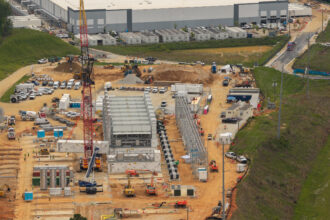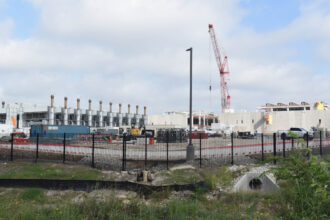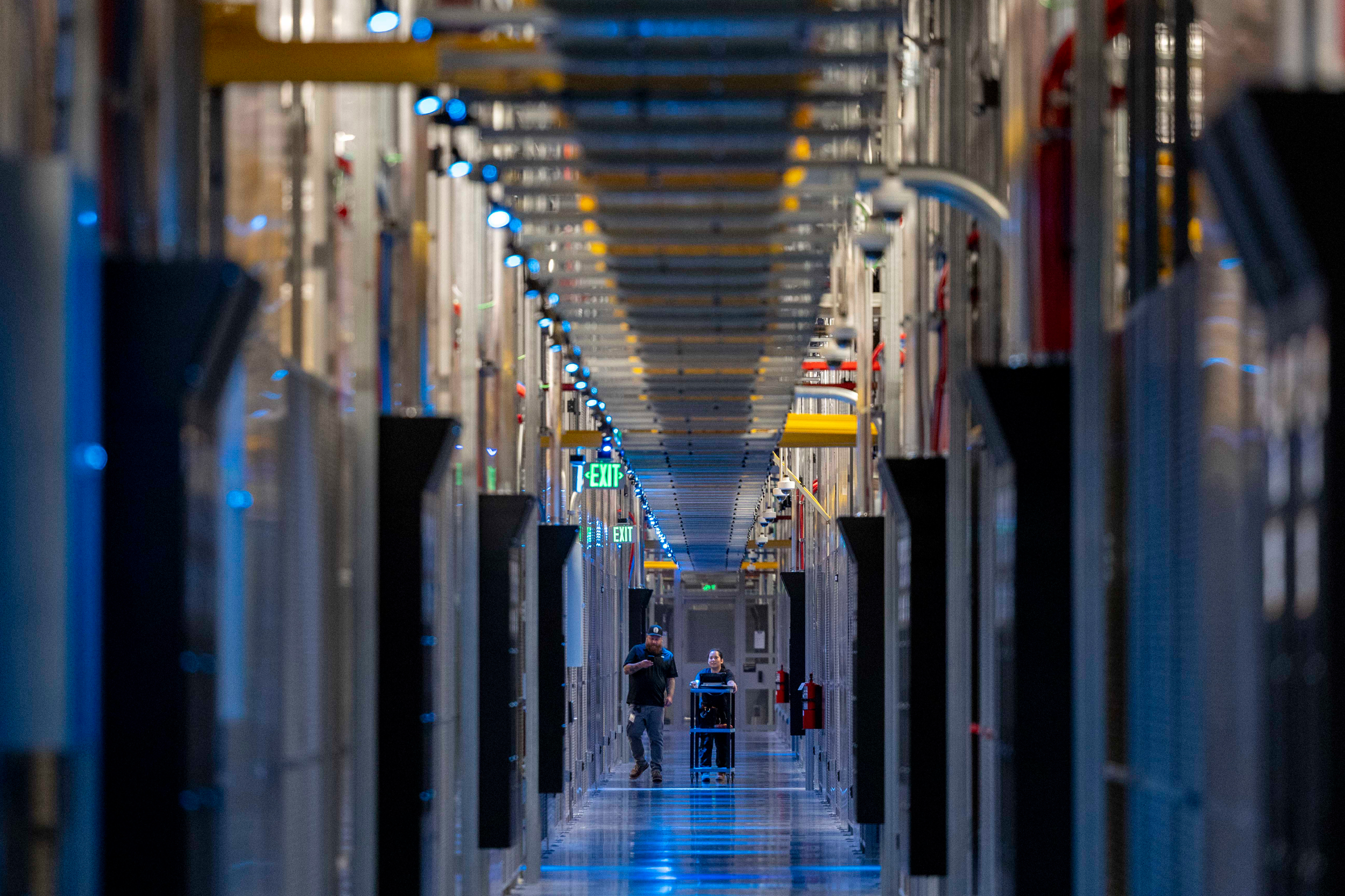


In central and eastern Washington, cheap electricity from the Bonneville Power Administration and its network of dams has long been attractive to the companies behind data centers, like Microsoft and Amazon, both headquartered in the state. But now, as hyperscale data centers spread across the country, concerns are growing about the impact that these operations—sometimes consuming as much power as an entire city—are having on communities of color.
In Washington state, new research finds that data centers are disproportionately located in census tracts with high proportions of people of color. The study, published on Wednesday by the nonprofit Front and Centered, is the first of its kind to comprehensively examine the relationship between data centers and nearby communities in Washington. In addition to policy recommendations, the report suggests a moratorium on hyperscale data center development in the state.
“Under the current circumstances, this is not a responsible way to develop anything, let alone data centers,” said Jamie Hearn, policy counsel with Front and Centered. Data centers can bring with them a myriad of environmental risks, including air pollution from backup diesel generators, soil pollution from electronic waste and high levels of water and electricity usage, which Front and Centered fears are straining communities burdened by existing stressors.
Washington ranks 10th in the nation for its number of operating and planned data centers. To understand how existing data centers overlap with vulnerable populations, Front and Centered combined known data center locations with the state’s own Environmental Health Disparities map. This map joins environmental risks, such as pesticide levels and poor water quality, with census tract information, like race and poverty, to create cumulative health scores.
Nearly half of the 81 data centers studied were located in census tracts with cumulative health scores of 7 or above, which indicates high negative health impacts. Over half of the data centers included in the study are located in census tracts with the highest proportions of people of color.
The Data Center Coalition, a trade group representing the industry, did not respond to a request for comment. On its website, the coalition argues that data centers are “vital economic engines for local communities” that create jobs and act as “catalysts for broader economic growth.”
The racial and health discrepancies uncovered in the study are made harder to track by the disjointed permitting and approval processes for data centers under state law. “It’s happening in this really piecemeal way,” Hearn said. “It’s kind of hard to connect the dots.”
Regulatory frameworks for data centers in Washington state are decentralized, subject to local zoning and building codes in addition to state oversight on water, energy and air quality. This makes it difficult for advocacy organizations and communities to monitor data center development.
Since there is no official list of data centers in Washington state, Front and Centered created its own using a hodge-podge of resources. The report also includes a lengthy survey of public health, affordability and grid capacity concerns pertinent to environmental justice communities across the state.
As data centers drive up electric costs across the country, study participants are worried that Washingtonians will not be able to cope.
“ Many families are already struggling and having to make [the] impossible choice between paying for their electricity, versus buying groceries, versus covering rent, or meeting other essential needs. That’s why conversations about data centers matter,” said Sibongile Chadyiwa, program manager at the Washington state nonprofit Immigrant Guide, in a public briefing on Wednesday. Immigrant Guide was one of nearly 30 organizations interviewed as part of the study.
“I’m not opposed to technology or innovation—Washington benefits from both. But growth should never come at [the] expense of families who are already struggling to make ends meet,” Chadyiwa said.
“Perhaps not since the expansion of airplane and automobile manufacturing have we seen an industry so rapidly grow.”
— Washington State Department of Ecology
In an earlier statement to Inside Climate News about Pennsylvania’s data-center boom, Dan Diorio of the Data Center Coalition said, “The industry is committed to paying its full cost for the energy it uses.”
Currently, data centers consume 6 percent of the state’s total energy. Advocates worry that rushed development will compound environmental and social vulnerabilities in surrounding communities. Many hyperscale data centers, for example, are located in drought-stricken eastern and central Washington. In Grant County, 45 percent of the population is Hispanic, and 37 percent of the county’s energy goes toward data centers. The county is also expanding transmission capacity, as local hydropower can no longer accommodate energy demand. Locals say they are losing their land over the expansion.
“Perhaps not since the expansion of airplane and automobile manufacturing have we seen an industry so rapidly grow and require the amount of land needed to establish operations,” the Washington State Department of Ecology said in a written statement to Inside Climate News. “Unchecked, that kind of expansion can have serious consequences for communities, which is exactly why agencies like Ecology work proactively to create a baseline of protective measures before new industries even emerge.”
But advocates say the state lacks the protective measures needed to stave off the negative impacts frontline communities may experience as data centers expand. That’s why Hearn said the new report suggests a moratorium on hyperscale data center development in the state, a move that is becoming more widespread. Several city councils in the state, including Spokane and Seattle, have passed year-long moratoria on new data centers. The state of New York imposed a one-year ban on large-scale data center development earlier this month.
“It feels important in this moment to, at the bare minimum, take a pause so that we can really understand what the long-term impact of these types of infrastructure is,” Hearn said.
About This Story
Perhaps you noticed: This story, like all the news we publish, is free to read. That’s because Inside Climate News is a 501c3 nonprofit organization. We do not charge a subscription fee, lock our news behind a paywall, or clutter our website with ads. We make our news on climate and the environment freely available to you and anyone who wants it.
That’s not all. We also share our news for free with scores of other media organizations around the country. Many of them can’t afford to do environmental journalism of their own. We’ve built bureaus from coast to coast to report local stories, collaborate with local newsrooms and co-publish articles so that this vital work is shared as widely as possible.
Two of us launched ICN in 2007. Six years later we earned a Pulitzer Prize for National Reporting, and now we run the oldest and largest dedicated climate newsroom in the nation. We tell the story in all its complexity. We hold polluters accountable. We expose environmental injustice. We debunk misinformation. We scrutinize solutions and inspire action.
Donations from readers like you fund every aspect of what we do. If you don’t already, will you support our ongoing work, our reporting on the biggest crisis facing our planet, and help us reach even more readers in more places?
Please take a moment to make a tax-deductible donation. Every one of them makes a difference.
Thank you,

Claire Barber
Fellow
Claire Barber is a fellow at Inside Climate News and a master’s in journalism student at Stanford University. She is an environmental and outdoor journalist, reporting primarily in the American Southwest and the West. Her writing has appeared in The San Francisco Chronicle, Outside, Powder Magazine, Field & Stream, Trails Magazine and more. She loves to get lost in the woods looking for a hot spring, backpacking to secluded campsites and banana slugs.