

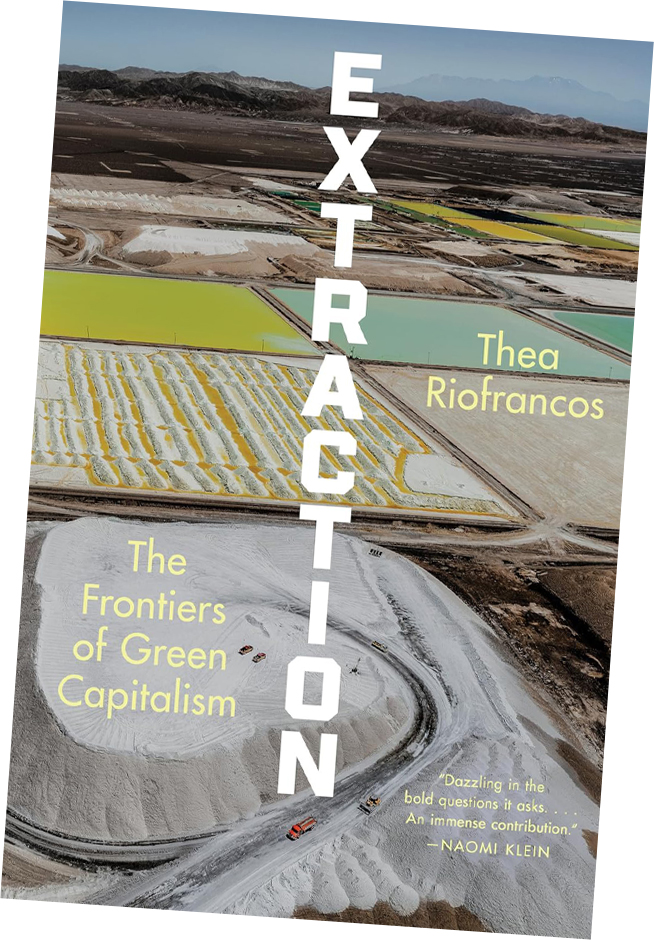
From our collaborating partner Living on Earth, public radio’s environmental news magazine, an interview by Paloma Beltran with Thea Riofrancos, the author of “Extraction: The Frontiers of Green Capitalism.”
Electric vehicle sales are skyrocketing. In 2025, more than one in five new cars sold globally were electric.
But while electrifying transportation is essential to addressing the climate crisis, the mining required to build out these green technologies brings its own environmental and social costs. The batteries that power electric cars are typically made of metals like nickel, copper and lithium. The intensive extraction of these critical minerals from the earth has left numerous ecosystems and communities with polluted land, water and air.
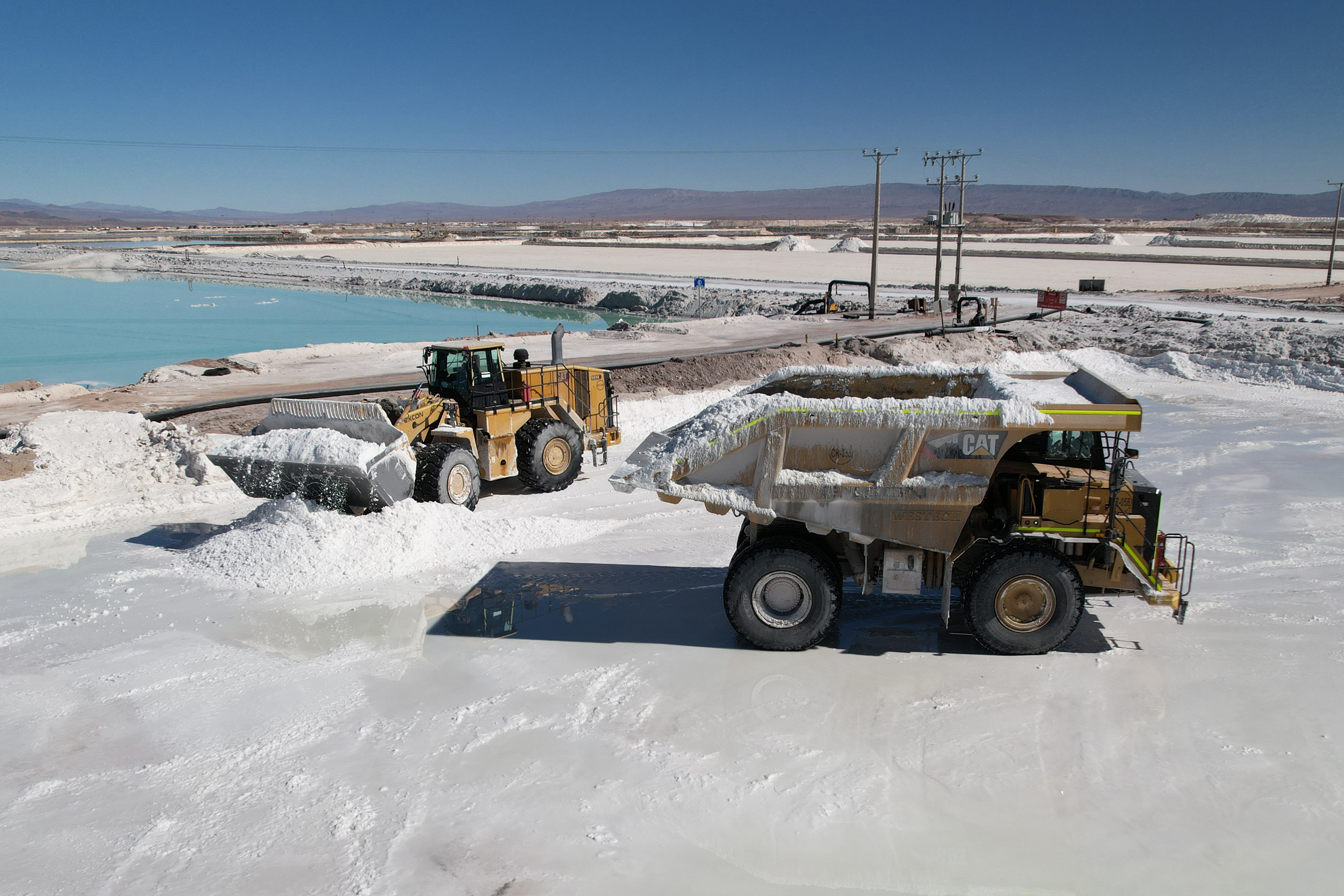
To understand these impacts, author and political scientist Thea Riofrancos traveled to the Atacama Desert in Chile, home to one of the largest lithium reserves in the world. She is an author and associate professor of political science at Providence College. Her latest book is “Extraction: The Frontiers of Green Capitalism.”
PALOMA BELTRAN: “Extraction” opens in Salar de Atacama, the largest salt flats in Chile, and one of the driest areas in the world. It barely sees one millimeter of rainfall in an entire year. How does it feel to visit such a place?
THEA RIOFRANCOS: In the northern desert of Chile, the Salar de Atacama is the salt flat, and the Atacama Desert is the broader region. The reason I went there is because that’s where about a fifth of global lithium supplies come from. What I wanted to understand is, what is the local impact of this? What does the landscape look like? How do the communities interface with this?
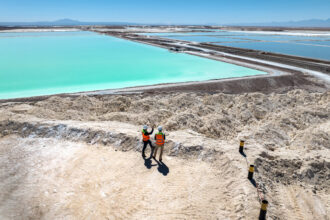
What I discovered was a place that was, at the same time, impacted by extraction and yet full of life and vibrancy and community. And that salt flat is just amazing. First of all, it is enormous—it is two-thirds of the size of the state of Rhode Island. And it’s surrounded by beautiful, towering Andean mountains. And then on the salt flat itself is kind of a strange environment to someone who hasn’t been to one before. It’s very crusted with salt, and there are these surface lagoons, and you’re at a high altitude and the sun is really intense. But at the same time, there are flamingos living there. And you know, just 20, 30, 40, miles away are where the mines are, on the same salt flat. So, so much comes together in this place that I think gives us just a different perspective on what it means to organize an energy transition and develop these green technologies.

BELTRAN: As you write, it may seem like these salt flats are a vast expanse of nothingness, but they actually house a lot of ecological richness and cultural significance.
RIOFRANCOS: There’s a very common trope that dates to colonialism that the landscapes of extraction are empty. From the colonial period to the present, people searching for those resources have said, well, it doesn’t matter. Nobody lives here. There’s no important communities or life. All there is is the resources, the copper, the oil, the lithium, whatever is of interest.
That is very rarely to never the case, and this is a very good example of that. There are these amazing endemic species, including the Andean flamingo—this light pastel pink, beautiful bird that touches down on the salt flat during its migratory patterns and eats different snacks from the lagoon.
Around the salt flat, where we begin to have lusher vegetation and also fresh water supplies underground, that’s where we have human communities that have developed really amazing forms of agriculture using ancestral Indigenous knowledge developed over thousands of years. In many ways, it’s a testament to the resilience of life, because it’s not just the driest desert on Earth and the oldest desert on Earth, it’s also very high altitude, very big ranges of temperature, hot during the day, freezing at night. It’s an area in which we can think life has difficulty surviving. But as the saying goes, life always finds a way, and what’s amazing is how life persists and flourishes even under conditions of duress.
BELTRAN: What exactly is lithium, and why does it hold so much global significance?
RIOFRANCOS: I like to call lithium the MVP, like the most valuable player of the energy transition. And there are two main purposes that lithium serves. But all of it relates to lithium batteries. Lithium batteries are the same batteries that we have in our laptops, our cell phones. A similar type of lithium battery is also in electric vehicles, which we know we need to decarbonize our transportation system. It’s worth noting that transportation is the number one source of U.S. carbon emissions, so we definitely need to draw down emissions in that sector.
The number two source of U.S. carbon emissions is the energy sector, the electric grid. Lithium batteries are now playing a huge role in U.S. energy grids to stabilize renewable energy so that there’s always supply when there’s demand. If we had to choose one technology that we could say shows what the energy transition is about, the lithium battery is key to decarbonizing the two largest sources of U.S. emissions.
BELTRAN: How has lithium extraction in the Atacama Salt Flats led to the exploitation of the land and the people there?
RIOFRANCOS: It’s been quite concerning, because now we’re decades into large-scale lithium mining in one of the top lithium providers to the global economy, and we see quite a bit of evidence of both ecological and social harm.
The ecological harm relates to some points that we already discussed. Those flamingos that I mentioned, their populations are decreasing in ways that are tightly correlated to the expansion of mining. All of the noise, the roads, the machinery, disrupts the habitat, scares the birds, makes it harder for them to procreate. So we have impacts on biodiversity.
We also have impacts on water, and this gets a little bit tricky, because in the center of the salt flat, the water is salt water. That’s not the water that humans drink. However, when we go to the edge of the salt flat, there is fresh water. What the scientific evidence is showing is that sucking out all the salt water makes the fresh water harder to access by drawing it toward the middle of the salt flat, away from the human communities that live around the salt flat.
Then, until very recently, there had never been a real consultation of the Indigenous people that live there. The first time that such a consultation happened was this past year under the current government, a progressive government. But prior to that, there had never been a consultation about any of this mining, and so communities were left to either protest or just fend for themselves amid all of these major environmental changes that impact their households and livelihoods.
BELTRAN: Who’s benefiting from the lithium extraction in Chile? Who are the main players?
RIOFRANCOS: It’s a really interesting question, because there are mining companies, and I’ll get into that in a moment. But there is this broader question that I think all of us climate advocates have to grapple with, which is, what are the costs and benefits of the energy transition? Is there a way that we, writ large, global humanity, are all benefiting from Chilean lithium? If so, is it fair that Chile has so much environmental burden as a result of that?
There are some big questions to ask, but more directed to this issue of the corporations. Right now, there are two major companies extracting lithium in Chile, SQM and Albemarle. SQM is a Chile-based multinational shareholder firm, and Albemarle is a U.S.-based multinational shareholder-owned firm. Both of them operate in other contexts—they have lithium assets elsewhere—but Chile is a really important part of their portfolio, and they have certainly benefited. They’ve gotten long-term contracts through Chilean lithium, have become key players in the global electric vehicle supply chain. They have, at various points that my book gets into, influenced the government, past governments, sometimes been able to water down regulations, and so they have managed the situation to their benefit.
But I do want to say civil society exists, communities exist and progressive policy makers also exist. And so these companies do not operate in a vacuum. It is a contested terrain in which different voices and viewpoints are battling to figure out what is the best way to govern lithium in Chile and govern these critical minerals in general.
BELTRAN: Throughout your book, you give us a few examples of pushback from local communities to mining projects. What role have local communities played in mitigating the exploitation that often comes with extraction?
RIOFRANCOS: I’m of the belief that one of the best ways to trigger better governance of mining is to have empowered, engaged and organized communities. It really starts that way, because communities are first of all on the ground. They know their local environment. They may have deep cultural attachments, and they tend to pick up on early signs of environmental threats as well as poor governance.
When communities are organized but also excluded, that’s when we get more intense forms of protest, sometimes, which then are met with repression or criminalization, quite unfortunately, and even people getting killed. And there’s a lot of examples of this, tragically, in the mining sector.
The other side to the coin of better governance is the government itself—what is the government doing? There’s a range of things that governments can do, from monitoring the environmental impacts to regulation to helping to channel more economic benefits to local communities.
But an even bigger type of intervention that a government can make relates to ownership. Ownership gives you leverage, it gives you power. It’s not for no reason that governments in the Global South, starting many decades ago, in some cases, soon after decolonization, we see governments taking over natural resources saying that the only way that we can have economic sovereignty over our own countries is if we have more control over these strategic resources within our territory.
Latin America really stands out as a place where a lot of those types of nationalizations have occurred. This can create different types of tensions with local communities. Sometimes local communities support nationalization. Sometimes they feel “OK, now instead of fighting a private company, we’re fighting the state.” It really comes out of a lineage of a history of foreign control of resources being replaced with more national or state control.
This story is funded by readers like you.
Our nonprofit newsroom provides award-winning climate coverage free of charge and advertising. We rely on donations from readers like you to keep going. Please donate now to support our work.
Donate NowBELTRAN: Electric vehicles are somewhat the protagonist of the lithium boom, and many people see them as a climate-conscious choice. But your book takes into account factors we don’t think about when making this decision, such as the environmental and cultural impacts of mining. What do you say to listeners who may be questioning their decision to purchase an electric vehicle?
RIOFRANCOS: The first thing I want to say is that my book is not an argument against electric mobility. It is not me saying that a gas-guzzling car is better than an electric car, which is not true. We shouldn’t lose sight of the fact that 14 million barrels of oil a day are extracted just for U.S. transportation alone. We live in an extractive economy already. It’s just that the extraction is for fuel that is burned and creates the climate crisis, versus the extraction being more about mining and the physical building out of a new energy system. It’s urgent, I should say, to leave the oil and gas and coal in the ground.
That said, the environmental harm that comes from lithium mining for electric vehicles is exacerbated by the fact that our imagination of the energy transition is very car-dependent. The imaginary is, every household is going to swap in their traditional car for an electric car, and that’s how we’re solving the climate crisis. That’s a huge amount of mining.
If, in contrast, we think about other forms of mobility—what if we think about electric buses? What if we think about creating and designing cities in which distances are shorter, people can walk places? And the more that we can embrace a varied toolkit, the more progress we’ll make on climate action, and honestly, the more equitable we will be. Because we’re in a cost-of-living crisis right now, the idea that a working class or even middle class person is about to shell out tens of thousands of dollars for a new vehicle when their current vehicle works OK, that’s a big proposition. That’s a big investment for struggling American households. We’re just very hemmed in by the assumption that everything has to be about driving in the U.S., and that’s not serving us financially, in terms of the climate crisis, or in terms of the environmental impacts of these supply chains.
BELTRAN: Where are we right now in regard to the energy transition and what’s the current status of our progress?
RIOFRANCOS: It’s such a hard moment to answer that, because in some ways we are, in a devastating sense, not only falling behind where we need to be, but undoing progress we’ve already made. We see that with the current Trump government, with the Republicans in Congress. But what I like to reference when I think about this is that the U.S. isn’t the world. There are other powers out there. You know, China is economically ascendant. Europe is another important set of economic and political powers. There’s Global South countries that are rising up from Brazil to South Africa, so-called emerging economies. Last year in Nepal, like 75 percent of its vehicles were electric in terms of the car sales. Solar panels are blanketing every rooftop in Pakistan. You go to Brazil, you go to Mexico, there are conversations about how can we get this green industry here?
So it’s not the case that all these countries are following the U.S. footsteps in terms of returning to or regressing to more fossil fuels. I don’t even think, honestly, that the changes that Trump is implementing are permanent. We still see major growth in solar despite what Trump is doing, because the economics actually cash out very well.
All of this together, it’s a complex and contradictory picture. We are still extracting more and more fossil fuels. Emissions are still going up, the temperature scenarios are concerning. On the other hand, we are also globally making faster progress toward decarbonization of certain sectors than we would have predicted a decade ago. So that’s how I would frame it. It’s a hard balance to add up, but the complexity, I think, is better than the sense that we are moving backwards globally. That is not the case.
BELTRAN: What do you envision a just energy transition to look like? What do you hope for in the future?
RIOFRANCOS: There’s so much that an energy transition could offer to communities around the world. The question is, what is the long-term vision? Are we moving holistically, where we’re thinking about both the need to have an energy transition, but also the need to reduce the environmental impacts of that transition? Can we chew gum and walk at the same time, and think both about building the better future without replicating the harms of the past? Can we think of the energy transition as an opening for more equity in our global economy and political system? Is this a moment where finally, Global South countries that have had the ambition to develop and be more sovereign in their politics can have that chance? Does this provide a set of economic development opportunities for the Global South?
There’s a lot of potential there. I think what’s tragic is that the world right now is just so conflictual and chaotic that leaders are focused on attacking one another and dismantling global rules and global governance, rather than moving forward in a multilateral, collaborative way. But that opportunity still exists. I see that when I see local communities in the U.S. that desire these changes, when I see social movements and climate activists that are fighting for this, when I go to Latin America and there’s a lot of enthusiasm about what green development could mean. I think it’s important to hold on to that hope so that we can move politics in that direction.
About This Story
Perhaps you noticed: This story, like all the news we publish, is free to read. That’s because Inside Climate News is a 501c3 nonprofit organization. We do not charge a subscription fee, lock our news behind a paywall, or clutter our website with ads. We make our news on climate and the environment freely available to you and anyone who wants it.
That’s not all. We also share our news for free with scores of other media organizations around the country. Many of them can’t afford to do environmental journalism of their own. We’ve built bureaus from coast to coast to report local stories, collaborate with local newsrooms and co-publish articles so that this vital work is shared as widely as possible.
Two of us launched ICN in 2007. Six years later we earned a Pulitzer Prize for National Reporting, and now we run the oldest and largest dedicated climate newsroom in the nation. We tell the story in all its complexity. We hold polluters accountable. We expose environmental injustice. We debunk misinformation. We scrutinize solutions and inspire action.
Donations from readers like you fund every aspect of what we do. If you don’t already, will you support our ongoing work, our reporting on the biggest crisis facing our planet, and help us reach even more readers in more places?
Please take a moment to make a tax-deductible donation. Every one of them makes a difference.
Thank you,