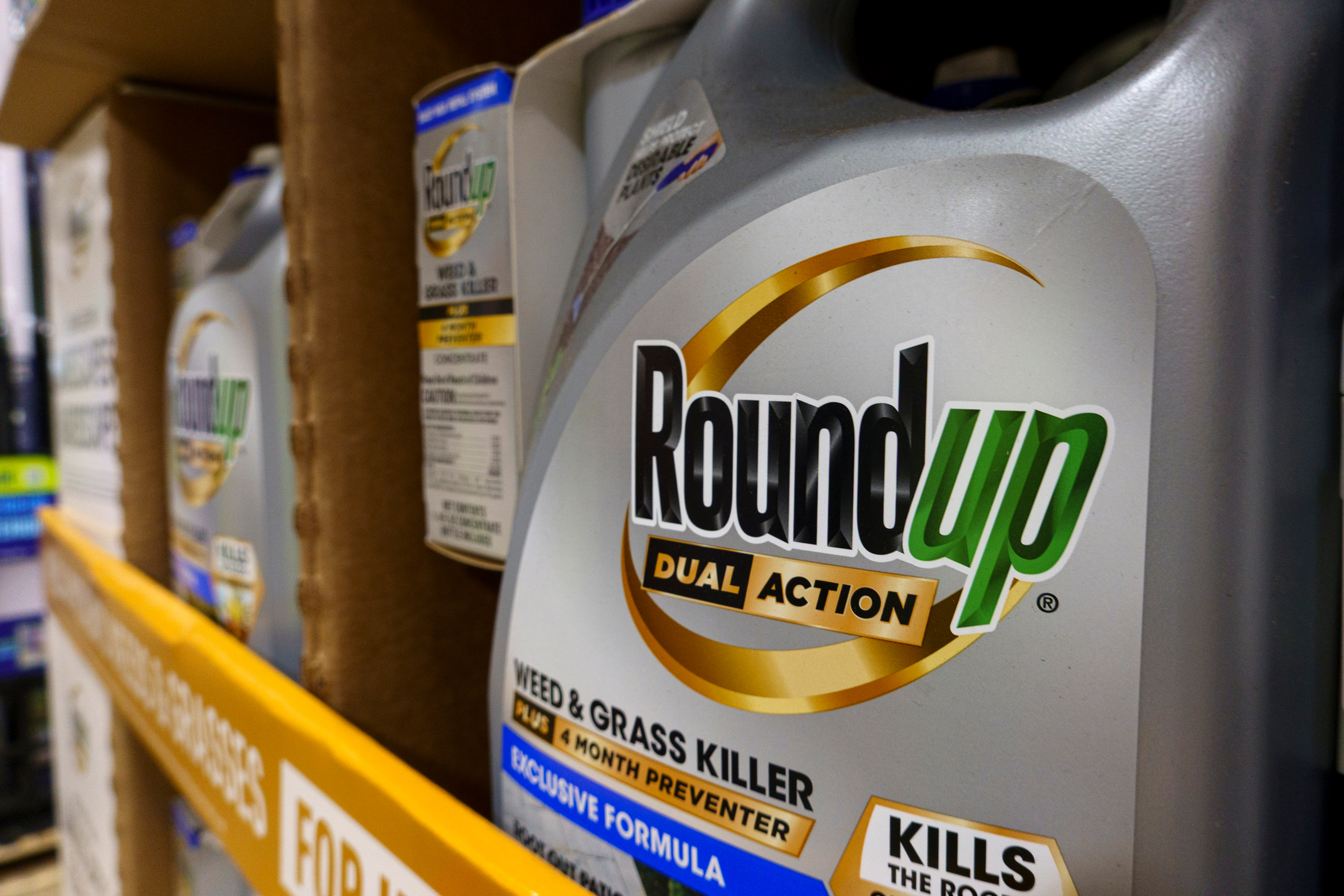


John Durnell just wanted to make things around his St. Louis neighborhood look a little nicer. So, on occasion, he’d spray a bit of Roundup in the obvious places—along weedy sidewalks and in public spaces he thought needed a little extra attention.
Decades later, after multiple rounds of chemotherapy, Durnell is recovering from blood cancer that a Missouri jury found in 2023 was caused by his exposure to Roundup, an herbicide manufactured by Monsanto. The jury ordered the company to pay Durnell $1.25 million in damages.
On Monday, the U.S. Supreme Court heard Monsanto’s appeal of Durnell’s victory against the company, a case that is poised to decide the fate of hundreds of similar lawsuits across the country.
Researchers have linked glyphosate, the active ingredient in many Roundup products, to a wide range of harmful effects in pollinators, lab animals and people. In 2023, one study linked Roundup to liver and metabolic disease in children. The World Health Organization has labeled the chemical, the world’s most commonly used herbicide, as “probably carcinogenic to humans.”
During Monday’s argument, the justices appeared friendly to Monsanto’s argument that states like Missouri are prohibited by federal law from allowing lawsuits against the company for failure to warn consumers about the possible risks of cancer.
Paul Clement, a well-respected appellate lawyer, represented Monsanto in the case, arguing that allowing state suits for failure-to-warn claims would impose “crippling liability” for companies like Monsanto. A federal law known as the Federal Insecticide, Fungicide, and Rodenticide Act (FIFRA), exclusively governs herbicide and pesticide labeling, not states, Clement argued.
Departing from the federal government’s previous position under the Biden Administration, a lawyer representing the Trump administration backed Monsanto’s position in court, asking the justices to limit citizens’ ability to bring state law tort claims against chemical manufacturers like Monsanto.
Both Clement and Sarah Harris, the deputy solicitor general who participated in Monday’s oral arguments, told justices that the EPA and the federal government, not states, have the final say over pesticide and herbicide labeling. Lawsuits resulting from claims made under state laws that usurp federal law, then, are invalid, they argued.
At one point, Chief Justice John Roberts seemed concerned about the scope of Clement’s arguments, which Roberts suggested may leave states without any unilateral ability to regulate what could be harmful chemicals.
“The states cannot do anything?” Roberts asked Clement.
Clement conceded that while he believes states cannot legally require cancer-warning labeling, they may be able to ban a pesticide altogether.
Justice Neil Gorsuch, a Trump nominee, said that outcome seemed absurd. States can’t require warning labels but can ban a product altogether, he asked?
That’s the current state of the law, Clement suggested.
Despite the back and forth, most justices seemed largely comfortable with Clement’s argument that federal law supersedes states’ ability to require additional labeling, particularly when the Environmental Protection Agency has determined that such labeling is not necessary.
The EPA has long deemed glyphosate a safe herbicide and has not required manufacturers to warn consumers about potential health risks.
But Ashley Keller, who represented Durnell at Monday’s hearing in Washington, D.C., told justices that states’ hands should not be tied behind their backs simply because of the EPA’s determination that glyphosate is safe.
“Things slip through the cracks with that agency,” he said.
This story is funded by readers like you.
Our nonprofit newsroom provides award-winning climate coverage free of charge and advertising. We rely on donations from readers like you to keep going. Please donate now to support our work.
Donate NowJ.W. Glass, senior EPA policy specialist at the Center for Biological Diversity, said he hoped the justices do not fall for the notion that the EPA’s regulatory program is robust enough to protect Americans when the evidence suggests the opposite.
“Any honest assessment of the [EPA] pesticide office’s track record can only conclude that it has failed catastrophically at assessing the health risks of dangerous pesticides,” Glass said. “Considering the EPA has declined to require cancer labels on 99 percent of the pesticide products that contain chemicals the agency itself has found to be probable carcinogens, why would anyone believe that Americans’ health is being looked out for by the EPA or the pesticide industry?”
As recently as this year, public health experts have called on regulators to address glyphosate’s impact on human health.
“The evidence that glyphosate and GBHs [glyphosate‐based herbicides] harm human health at levels of current use is now so strong that no additional delays in regulation of glyphosate can be justified,” a March letter signed by 70 experts said. “Regulatory agencies in countries around the world should treat glyphosate and GBHs as hazardous, as some countries have started to do. Agencies should act without further delay to limit their use, or eliminate them if legally required, to protect public health.”
Tarah Heinzen, legal director at the nonprofit Food & Water Legal Watch, said that the justice’s decision in the case will have serious impacts from coast to coast. A recent Food & Water Watch analysis linked high glyphosate use with elevated rates of non-Hodgkin lymphoma cancer in the U.S.
“Bayer is intent on preserving its right to harm at all costs—a pursuit the Trump administration is all too willing to endorse,” Heinzen said. “This case threatens to close the courthouse doors to the many Americans harmed by pesticides. Should the Supreme Court hold that the Environmental Protection Agency’s failed pesticide regulatory scheme preempts state failure to warn lawsuits, leaving tens of thousands of sick Americans without legal recourse, Trump and his industry-dominated EPA will be to blame.”
A Supreme Court win would be a financial windfall for Bayer, which has already spent nearly $11 billion settling claims over glyphosate exposure.
The company has already gained ground under the Trump Administration, securing an executive order in February that categorizes the production of glyphosate as in the national security interest.
About This Story
Perhaps you noticed: This story, like all the news we publish, is free to read. That’s because Inside Climate News is a 501c3 nonprofit organization. We do not charge a subscription fee, lock our news behind a paywall, or clutter our website with ads. We make our news on climate and the environment freely available to you and anyone who wants it.
That’s not all. We also share our news for free with scores of other media organizations around the country. Many of them can’t afford to do environmental journalism of their own. We’ve built bureaus from coast to coast to report local stories, collaborate with local newsrooms and co-publish articles so that this vital work is shared as widely as possible.
Two of us launched ICN in 2007. Six years later we earned a Pulitzer Prize for National Reporting, and now we run the oldest and largest dedicated climate newsroom in the nation. We tell the story in all its complexity. We hold polluters accountable. We expose environmental injustice. We debunk misinformation. We scrutinize solutions and inspire action.
Donations from readers like you fund every aspect of what we do. If you don’t already, will you support our ongoing work, our reporting on the biggest crisis facing our planet, and help us reach even more readers in more places?
Please take a moment to make a tax-deductible donation. Every one of them makes a difference.
Thank you,

Lee Hedgepeth
Reporter, Alabama
Lee Hedgepeth is Inside Climate News’ Alabama reporter. Raised in Grand Bay, Alabama, a small town on the Gulf Coast, Lee holds master’s degrees in community journalism and political development from the University of Alabama and Tulane University. Lee is the founder of Tread, a newsletter of Southern journalism, and has also worked for news outlets across Alabama, including CBS 42, Alabama Political Reporter and the Anniston Star. His reporting has focused on issues impacting members of marginalized groups, including homelessness, poverty, and the death penalty. His award-winning journalism has appeared in publications across the country and has been cited by the New York Times, the Wall Street Journal and the Washington Post, among others.