By John Ivanko
On a trip to Santa Monica, Calif., a friend treated my family to an amazing – if not also disturbing and mind-opening – display of crocheted sculptures created from trash.
The exhibit, Hyperbolic Crochet Coral Reefs, is sponsored by the Institute For Figuring (IFF), an organization dedicated to the poetic and aesthetic dimensions of science, mathematics and the technical arts.
It is a stunning display of an ingenious use of waste materials, creativity and community that draws attention to the plight of our oceans – and the depository for our trash that they have become. As the IFF explains:
- Worldwide, 3,000 square kilometers of living reef are lost each year, a percentage rate attrition that is five times faster than rainforests are disappearing.
- Of the 100 million tons of plastic produced annually, it is estimated that 10 percent ends up in the oceans.
- Each year, 1,000,000 sea birds and 100,000 marine mammals die of plastic ingestion.
- The United National Environmental Program estimates that the Great Pacific Garbage Patch has about 46,000 floating pieces of plastic per square mile of ocean, constituting six pounds of plastic for every pound of living phytoplankton.

A mathematician, Daina Taimina, presented a hyperbolic structure made with crochet to demonstrate a surface with a negative curvature that set the stage for this exhibit. As it turns out, corals, kelps, sea slugs, sponges, nudibranchs and flatworms all exhibit hyperbolic anatomical features.
The diversity of crocheted pieces in the Reef Coral Exhibit, now on display in Scottsdale, Ariz., is astounding. There are jellyfish type artwork in cases, wall-hanging pieces and elaborate floor displays with intricately crocheted artwork that brought back memories of my time snorkeling in the Great Barrier Reef.
“The Blue Reef” was created entirely of New York Times plastic bags. Other pieces inventively used a mish-mash of waste that one might find, over time, washed up on the shores.
Artists Trevor and Ryan Oakes created a hyperbolic pseudosphere woven out of pipe-cleaners. Arlene Mintzer’s black plastic jelly-yarn corals were made from synthetic hair-ornaments, plastic "rubber bands" and pieces of New York subway pass cards.
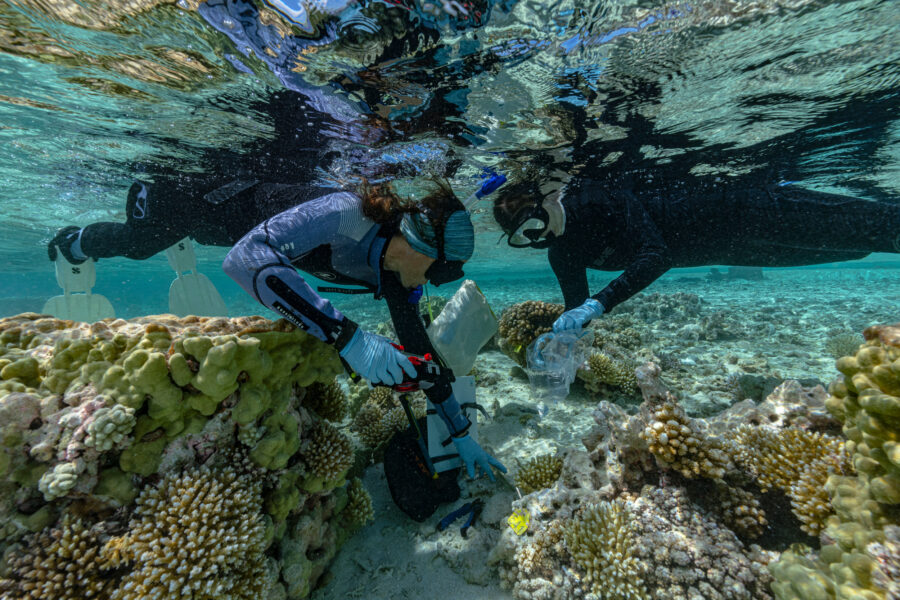
Among the natural world’s greatest wonders, the Great Barrier Reef along the coast of Queensland, Australia, is now threatened by both global warming and pollution. The Coral Reef exhibit powerfully depicts the escalating problem of plastic trash inundating the oceans and choking marine life.
“All over the world coral reefs are dying out,” the IFF explains. “Marine pollutants, agricultural run-off and, above all, global warming, are taking a toll on these fragile marvels of nature. The Great Barrier Reef, the world’s largest living organism, has already suffered coral die-off in almost one third of its 133,000 square miles.
"Of all the carbon dioxide spewing into the atmosphere, around 30 percent will ultimately be absorbed by the oceans. This excess carbon dioxide increases ocean acidity, with dire consequences for corals."
Another interesting feat of the exhibition is the sense of collaboration and community. Many of the artwork pieces were created by numerous artists collaborating across the continent and around the world, like the “The People’s Reef”, a melding of Chicago Reef and New York Reef contributors. The Chicago Reef was originally created in 2007 under the auspices of the Jane Addams Hull-House Museum and the Chicago Humanities Festival. The New York Reef was created in 2008 under the auspices of the New York Institute of the Humanities, New York Crochet Guild and the Harlem Knitting Circle.
“By highlighting plastic waste and recycling it into an ‘art work’ we hope we can help focus attention on the tsunami of plastic that is engulfing our oceans and strangling marine life,” said the reef’s creators and curators, Christine and Margaret Wertheim.
“What we hope to create here is not just an aesthetic experience but a transformation in behavior. Beginning with our own.”
Photos: John Ivanko
(Originally published at Sustainablog)
John Ivanko is a co-author of ECOpreneuring, Rural Renaissance and Edible Earth.
About This Story
Perhaps you noticed: This story, like all the news we publish, is free to read. That’s because Inside Climate News is a 501c3 nonprofit organization. We do not charge a subscription fee, lock our news behind a paywall, or clutter our website with ads. We make our news on climate and the environment freely available to you and anyone who wants it.
That’s not all. We also share our news for free with scores of other media organizations around the country. Many of them can’t afford to do environmental journalism of their own. We’ve built bureaus from coast to coast to report local stories, collaborate with local newsrooms and co-publish articles so that this vital work is shared as widely as possible.
Two of us launched ICN in 2007. Six years later we earned a Pulitzer Prize for National Reporting, and now we run the oldest and largest dedicated climate newsroom in the nation. We tell the story in all its complexity. We hold polluters accountable. We expose environmental injustice. We debunk misinformation. We scrutinize solutions and inspire action.
Donations from readers like you fund every aspect of what we do. If you don’t already, will you support our ongoing work, our reporting on the biggest crisis facing our planet, and help us reach even more readers in more places?
Please take a moment to make a tax-deductible donation. Every one of them makes a difference.
Thank you,