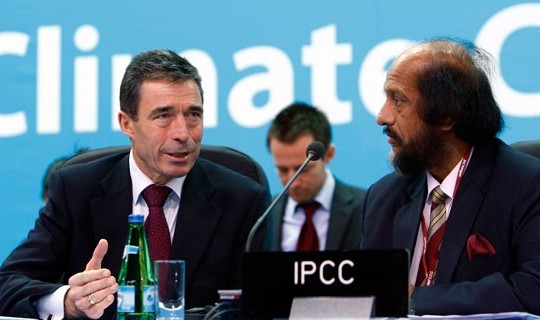


The peer review process at the heart of the UN climate science panel is one of the most rigorous in the “history of science,” climate scientists said as they attempted to shore up trust in an institution that has been battered in the media.
“It is hard to conceive of a more comprehensive and transparent process than that used by the IPCC,” Neville Nicholls, a climate scientist and lead writer on parts of the most recent report of the Intergovernmental Panel on Climate Change (IPCC), told reporters Thursday.
An error in the 3,000-page IPCC report that exaggerated the rapid melting of the Himalayan glaciers has triggered claims of sloppiness in the panel’s peer-review procedures, and the UN said today it would appoint an independent panel to review the planet’s top climate science body.
The world’s climate change skeptics have gone a step farther, though, taking advantage of the gaffe to promote their point of view that global warming is not real.
Scientists say that the calls for substantial reform of the IPCC’s expert and government peer-review process by opponents are overkill.
“Peer review can certainly be trusted,” said Paul Beggs, a climate scientist from Australia’s Macquarie University. This is particularly true of the IPCC peer review process, he said, which is “arguably the most rigorous and transparent peer review process in the history of science.”
Nicholls, a professor at Monash University in Victoria, Australia, said the IPCC 2007 Fourth Assessment report was subjected to several rigorous tiers of review. The study cites over 10,000 papers from the scientific literature, “most of which have already been through the peer-review process to get into the scientific literature.”
The report went through four separate reviews and received 90,000 comments from 2,500 reviewers, all of which are publicly available, along with the responses of the authors, Nicholls said.
Kurt Lambeck, a geophysicist at the Australian National University and president of the Australian Academy of Science, said the Himalayan blunder is one of a few that “slipped through.” The other that skeptics have seized on involved the percentage of the Netherlands that is below sea level, a number that was provided by the Dutch government itself.
Occasional errors are not surprising, said Kevin Walsh, a professor of meteorology at the University of Melbourne.
“Even rigorous peer review can let things slip through, or assess work incompletely,” Walsh said. “It’s not surprising, therefore, that in the several thousand pages of the IPCC reports, a few problems have been found with the review process.”
The fact that the error did not make it into the report summary — which contains all the findings of importance to world governments that are crafting climate regulation — should lessen the impact of it, the scientists say.
The summaries, they argue, are key.
“Every sentence in these summaries is discussed and argued about and finally agreed by consensus — not a vote — by scientists and representatives from more than 130 governments,” said Nicholls. “Many of these government representatives are also scientists.”
Steven Sherwood, an atmospheric physicist at the University of New South Wales, said the whole debacle has been “horribly” overblown. The Himalayan melting claims that caused the controversy were “so minor,” he said. Echoing Nicholl’s comments, Sherwood said the mistakes “were not even mentioned in the report’s Executive Summary. The executive summaries are vetted very, very thoroughly” and “could not have errors of this kind.”
Sherwood conceded, however, that the “bowels of the text,” where the errors were found, were not vetted very well. “IPCC needs to address this,” he said.
The scientists encouraged the media and the public to not get bogged down on the Himalayan glacier error and to look at the bigger picture of the warming planet instead.
Nicholls pointed to the work of the World Glacier Monitoring Service (WGMS), which has been tracking the fate of glaciers for over a century.
The Switzerland-based WGMS said in 2008 that between the years 2004-2005 and 2005-2006 the average rate of melting and thinning in the world’s glaciers had more than doubled. The data came from observations of close to 30 glaciers in nine mountain ranges.
The WGMS is “convinced that the vast majority of glaciers that we have data on are showing a recession,” Nicholls said.
Gray Matter
Scientists are concerned that the UN’s coming review of the IPCC could result in some kind of ban on non-peer reviewed “gray literature,” or material that has not been published in scientific journals.
The IPCC uses such evidenced-based data throughout its last study. Most comes from reports by nations and organizations, including government statistics offices, the International Energy Agency and the World Bank.
Scientists consider these figures crucial to accurate measurement of climate change and its impacts.
But the Himalayan glacier error, which stated the glaciers would melt by 2035, came from a “gray” report of the environmental group WWF. It was based on an interview with an Indian journalist, not peer-reviewed science. The green group’s claim, clearly, was not carefully checked, and some opponents are now seeking an embargo on the use of gray literature in future IPCC assessments.
Nicholls said it is absolutely “essential” to cite both peer- and non-peer-reviewed findings in IPCC reports. There is a reason, he argued, why gray literature has always gotten the green light: “The IPCC does not exclude the use of that sort of gray literature because it would just be stupid to talk about extremes, for instance, and not include that sort of gray literature.”
“We would be delinquent in our responsibility to try and produce a fair and balanced overall assessment of climate change and its impacts” if the IPCC disallowed such data, Nicholls said.
See also:
Opponents of Climate Regulations Start Targeting Scientists
Scientists Respond to IPCC Backlash
About This Story
Perhaps you noticed: This story, like all the news we publish, is free to read. That’s because Inside Climate News is a 501c3 nonprofit organization. We do not charge a subscription fee, lock our news behind a paywall, or clutter our website with ads. We make our news on climate and the environment freely available to you and anyone who wants it.
That’s not all. We also share our news for free with scores of other media organizations around the country. Many of them can’t afford to do environmental journalism of their own. We’ve built bureaus from coast to coast to report local stories, collaborate with local newsrooms and co-publish articles so that this vital work is shared as widely as possible.
Two of us launched ICN in 2007. Six years later we earned a Pulitzer Prize for National Reporting, and now we run the oldest and largest dedicated climate newsroom in the nation. We tell the story in all its complexity. We hold polluters accountable. We expose environmental injustice. We debunk misinformation. We scrutinize solutions and inspire action.
Donations from readers like you fund every aspect of what we do. If you don’t already, will you support our ongoing work, our reporting on the biggest crisis facing our planet, and help us reach even more readers in more places?
Please take a moment to make a tax-deductible donation. Every one of them makes a difference.
Thank you,