

From our collaborating partner Living on Earth, public radio’s environmental news magazine, an interview by Aynsley O’Neill with Inside Climate News’ Teresa Tomassoni.
Maybe you’re dreaming of an escape from the frigid temperatures of the Northern Hemisphere this time of year. But your tropical vacation could be disrupted by something clogging those sandy shores.
Sargassum is a floating macroalgae, and it saw a record bloom in the Atlantic Ocean in 2025, wreaking havoc on coastal communities. Most of this seaweed is normally contained by ocean currents in the Sargasso Sea in the North Atlantic, where it provides critical habitat for many species.
But from 2009 to 2011, an unprecedented and prolonged wind event and possible ocean current changes pushed some sargassum out of the Sargasso Sea toward southern waters, where it’s found a fertile home.
Teresa Tomassoni is an oceans correspondent with Inside Climate News based in Turks and Caicos. This interview has been edited for length and clarity.
AYNSLEY O’NEILL: What do these blooms look like, and how do they affect coastal communities?
TERESA TOMASSONI: The sargassum bloom in the tropical Atlantic has formed what’s called the Great Atlantic Sargassum Belt. This is a giant patch of about 5,000 miles that stretches from the west coast of Africa to the Gulf of Mexico in the Caribbean. It’s a giant floating patch of sargassum that can be seen from space, the largest macro-algal bloom on Earth.
Since 2011, we’ve seen with some variability year to year, but overall, an increasing trend of this sargassum flooding beaches. Last year was a record-breaking year, with a 40 percent increase in the volume of sargassum in the Atlantic from 2022, the previous record year. Scientists are saying 2026 is looking to be another record-breaking year, so scientists and governments are dedicating a lot of time and resources to understanding what is causing this bloom and how we manage it.
O’NEILL: What’s the primary driver behind these blooms? How much of this has to do with something like climate change versus other factors?
TOMASSONI: It’s a really interesting and important question and I haven’t necessarily gotten straight answers from scientists. They’re still trying to figure out what exactly caused this and is perpetuating this crisis.
What we do know is that climate change was likely a culprit for driving that unprecedented wind event that blew the sargassum outside of the Sargasso Sea. Then this sargassum gets carried away into currents, into warmer waters in the tropical Atlantic. We know that sargassum thrives in warmer waters. It also thrives in nutrient-filled waters. The scientists I’ve been speaking with have said it was sort of this perfect storm of conditions: warm temperatures, nutrient-filled waters from agricultural runoff from deforestation off the mouth of the Amazon River Basin, the mouth of the Congo, and the East Coast of the U.S. and in the Caribbean.
Runoff from farms carries major amounts of nitrogen, phosphorus and iron, all of which help plants grow. In the ocean, it’s helping sargassum bloom at unprecedented, massive rates.
For a long time, it was thought that climate change is the primary driver for sargassum blooms. That might have been the initial culprit for getting sargassum outside the Sargasso Sea, but it’s not necessarily the driving factor for these blooms. Warmer water conditions are favorable to sargassums, so it really thrives. But I’m also told that sargassum thrives within a certain range of temperatures, so if it gets too hot, it may actually stop growing.
O’NEILL: In its original context, the sargassum was a boon. It was a habitat for local fish populations. But what about in this situation? And what are some of the environmental consequences that happen when you have this overabundance of sargassum?
TOMASSONI: You’re right. Sargassum is this critical habitat. It’s a good thing. We need sargassum in the ocean, but as several scientists mentioned, too much of a good thing in the wrong place at the wrong time can be bad. It can be really bad.
What we’ve seen with these blooms are very severe environmental consequences as well as economic consequences for the countries or the states that are most affected by these inundations, these floods of seaweed washing upon their shores.
Environmentally, these dense mats of seaweed that are getting pushed toward shorelines by currents, by tides, are really devastating near-shore ecosystems. They’re so dense that they block sunlight from filtering through the water. Coral reefs and seagrass beds need sunlight to survive, for instance, but that seaweed is blocking that sunlight from reaching them, and when it dies, it’s falling and even smothering entire seagrass beds and coral reefs.
It also becomes a hazard for some marine life. So it’s no longer a constructive habitat for baby sea turtles or other marine life, for instance. It’s actually too thick for them to get through. I spoke with one sea turtle biologist here in Turks and Caicos who said she’s seen drowned adult sea turtles entangled in these beds of seaweed floating near shore.
A few years ago, I was reporting on leatherback sea turtle conservation in Panama, and while patrolling the beaches there with scientists and community members, I watched as they had to aid these tiny, two-inch baby hatchlings climb over and get to the shore, because there were mountains of sargassum in their way that would either entangle or trap them or just block their path from reaching the ocean.
O’NEILL: And how are these blooms affecting humans?
TOMASSONI: These blooms are not only affecting marine life, they’re affecting people. There are major health consequences to these blooms. Once sargassum arrives on shore, in about 48 hours, it starts to decompose, and when it starts to decompose, it begins to release toxic gases—hydrogen sulfide and ammonia. This can cause respiratory issues. Some people develop asthma if they’re exposed to these gases over a longer period of time. It can cause skin irritations, eye irritations. It can cause headaches and nausea as it decomposes.
This story is funded by readers like you.
Our nonprofit newsroom provides award-winning climate coverage free of charge and advertising. We rely on donations from readers like you to keep going. Please donate now to support our work.
Donate NowIt’s also producing this brown, toxic water, one scientist told me. It’s filled with arsenic, and in places like the Yucatán Peninsula, where the land is very porous, that water is seeping into fresh groundwater that’s used for drinking water, into fresh water swimming holes like cenotes, so it can have even further health consequences for people.
O’NEILL: I imagine there might also be some sort of economic consequence going on here, too. There are toxic mounds all over the beaches. How does this affect local communities?
TOMASSONI: These blooms are taking an economic toll on countries and states in the Caribbean, in Florida, Puerto Rico and the U.S. Virgin Islands. Some of these places are losing millions, if not billions, of dollars each year in revenue they would have otherwise gained in various marine sectors: fishing, tourism, hotels, restaurants along the coast.
There was a recent study put out by the Woods Hole Oceanographic Institution that puts numbers to this impact. The scientists who produced this analysis estimate Florida loses around $5 billion each year due to sargassum and the harmful impacts it causes.
Sargassum, as it’s decomposing, not only produces toxic gases, it also produces a rotten egg smell, which is really a deterrent for tourists who want to relax on the coast and enjoy their vacation. I’ve spoken with people who either live along the coast or visit parts of the Yucatán Peninsula regularly, and they have decided to no longer visit there because they would prefer to go places inshore where that smell and those gases are not bothering them. People are making real choices to avoid these areas, and that’s having large economic impacts.
O’NEILL: How are communities dealing with these blooms? I assume they’re not just saying, “Yeah, we’ll take those economic and health consequences.” So what sort of management tactics are they using?
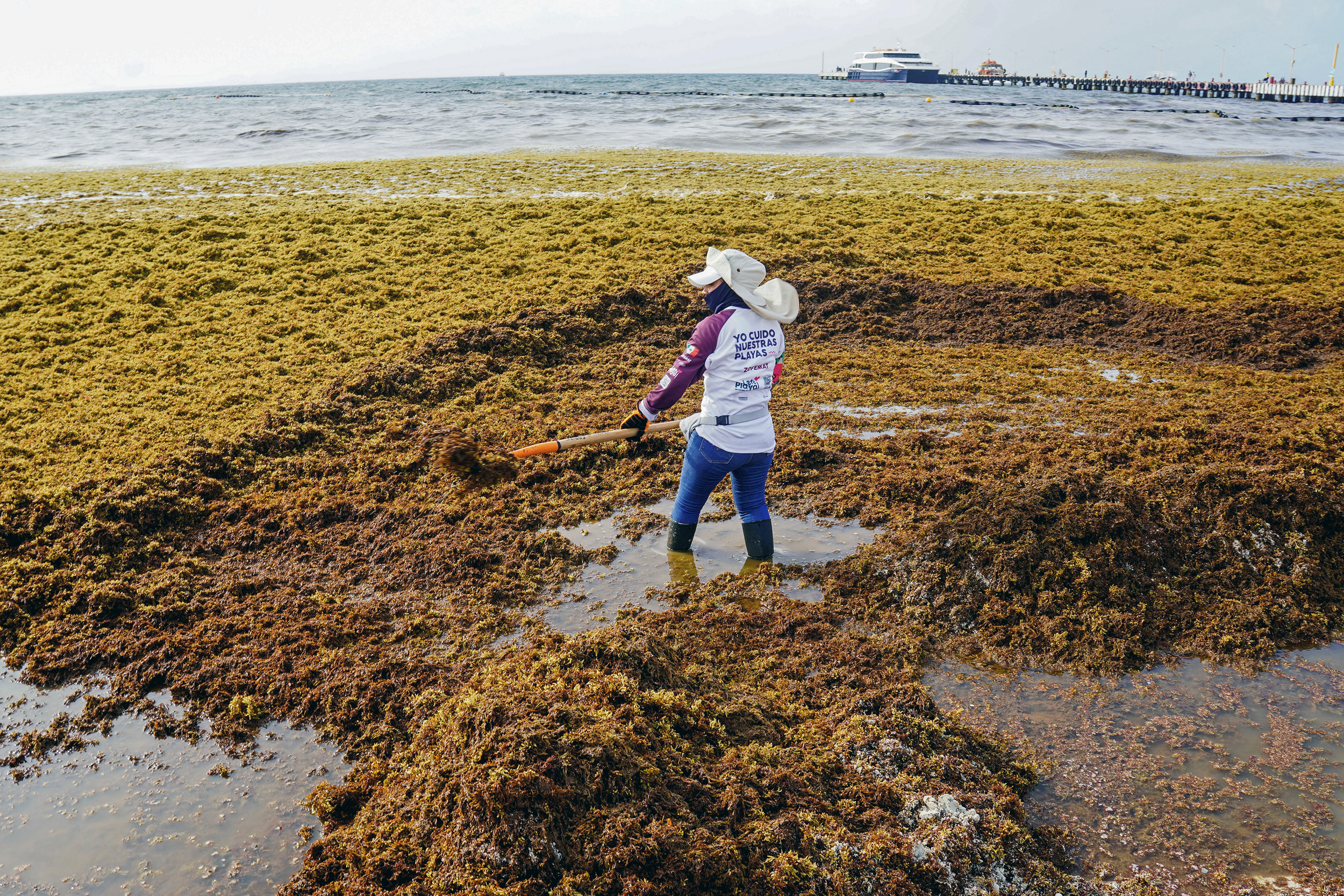
TOMASSONI: Communities are struggling to cope with sargassum inundations. You see people doing really arduous labor, using shovels, rakes, wheelbarrows, to dig up the sargassum, put it in a wheelbarrow, transport it off the beach, or dig these giant holes on the beach and just bury it if they have nowhere to transport the sargassum.
Some areas are using deflection barriers called booms to prevent the sargassum from reaching the shore. But these are expensive, and not every place has access to these booms.
There’s also a question of what to do with the sargassum once they collect it on the beach. Sometimes it goes to landfills, which can have pretty severe climate impacts, one scientist told me. I mentioned that the sargassum releases hydrogen sulfide and ammonia, but it also starts to produce methane as it decomposes, and methane is a potent greenhouse gas, stronger than carbon dioxide. Amassing more and more sargassum in landfills is inevitably going to have a climate impact as well.
People are really starting to rethink how we collect the seaweed and where we put it to have the least environmental impacts, the least climate impacts.
O’NEILL: Some people are saying, “Well, we can’t just get rid of it, and we can’t just bury it,” and are looking toward harnessing it. What have you heard about that?
TOMASSONI: You’re correct in that a lot of folks, including various entrepreneurs, scientists, governments, startups, are all trying to think creatively about, how can we harness this seaweed? Out in the ocean it was once a good thing. How can we create something good again out of it, and not leave it on shore to decompose on shore or in the landfills where it could harm people or the environment.
One organization, a U.K. startup called Seafields, is looking to create farms of sargassum offshore. I mentioned the deflection barriers, the booms that basically serve as a blockade in sargassum reaching the shorelines. Seafields is looking to create what they call paddocks, or farms, offshore as well. They would use the booms to basically funnel the sargassum into these paddocks, where they would intentionally keep the sargassum alive, because it has less-harmful impacts when it’s alive, and they would keep it alive until it was ready to be harvested and then used to create other products.
Some startups are using sargassum to create biochar. Biochar is kind of like a type of charcoal. It stores CO2 long term and is being added to concrete to reduce concrete’s carbon footprint, and also it’s been proven to make concrete stronger. Some entrepreneurs in Mexico, I’m told, are using sargassum to add to plastic to make these wave-like flexible roof panels or sandals. Others are using sargassum to make fertilizer additives to make the soil healthier and prompt faster growth of plants. We know sargassum grows well, so it’s got a lot of properties that can potentially help other plants grow efficiently as well.
This problem, unfortunately, is not likely to go away anytime soon. One scientist told me that for the next 10 years, at least, unless there’s a major climate event that stops the growth of sargassum, this is the new reality, and we have to face it.
About This Story
Perhaps you noticed: This story, like all the news we publish, is free to read. That’s because Inside Climate News is a 501c3 nonprofit organization. We do not charge a subscription fee, lock our news behind a paywall, or clutter our website with ads. We make our news on climate and the environment freely available to you and anyone who wants it.
That’s not all. We also share our news for free with scores of other media organizations around the country. Many of them can’t afford to do environmental journalism of their own. We’ve built bureaus from coast to coast to report local stories, collaborate with local newsrooms and co-publish articles so that this vital work is shared as widely as possible.
Two of us launched ICN in 2007. Six years later we earned a Pulitzer Prize for National Reporting, and now we run the oldest and largest dedicated climate newsroom in the nation. We tell the story in all its complexity. We hold polluters accountable. We expose environmental injustice. We debunk misinformation. We scrutinize solutions and inspire action.
Donations from readers like you fund every aspect of what we do. If you don’t already, will you support our ongoing work, our reporting on the biggest crisis facing our planet, and help us reach even more readers in more places?
Please take a moment to make a tax-deductible donation. Every one of them makes a difference.
Thank you,