

When President Donald Trump first sought to be the Republican standard-bearer in 2016, he promised to reduce the Environmental Protection Agency to “little tidbits.”
Ten years later, he is closer than ever to that goal, according to an Inside Climate News analysis of federal workforce data released by the Office of Personnel Management.
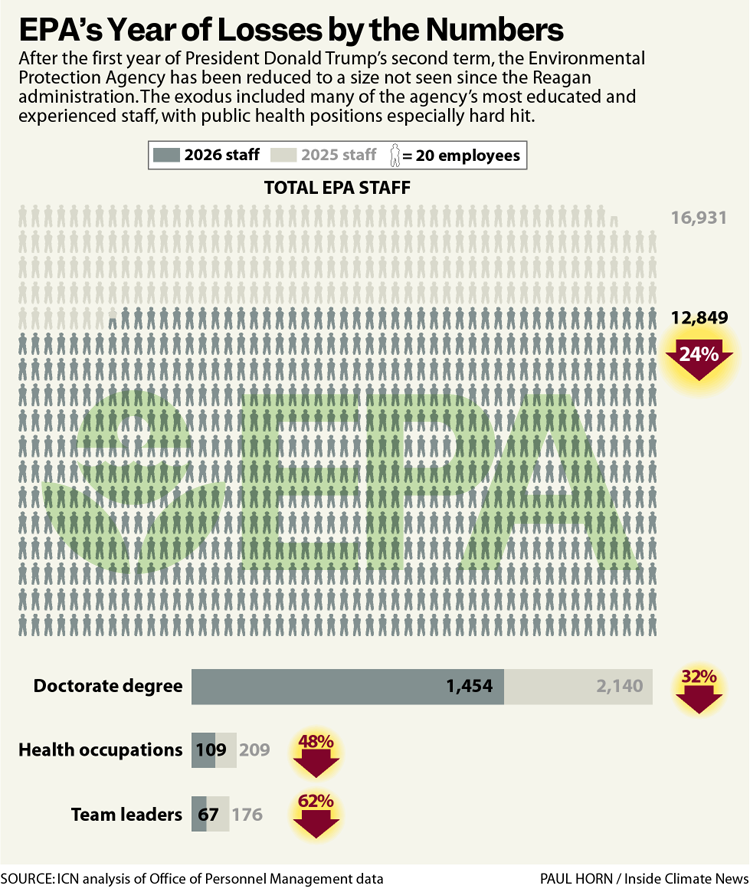
The EPA lost more than 4,000 employees in the first year of Trump’s second term, bringing its staffing down to a total of 12,849—a level not seen since the Reagan administration. That represents a reduction of 24 percent, more than double the rate of losses across the entire federal workforce.
The loss of expertise, particularly in science and health, runs deeper still. Proportionately, there were even greater reductions of staff with doctorate degrees, team leaders and those working in health occupations, a broad government employment category that includes public health experts.
The EPA said the changes in staffing were meant to improve the agency’s ability to carry out its mission. “Over the past year, EPA has undertaken a strategic restructuring to better provide clean air, land, and water for all Americans grounded in an unwavering commitment to gold-standard science,” an agency spokesperson said in an email. “This transformation ensures that every decision we make best fulfills our statutory obligations to protect human health and the environment, Power the Great American Comeback, and serve as exceptional stewards of taxpayer dollars.”
Environmental advocates, including former EPA scientists, see the cuts quite differently.
“It’s devastating,” said Betsy Southerland, who retired in 2017 as director of the EPA’s Office of Science and Technology within the Office of Water.
Among those who departed in 2025, she noted, were members of the team that developed an acclaimed new method for speeding up evaluations of the health risks of the thousands of biopersistent chemicals found nationwide in drinking water, soil, air, wildlife and human blood. Southerland worries about setbacks to managing these “forever chemicals”—PFAS, or per- and polyfluoroalkyl substances.
“I don’t know if any of that work can continue at all, or if it will happen so much more slowly, because everybody’s gone,” Southerland said. “You can’t replace them with junior people who have just joined EPA. You’d be asking them to replace the people who literally developed the testing methodology.” Those pioneers are not around to train their successors.
Congress Balked, But the EPA Cut Anyway
The full extent of the exodus from the EPA became apparent only this week, when the Office of Personnel Management (OPM) released its snapshot of the federal workforce as of the end of January.
In the previous monthly data release, the EPA was shown as having lost just over 13 percent of its employees by the end of 2025. But that was before the effective date for a wave of voluntary and early retirements. Data on departures from government employment indicate that almost 2,000 staff left the EPA’s roster at year-end, taking with them huge reserves of institutional experience: Those who left had a median length of service of 30.3 years, compared to 10.8 years for the staff who remain.
Under the EPA’s Deferred Resignation Program, many of the workers OPM listed as retiring in December had been out of the office since July.
“They were being paid not to come into work, with no access to government email—basically on paid leave until their official retirement paperwork went into effect at the end of December,” said Jennifer Orme-Zavaleta, former principal deputy assistant administrator for EPA’s Office of Research and Development (ORD). Orme-Zavaleta, who spent 40 years at the agency before her 2021 retirement, has kept in touch with former colleagues and believes the exits ultimately will be even larger than those already recorded. “Right now, OPM is flooded with processing those separations,” she said.
Southerland said she feels the term “retirements” is a misnomer for the staff departures in the agency’s science research arm.
“They were forced out,” she said. “They were basically told, ‘We’re eliminating ORD. You can stay and try to apply to … some other office and see if they’ve got a vacancy to pick you up, or you can retire.’ And a lot of them left.”
The reduction in staff largely fulfills the reorganizational goals that EPA Administrator Lee Zeldin announced last July, which centered on eliminating ORD. Zeldin said at the time that the EPA would shift its scientific expertise to the program offices that focus on issues like clean air and water, while saving the agency nearly $750 million.

Democratic members of Congress balked at the plan, calling it “a catastrophe for public health, environmental protection, and the civil servants working in ORD offices across the country.” And Republicans joined in approving a fiscal year 2026 budget for the EPA that included a more modest cut of about $300 million, or 3 percent.
A bipartisan Senate report accompanying the bill last summer directed the EPA to halt all action to close or reorganize ORD. The GOP leadership succeeded in weakening that language in the appropriations package passed in January after months of partisan rancor and the longest government shutdown in history. But the final legislation directed the EPA to “maintain staffing levels in order to fulfill the mission and statutory obligations of the agency,” including a 1981 law requiring a separate research and development program.
An EPA spokesperson said its aim was to better integrate science into decision-making by moving scientific expertise into the EPA’s program offices, with support from a new Office of Applied Science and Environmental Solutions.
“EPA is ensuring that gold-standard science continues to be infused into every rulemaking, technical assistance to states, and programmatic decisions,” the EPA spokesperson wrote. “This approach positions scientific rigor at the forefront of our mission, strengthening our capacity to meet statutory requirements with the highest level of scientific integrity.”
But at least one member of Congress who helped negotiate the appropriations deal for the EPA, Rep. Chellie Pingree (D-Maine), said that the deep cuts are contrary to lawmakers’ intent.
“What we did is a real rebuke to this administration and what they’ve been doing,” said Pingree, the ranking member of the Appropriations Committee’s subcommittee on Interior, Environment and Related Agencies. “We made it very clear that we wanted them to staff back up and to replace some of the expertise.”
This story is funded by readers like you.
Our nonprofit newsroom provides award-winning climate coverage free of charge and advertising. We rely on donations from readers like you to keep going. Please donate now to support our work.
Donate NowPingree said she was “beyond outraged” at the cuts and is determined to question the EPA’s leadership at an upcoming hearing the Appropriations Committee is now working to schedule.
“We know that this administration does not like the EPA, does not really understand the environmental challenges that are out there, and as a consequence, they are really happy to shrink the organization to a size where it’s questionable how well it will be able to function,” Pingree said.
Sen. Jeff Merkley (D-Ore.), top Democrat on the Senate Appropriations subcommittee that oversees the EPA, also said he intends to push back against the cuts.
“As the EPA loses leaders who are experts in fighting for human health and the environment, it is the American people who will suffer,” Merkley said in an email. “The Trump Administration is carelessly cutting critical jobs at the EPA and other agencies, and Congress must use its oversight powers to fight this dangerous trend.”
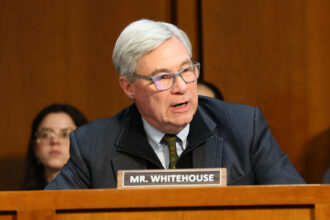
Sen. Sheldon Whitehouse (D-R.I.), the ranking member of the Senate Environment and Public Works Committee, sees the cuts in light of the Trump administration’s support of the fossil fuel industry. “President Trump and Lee Zeldin’s decimation of the EPA will lead to decades of disease from poisoned water and toxic air, and an increasingly unlivable planet, plundered by Big Oil,” he wrote in an email. “The depth of the corruption is unprecedented.”
2026 Problems; 1985 Staffing Levels
By bringing the EPA’s staff down to a 40-year low, the Trump administration has reduced it to the size it was before Congress gave the agency massive additional responsibilities in amendments to the Clean Air Act, the Safe Drinking Water Act and the Toxic Substances Control Act, to name just a few examples.
Moreover, current staffers face new challenges like PFAS and climate change.
Tracey Woodruff, professor of epidemiology and population health and senior fellow at the Woods Institute for the Environment at Stanford University, who served as a scientist at the EPA for 13 years, noted that agency scientists have been instrumental in addressing the threats of PFAS, including discovering contamination of a new generation of those chemicals in the Cape Fear River in North Carolina in 2012.
“Now that we don’t have those scientists, these industries can go ahead and dump whatever they want, wherever they want, because there’s not going to be any scientists to identify these toxic health effects and alert the appropriate authorities,” Woodruff said.
The contraction of the EPA staff, however, coincides with the shift in priorities under the second Trump administration. At least some of the ORD scientists who were working on PFAS detection methods have been reassigned to evaluate new chemicals coming on the market. The chemical industry has long complained of the backlog in these reviews, which by law are supposed to be completed within 90 days, and Zeldin has pledged to speed up the process.
“Under the previous administration, hundreds of new chemicals remained in regulatory limbo far beyond statutory review timelines, as did more than 12,000 pesticide reviews, and 685 State Implementation Plans to improve air quality around the country,” the EPA spokesperson said. Such backlogs were proof that “these transformational changes were necessary,” the spokesperson said.
Even at a reduced size, the spokesperson said, “we remain confident EPA has the resources needed to accomplish EPA’s core mission.”
“They have a different mission for EPA than the career staff who actually thought the mission was to protect public health and the environment.”
— Betsy Southerland, former director of the EPA Office of Science and Technology
But scientists fear resources are being shifted away from problems that would put the EPA in conflict with the industries it regulates, while the team leaders and experienced scientists who would be in a position to challenge decisions have been winnowed out of the agency.
“They want political leadership to be the only ones to decide what will or will not be regulated,” Southerland said. “They didn’t want to have in-house experts who could say, ‘Oh, my God, you must regulate this.’ They have a different mission for EPA than the career staff who actually thought the mission was to protect public health and the environment.”
Zeldin has expressed the agency’s mission as two-fold, protecting health while freeing businesses, especially in the energy industry, from regulatory restraints. “Under President Trump’s leadership, EPA has taken a close look at our operations to ensure the agency is better equipped than ever to deliver on our core mission of protecting human health and the environment while Powering the Great American Comeback,” Zeldin said in a statement when he announced the decision to dissolve ORD.
But critics say the dual mission that Zeldin has articulated is at odds with itself, as when industry pollution threatens public health. They see the cuts in the EPA’s scientific expertise as in line with the agency’s decisions to roll back regulations on ozone, soot and greenhouse gas pollution from motor vehicles and power plants.
“The scientists at EPA, for generations now, have been absolutely instrumental in doing what Congress intended EPA to do when it enacted the Clean Air Act, which is harnessing knowledge, harnessing scientific progress and harnessing technological progress to improve public health,” said Joe Goffman, who was the EPA’s assistant administrator for air programs in the Biden administration, and shepherded the greenhouse gas rules that are now being dismantled. “If your agenda is to put a stop to all that, then you have to remove one of the key links in this chain of improvement and change, which is the scientists themselves.”
About This Story
Perhaps you noticed: This story, like all the news we publish, is free to read. That’s because Inside Climate News is a 501c3 nonprofit organization. We do not charge a subscription fee, lock our news behind a paywall, or clutter our website with ads. We make our news on climate and the environment freely available to you and anyone who wants it.
That’s not all. We also share our news for free with scores of other media organizations around the country. Many of them can’t afford to do environmental journalism of their own. We’ve built bureaus from coast to coast to report local stories, collaborate with local newsrooms and co-publish articles so that this vital work is shared as widely as possible.
Two of us launched ICN in 2007. Six years later we earned a Pulitzer Prize for National Reporting, and now we run the oldest and largest dedicated climate newsroom in the nation. We tell the story in all its complexity. We hold polluters accountable. We expose environmental injustice. We debunk misinformation. We scrutinize solutions and inspire action.
Donations from readers like you fund every aspect of what we do. If you don’t already, will you support our ongoing work, our reporting on the biggest crisis facing our planet, and help us reach even more readers in more places?
Please take a moment to make a tax-deductible donation. Every one of them makes a difference.
Thank you,

Marianne Lavelle
Bureau Chief, Washington, D.C.
Marianne Lavelle is the Washington, D.C. bureau chief for Inside Climate News. She has covered environment, science, law, and business in Washington, D.C. for more than two decades. She has won the Polk Award, the Investigative Editors and Reporters Award, and numerous other honors. Lavelle spent four years as online energy news editor and writer at National Geographic. She spearheaded a project on climate lobbying for the nonprofit journalism organization, the Center for Public Integrity. She also has worked at U.S. News and World Report magazine and The National Law Journal. While there, she led the award-winning 1992 investigation, “Unequal Protection,” on the disparity in environmental law enforcement against polluters in minority and white communities. Lavelle received her master’s degree from Columbia University Graduate School of Journalism, and is a graduate of Villanova University.

Peter Aldhous
Data Journalist
Peter Aldhous is a science and data reporter based in San Francisco. He got his break in journalism in 1989 as a reporter for Nature in London, fresh from a Ph.D. in animal behavior. Later he worked as European correspondent for Science, news editor for New Scientist and chief news & features editor with Nature, before moving to California in 2005 to become New Scientist’s San Francisco bureau chief. From 2015 to 2022 he worked on the science desk at BuzzFeed News. Peter also teaches investigative and policy reporting, data visualization, and news features writing in the Science Communication Program at the University of California, Santa Cruz. He is a two-time winner in the Global Editors Network Data Journalism Awards. His reporting has also been honored by the Association of British Science Writers, the Association of Health Care Journalists, the Society of Environmental Journalists, and the Royal Statistical Society.