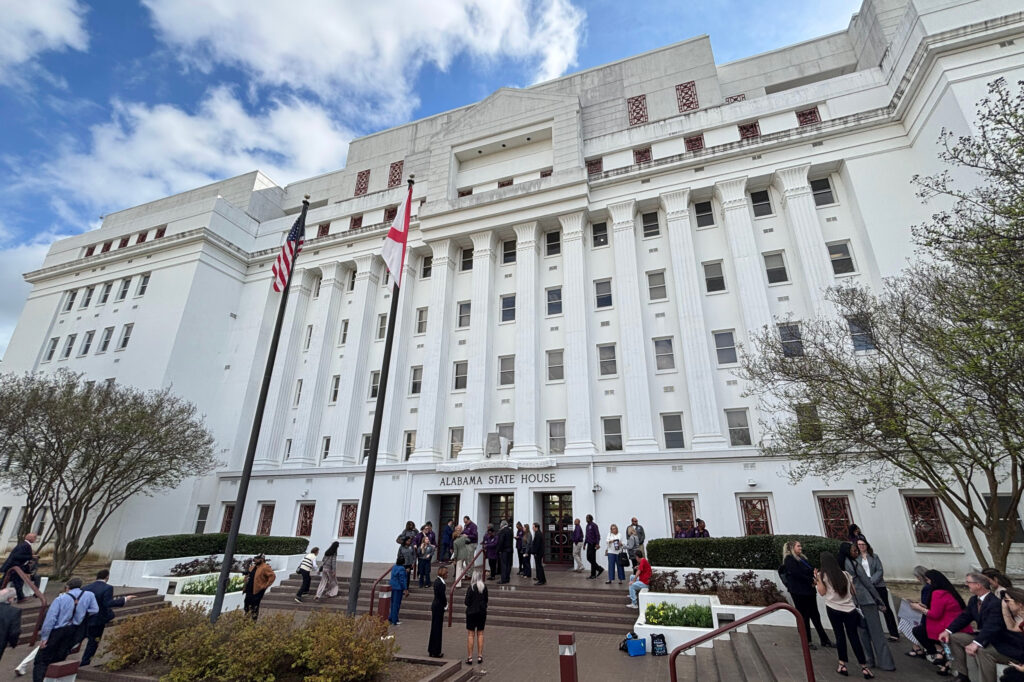
MONTGOMERY, Ala.—High electricity costs have been the talk of the session in the Alabama Legislature, and the state seems poised to totally revamp its utility regulatory process.
But which changes will be made and how effective those changes will be are very much in question, as the session winds down with multiple utility bills still in the works.
“The people of Alabama are frustrated,” state Sen. Clyde Chambliss, a Republican, said in session Thursday. “They’re frustrated that our power rates have increased faster than most of our neighboring states, and in fact, most of the states.”
Chambliss is the sponsor of a bill, unanimously approved by the Senate Thursday, that would dramatically reshape the Alabama Public Service Commission, which regulates the state’s largest electricity provider, Alabama Power. Chambliss’s bill would expand the commission from three members to seven, one for each of the state’s congressional districts, and prohibit electricity rate increases until 2029.
Meanwhile, the Alabama House is expected to vote next week on a bill that would force Alabama Power to undergo regular formal rate case hearings, something it has not had to do since 1981. The House bill also includes a profit cap for electric utilities in the state.
“I feel like now it’s the best chance ever, and I don’t know that you’ll get another opportunity anytime soon,” said Rep. Mack Butler, the Republican who sponsored the House bill. “This was kind of a perfect storm.”
The moves come after months of debate over high electricity prices in Alabama. An Inside Climate News investigation found Alabama Power’s residential customers saw the highest total power bills of 100 of the country’s largest utilities in 2024, based on federal filings.
Since then, the voices advocating for reform have grown louder across the political spectrum.
The state’s all-Republican Public Service Commission reached an agreement for a two-year rate freeze last December, delaying a planned rate increase due to Alabama Power’s purchase of an existing natural gas power plant earlier that year.
U.S. Sen. Katie Britt has made recent public comments noting that Alabama has the highest electric rates in the Southeast. She called the situation “unacceptable.”
Senate Bill Would Expand PSC, Create Secretary of Energy Role
Sen. Chambliss’s bill, SB360, now heading to the House for consideration, is called the “Power to the People Act.” The bill would expand the PSC and also create a cabinet-level Secretary of Energy to be appointed by the governor that would set the agenda for PSC meetings.
It would prohibit utilities from contributing to campaigns for PSC members and set limits on which advertising and lobbying expenses would be counted in the rate base.
“We’re heading in the wrong direction, and the people are frustrated by that,” Chambliss said. “So what we want to do is give the power back to the people. We want to put control of these rates over time back to the people.”
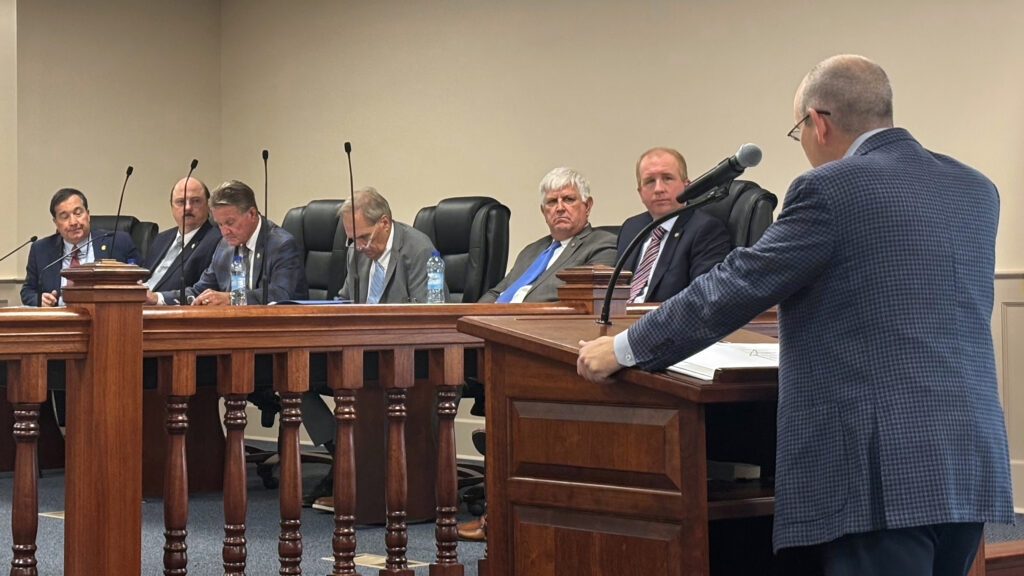
But critics say the Power to the People Act actually takes some power away from the people.
Energy Alabama, a nonprofit consumer advocacy group, is urging its members to oppose SB 360, saying the bill gives too much power to the Secretary of Energy to set the agenda and steer the public service commission.
In addition, the new PSC commissioners will be at first appointed by the governor, with elections being held on a staggered basis over the next several years until the seats are all elected.
“This will not generate the savings that they are looking for,” said John Dodd, policy manager for Energy Alabama, after a committee hearing Wednesday. “Instead of forcing the commission to do a better job at lowering the rates that Alabama Power is allowed to charge their customers, they have, instead, locked in some of the highest rates that we are seeing in the southeastern part of the United States.”
SB360 emerged after the failure of a previous bill that would have changed Alabama’s Public Service Commission seats from elected to appointed positions. That bill died after public outcry over taking the vote away from the people.
Dodd also said the speed at which the Senate moved SB360 was concerning. The bill was introduced Tuesday, sailed through committee on Wednesday and passed the Senate on Thursday, less than 48 hours after introduction. The Senate public hearing included almost no conversation on the substance of the bill from the senators, and only two members of the public spoke against the bill.
This story is funded by readers like you.
Our nonprofit newsroom provides award-winning climate coverage free of charge and advertising. We rely on donations from readers like you to keep going. Please donate now to support our work.
Donate NowSen. Bobby Singleton, a Democrat, spoke in favor of the bill Thursday, saying it would give representation to areas of the state that are not currently represented by the commissioners, who are all elected by a statewide ballot.
“What I’m hearing from a lot of people out there on the streets [is] that we’re taking their right to vote away, and that could be far from the truth,” Singleton said. “This bill does not do that.”
House Bill Carries More Teeth
Meanwhile, in the Alabama House, HB 475 would limit Alabama Power’s return on equity to the regional average for investor-owned utilities in states that border Alabama, and would require the company to participate in formal rate case hearings for the first time since 1981.
Alabama Power reported a record $1.5 billion profit in 2025.
“If you look at [Alabama Power’s] record profits, all I want them to do is lay their cards on the table,” Rep. Butler told Inside Climate News. “They’re a monopoly. Lay the cards on the table and be transparent and be under oath. And if they can justify where we are, so be it.”
Butler said he expects the bill to go before the full House on Tuesday, after it cleared committee this week.
Energy Alabama has endorsed Butler’s bill.
“We urge every Alabamian who wants real reform to contact their House representative and direct their attention to HB 475, legislation led by Rep. Mack Butler that would require rate reviews under oath, meaningfully reduces utility profits, and keeps the PSC fully accountable to voters,” the group said in a statement Thursday.
Alabama currently uses a formula-based system to determine Alabama Power’s allowable profit levels. That system was implemented in 1982 to avoid messy political battles over electricity prices after decades of clashes between Alabama Power and then-Governor George Wallace drove the company to the brink of bankruptcy.
Butler’s bill would require the formal rate cases that are part of most state regulatory systems, where company witnesses are questioned under oath and proposed rate increases have to be justified to the public.
“At some point, they’ve got to do the job for the rate payers instead of looking out for the utility,” Butler said. “And if they can justify their record profits, so be it. But this is something that people are demanding that we do.”
Butler said he remains hopeful that his bill will pass before the end of the session.
“We need to get something out while there seems to be a posture to do so,” Butler said. “I do not think this is a bill you want to be seen voting against.”
About This Story
Perhaps you noticed: This story, like all the news we publish, is free to read. That’s because Inside Climate News is a 501c3 nonprofit organization. We do not charge a subscription fee, lock our news behind a paywall, or clutter our website with ads. We make our news on climate and the environment freely available to you and anyone who wants it.
That’s not all. We also share our news for free with scores of other media organizations around the country. Many of them can’t afford to do environmental journalism of their own. We’ve built bureaus from coast to coast to report local stories, collaborate with local newsrooms and co-publish articles so that this vital work is shared as widely as possible.
Two of us launched ICN in 2007. Six years later we earned a Pulitzer Prize for National Reporting, and now we run the oldest and largest dedicated climate newsroom in the nation. We tell the story in all its complexity. We hold polluters accountable. We expose environmental injustice. We debunk misinformation. We scrutinize solutions and inspire action.
Donations from readers like you fund every aspect of what we do. If you don’t already, will you support our ongoing work, our reporting on the biggest crisis facing our planet, and help us reach even more readers in more places?
Please take a moment to make a tax-deductible donation. Every one of them makes a difference.
Thank you,

Dennis Pillion
Reporter, Alabama
Dennis Pillion is a reporter for Inside Climate News based in Alabama. He joined ICN in 2024 after 17 years working for Alabama Media Group, including nine as the statewide natural resources reporter. His work for AL.com and The Birmingham News, won numerous Green Eyeshade and Alabama Press Association awards for his coverage of environmental issues in Alabama. He was born and lives in Birmingham, Ala.