

Since the start of his second term last year, President Donald Trump has sought to weaken the federal foundations underpinning American science, slashing or stalling research funding, firing or pushing out thousands of scientists, canceling grants for ideological reasons and shuttering research facilities across the country.
But even against that bleak backdrop, the administration’s firing of all 22 current members of the National Science Board last week stands out as “one of the darkest moments” of the past year and a half, said Jacquelyn Gill, a paleoecologist and biogeographer at the University of Maine.
“It was incredibly chilling, and my stomach just dropped to my feet when I saw that the entire board had been fired,” Gill said. “Because now this last bastion of accountability and transparency and scientific expertise has been dismantled overnight.”
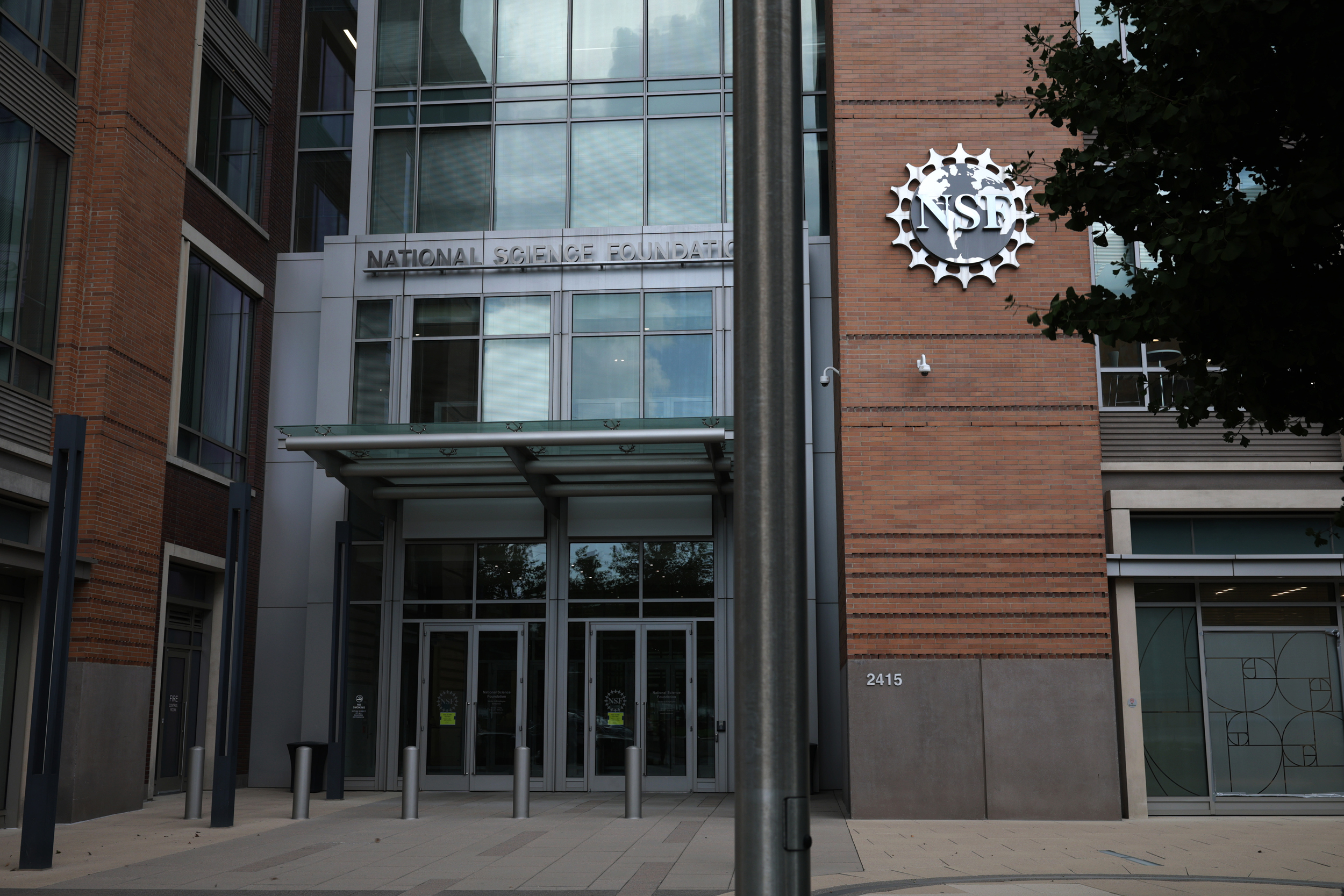
The National Science Board plays a key role in overseeing the National Science Foundation, a major research funder in fields such as chemistry, engineering, biology, the environment, computing and technology, which supports academic inquiry and helps train the next generation of scientists.
The NSB and the NSF were designed to be “driven by our best and brightest scientific experts who are really representing a consensus of where science should go in this country,” Gill said. “It’s not at the whims of whatever president steps into office.”
Created by Congress in 1950 as an independent body of scientific advisors, the board is appointed by the president in staggered six-year terms and chosen for their distinguished service and eminence in their disciplines. On Friday, members received an email saying their positions were “terminated, effective immediately.” The NSF website now reads “pending new appointments” instead of listing members’ names.
“This board is so important for being able to advise Congress as well as the president on issues that are so important to the country,” said Geraldine Richmond, presidential chair in science and professor of chemistry at the University of Oregon and a former member of the NSB. Richmond was first appointed to the board by President Barack Obama and later by Trump during his first term.
In the wake of the board’s sudden dismissal, experts fear that its members will be replaced with people chosen for their political loyalty rather than their scientific qualifications and who will be focused on short-sighted partisan concerns rather than the greater societal good.
Because of the board’s importance in the ecosystem that fosters American innovation, observers worry the decision will contribute to a loss of trust in public science and cause long-term damage to American competitiveness in critical research areas and the pipeline for educating and retaining new scientists.
“As concerning as this is, it’s not a surprise because of what this administration has been doing now” since January 2025, said Carlos Javier Martinez, a senior climate scientist at the Union of Concerned Scientists who previously worked for the National Science Foundation. “It’s a continuous onslaught of attacks on science.”
In a statement to Inside Climate News, a White House official implied the decision to fire the board stemmed from a 2021 U.S. Supreme Court case related to the appointment of administrative patent judges.
This ruling “raised constitutional questions about whether non-Senate confirmed appointees can exercise the authorities that Congress gave the National Science Board,” the official said. “We look forward to working with the Hill to update the statute and ensure the NSB can perform its duties as Congress intended. The National Science Foundation’s work continues uninterrupted.”
This story is funded by readers like you.
Our nonprofit newsroom provides award-winning climate coverage free of charge and advertising. We rely on donations from readers like you to keep going. Please donate now to support our work.
Donate Now“Like many of the legal claims they’ve made so far, it’s more of a smoke screen than a really plausible legal argument,” said Lauren Kurtz, an attorney and the executive director at the Climate Science Legal Defense Fund. The Supreme Court ruling cited by the White House is “factually, legally very different” from the process governing appointments to the NSB, she said. “I think trying to apply it in this case is disingenuous.”
The statute governing the National Science Board was updated in 2022, Kurtz pointed out. Martinez agreed with Kurtz’s assessment of the White House’s argument. “It doesn’t hold water,” he said.
“They’ve basically taken a wrecking ball to this [board], and we don’t know exactly how they plan to rebuild it, but if history is any indication, they will want to put in very administration-loyal, probably unqualified people,” Kurtz said.
“Without that body, really, the agency is now fully at the behest of the White House,” Martinez said.
In Gill’s view, the NSF is already being guided by industry priorities, especially Silicon Valley’s behemoth tech companies, which have tried to win over the second Trump administration with donations and public flattery.
“Having a scientific enterprise that focuses primarily on the needs of industry just means that we’re losing curiosity-driven science,” she said. That emphasis also shortchanges research, like her own, that focuses on areas industry is typically uninterested in or even hostile to, such as climate change, biodiversity and pollution monitoring.
The “beautiful thing” about the NSF, Gill said, was its “recognition that science without an immediate benefit or application was worth pursuing.”
“We studied electricity for hundreds of years before it had any practical purpose. We don’t know what we’re going to be missing out on in the decades and centuries to come because we have hamstrung our ability to do exploratory research,” she said. “You never know what is going to lead to the next breakthrough.”
About This Story
Perhaps you noticed: This story, like all the news we publish, is free to read. That’s because Inside Climate News is a 501c3 nonprofit organization. We do not charge a subscription fee, lock our news behind a paywall, or clutter our website with ads. We make our news on climate and the environment freely available to you and anyone who wants it.
That’s not all. We also share our news for free with scores of other media organizations around the country. Many of them can’t afford to do environmental journalism of their own. We’ve built bureaus from coast to coast to report local stories, collaborate with local newsrooms and co-publish articles so that this vital work is shared as widely as possible.
Two of us launched ICN in 2007. Six years later we earned a Pulitzer Prize for National Reporting, and now we run the oldest and largest dedicated climate newsroom in the nation. We tell the story in all its complexity. We hold polluters accountable. We expose environmental injustice. We debunk misinformation. We scrutinize solutions and inspire action.
Donations from readers like you fund every aspect of what we do. If you don’t already, will you support our ongoing work, our reporting on the biggest crisis facing our planet, and help us reach even more readers in more places?
Please take a moment to make a tax-deductible donation. Every one of them makes a difference.
Thank you,

Kiley Bense
Senior Editor
Kiley Bense is a senior editor at Inside Climate News. She was previously the Pennsylvania reporter, covering climate change and the environment with a focus on politics, energy, pollution and public health, and reporting on everything from fracking and steel to plastics, wildlife and extreme weather. Her past work has appeared in the New York Times, the Atlantic, Smithsonian Magazine, the Believer, and Sierra Magazine, and she holds master’s degrees in journalism and creative writing from Columbia University. She is based in Pennsylvania.