A decade ago, Pennsylvania’s Department of Environmental Protection published a study on radioactivity in the oil and gas industry, motivated by fears that increasing volumes of toxic fracking waste could pose risks to the environment and public health. That study concluded, in part, that more research was needed—especially regarding the impacts on landfills where this waste is disposed.
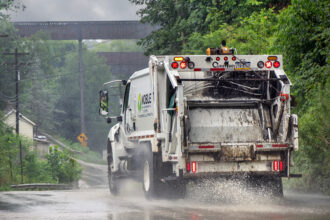
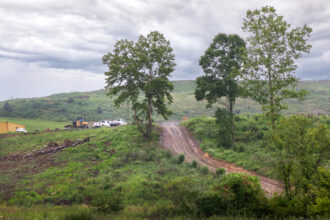
On Friday, the agency released a follow-up study that specifically examined landfill leachate, the liquid byproduct formed when rainwater passes through waste, picking up contaminants along the way.
“The takeaway here is that there is no risk to human health from radiation in landfill leachate,” said Jessica Shirley, DEP’s secretary, in a press release. DEP’s study analyzed samples from 49 landfills in Pennsylvania over two years, from 2021 to 2023. That includes 23 landfills that received oil and gas waste, according to state records.
But environmental and policy experts warned that this study was too narrow to draw definitive conclusions about the potential for long-term harm from leachate contaminated by such waste.
“This is an interim report,” said Daniel Bain, an associate professor of geology and environmental science at the University of Pittsburgh who has studied oil and gas waste. “This is not, ‘We’ve looked at the problem; it’s not a problem.’ It’s, ‘We’ve looked at the problem. There doesn’t appear to be a problem now.’”
The snapshot DEP captured in this study doesn’t preclude different results in the future, Bain said, and provides little insight into cumulative environmental effects.
The study acknowledges its determination that there is “no current cause for concern” is based on limited data. “It is important to recognize that more landfill leachate samples and radiochemistry analysis is warranted to generate additional data to confirm these initial findings,” the study’s authors wrote in their conclusions.
David Allard, the former director of DEP’s Bureau of Radiation Protection, who oversaw the 2016 study on oil and gas waste, said he was “not surprised” by the results. “It’s in line with what they were seeing early on,” he said. “I’m comfortable with the findings” that radioactivity from leachate doesn’t currently pose a threat to human health.
However, DEP should implement consistent, long-term monitoring, Allard said. “The landfills will change over time. My opinion is there should be at least annual sampling.”
In 2021, then-Gov. Tom Wolf announced that landfills in Pennsylvania would be required to regularly test for radium. Gov. Josh Shapiro, who was then the attorney general, supported Wolf’s decision at the time. DEP confirmed in December that the requirement had not been implemented, and it did not announce any such rule alongside the new report.
DEP found that samples from only 11 of the landfills exceeded the U.S. Environmental Protection Agency’s limits for combined radium-226 and 228 in drinking water, and none of them exceeded the much higher annual average standard for radium set by the U.S. Nuclear Regulatory Commission for untreated wastewater from facilities licensed to use radioactive material.
Neither of these numbers is ideal for assessing leachate. “There really are no standards for leachate,” Allard said.
DEP also found “no correlation” between samples that exceeded the EPA standard and landfills that, according to state records, had accepted oil and gas waste. But a 2025 Inside Climate News analysis found that some of those records are full of inconsistencies. Discrepancies totaled almost 1.4 million tons between what Pennsylvania oil and gas operators said they’d sent and what landfills said they’d received, with some landfills reporting far more incoming oil and gas waste. One possible explanation is waste coming in from other states.
This story is funded by readers like you.
Our nonprofit newsroom provides award-winning climate coverage free of charge and advertising. We rely on donations from readers like you to keep going. Please donate now to support our work.
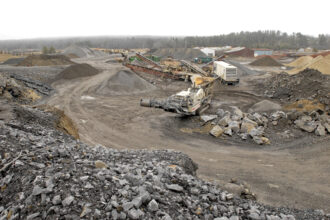
Donate NowOil and gas operators reported creating nearly 8.8 million tons of solid waste between 2017 and 2024. About 6.3 million tons of it went to landfills across the state.
Environmental groups in Pennsylvania have worried about the consequences of generating and disposing of so much oil and gas waste since the fracking boom began two decades ago. Oil and gas waste is often radioactive, and it can also contain heavy metals and other toxic chemicals.
Former DEP Secretary David Hess, who now runs the publication PA Environment Digest, pointed out several previous issues related to radioactive fracking waste, from it being sent to public wastewater treatment plants that couldn’t properly handle it to treatment equipment needing to be decontaminated for radiation.
“Like a lot of things with the shale gas industry, we are the guinea pigs and have to learn things the hard way,” he said.
Several studies have shown that some radioactivity from oil and gas waste has already found its way into the environment—for example, downstream of discharge points from facilities that processed or accepted that waste.
“They are just acting like the end of the pipe is the end. They aren’t thinking about what’s going to happen as things accumulate in the streams,” Bain said of the DEP study.
He cautioned that the nature of the pollutants in oil and gas waste—and the total volume produced by the state every year—means regulators will need to keep a close eye on radioactivity in the environment and at landfills for a long time to come.
“Now that we’ve allowed it to happen, we’re going to have to be watching forever,” he said.
About This Story
Perhaps you noticed: This story, like all the news we publish, is free to read. That’s because Inside Climate News is a 501c3 nonprofit organization. We do not charge a subscription fee, lock our news behind a paywall, or clutter our website with ads. We make our news on climate and the environment freely available to you and anyone who wants it.
That’s not all. We also share our news for free with scores of other media organizations around the country. Many of them can’t afford to do environmental journalism of their own. We’ve built bureaus from coast to coast to report local stories, collaborate with local newsrooms and co-publish articles so that this vital work is shared as widely as possible.
Two of us launched ICN in 2007. Six years later we earned a Pulitzer Prize for National Reporting, and now we run the oldest and largest dedicated climate newsroom in the nation. We tell the story in all its complexity. We hold polluters accountable. We expose environmental injustice. We debunk misinformation. We scrutinize solutions and inspire action.
Donations from readers like you fund every aspect of what we do. If you don’t already, will you support our ongoing work, our reporting on the biggest crisis facing our planet, and help us reach even more readers in more places?
Please take a moment to make a tax-deductible donation. Every one of them makes a difference.
Thank you,

Kiley Bense
Senior Editor
Kiley Bense is a senior editor at Inside Climate News. She was previously the Pennsylvania reporter, covering climate change and the environment with a focus on politics, energy, pollution and public health, and reporting on everything from fracking and steel to plastics, wildlife and extreme weather. Her past work has appeared in the New York Times, the Atlantic, Smithsonian Magazine, the Believer, and Sierra Magazine, and she holds master’s degrees in journalism and creative writing from Columbia University. She is based in Pennsylvania.