

It’s been a weird few weeks for weather across the United States.
While the West braces for the peak of a record-breaking heat wave, massive snowstorms and hail pummel several states in the Midwest. Meanwhile, communities in the Southeast and along the East Coast contend with severe storms that could trigger flooding and wind damage throughout the region.
In certain areas, these storms could bring some of the deadliest weather disasters: tornadoes. Several tornadoes ransacked the Midwest earlier this month, with multiple fatalities confirmed. A few more twisters have already hit this week, including in Tennessee, Alabama and North Carolina. Tornado warnings extended as far north as New Jersey Monday night.
This aligns with a subtle shift scientists have observed in the places these weather events hit, with rising tornado frequency across parts of the Northeast, the Southeast and the Midwest. At the same time, researchers have seen a decrease in the atmospheric conditions that support tornadoes in some parts of Texas, Oklahoma and Colorado—where they’ve historically been a greater threat. There are some indications that climate change has played a part in this trend and slight changes in tornado behavior in recent decades, as my colleague Kiley Bense reported.
But tornadoes are notoriously difficult to predict, and sussing out their climate connection is even harder, scientists say. While many questions remain, any changes in tornado activity and ranges could have major consequences for the more populated Southeast and East Coast.
A Recipe for Twisters
March marks the start of the main severe weather season in the United States, so it’s not necessarily surprising that storms, hail and tornado threats are occurring in different parts of the country simultaneously (although as I reported last week, the severity of the Western heat wave is anomalous).
Spring atmospheric conditions often provide the ingredients conducive to storm development: moisture, instability, lift and wind shear. Instability emerges when warm air rises, while lift develops when that warm air collides with a cold front. But wind shear—the change in wind speed and direction as unstable air rises—is largely what sets apart tornado-producing thunderstorms.
Tornadoes are relatively rare and most are weak. But the U.S. does experience around 1,000 tornadoes annually, and violent twisters are especially dangerous. More than 75 tornadoes already hit this year, including several that tore through Southwest Michigan in March and killed four people.
So is climate change supercharging these deadly whirlwinds, like so many other extreme weather events? The answer to that is complicated—and largely open-ended at the moment.
“Each tornado is a localized creature, which makes it difficult to link directly to global climate trends,” meteorologist Bob Henson wrote for Yale Climate Connections in 2021.
Still, some answers to how tornado behavior is changing over the long term are coming into focus. More data exists as stormchasers and social media users contribute photos and videos of tornadoes.
That can make it harder to determine whether changes are occurring or we are just keeping a closer eye on things, of course. But as scientists account for this, research shows that tornadic activity is becoming more concentrated, and that it’s happening less frequently in the spring and summer and more often in the fall and winter. A landmark 2018 study by scientists at Northern Illinois University and the National Severe Storms Laboratory identified a potential eastward movement, with upward of three to four more days of tornado conditions per decade in this region.
I checked in with Stephen Strader, an atmospheric scientist and disaster expert at Villanova University, both to hear if there have been any updates since then and because this increase seems … small. He told me that scientists are still working to unravel climate change’s influence but that even this modest increase, especially in the Southeast or Northeast, could have catastrophic impacts.
“A tornado going through the middle of nowhere Alabama is going to hit more things than a tornado going through the middle of nowhere Kansas,” Strader said, adding that many homes in the Southeast are manufactured and extremely vulnerable to tornadoes. In fact, occupants in these types of homes are as much as 20 times more likely to be killed than those living in site-built houses, research shows.
He explained it with one of the most iconic tornadoes in cinematic history: “In ‘The Wizard of Oz,’ where you see Dorothy running to the shelter and there’s a tornado dancing in the landscape behind her, that same scene is happening in the Southeast, except … it’s not dancing through the field, it’s dancing through a subdivision, through a forest, through all kinds of things that [it will] hit, and that means that there’s greater impacts.”
How Hail Is Changing
Another possible byproduct of severe convective storms is hail, formed when strong upward currents carry raindrops high enough to freeze. Measured by total financial costs in the U.S., these icy balls take the cake over tornadoes, with hailstorms costing the United States $46 billion in 2023 alone. That represents around 80 percent of the losses from hail, tornadoes, wind and lightning-caused fires combined, Science reports.
Climate change’s influence on hailstorms is also clearer. A growing body of research shows that human-caused global warming is making large, destructive hail more likely. My colleague Bob Berwyn recently covered new research that for the first time linked human-caused warming with the size of hailstones in a single thunderstorm, this one in Paris.
Last week, supercell storms brought tornadoes and hail to Indiana and Illinois. Scientists identified a hailstone 7.125 inches wide—the biggest in Illinois state history, if verified, the Chicago Sun Times reports.
But Strader cautions people to remember that “science is a slow process,” and climate attribution research is complex.
“We know there’s going to be more storms and more severe weather and more disasters,” he said. “The question is, is it going to be more hail? Wind? Tornadoes? Where? When? Those are the things we’re trying to answer, and that’s where we can make our best guess. It’s just, there’s big error bars on it. And that’s a little bit hard to convey to the public.”
More Top Climate News
A new study finds that global warming may further decrease the likelihood of outdoor physical activity worldwide, which could increase risks of health issues such as heart disease and cancer, Chloé Farand reports for the Guardian. Researchers analyzed physical activity and climate data from 156 countries from 2000 to 2022, modeling the effect of rising temperatures by 2050. Each additional month with an average temperature above 82 degrees Fahrenheit would increase physical inactivity by 1.5 percentage points on average around the world, the model showed.
Climate change and pollution are triggering more algal blooms in mountain lakes, which could threaten alpine food systems and freshwater supplies, Cody Cottier reports for Scientific American. Cottier chronicles his journey with researchers studying this trend in Colorado’s San Juan Mountains, though the algal blooms are increasing around the world—from the Alps to the Himalayas. Fueled by climate change in many areas, the nutrient loads are brought by a variety of sources, including car exhaust and wildfires releasing nitrogen in vegetation.
New research shows that climate change coverage in the news has declined by nearly 40 percent since 2021, Kate Yoder reports for Grist. In many cases, this is due to the deluge of other stories flooding the news, including coverage of the Epstein files and President Donald Trump’s steady stream of orders and directives reshaping U.S. laws and initiatives, the researchers say. No matter the reason, this decline has consequences for climate awareness and policy, which can be difficult to enact without public attention, experts say.
Postcard From … New Hampshire
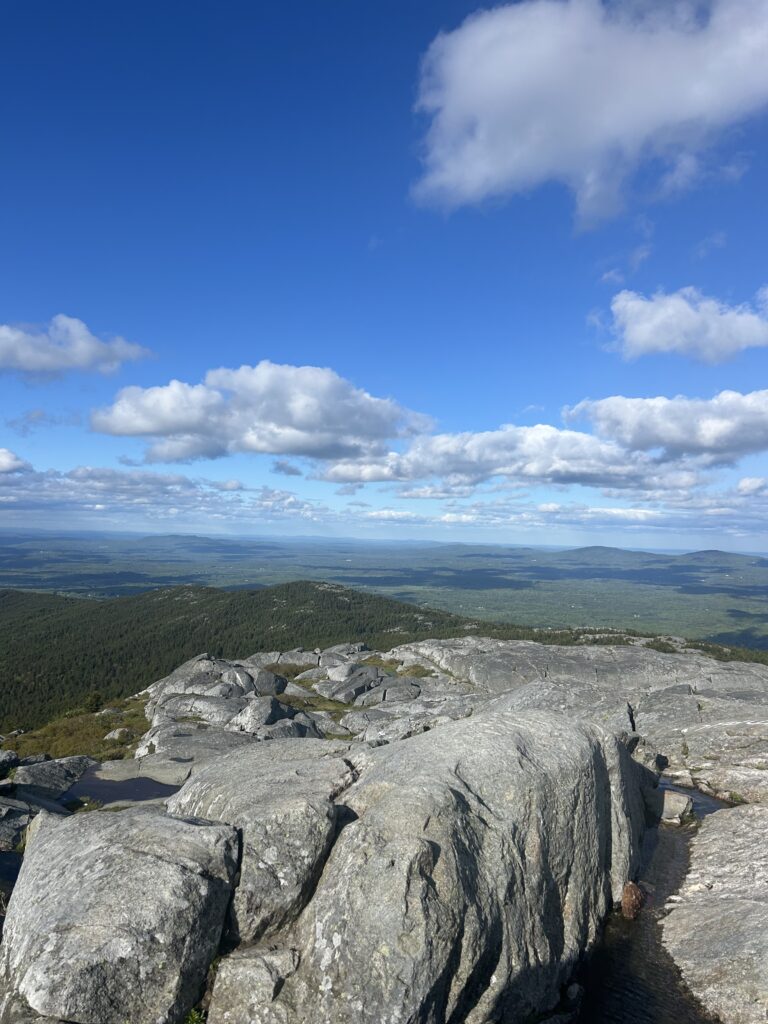
I decided to contribute one of my own photos for this week’s installment of “Postcards From” because I was reminiscing during the brief window of warm weather the other week in New York on a crisp summer hike I took in New Hampshire last year. After a scenic climb up the mountain and exhausting trek back down, my hiking partner and I were walking to the car when I looked through my binoculars and spotted a group of bobcat kittens playing nearby. I can’t wait to get back on the trails as conditions warm up!
Today’s Climate readers, what are you most excited to do as the seasons change? Any fun memories to share from last year that you are looking forward to recreating? We want to feature your photos from nature, whether you are in a city, suburb, forest or anywhere in between. Please send your photos to [email protected].
About This Story
Perhaps you noticed: This story, like all the news we publish, is free to read. That’s because Inside Climate News is a 501c3 nonprofit organization. We do not charge a subscription fee, lock our news behind a paywall, or clutter our website with ads. We make our news on climate and the environment freely available to you and anyone who wants it.
That’s not all. We also share our news for free with scores of other media organizations around the country. Many of them can’t afford to do environmental journalism of their own. We’ve built bureaus from coast to coast to report local stories, collaborate with local newsrooms and co-publish articles so that this vital work is shared as widely as possible.
Two of us launched ICN in 2007. Six years later we earned a Pulitzer Prize for National Reporting, and now we run the oldest and largest dedicated climate newsroom in the nation. We tell the story in all its complexity. We hold polluters accountable. We expose environmental injustice. We debunk misinformation. We scrutinize solutions and inspire action.
Donations from readers like you fund every aspect of what we do. If you don’t already, will you support our ongoing work, our reporting on the biggest crisis facing our planet, and help us reach even more readers in more places?
Please take a moment to make a tax-deductible donation. Every one of them makes a difference.
Thank you,

Kiley Price
Reporter
Kiley Price is a reporter at Inside Climate News, with a particular interest in wildlife, ocean health, food systems and climate change. She writes ICN’s “Today’s Climate” newsletter, which covers the most pressing environmental news each week.
She earned her master’s degree in science journalism at New York University, and her bachelor’s degree in biology at Wake Forest University. Her work has appeared in National Geographic, Time, Scientific American and more. She is a former Pulitzer Reporting Fellow, during which she spent a month in Thailand covering the intersection between Buddhism and the country’s environmental movement.