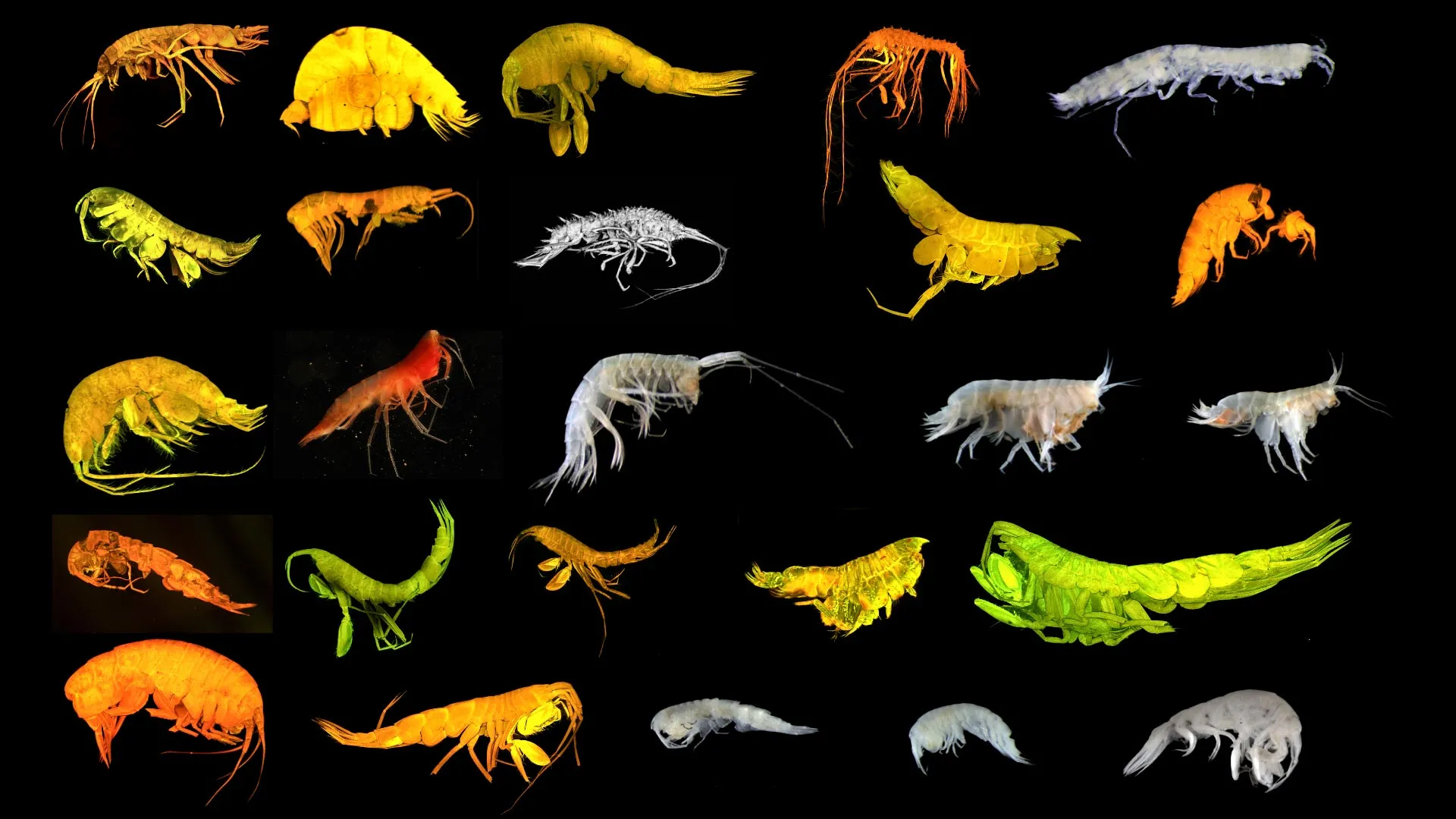


Beneath the neon lights of a laser-scanning microscope, newly classified species glow in vivid greens and oranges—a far cry from the pitch-black abyss of their natural ocean floor.
Researchers have identified 24 new deep-sea creatures and a whole new evolutionary branch in the Clarion Clipperton Zone (CCZ), a wide swath of ocean between Hawaii and Mexico. The findings surface as the Trump administration, via a January mandate from the National Oceanic and Atmospheric Administration, has fast-tracked permits for deep sea mining in that zone, one of the planet’s richest rare-earth metal regions.
The identification of a new branch of life underscores the stakes of an international regulatory vacuum: Mining might be allowed to occur before scientists even have the chance to name species that call the seabed home.
Tammy Horton, co-author and researcher at the National Oceanography Centre, Southampton, explained the significance of a new evolutionary branch this way: “If you imagine that on planet Earth, we know about carnivorous mammals, we know that bears exist and we know that the families of cats exist, it would be like finding dogs.”
That superfamily of amphipods that researchers described dwell 13,000 feet down. Compared to their shallow-water relatives—like common sand fleas tucked under seaweed on beaches—these deep-sea species have evolved in darkness for millions of years. The shrimp-like creatures with a unique conical mouth mostly measure around one centimeter.
“It was, and it still is, the most exciting thing I’ve had in my career,” said Horton, highlighting how discovering new species in the deep sea is relatively common, but only very rarely a new superfamily. “It just shows you how little we know about what’s in the deep sea.”
The breakthrough was the result of immense scientific collaboration. Horton and co-author Anna Jażdżewska each individually worked on their collections before realizing they’d reached the same conclusions. Merging datasets and bringing together a team of more than a dozen experts accelerated the often years-long taxonomic process into a single week’s workshop.
Researchers immortalized their finds by naming them. Byblis hortonae and Byblisoides jazdzewskae took inspiration from Horton and Jażdżewska, respectively, while Horton bestowed her daughter’s name on the new superfamily: Mirabestia maisie. The names serve a deeper purpose than mere tribute.
Naming species affords them a “passport for living,” said Jażdżewska, professor at the University of Łódź. It allows people and policymakers to think about a species like the living entity it is.
“Until they are properly named for science in this official way, they are not communicable about,” said Horton. “It absolutely gives them a passport to be discussed, to be talked about, to be conserved.”
However, with over 90 percent of species in the CCZ still unnamed, it will likely be difficult for policymakers to know the true impacts of proposed deep-sea mining projects on fauna.
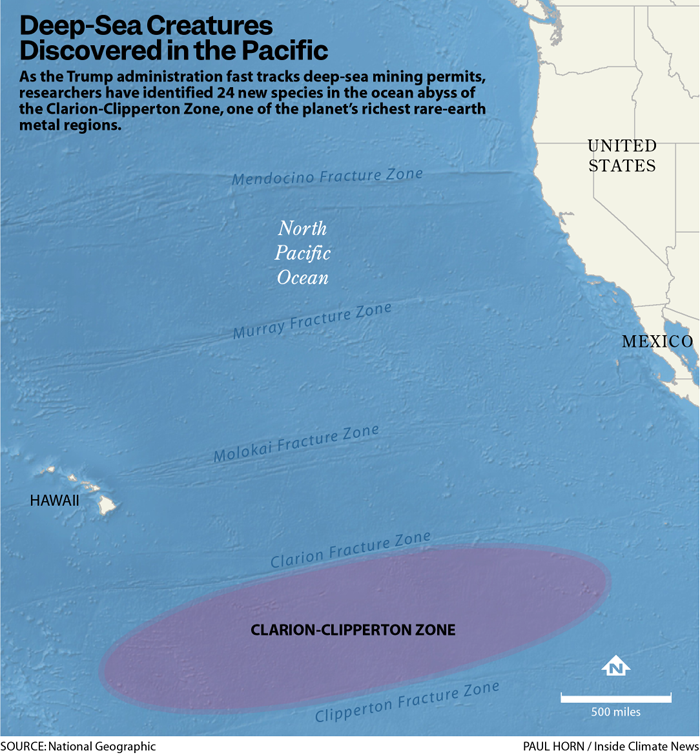
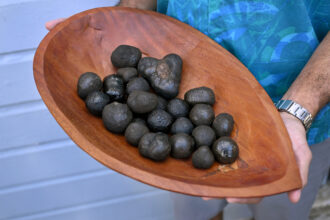
Spanning 1.7 million square miles of the eastern Pacific seabed, the CCZ teems with significant stores of manganese nodules. These potato-sized deposits contain high concentrations of battery-grade metals such as nickel, cobalt and copper.
In January, NOAA finalized changes to the Deep Seabed Hard Mineral Resources Act that fast-track deep-sea mining projects by allowing companies to apply for a commercial recovery permit at the same time as an exploration license. Previously, companies were required to undertake extensive scientific research prior to receiving an extraction permit.
“This consolidation modernizes the law and supports the America First agenda,” said Neil Jacobs, NOAA’s administrator, in a statement. Earlier this month, NOAA accepted for review an application from The Metals Co. to target over 25,000 square miles of the same zone where the new species live.
Mining exacts an environmental cost. Just two months after commercial machinery plowed the CCZ’s silty seabed in large-scale tests in 2022, species abundance dropped 37 percent and biodiversity fell by almost a third, according to sediment analysis by the U.K.’s Natural History Museum.
Horton and Jażdżewska plan to keep uncovering the wonders of the deep sea as part of the International Seabed Authority’s Sustainable Seabed Knowledge Initiative to identify 1,000 new species by the end of the decade.
Indeed, while the description of two dozen new species and the discovery of a new superfamily is a monumental leap, researchers know much further identification work lies ahead. Understanding how the animals live, how they reproduce and what they feed on is completely unknown beyond basic inference, said Jażdżewska.
“We’ve just done 24 and that is a drop in the ocean, literally, of how many more we have to describe,” said Horton.
About This Story
Perhaps you noticed: This story, like all the news we publish, is free to read. That’s because Inside Climate News is a 501c3 nonprofit organization. We do not charge a subscription fee, lock our news behind a paywall, or clutter our website with ads. We make our news on climate and the environment freely available to you and anyone who wants it.
That’s not all. We also share our news for free with scores of other media organizations around the country. Many of them can’t afford to do environmental journalism of their own. We’ve built bureaus from coast to coast to report local stories, collaborate with local newsrooms and co-publish articles so that this vital work is shared as widely as possible.
Two of us launched ICN in 2007. Six years later we earned a Pulitzer Prize for National Reporting, and now we run the oldest and largest dedicated climate newsroom in the nation. We tell the story in all its complexity. We hold polluters accountable. We expose environmental injustice. We debunk misinformation. We scrutinize solutions and inspire action.
Donations from readers like you fund every aspect of what we do. If you don’t already, will you support our ongoing work, our reporting on the biggest crisis facing our planet, and help us reach even more readers in more places?
Please take a moment to make a tax-deductible donation. Every one of them makes a difference.
Thank you,
Johnny Sturgeon
Fisheries Reporter
Johnny Sturgeon is a London-based reporter covering fisheries and aquaculture. Joining us from the Outlaw Ocean Project, he has experience producing in-depth maritime investigations for nonprofit newsrooms. A former boatbuilder, he holds a B.A. in History & Politics from the University of Oxford, and an M.S. from Columbia Journalism School.