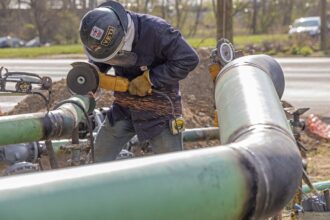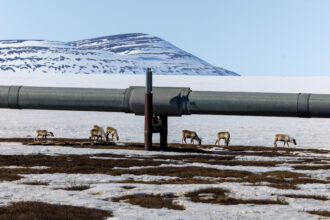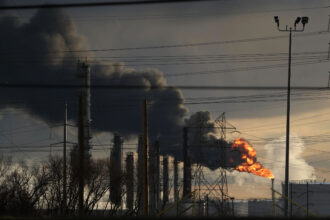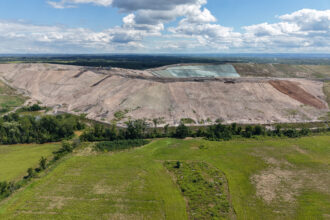


Five environmental groups are petitioning a federal appeals court to invalidate a water quality permit issued by the U.S. Army Corps of Engineers for a controversial Transco pipeline.
The $1.5 billion Southeast Supply Enhancement Project (SSEP) would run through five states, including North Carolina, where it would extend for 28 miles in Rockingham, Guilford, Forsyth and Davidson counties.
The SSEP is one of the largest pipeline capacity expansions in the Southeast in decades, and necessary, Transco says, to meet regional demand for natural gas. It involves adding pipelines alongside existing ones to carry more gas between the Gulf and the Southeast.
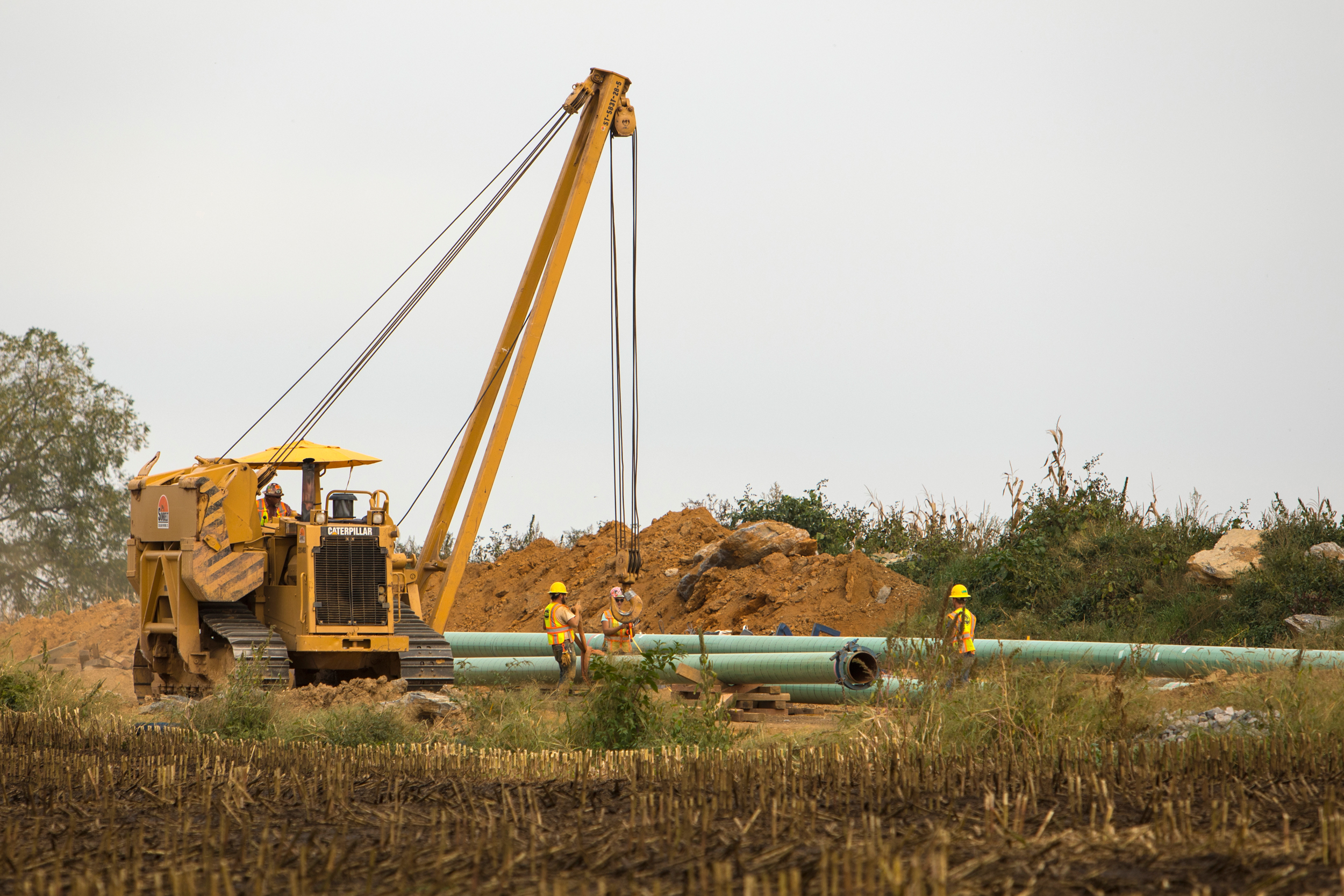
For 165 of the pipeline’s 173 stream and wetland crossings, Transco received a federal water quality permit from the Corps to construct the pipelines using a “dry-ditch, open-cut” crossing method, which can permanently damage aquatic ecosystems.
The method involves dewatering the construction site by diverting the river or stream flow while the ditch is dug and the pipe is laid, according to a 2021 study by Downstream Strategies of West Virginia, an economic and environmental consulting firm. The goal is to reduce the sediment releases from pipeline construction into the stream.
However, releases still occur, the study says, often when the diversion materials are being installed. Excess sediment can suffocate aquatic life, and bury their food sources and eggs. It can also carry other pollutants, which burden treatment plants if the river is a drinking water supply.
“Rivers have the right to flow and thrive. Our communities and all species have the right to a healthy environment. We continue to raise our voices against SSEP, and the dangerous policies that put corporate profit over community wellbeing,” said Crystal Cavalier-Keck, executive director of 7 Directions of Service, a North Carolina environmental nonprofit led by indigenous people.
The Southern Environmental Law Center and the Appalachian Mountain Project are representing the plaintiffs before the Fourth Circuit Court of Appeals: Wild Virginia, 7 Directions of Service, Haw River Assembly, Sierra Club and Appalachian Voices.
Williams, the parent company of Transco, told Inside Climate News that “the Southeast Supply Enhancement project has undergone a rigorous, multi‑year review process, and the Army Corps of Engineers issued the Section 404 permits following a thorough evaluation under federal law. We strongly disagree with the claims raised in the SELC lawsuit and are confident the Corps’ permitting decision is sound and will be upheld.”
The Corps did not respond to a request for comment.
More than 90 environmental groups had petitioned the Federal Energy Regulatory Commission (FERC) in 2024 to require Transco to submit a comprehensive Environmental Impact Statement about the project. Instead, the following year, FERC allowed the company to file an Environmental Assessment, which is less thorough and has a shorter public comment period.
Many local governments along the SSEP route in North Carolina passed resolutions of concern about the expansion, which will also require new, powerful compressor stations that push the gas down the pipeline. Compressor stations release many harmful air pollutants, including carbon monoxide, volatile organic compounds, particulate matter and greenhouse gases.
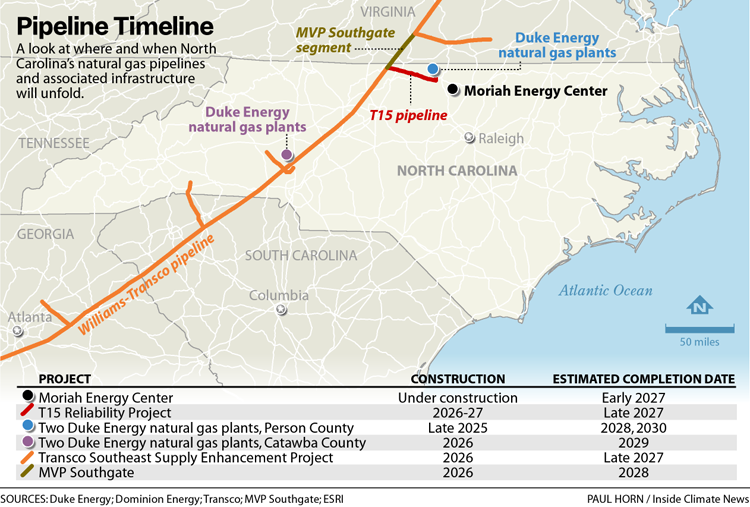
The SSEP is part of a vast natural gas expansion in North Carolina. It would intersect Enbridge’s T15 Reliability Project, which runs 45 miles between Person County and Rockingham County, near Eden, and the MVP Southgate, also near Eden.
MVP Southgate is an extension of the main Mountain Valley Pipeline, which runs 300 miles through West Virginia and Virginia. A consortium of energy companies owns it.
The pipelines in North Carolina would supply Duke Energy’s immense natural gas projects, including two new power plants in Person County, which are under construction. Duke has proposed at least five more, which will require approval by the state Utilities Commission.
Transco began construction on the SSEP on March 2, according to commission filings. Contractors have begun to fell trees, install acoustic barriers and conduct test drilling in preparation for blasting.
“SSEP would trench across streams and wetlands, damaging sensitive aquatic ecosystems,” said Caroline Hansley, campaign organizing strategist for the Sierra Club, in a prepared statement. “Regulators have consistently ignored the overwhelming burden the SSEP project would place on the environment and the communities it would run through. Communities all along the proposed route have passionately spoken out against this unneeded project.”
About This Story
Perhaps you noticed: This story, like all the news we publish, is free to read. That’s because Inside Climate News is a 501c3 nonprofit organization. We do not charge a subscription fee, lock our news behind a paywall, or clutter our website with ads. We make our news on climate and the environment freely available to you and anyone who wants it.
That’s not all. We also share our news for free with scores of other media organizations around the country. Many of them can’t afford to do environmental journalism of their own. We’ve built bureaus from coast to coast to report local stories, collaborate with local newsrooms and co-publish articles so that this vital work is shared as widely as possible.
Two of us launched ICN in 2007. Six years later we earned a Pulitzer Prize for National Reporting, and now we run the oldest and largest dedicated climate newsroom in the nation. We tell the story in all its complexity. We hold polluters accountable. We expose environmental injustice. We debunk misinformation. We scrutinize solutions and inspire action.
Donations from readers like you fund every aspect of what we do. If you don’t already, will you support our ongoing work, our reporting on the biggest crisis facing our planet, and help us reach even more readers in more places?
Please take a moment to make a tax-deductible donation. Every one of them makes a difference.
Thank you,

Lisa Sorg
Reporter, North Carolina
Lisa Sorg is the North Carolina reporter for Inside Climate News. A journalist for 30 years, Sorg covers energy, climate environment and agriculture, as well as the social justice impacts of pollution and corporate malfeasance.
She has won dozens of awards for her news, public service and investigative reporting. In 2022, she received the Stokes Award from the National Press Foundation for her two-part story about the environmental damage from a former missile plant on a Black and Latinx neighborhood in Burlington. Sorg was previously an environmental investigative reporter at NC Newsline, a nonprofit media outlet based in Raleigh. She has also worked at alt-weeklies, dailies and magazines. Originally from rural Indiana, she lives in Durham, N.C.