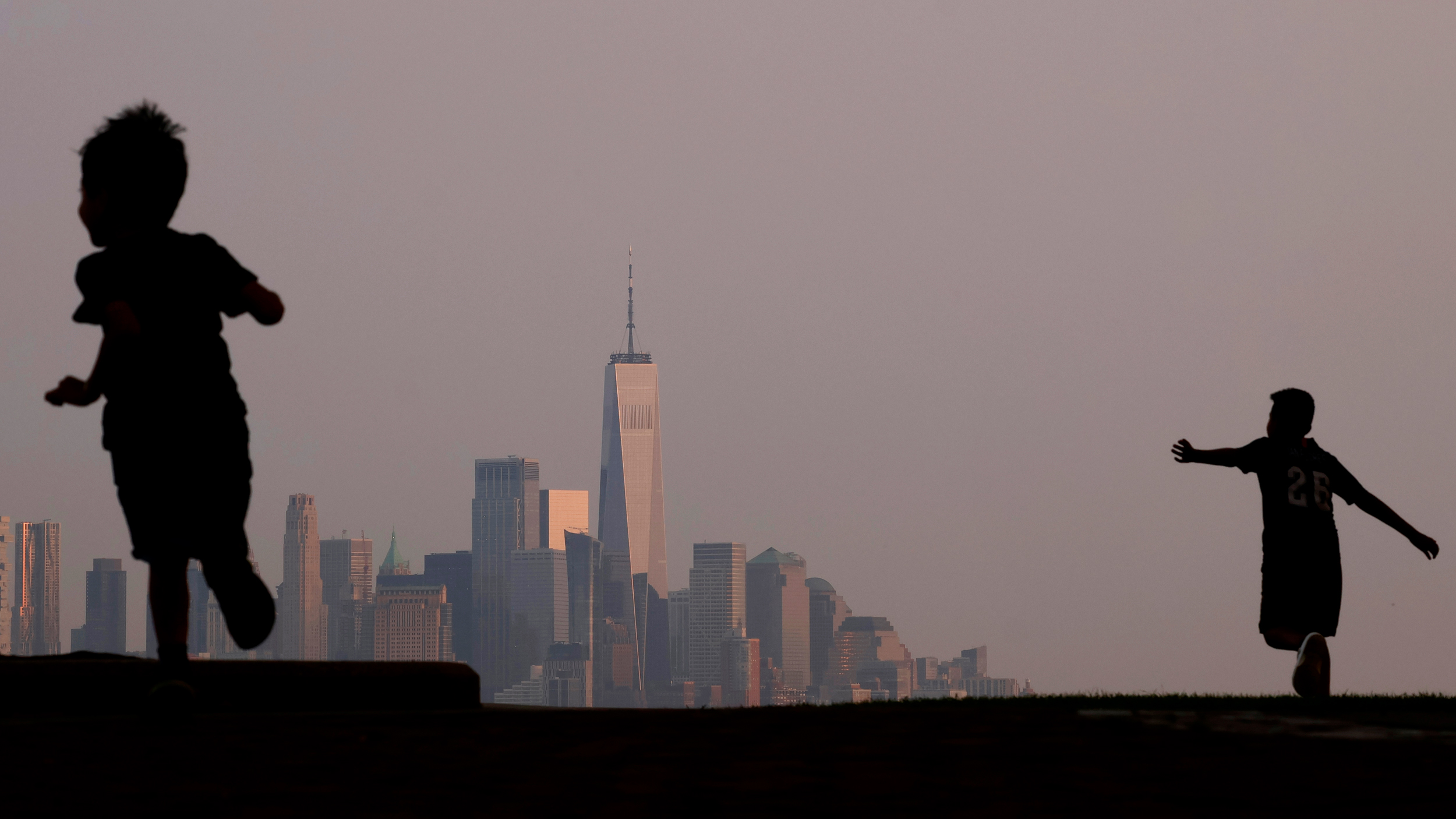


Nearly half the nation’s children live in places with dangerous levels of air pollution, according to a report released Wednesday by the American Lung Association.
That’s 33.5 million children—46 percent of the country’s kids—living in areas with failing grades for at least one measure of air pollution that is particularly harmful to developing lungs.
The report also found that people of color are more than twice as likely as white people to live in a community with failing grades for all three measures. Latinos are more than three times as likely to live in such communities, unchanged from last year’s report.
Since 2000, the ALA’s annual State of the Air reports have detailed the nation’s air quality, which improved for decades following the passage of the 1970 Clean Air Act. But in recent years, heat and wildfires worsened by climate change are reversing some of that progress.
Last year’s report, covering 2021 through 2023, showed worsening air pollution during a particularly rough period that included two severe wildfire seasons. Wednesday’s report, looking at air quality from 2022 through 2024, showed that the number of people living in highly polluted areas fell from the prior period but remained well above lows within the last decade. And for the second year in a row, heat-driven ozone pollution got worse.
The takeaway is that millions of Americans are at risk, said the ALA’s Will Barrett.
“Progress is fragile,” said Barrett, the group’s assistant vice president for nationwide clean air policy. “We have a lot of work left to do to make sure that every child in the United States grows up breathing healthy air.”
Air pollution is a serious health hazard. Years of research have linked it to asthma, heart disease, dementia, cancer, low birth weight and more. It kills about 7 million people every year, the World Health Organization estimates.
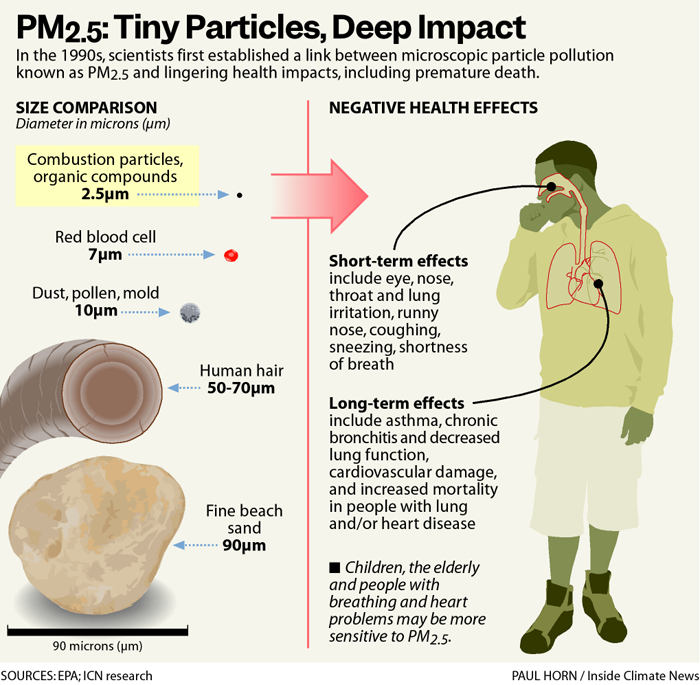
Children, whose lungs are smaller and who often breathe more rapidly than adults, taking in more pollution relative to their body size, are especially susceptible to its health effects.
The new ALA report analyzes three years of U.S. Environmental Protection Agency air monitoring data, ending in 2024, so it does not yet reflect any impacts from actions taken by President Donald Trump. But his administration has aggressively targeted clean-air protections to benefit polluting industries.
Since January last year, the Trump administration has rolled back air-quality standards, repealed the endangerment finding that allows the EPA to act on climate health threats and granted widespread pollution exemptions to industrial facilities and power plants. It’s also reinvesting in coal.
Each will harm health, experts warn. The ALA is calling on the public to pressure the EPA to reverse course.
“They are devaluing the health of our children by ignoring the costs of air pollution,” Barrett said. “In the years ahead, we will start to see the devastating effects of those decisions.”
In an emailed statement, an EPA spokesperson said the agency is continuing to regulate air pollution and that protecting human health and the environment remain its central goals.
The agency wrote that the ALA “gets lots of money from left-wing foundations,” and that “spreading lies” that the federal government is leaving pollution unchecked would be “grossly irresponsible.”
The ALA’s supporters include private foundations like the CVS Health Foundation as well as large corporations, including Pfizer, AstraZeneca and PayPal. Since Trump regained office, the EPA has frequently claimed that critics of its policies are left-wing radicals.
“Each and every day, we have proven that we can BOTH protect the environment and grow the economy, and we won’t stop in our mission to make sure every American is healthier than ever and breathing clean, crisp air,” the agency wrote.
Raising the Alarm on Pollution
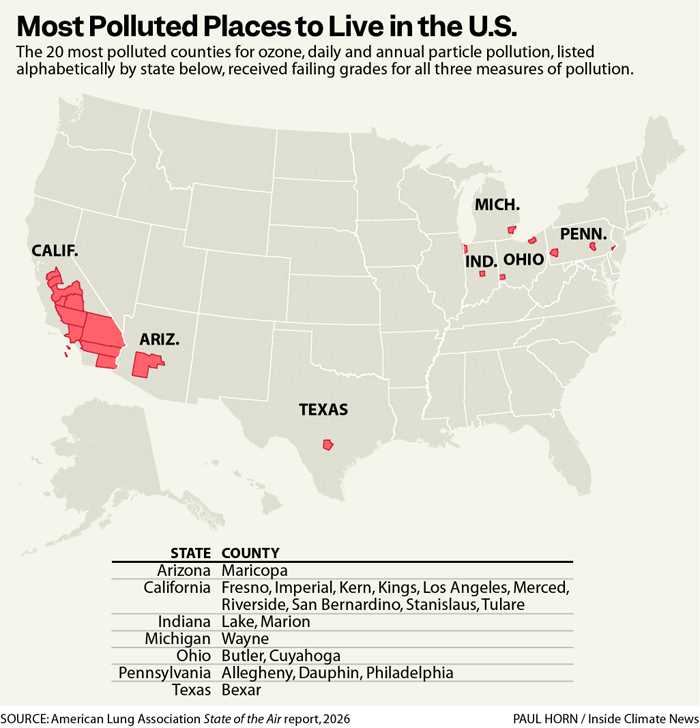
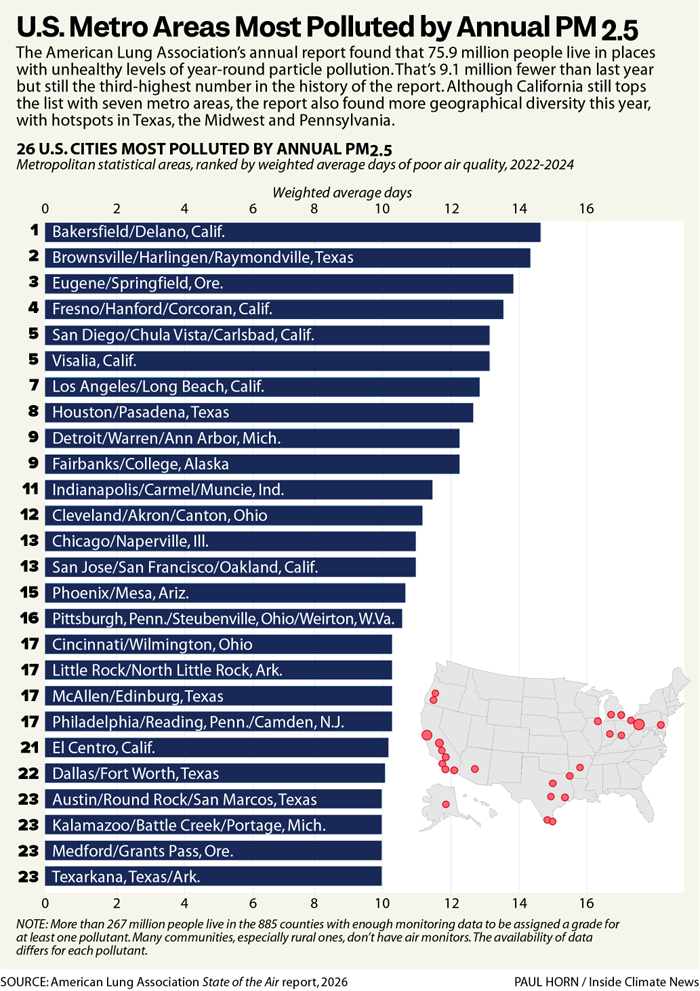
The ALA looks at three measures for air pollution: ground-level ozone—often called smog—and both daily and annual measures of particle pollution, all of which are harmful. The group found that 152 million people, or 44 percent of the U.S. population, live in areas with failing grades for at least one of those measures.
That’s about 4 million fewer than last year’s report. But it’s still 20 million more than the 2024 report.
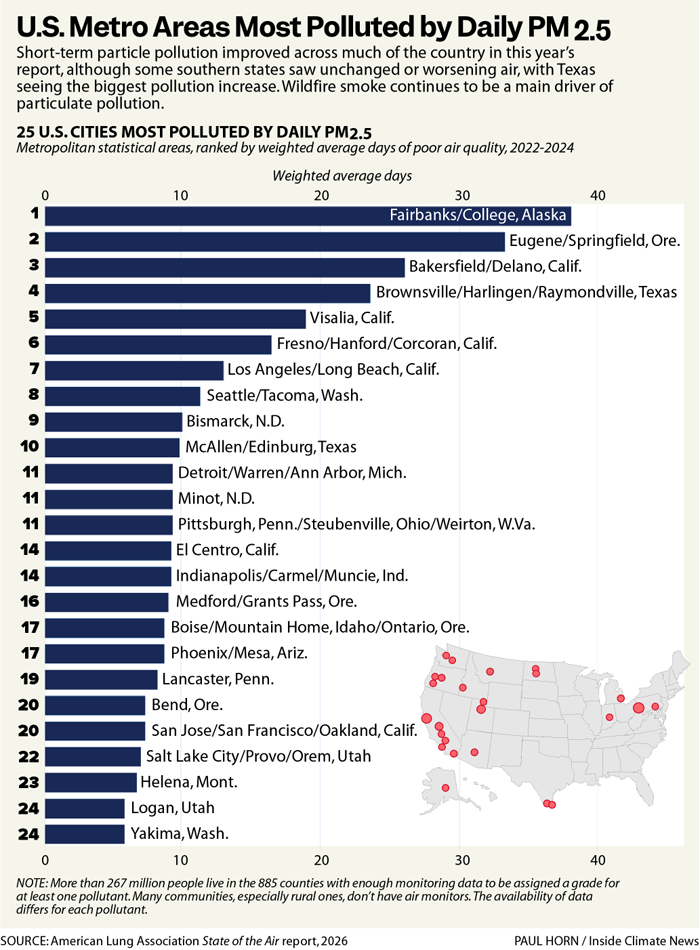
About 62 million people live in counties with a failing grade for short-term particle pollution. That’s 15.6 million fewer than last year’s report, ending a seven-year streak of continuous increases. Still, the numbers are much higher than the historic low of 35 million in 2018.
What Is Ground-Level Ozone?
Ground-level ozone is a pollutant created when nitrogen oxides and volatile organic compounds interact with sunlight, producing “smog” that makes it harder and more dangerous to breathe. That’s different from stratospheric ozone—the good kind—which occurs naturally in the upper atmosphere and helps cool the Earth’s surface by providing protection from the sun’s rays.
Vehicles, power plants, oil production and other industrial sources contribute ingredients for the bad kind of ozone. Manmade emissions, meanwhile, are eroding the good kind of ozone, contributing to dangerous global heat that further ramps up smog.
And like last year, smoke from wildfires fueled in part by climate change remains a significant driver of this pollution.
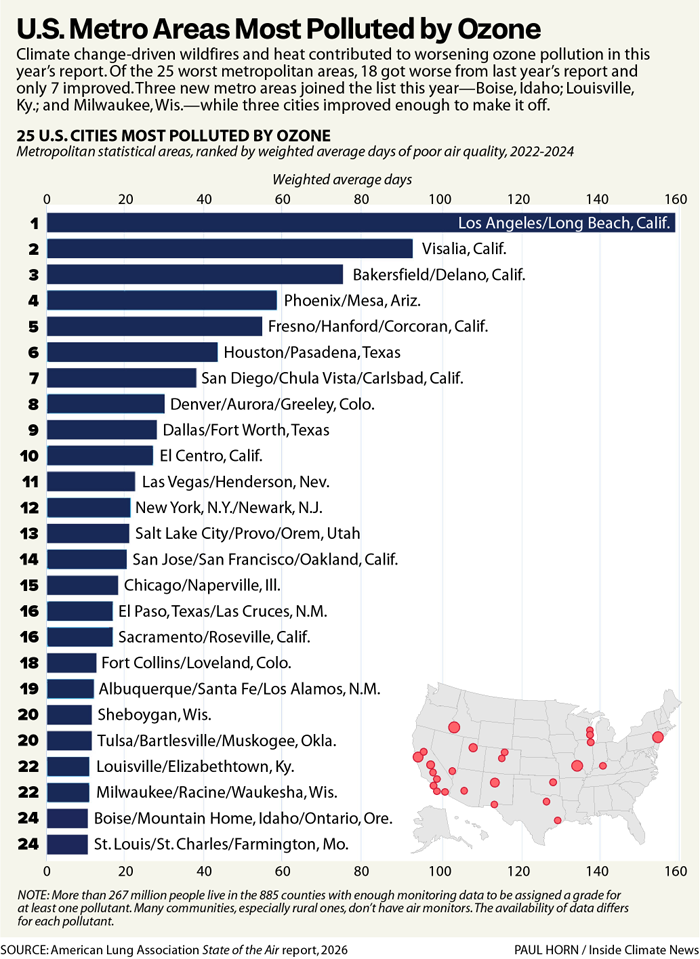
Meanwhile, smog got worse. More than 129 million people are living in counties with failing grades for ground-level ozone pollution, a 4 million increase from last year’s report. The Southwest and Midwest regions are most impacted by worsening ozone, the report found, likely driven by climate-related extreme heat, drought and wildfires.
Doctors often describe the effects of ozone pollution as “sunburn of the lungs” because it can cause intense inflammation. Shortness of breath, coughing, asthma, bronchitis and even premature death can follow.
Mary Wagner lives in Las Vegas—one of the fastest-warming cities in the country—with her two sons. Her oldest, 15, has had asthma since he was very young. His attacks get worse during heat waves and when wildfire smoke blows in from California, she said.
The Nevada field organizer for Moms Clean Air Force, Wagner is angry that the federal government is abandoning policies put in place to protect families like hers from dirty air.
“As a citizen, I just feel like they have turned their backs on us,” she said.
Her son is one of about 4.7 million children living with asthma in the U.S. About half, like him, live in areas that received a failing grade for at least one pollutant.
What Is Particulate Pollution?
Particulate matter pollution is a mix of solid particles and liquid droplets that range in size and can contain hundreds of different kinds of chemicals. Particle pollution less than 10 micrometers in diameter can get into human lungs and even the bloodstream, causing serious health harms.
The American Lung Association report focuses on fine particulate matter, the most dangerous type: PM 2.5, or very tiny inhalable particles with diameters of 2.5 micrometers or less. That pollution can cause heart attacks, aggravated asthma, decreased lung function and premature death.
More than 530,000 children and over 2 million adults with asthma live in areas that fail on all three measures.
For many children diagnosed with asthma, it can be a lifelong condition, said S. Christy Sadreameli, a pediatric pulmonologist at the Johns Hopkins Hospital and an ALA volunteer.
Sadreameli said her patients and their families have reported asthma flare-ups on days with extreme heat, and when wildfire smoke from Canada brought unusually acute air pollution to Baltimore and other parts of the East Coast in recent years.
She has started counseling patients to check air quality on hot days and be aware that their symptoms may worsen. Although poor air quality impacts everyone’s health, people with existing lung conditions feel it more acutely, she said.
Liz Hurtado, senior manager of field engagement and partnerships at Moms Clean Air Force, has become increasingly conscious about the air’s impact on her four children. She now checks her air-quality app before sending them outside to play, she said.
“Those are things we shouldn’t have to do,” Hurtado said.
Hurtado also manages EcoMadres, the organization’s program dedicated to outreach and engagement with Latino communities. She wasn’t surprised to see how disproportionately burdened Latinos are, but the statistics were still “gut-wrenching.”
The federal immigration crackdown has made some communities she works with more hesitant to advocate publicly for the government to step up for clean air, Hurtado said, adding to already existing fear and distrust. Still, she wants to motivate people to advocate for their health. She hopes the information in the report can be a galvanizing force.
“The report is such a powerful resource to inform our community and at the same time use those resources, those statistics to take action,” Hurtado said. “We really look forward to this every year.”
Calling for Action Against EPA Rollbacks
The ALA report is partially hamstrung every year by the dearth of air monitoring across many parts of the country.
More than 267 million people live in the 885 counties nationwide that have enough monitoring to be included in the report, the group says. But the majority of U.S. counties don’t have official monitors, leaving about 74 million people—largely in rural areas—in the dark about what kind of air they’re breathing.
The report’s authors also warn that the artificial intelligence boom makes clean air regulations even more urgent. If left unchecked, rising energy demand and diesel-powered backup generators for a rapidly growing network of data centers will deliver more hazardous pollution, particularly in the communities closest to the facilities.
Policies aimed at improving local air pollution can work, the report’s authors argued. For the second year in a row, Sacramento, California—one of the 25 most ozone-polluted metropolitan areas in the country—marked its fewest number of smog days in the report’s history. That’s due in part to significant local air-quality management, investments in zero-emission vehicles and efforts to boost cleaner transportation options like walking and biking, Barrett said.
The lung association’s report included a call to action for the public to push the EPA to reverse course on climate change and air pollution. Instead of weakening standards for vehicles and polluting industries and eliminating crucial health-related data, the agency should push to curb emissions and prioritize children’s wellbeing, Barrett said.
“We are calling on everyone to tell the EPA that our kids’ health counts,” he said.
About This Story
Perhaps you noticed: This story, like all the news we publish, is free to read. That’s because Inside Climate News is a 501c3 nonprofit organization. We do not charge a subscription fee, lock our news behind a paywall, or clutter our website with ads. We make our news on climate and the environment freely available to you and anyone who wants it.
That’s not all. We also share our news for free with scores of other media organizations around the country. Many of them can’t afford to do environmental journalism of their own. We’ve built bureaus from coast to coast to report local stories, collaborate with local newsrooms and co-publish articles so that this vital work is shared as widely as possible.
Two of us launched ICN in 2007. Six years later we earned a Pulitzer Prize for National Reporting, and now we run the oldest and largest dedicated climate newsroom in the nation. We tell the story in all its complexity. We hold polluters accountable. We expose environmental injustice. We debunk misinformation. We scrutinize solutions and inspire action.
Donations from readers like you fund every aspect of what we do. If you don’t already, will you support our ongoing work, our reporting on the biggest crisis facing our planet, and help us reach even more readers in more places?
Please take a moment to make a tax-deductible donation. Every one of them makes a difference.
Thank you,

Keerti Gopal
Reporter, Health and Justice
Keerti Gopal covers intersections between climate change, public health and environmental justice at Inside Climate News. Previously, she covered climate activism and movement repression. She is a National Geographic Explorer and has received fellowships from Fulbright, the Solutions Journalism Network, The Lever, and the National Press Foundation.