

A key Republican joined Democrats in pushing back against the Trump administration’s proposal to slash the National Oceanic and Atmospheric Administration’s research and data collection programs at a House environment subcommittee hearing Tuesday.
NOAA requested a 26 percent reduction in its proposed budget for fiscal year 2027, with plans to terminate 35 projects and institutes.
Rep. Brian Babin (R-TX), who chairs the House Committee on Science, Space, and Technology, expressed concern about a proposed elimination of grants that support extreme weather event warnings. He said he did not believe the budget request meets Trump’s expectation for NOAA’s mission to protect lives and property.
“After the catastrophic events in Kerr County, Texas, last July 4, I’m particularly sensitive to efforts to improve flash flood watches, warnings, decisions, support and products that inform timely evacuation,” he said. “I am concerned eliminating these grants would stymie future improvements.”
The rising flood waters from the Guadalupe River killed 135 people in Central Texas.
Democratic representatives also questioned the cuts, warning that they will cost lives.
The proposed FY2027 budget would cut more than $1 billion from NOAA’s programs and attempt, for the second year in a row, to eliminate the Office of Oceanic and Atmospheric Research (OAR) and many other research and protection grants and offices. Last year, Congress rejected that cut and retained the office’s funding.
“The budget mentions terminating programs to realign to NOAA’s mission, but the mission that you’ve said today is to protect lives and property, and that requires research as well as operational capacity,” Rep. Zoe Lofgren (D-Calif.) said at the hearing. “All of which the administration appears to be suggesting be cut.”
NOAA Administrator Neil Jacobs defended the cuts, saying the research programs contained within OAR would be transferred to National Ocean Service and National Weather Service offices.
“What we’re proposing to do is actually transfer a lot of the internal research to the operational offices,” Jacobs said. “It’s really the extramural research that’s going to be cut.”
The Trump administration’s proposal would also slash funding for research that had enabled scientists and policymakers to understand humans’ impact on the environment and make informed decisions.
For example, NOAA currently operates a network of measurement stations across the globe. These stations collect air samples, which are then sent for analysis to the Global Monitoring Laboratory in Boulder, Colorado.
But the FY2027 budget threatens the future of the whole measurement network, which has already been disrupted by separate funding issues. Earlier this month, a pause in federal grant funding resulted in staff furloughs at the Global Monitoring Laboratory. Funds were released on April 16 and staff subsequently returned to work.
Joe Neguse, the Democratic congressman who represents the Boulder lab’s district, said in a statement that “we must continue to push for reversal of any plans to eliminate funding for these critical institutions or diminish the strength of our national labs, and stand strongly opposed to reckless and short-sighted proposals that undermine American science research.”
The proposed budget would eliminate funding for the network of global monitoring laboratories and 14 other climate laboratories across the country. This would include the Mauna Loa observatory, where the first significant evidence of rapidly increasing carbon dioxide levels in the atmosphere was observed in 1958.
It would also cut support for the National Sea Grant College Program, a network of 34 university projects that supports research, education and outreach on marine and coastal issues.
This story is funded by readers like you.
Our nonprofit newsroom provides award-winning climate coverage free of charge and advertising. We rely on donations from readers like you to keep going. Please donate now to support our work.
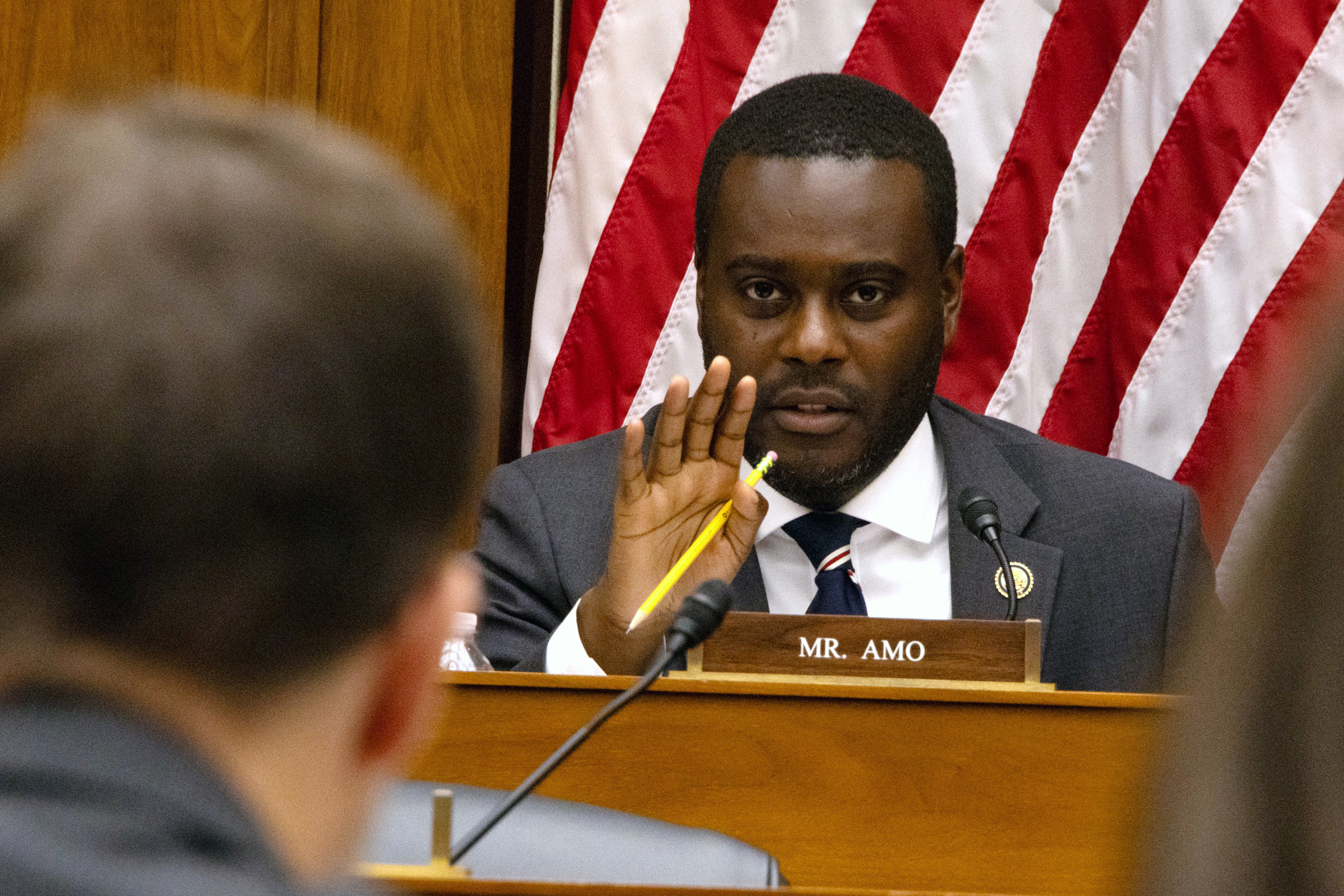
Donate NowRep. Gabe Amo (D-R.I.) defended the Sea Grant program, saying a $94 million dollar federal investment in 2024 leveraged approximately $1.5 billion dollars nationwide in economic benefits, creating businesses and an estimated 21,000 jobs. He said the termination of the grants would strike a “blow to Rhode Island’s nascent blue economy.”
“Cutting that is not saving money, it’s costing us opportunity,” he said. “Budgets are about priorities, and this one sends the wrong message. Less preparedness, more risk, and a higher cost for the American people.”
Some Republican lawmakers applauded the budget, especially the proposed increases for critical minerals exploration. Rep. Scott Franklin (R-Fla.), who chairs the environment subcommittee, said he was pleased to see the increases to the budgets of the National Weather Service and the Office of Marine & Aviation Operations.
“This budget proposal and restructuring efforts of NWS reflect the goal of both the administration and Congress to create a more nimble and flexible workforce,” Franklin said.
Environmental advocacy organizations criticized the budget proposals.
In a statement, Katherine Tsantiris, director of government relations for the Ocean Conservancy, said the cuts to NOAA “would weaken weather forecasting, disrupt fisheries management and stall ocean research—putting American lives, livelihoods and global scientific leadership at risk.” She urged Congress to reject those cuts.
Joanna Slaney, vice president for political and governmental affairs at the Environmental Defense Fund, said the proposed cuts to NOAA run counter to the administration’s own goal of American seafood competitiveness.
“Reductions to data collection, habitat restoration, ecosystem research and on-the-water monitoring would make it harder to sustainably manage our fisheries that support millions of jobs and billions of dollars in economic activity,” she said.
The cuts to OAR proposed in NOAA’s 2027 budget were similar to the administration’s past plans. While it retained OAR last year, Congress did transfer some of its funds to the National Weather Service.
“NOAA’s work saves lives and supports a thriving economy, and Congress should again reject these shortsighted cuts and invest in the services Americans rely on every day,” Slaney said.
About This Story
Perhaps you noticed: This story, like all the news we publish, is free to read. That’s because Inside Climate News is a 501c3 nonprofit organization. We do not charge a subscription fee, lock our news behind a paywall, or clutter our website with ads. We make our news on climate and the environment freely available to you and anyone who wants it.
That’s not all. We also share our news for free with scores of other media organizations around the country. Many of them can’t afford to do environmental journalism of their own. We’ve built bureaus from coast to coast to report local stories, collaborate with local newsrooms and co-publish articles so that this vital work is shared as widely as possible.
Two of us launched ICN in 2007. Six years later we earned a Pulitzer Prize for National Reporting, and now we run the oldest and largest dedicated climate newsroom in the nation. We tell the story in all its complexity. We hold polluters accountable. We expose environmental injustice. We debunk misinformation. We scrutinize solutions and inspire action.
Donations from readers like you fund every aspect of what we do. If you don’t already, will you support our ongoing work, our reporting on the biggest crisis facing our planet, and help us reach even more readers in more places?
Please take a moment to make a tax-deductible donation. Every one of them makes a difference.
Thank you,

Gabriel Matias Castilho
Fellow
Gabriel Matias Castilho is an Inside Climate News fellow reporting on the Washington, D.C. area. Previously, he worked for Capitol News Illinois, covering environmental policy, energy and utilities across the state. He is currently a master’s student at Northwestern University.