


RICHMOND, Va.—A bill backed by Virginia’s largest and most powerful electric utility is on Gov. Abigail Spanberger’s desk for final action after the legislature rejected some of her cost-saving suggestions.
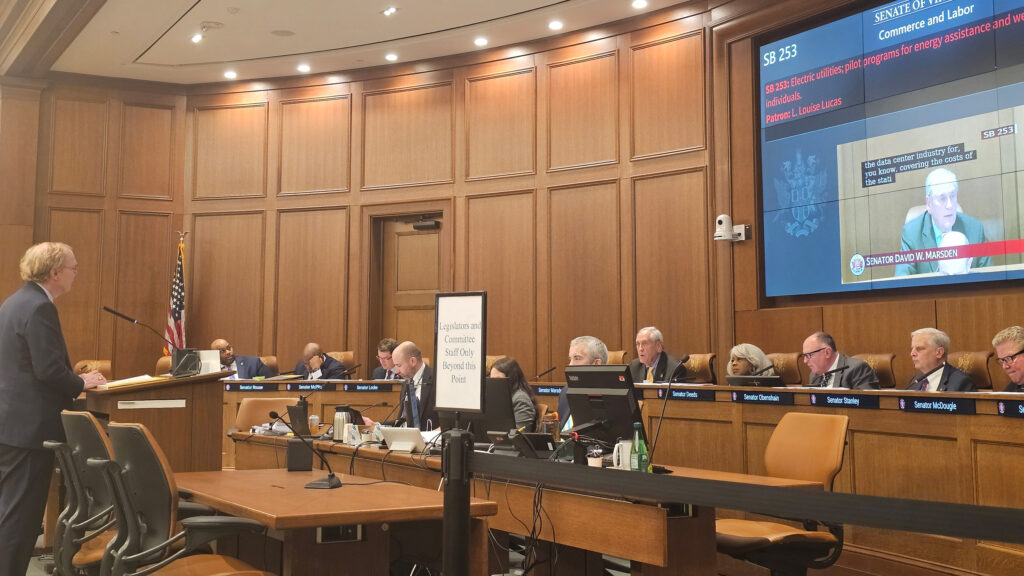
The legislation, sponsored by Senate President Pro Tempore Louise Lucas, D-Portsmouth, and Del. Destiny LeVere Bolling, D-Henrico, would assign certain electric grid upgrade costs to data centers and allow Dominion Energy to spend $900,000 a mile burying local distribution lines.
The two lawmakers receive campaign contributions from Dominion and are considered allies of the utility.
“I think we got to a good place,” said Josephus Allmond, Spanberger’s recently appointed chief energy officer, in a brief interview last Wednesday, adding that the bills are “still under review.”
Lucas touted the provision on grid upgrades as a way to make data centers pay their fair share. People have become increasingly concerned that non-data center customers are paying the costs of upgrading the grid to serve data centers. The “fair share” slogan propelled Spanberger to a 15-point victory in the November governor’s race.
“We have all heard about affordability and energy costs. There are more than 200 energy bills this session,” Lucas said. “As far as I’m aware, this is the only proposal to actually reduce rates in the near term.”
Costs to Data Centers
The grid upgrade provision would require data centers to cover the costs of buying electricity from the capacity market through PJM Interconnection, the regional grid operator for Virginia, 12 other states and the District of Columbia.
Those capacity market costs, used when there’s peak strain on the grid, ballooned from about $28 per megawatt-hour in 2023 to $329 in 2025, contributing to a 1.5 to 5 percent increase on all customers’ bills. The pace at which data centers want to connect to the grid and the lack of new power generation have caused supply-and-demand imbalance, raising costs.
Data centers are “where all the load growth is,” Joe Reid, a McGuireWoods attorney who represents Dominion, said during debate on Lucas’ legislation. “The other customer classes aren’t contributing to that expense because their load growth is flat.”
The provision would also assign the financing costs for data center distribution and substation needs to those customers. Substations allow data centers to receive electricity distant locations delivered through large transmission lines.
Dominion Energy recently had a rate case that determined how much the utility will spend to provide service and how much it can recover those costs from customers through monthly rates. In that case, distribution and substation upgrades for data centers could have cost $1.5 billion. But the State Corporation Commission, which regulates Virginia’s utilities, reduced that amount by $853 million since some of the expected data center growth may not actually materialize.
“It takes several years to construct” substations, Reid told lawmakers. Because of that time period, the construction funds require financing, which are recovered from ratepayers along with a return on equity, or profit margin, now set at 9.8 percent.
“Under current protocols, those are being paid by all customers,” Reid said.
As a result of both changes, Virginia’s electric utility regulators at the State Corporation Commission found the two changes would save a typical residential customer $5.52 a month and lower their bill by 3.4 percent starting Jan. 1. Bills for data center customers would increase by 15 percent.
The changes immediately drew the ire of the data center industry by imposing additional costs on data centers. The last rate case that created the new rate class for data centers required those customers to either agree to a 14-year contract or take electricity from a limited number of third-party independent power producers.
Under the contracts, data centers must pay for a minimum amount of their needs, even if they use less. They must also pay collateral fees upfront and exit fees if they leave Dominion’s service territory early. Those fees ensure that other customers aren’t on the hook for grid upgrades to serve data centers if they leave and disincentivize those customers from doing so.

The Data Center Coalition argued the bill’s assignment of costs would go outside of traditional ratemaking processes, and the industry could build and pay for the substation infrastructure themselves.
“That way, ratepayers are shielded from 100 percent of the costs, and not just financing costs,” said Nicole Riley, director of Virginia Government Affairs for the coalition.
Undergrounding
The provision on underground cables would allow Dominion to spend up to $900,000 a mile for a strategic undergrounding program. The program allows the utility to recover its costs and maintain its profit margin by burying the local distribution lines that deliver power to homes underground. Those lines are less prone to storm damage that causes outages. The program was set to expire in 2028.
This change drew the ire of ratepayer advocates because the undergrounding program would add a $4.88 monthly fee to a typical residential customer’s bill. For years, the SCC had been concerned about the program’s costs, rejecting it in 2016 and 2017. Then, in 2018, former Dominion-backed Senate President Pro Tem Dick Saslaw, D-Fairfax, carried the Grid Transformation and Security Act, which passed and mandated the SCC’s approval of the program.
While proponents of undergrounding support the savings from reduced outages, Dana Wiggins with the Virginia Poverty Law Center would like to see an analysis of whether the areas where lines were underground actually were susceptible to outages. Outages were minimal during Winter Storm Fern, she said.
This story is funded by readers like you.
Our nonprofit newsroom provides award-winning climate coverage free of charge and advertising. We rely on donations from readers like you to keep going. Please donate now to support our work.
Donate NowMore broadly, there are other ways to make bills affordable rather than paying for bills on the back end through the energy assistance program, she added. Energy efficiency and income- percentage payment programs can be more effective at creating economic sustainability on the front end of customer bills.
“The saddest thing is to have all of this talk around affordability, to not have people actually feel that affordability (is) affecting their lives positively on a month-to-month basis,” Wiggins said in an interview. “And to not have that be realized in full.”
The Spanberger Amendments
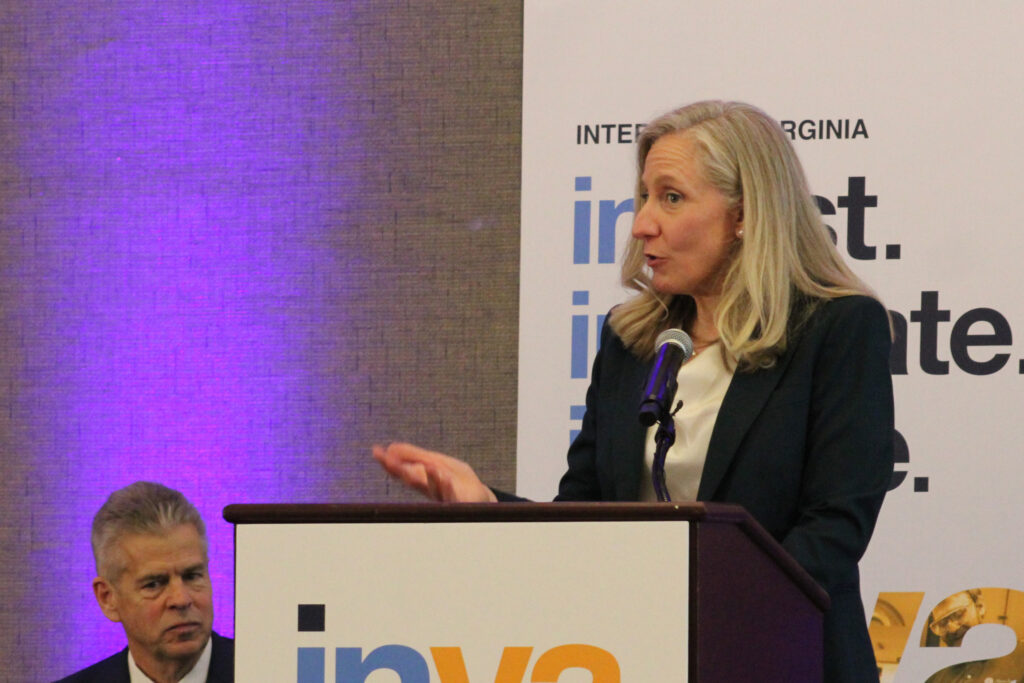
The legislation that reached Spanberger’s desk did not include several amendments she offered to protect ratepayers from costs related to the underground program.
One of the amendments would have given the State Corporation Counsel, which regulates utilities, sole discretion in deciding which proposals for burying residential power lines were “reasonable and prudent.” Without the amendment, the bill mandates approval of the program.
Another Spanberger amendment would have limited Dominion’s annual increase in expenditures on the program to no more than two percent of the utility’s rate base, the total cost of all its grid infrastructure, instead of four percent, under the bill’s original text.
On the assignment of costs to data centers, the bills allow customers employing at least 200 employees to opt out of the provisions. Spanberger wanted to raise the threshold to 10,000 customers, effectively making shipbuilders in the Newport News area only eligible to opt out.
Language was also added to have the SCC look at Dominion’s 9.8 percent profit margin. The amended language would require the utility to return any earnings above 9.3 percent to customers.
But the legislature rejected those amendments.
Another amendment from the governor added language requiring the SCC to “take all steps necessary” to ensure that costs for electricity generation and distribution to serve data centers were not paid by other customers, including residential ones. The original bill said the SCC “shall consider” shifting an estimated $1.3 billion to data centers, potentially leaving the door open for not doing so.
Still another amendment proposed removing language that established a rate for data centers with their own power plants, which is a growing trend.
Spanberger also gave the SCC more authority to determine “in its sole discretion” if a request to finance fuel costs is in the public interest when approving or rejecting the proposal. The original bill had the commission simply accept or reject the proposal.
Those amendments were accepted.
Language that requires the SCC to consider prevailing wages when evaluating approval of an energy generation project was left untouched.
“More work to do, but I think we’re in a good place,” Del. LeVere Bolling said about discussions l with the governor, adding the wage provisions were “exciting.”
“If (data centers) are going to be using more energy, they should be paying their fair share,” she added.
Spokespeople for Dominion Energy and the Data Center Coalition did not immediately respond to requests for comment.
The governor now has thirty days to either sign or veto the bills. It’s unclear what she’ll do, given the legislature’s rejection of her amendments for stronger ratepayer protections on the underground program and the over-earning refunds to customers. That could make a veto likely, but then the accepted amendment to evaluate the assignment of costs to data centers would be nixed, though how much would be assigned would be at the SCC’s discretion.
And it’s unclear what a veto would do during a tense budget-negotiation impasse between Sen. Lucas, the bill’s patron, Spanberger and the data centers
Brennan Gilmore, executive director of Clean Virginia, a group formed to counter Dominion’s influence, said without Spanberger’s amendments, the bill is another utility-backed effort to shirk regulation and maximize profit at the expense of Virginian families and businesses.
“The General Assembly failed to appropriately respond to the overwhelming chorus of Virginia voters asking for help with skyrocketing electric bills, and now it’s up to the governor to step in and veto this misguided legislation so costs don’t rise even further,” Gilmore said.
About This Story
Perhaps you noticed: This story, like all the news we publish, is free to read. That’s because Inside Climate News is a 501c3 nonprofit organization. We do not charge a subscription fee, lock our news behind a paywall, or clutter our website with ads. We make our news on climate and the environment freely available to you and anyone who wants it.
That’s not all. We also share our news for free with scores of other media organizations around the country. Many of them can’t afford to do environmental journalism of their own. We’ve built bureaus from coast to coast to report local stories, collaborate with local newsrooms and co-publish articles so that this vital work is shared as widely as possible.
Two of us launched ICN in 2007. Six years later we earned a Pulitzer Prize for National Reporting, and now we run the oldest and largest dedicated climate newsroom in the nation. We tell the story in all its complexity. We hold polluters accountable. We expose environmental injustice. We debunk misinformation. We scrutinize solutions and inspire action.
Donations from readers like you fund every aspect of what we do. If you don’t already, will you support our ongoing work, our reporting on the biggest crisis facing our planet, and help us reach even more readers in more places?
Please take a moment to make a tax-deductible donation. Every one of them makes a difference.
Thank you,

Charles Paullin
Charles Paullin is a Richmond, Virginia-based reporter focusing on energy and environment issues. He’s won several awards for his previous work covering state policy with the Virginia Mercury and local news with the Northern Virginia Daily in the Northern Shenandoah Valley. His first reporting gig was with the New Britain Herald in Connecticut, a couple years after attending the University of Hartford, where he first studied sports journalism.