

Recalling the optimism that surrounded the launch of the National Electric Vehicle Infrastructure program is bewildering, even though it happened just five years ago.
The $5 billion initiative was part of the Biden administration’s goal of having 500,000 public EV charging ports by 2030. Pete Buttigieg, Biden’s transportation secretary, said NEVI would “help us win the EV race.”
And then things went sideways. First, the Biden administration took a long time to write the program’s rules and had barely started disbursing money by the time President Donald Trump took office. Then, Trump froze the funding and has been defending the decision in court ever since.
It would be reasonable to assume that NEVI hasn’t done much. But a report issued this week by the Sierra Club tells a different story. Despite many obstacles, the program increased its reach and accomplishments in 2025, with states spending $94 million on projects. That’s more than double the $44 million spent in 2024. This translates to hundreds of charging ports, with agreements to deploy thousands more.
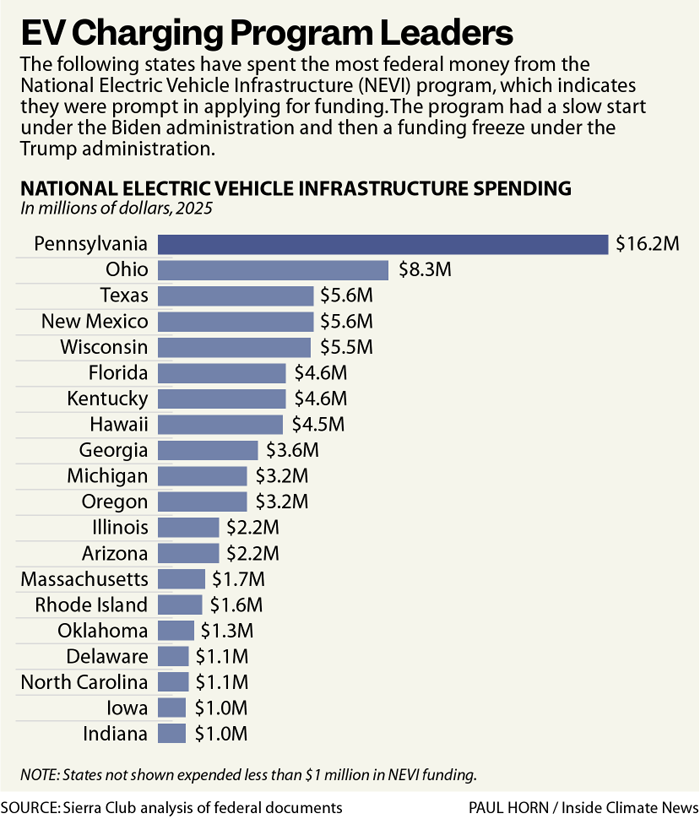
And the successes aren’t where you might expect. Pennsylvania and Ohio rank first and second, respectively, in program funding because they were among the first to get organized and apply.
But the spending is still a tiny share of the amount originally set by Congress with the 2021 Infrastructure Investment and Jobs Act, also known as the Bipartisan Infrastructure Law. More than 95 percent remains unspent, largely because of legal challenges related to the federal freeze.
“Far more urgency, accountability, and action are needed to deliver the truly nationwide EV charging system Congress promised the American people in 2021,” said Josh Stebbins, managing attorney at Sierra Club, in an email.
Stebbins is part of the legal challenges to the freeze. In one case, Washington v. U.S. Department of Transportation, 17 states and a coalition of environmental advocacy groups successfully argued that the Trump administration broke the law by trying to claw back the money. A Jan. 23 ruling by the U.S. District Court for the Western District of Washington agreed with the states and ordered that funding resume.
Advocacy groups are urging states to move aggressively to secure and spend the funds, which requires work to develop project proposals for charging stations.
The 2021 legislation allocated funding to states based on their share of federal highway aid, with the payments spread over five fiscal years starting in 2022.
At the end of 2025, $2.7 billion was available under the terms of the legislation but not yet sent to the states; $1.3 billion was “obligated” under the program, which means states had contracts to spend this money but had not spent it; and $94 million had been spent, according to the report.
The states that spent the most were the ones that moved the fastest to submit proposals from 2022 to 2024. This is why Pennsylvania, with $16.2 million from the program, has received more money than larger states such as California, which got $920,000.
Federal money covers a portion of the costs to deploy public charging stations, with others, often businesses, covering the rest.
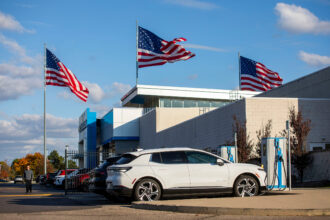
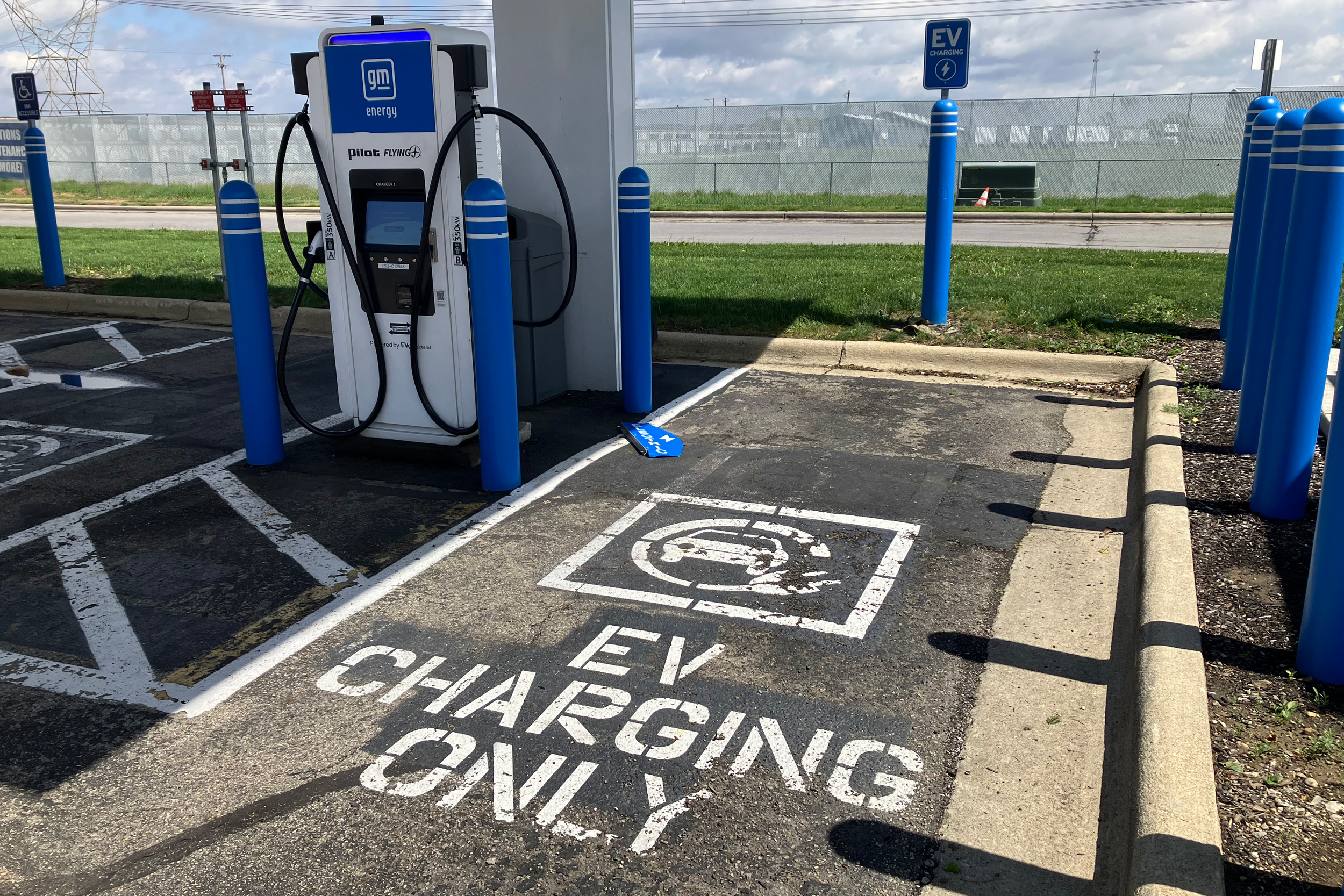
After reading the Sierra Club report, I decided to visit the first NEVI-funded project in the United States, which is a short drive from me in the Columbus metro area. It’s at a Pilot Travel Center along I-70 in London, Ohio.
The area around the exit has four large gas stations or truck stops, two of which have EV chargers.
The Pilot Travel Center’s four charging ports looked the same as when I wrote about them in 2023. And just like then, nobody was charging during my visit.
This story is funded by readers like you.
Our nonprofit newsroom provides award-winning climate coverage free of charge and advertising. We rely on donations from readers like you to keep going. Please donate now to support our work.
Donate NowSo, I went down the street to TA Travel Center, which had 12 charging ports, and met Chip and Cathy Lillyman of Celina, Ohio, who were relaxing in their Lexus RZ 450e while the battery charged.
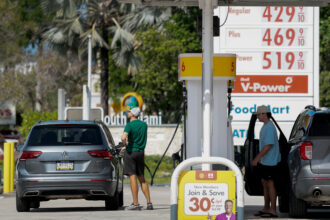
High gasoline prices make this a good time to buy an EV, even with the Trump administration’s cancellation of consumer rebates. The price was $4.29 at every station that day, which is pretty close to the local high since the Iran war started in February.
Chip Lillyman, who is a retired auto body shop owner, said high gas prices were one the main reasons they bought an EV. Previous gas price shocks are vivid in his memory, especially the one during the early 1970s Middle East oil embargo.
“I worked at a gas station at that time,” he said.

The Lillymans traded in their Honda CR-V for the Lexus last week, and plan to do most of their charging at home, but were traveling that day.
The TA Travel Center is not listed among those receiving NEVI funding.
Providing EV charging is one of several ways a convenience store can attract customers, and competition is intense at this exit. But EV market share in Ohio remains low, ranked 28th in the country as of the third quarter of last year, the most recent figure available from the Alliance for Automotive Innovation, a trade group.
As EV market share grows, convenience stores will need to add chargers. I’m going to keep checking in and see which nearby locations here have chargers, and how much they’re used.
As of March, the country had 170,158 public level 2 charging ports, which are a step up from a garage wall outlet, and 69,630 DC fast-charging ports, according to the federal government’s Joint Office of Energy and Transportation.
Five years earlier, the country had 81,601 level 2 ports and 17,231 DC fast-charging ports.
But NEVI has had little to do with the growth. The few hundred chargers connected to the program are barely a blip compared to what’s happened in the broader market, with private investment and state and local programs helping to build a national network.
Most of NEVI’s contribution is still coming, which is one reason I think the Biden-era goal of having 500,000 charging ports by 2030 is well within reach—even though the current administration is often hostile to EVs.
Other stories about the energy transition to take note of this week:
EV Ownership Reaches a Tipping Point in Much of the World: Data and recent research indicate that electric vehicle sales have reached a point of self-sustaining momentum in China, parts of Southeast Asia and Europe, Attracta Mooney, Kana Inagaki, Nassos Stylianou and Jana Tauschinski report for Financial Times. This is despite what’s happening in the United States, where the Trump administration’s cancellation of consumer tax credits has contributed to a slowdown in EV sales.
You Could Buy 5 Chinese EVs for the Price of 1 New Car in the United States: Reuters looked at the lack of affordable electric vehicle adoptions, one reason for slow adoption in the United States. The average new car in the U.S. in March cost $51,456, while Chinese automakers offer a variety of EVs that cost the equivalent of about $10,000, as Qiaoyi Li and David Dolan report.
The Trump Administration Agrees to Pay Two More Companies to Abandon Offshore Wind Leases: Bluepoint Wind and Golden State Wind have said they will end their offshore wind leases and receive reimbursements from the federal government of about $900 million, as Jennifer McDermott and Matthew Daly report for The Associated Press. This follows the administration agreeing to pay TotalEnergies to abandon plans for offshore wind projects, as part of a larger strategy to discourage offshore wind development. Bluepoint Wind was going to be off the coast of New Jersey and New York, and Golden State Wind was going to be off the coast of California.
Inside Clean Energy is ICN’s weekly bulletin of news and analysis about the energy transition. Send news tips and questions to [email protected].
About This Story
Perhaps you noticed: This story, like all the news we publish, is free to read. That’s because Inside Climate News is a 501c3 nonprofit organization. We do not charge a subscription fee, lock our news behind a paywall, or clutter our website with ads. We make our news on climate and the environment freely available to you and anyone who wants it.
That’s not all. We also share our news for free with scores of other media organizations around the country. Many of them can’t afford to do environmental journalism of their own. We’ve built bureaus from coast to coast to report local stories, collaborate with local newsrooms and co-publish articles so that this vital work is shared as widely as possible.
Two of us launched ICN in 2007. Six years later we earned a Pulitzer Prize for National Reporting, and now we run the oldest and largest dedicated climate newsroom in the nation. We tell the story in all its complexity. We hold polluters accountable. We expose environmental injustice. We debunk misinformation. We scrutinize solutions and inspire action.
Donations from readers like you fund every aspect of what we do. If you don’t already, will you support our ongoing work, our reporting on the biggest crisis facing our planet, and help us reach even more readers in more places?
Please take a moment to make a tax-deductible donation. Every one of them makes a difference.
Thank you,

Dan Gearino
Reporter, Clean Energy
Dan Gearino covers the business and policy of renewable energy and utilities, often with an emphasis on the midwestern United States. He is the main author of ICN’s Inside Clean Energy newsletter. He came to ICN in 2018 after a nine-year tenure at The Columbus Dispatch, where he covered the business of energy. Before that, he covered politics and business in Iowa and in New Hampshire. He grew up in Warren County, Iowa, just south of Des Moines, and lives in Columbus, Ohio.