

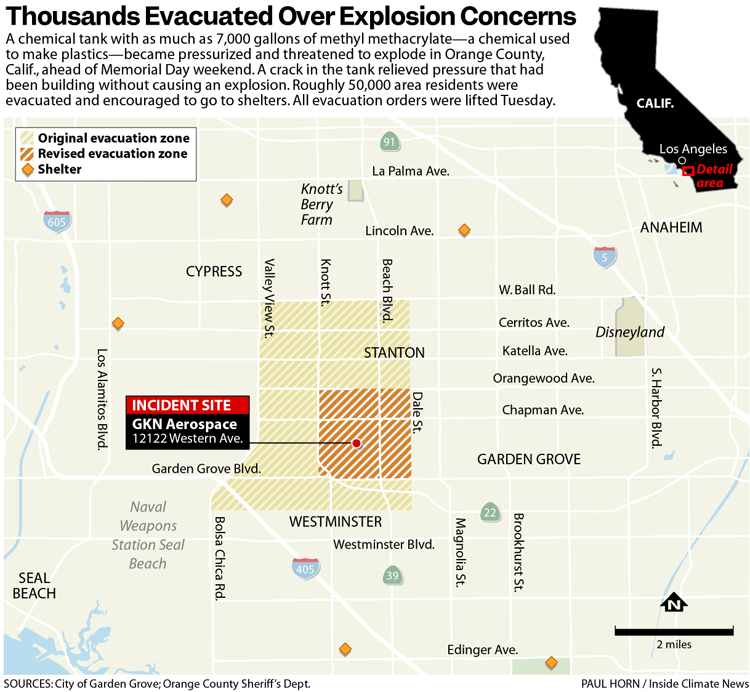
GARDEN GROVE, Calif.—The day before his 41st birthday, Hernando Morales found himself hurrying his one-year-old into the backseat of his car when an industrial tank just over a mile away from his apartment threatened to explode and release toxic chemicals throughout the area.
Five days later, local officials said it was safe and his family was allowed to return to Garden Grove.
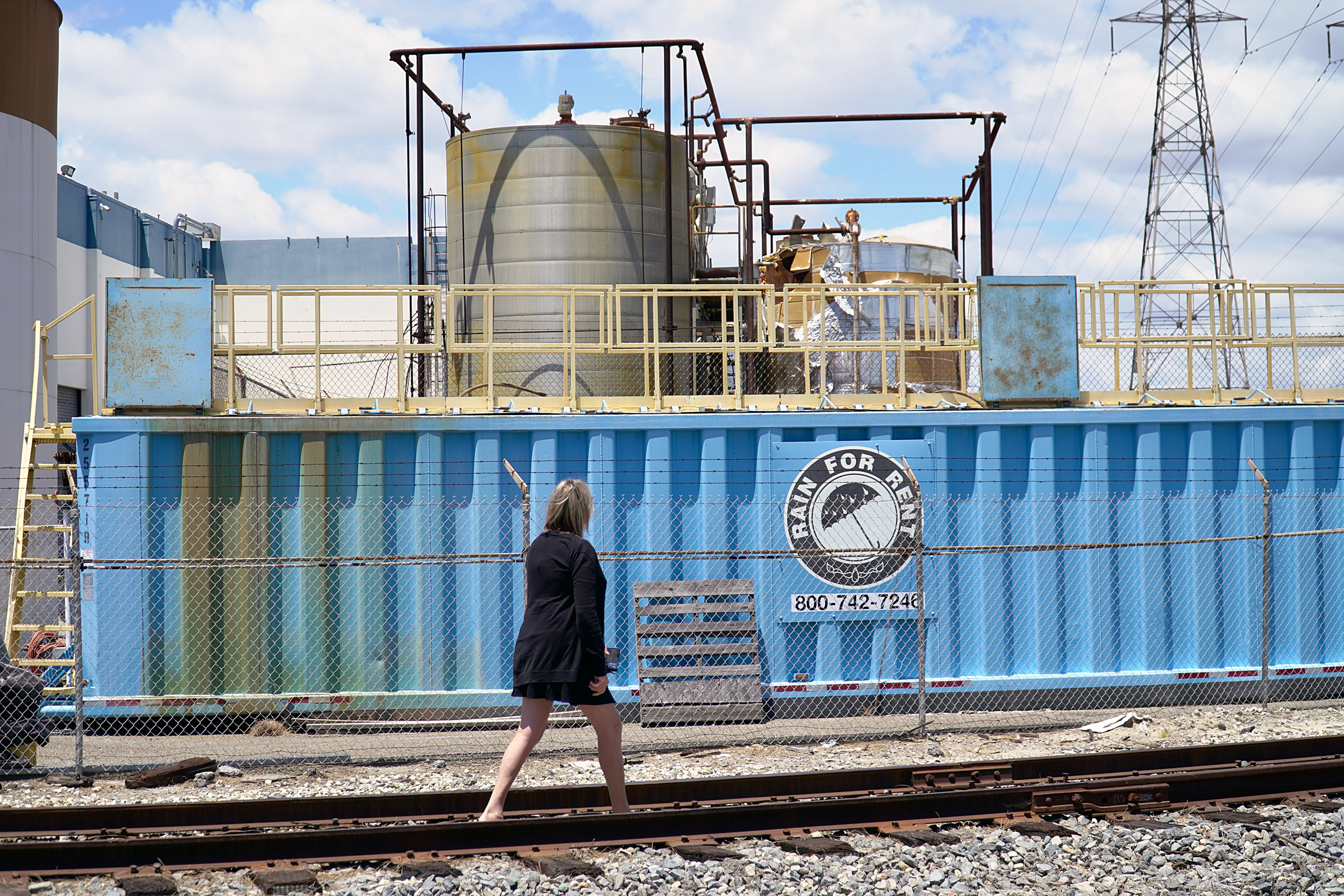
“Thank God we are able to now be back home,” Morales said in Spanish on Wednesday, while driving by the GKN Aerospace plant where the tank is located.
Multiple nights sleeping with his family in the car and days at a friend’s home took a toll, he said. “We finally got to rest last night.”
But that doesn’t ease the long-term concerns of people in Orange County about the aircraft components manufacturer.
Morales was one of about 50,000 people forced to evacuate after as much as 7,000 gallons of methyl methacrylate overheated inside of a tank and became liable to explode ahead of Memorial Day weekend. The chemical, which is used to make plastics, has a low boiling point and the resulting gas increased pressure inside the tank to dangerous levels.
The nearly week-long crisis sent thousands, including the Morales family, scrambling to pick up what possessions they could and flee their homes to nearby shelters. Today, many are left wondering how concerned they should be for their health.
“From what I’ve heard there could be toxic chemicals in the air and that’s what worries us,” Morales said from a shelter in Fountain Valley about concerns for his children and wife. “For their health.”


Orange County health officials said Tuesday there were no chemical leaks from the tank and it no longer posed a risk to the public. Air monitors around the facility did not detect methyl methacrylate or volatile organic compounds (other toxic chemicals), according to the U.S. Environmental Protection Agency.
Nonetheless, families question how safe the area is.
Andrew Whelton, a professor at the Lyles School of Civil and Construction Engineering at Purdue University, said he understood concerns from residents given the few details released by the county and federal officials over how exactly testing was conducted and what results were found around the site.
“To me, it doesn’t make sense that there was absolutely no chemical release from the tank,” Whelton told Inside Climate News on Wednesday. “If you have a pressurized soda can and you pop a hole in it, something will come out. I know the chemicals may have been captured (during the) water-spraying activity, so they didn’t leave the site, but these statements that absolutely no chemical was released from the tank are unsupported by the science and physics that I understand.”
A spokesperson for GKN Aerospace, which is based in the U.K., declined to answer questions, but referred to a statement provided Wednesday by Steve Carlin, GKN senior vice president, who oversees the Garden Grove site.
“On behalf of the team at GKN Aerospace, I want to say how sorry we are for the uncertainty and disruption this situation has caused,” said Carlin, noting the company has been a part of the community for six decades. “Officials have reported that there was no chemical leak, no contamination, and (there) have been no reported injuries.”
GKN Aerospace did not specify what air monitoring it had done on its own.
A spokesperson for EPA Region 9 told Inside Climate News via email that the federal agency deployed photoionization detectors, or PIDs, as the “primary sensor” for detecting methyl methacrylate and other possibly concerning chemicals around the GKN Aerospace facility and in the surrounding community.
Those monitors showed “no exceedances,” the EPA said. An agency spokesperson also said that Hawk IR monitoring was deployed on the tank to detect high levels of chemicals possibly escaping.
A spokesperson for the South Coast Air Quality Management District said it deployed a mobile air monitoring unit to the perimeter of the evacuation zone six times between May 21 and May 22. That monitor gathered “immediate, real-time air quality measurements.”
“Results from that air monitoring showed typical background levels both upwind and downwind of the facility,” the AQMD spokesperson said, only adding that the EPA took up wider air monitoring efforts.
The local and federal agencies did not provide detailed air test results.
The use of PID sensors to let residents know the air was safe after the six-day crisis could be worrisome, Whelton said.
“There’s a waterfall of evidence showing PID-only testing for emergencies and disasters isn’t health protective,” he said. “PIDs can be used to help inform decisions, but should not be used to determine safe versus unsafe environments.”
While PIDs can determine if methyl methacrylate, or MMA, was or was not emitted at the GKN facility, they can’t provide additional details families are asking for such as how toxic the air could have gotten in their neighborhood or the most recent test results before evacuations were lifted.
PIDs use a high-energy ultraviolet light to ionize chemicals in the air. Then, charged molecules are collected on a surface where they generate a current “proportional to the concentration of the chemical in the air being sampled,” according to a technical manual from the Occupational Safety and Health Administration, or OSHA. Experts note that while PIDs may prove useful for first responders, they do not determine specific chemical agents.
In February 2023, a train derailment, chemical spill and fire in East Palestine, Ohio, released contaminants, primarily vinyl chloride, into the air, soil, waterways and buildings. Afterward, Whelton developed a rapid-response study to determine the chemicals in the environment once the evacuation order was lifted and how returning residents could be exposed to them.

Business owners and others in Ohio conducted their own commercial lab tests and discovered that there were chemicals in buildings that PIDs never detected, Whelton noted.
“This was a catastrophic failure after the East Palestine chemical release, because the U.S. EPA at that time physically signed the testing report claiming that these devices were appropriate,” Whelton said, noting that situation shows why detailed information about the capabilities of monitors and other technologies used in similar accidents is important for residents. “Transparency is needed.”
“PIDs cannot positively identify contaminants present in an environment,” the OSHA manual states.
And PIDs “are well known to under- and overestimate chemical concentrations,” Whelton said.
In some cases, the very environmental conditions around PIDs have affected or interfered with the devices during testing. For example, temperature, humidity and extreme weather conditions can affect the devices’ reliability.
Whelton and other experts want to know what other air monitoring was done in Orange County during the tank crisis and exactly what the results showed, especially in light of community concerns. The South Coast Air Quality Management District referred additional questions about other air monitoring done to the EPA. County health officials could not immediately be reached for comment.
“For Now, We’re Staying Here”
Ronald Fritzgerald, a veteran with the U.S. Army Corps of Engineers, was among the dozens at a Fountain Valley shelter. His home in Stanton was in the zone marked red on a map identifying the areas most at risk in the event of a potential blast, but he never knew GKN Aerospace ran a plant about a mile from where he lived.
“Everything I own is in my apartment,” the 76-year-old said from the motorized scooter he uses to get around. “I literally escaped with just the shirt on my back.”
At the shelter, some families slept in their cars in the parking lot and others pitched tents, but Fritzgerald needed the bed inside due to health conditions. He had a sweater, a portable speaker and his Army Corps cap.

“Where else am I gonna live?” he responded when asked about how safe he felt returning to his home after the tank was stabilized. “This will be closed,” he said, pointing to the shelter.
“Right now, it’s short term. Right now, it’s day to day.”
Short-term exposure to methyl methacrylate has been linked by the EPA to skin and eye irritation, and, when inhaled, to respiratory problems and neurological symptoms. It is not listed as carcinogenic by the federal agency.
Francisco Lopez and Irma Ramirez were happy to get back into their home on Tuesday, but said planning for the long term around the tank is not easy. Police and local officials had warned the couple ahead of the Memorial Day weekend that the blast from the tank could be so strong it could release chemicals into their neighborhood and have enough force to shatter their windows.
This story is funded by readers like you.
Our nonprofit newsroom provides award-winning climate coverage free of charge and advertising. We rely on donations from readers like you to keep going. Please donate now to support our work.
Donate NowRamirez remembers experiencing a headache at home early during the evacuations, she said.
Despite his ongoing concerns, “for now we’re staying here,” Lopez, 50, said in Spanish, noting how much moving can cost. “We don’t have anywhere else to go.”
Noe Manjarrez and Elizabeth Manjarrez Pichardo, who have a 15-year-old son and live about two miles from GKN’s plant, spent hundreds of dollars on hotels while they were evacuated.
Elizabeth, 45, said she was eager Wednesday to return to work, a bakery that was also located in the evacuation zone.
But as the Lopezes, the Manjarrezes and other families in Orange County learn more about GKN Aerospace, they’re not finding peace of mind, they said.

A History of Citations
The U.K. company was cited by the South Coast Air Quality Management District last year for several violations and penalized $900,000.
Those included the company using more chemicals for manufacturing than its permits allowed, letting chemical emissions exceed the legal limits and mismanagement of records and permitting, according to authorities.
The Orange County Environmental Health Division most recently inspected the GKN Aerospace facility in 2024 and cited it for five violations related to labeling and managing hazardous waste, training issues and for not properly accounting for waste, the California Environmental Protection Agency said. Neither CalEPA or the U.S. EPA’s Region 9 office clarified when they had most recently done their own inspections.
OSHA has inspected GKN Aerospace facilities more than a dozen times since 2018 and given the company at least nine citations, according to a review of the agency’s data by Inside Climate News. Details on those violations were not immediately available.
The Santa Ana Water Quality Control Board inspected GKN’s facility in 2004, 2012 and 2013 and found violations during each of those inspections.
Almost 15 percent of incidents in the nation involving uncontrolled chemical reactions between 1980 and 2001 were polymerization thermal runaways like the one that threatened the GKN Aerospace tank, according to a study in the journal ACS Omega.
A study of methyl methacrylate and safety published three years ago highlighted that “from the analysis of case histories, the underlying cause of these incidents is a lack of understanding of the thermal hazards arising from unintended reaction.”
Mark Soucek, a professor of polymer science at the University of Akron, said now that the Garden Grove tank has cooled, a “runaway reaction” or spark that could lead to an explosion was unlikely.
But he wonders what condition the interior of the tank is in and what that could indicate about the incident itself.
Judith Enck, former U.S. EPA regional administrator and founder of the grassroots environmental advocacy group Beyond Plastics, said the crisis should spark a timely conversation.
“The chemical in question, [methyl methacrylate], is used to make plastic, so this is a stark reminder that [there are over] 16,000 different chemicals used to make plastic,” Enck said Wednesday on the phone.
“You run into problems even storing the chemicals, let alone turning them into consumer products.”
About This Story
Perhaps you noticed: This story, like all the news we publish, is free to read. That’s because Inside Climate News is a 501c3 nonprofit organization. We do not charge a subscription fee, lock our news behind a paywall, or clutter our website with ads. We make our news on climate and the environment freely available to you and anyone who wants it.
That’s not all. We also share our news for free with scores of other media organizations around the country. Many of them can’t afford to do environmental journalism of their own. We’ve built bureaus from coast to coast to report local stories, collaborate with local newsrooms and co-publish articles so that this vital work is shared as widely as possible.
Two of us launched ICN in 2007. Six years later we earned a Pulitzer Prize for National Reporting, and now we run the oldest and largest dedicated climate newsroom in the nation. We tell the story in all its complexity. We hold polluters accountable. We expose environmental injustice. We debunk misinformation. We scrutinize solutions and inspire action.
Donations from readers like you fund every aspect of what we do. If you don’t already, will you support our ongoing work, our reporting on the biggest crisis facing our planet, and help us reach even more readers in more places?
Please take a moment to make a tax-deductible donation. Every one of them makes a difference.
Thank you,

Steven Rodas
Reporter, California
Steven Rodas covers water, wildfires and agriculture throughout California for Inside Climate News. Based in Los Angeles, he previously reported on the environment in New Jersey, covering energy, pollution, wildlife and development. Steven’s work has appeared in the San Francisco Chronicle, NJ.com/The Star Ledger and Grist. He worked as a copywriter at Google. Steven has a master’s degree from Syracuse University’s S.I. Newhouse School Of Public Communications. He is fluent in English and Spanish (and welcomes your tips).