

This story was supported by the Pulitzer Center.
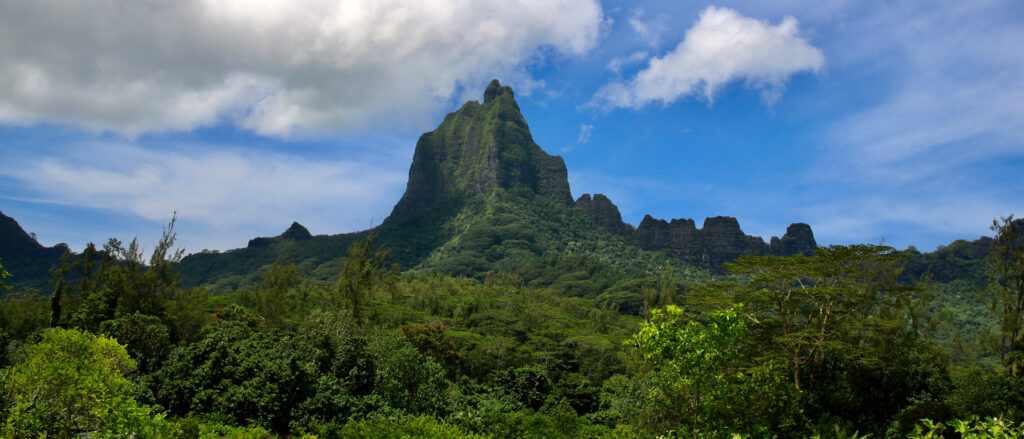
On the island of Moorea, in French Polynesia, deep green volcanic mountains slope from high peaks down towards the sea. But they don’t stop at the shore. The ridgelines of ancient lava flows stretch underwater, providing the perfect rocky substrate for a coral reef.
Between the ancient rock formations, blacktip reef sharks swish their tails over a sandy seabed. And on these underwater mountains, the reef once thrived.
In the middle of the South Pacific, 2,700 miles south of Hawaii, Moorea is known within the coral science community as an incredibly resilient place. But a new study has uncovered a peculiar phenomenon never before seen in scientific literature: hollowed-out dead corals are being structurally maintained by an encrusting algae.
When corals die, a cycle begins. Usually, storms pass through that remove dead coral “rubble” from the seabed, creating a clean slate on which new corals can seed and grow. But in Moorea, these dead corals are held in place by a host of microscopic organisms, so even as storms pass through, the skeletons remain. Since they aren’t breaking down, no new space is being created for coral to grow.
Because corals face myriad climate-related threats, understanding how and why they aren’t recovering is crucial. Though this study marks the first documentation of this hollowing-and-scaffolding phenomenon, there is some anecdotal evidence of it happening elsewhere, including on nearby islands. If this is indeed regional, or even global, this study could be the first step towards restoring reefs like Moorea’s—that are stuck somewhere between life and death.
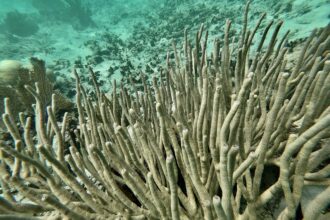
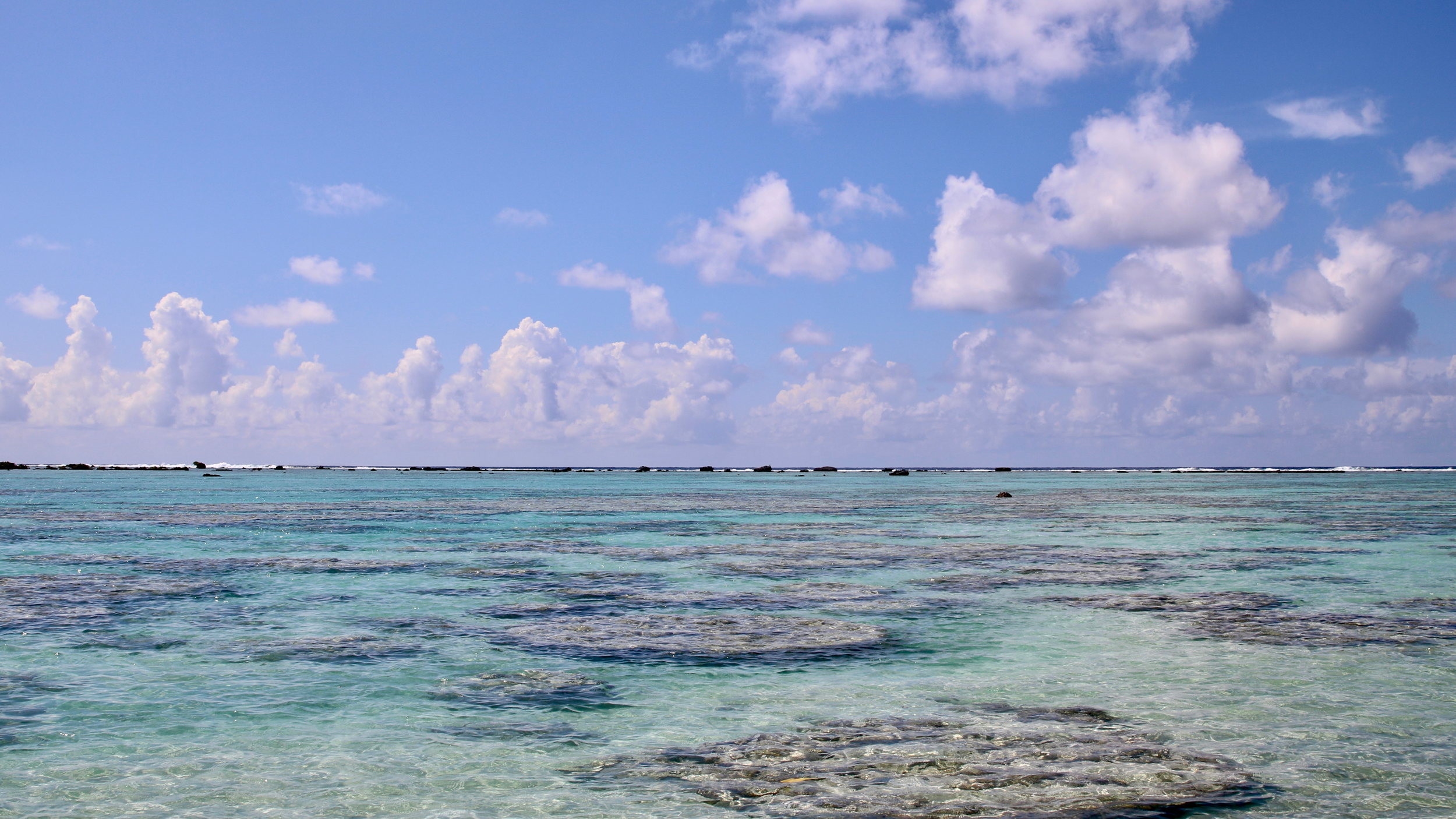
Diving on these reefs today presents a sobering picture. The grey rubble of dead corals stretches as far as underwater visibility will allow. Every few hundred feet, a living coral can be seen hanging on.
On one such dive, Hannah Stewart, head of science for the local nonprofit Coral Gardeners, was astonished. “I saw three live corals in 45 minutes,” she said. “It’s shocking.”
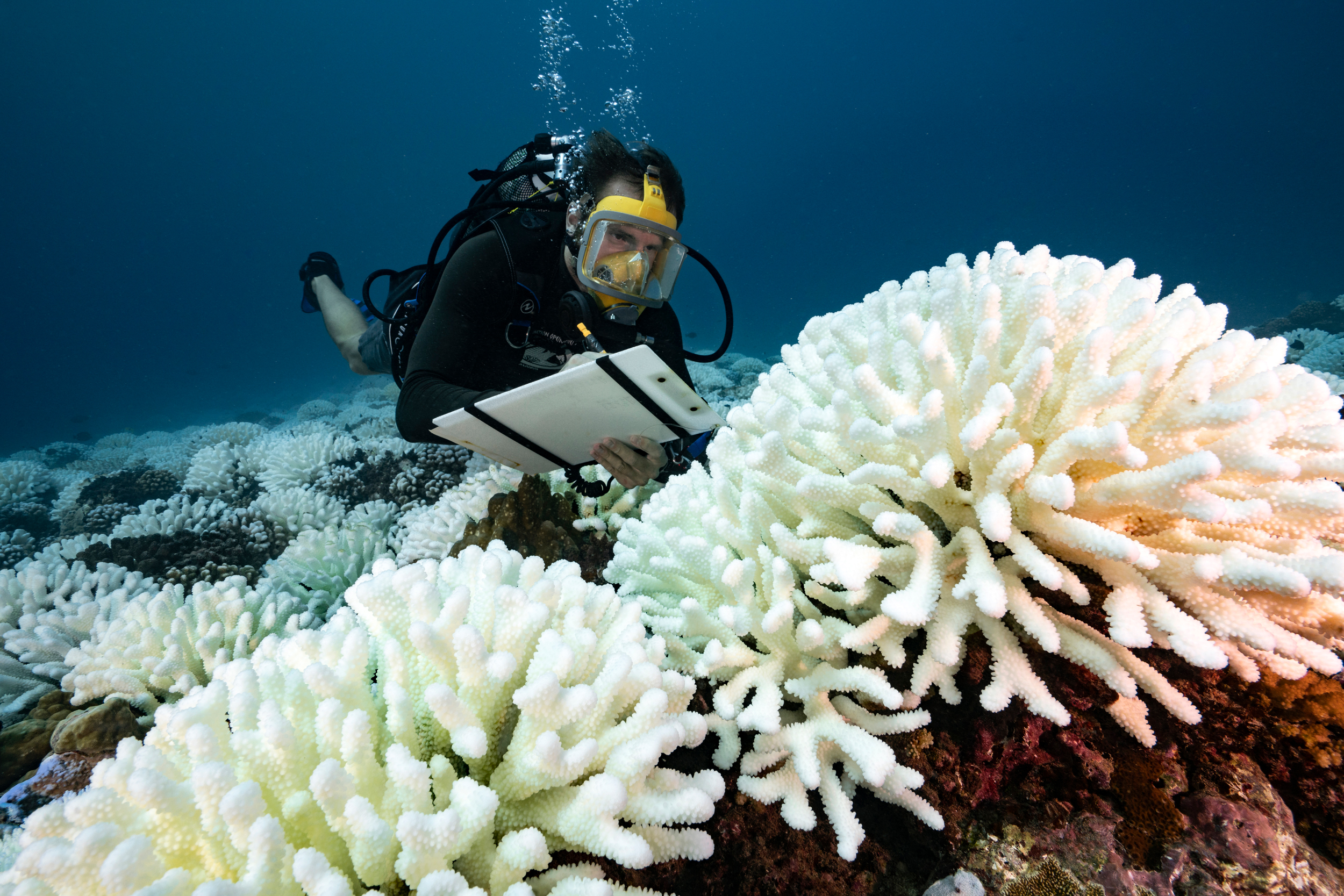
As these corals endure more frequent bleaching events, their ability to reproduce wanes. The bleaching is triggered by marine heatwaves that stress corals, causing them to expel the colorful algae that live in their tissues, turning them white.
In Moorea, the outlook for corals is often more positive than the global one. “Moorea has a fairly rapid recovery rate compared to other areas, because there’s a lot of upstream and downstream sources of larvae,” said Bill Precht, the director of coastal and marine science programs at Columbia University’s School of Professional Studies.
The Moorea Coral Reef Long-Term Ecological Research Program has closely monitored the recovery. “We’ve known what’s happening for a long time,” Stewart said. “There’s an example here in Moorea of a bleaching event killing a lot of the coral, and then a cyclone taking out that coral, but that providing a clean slate that was then recruited onto by new corals. That breakdown is important.”
Under normal circumstances, this clearing by storms has made room for new baby corals to grow. But the scientists leading the study discovered that something was inhibiting this recovery.
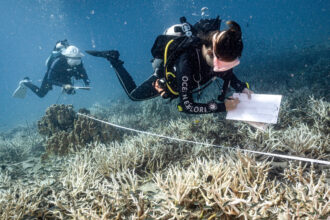
During a survey dive in 2020, Kathryn Scafidi, the study’s lead author and then Ph.D. student, was rolling out transect tape along the seabed. That day, the swell was strong, so she reached down to brace herself on a dead coral. The coral’s branch snapped off and, to Scafidi’s surprise, was entirely hollow inside.
This story is funded by readers like you.
Our nonprofit newsroom provides award-winning climate coverage free of charge and advertising. We rely on donations from readers like you to keep going. Please donate now to support our work.
Donate NowScafidi’s advisor, Peter Edmunds, who has been studying corals for over 40 years, had discovered something similar on his dive, so the pair discussed it back on the boat. In all his years, Edmunds had never seen anything like it. The team scoured the literature for anything similar and found nothing.
The scientists had previously noticed that this stretch of reef wasn’t recovering from the 2019 bleaching event. “We were a bit flummoxed,” said Edmunds, a biologist and professor at California State University, Northridge.
When Scafidi and Edmunds discovered these hollow husks of dead coral, they sent samples to their colleague Bruce Fouke, a geologist and professor at the University of Illinois. He had also never heard of this specific type of “internal dissolution” in coral skeletons. Fouke took the samples to his lab and examined them under a $1.8 million microscope that can image down to one billionth of a meter.
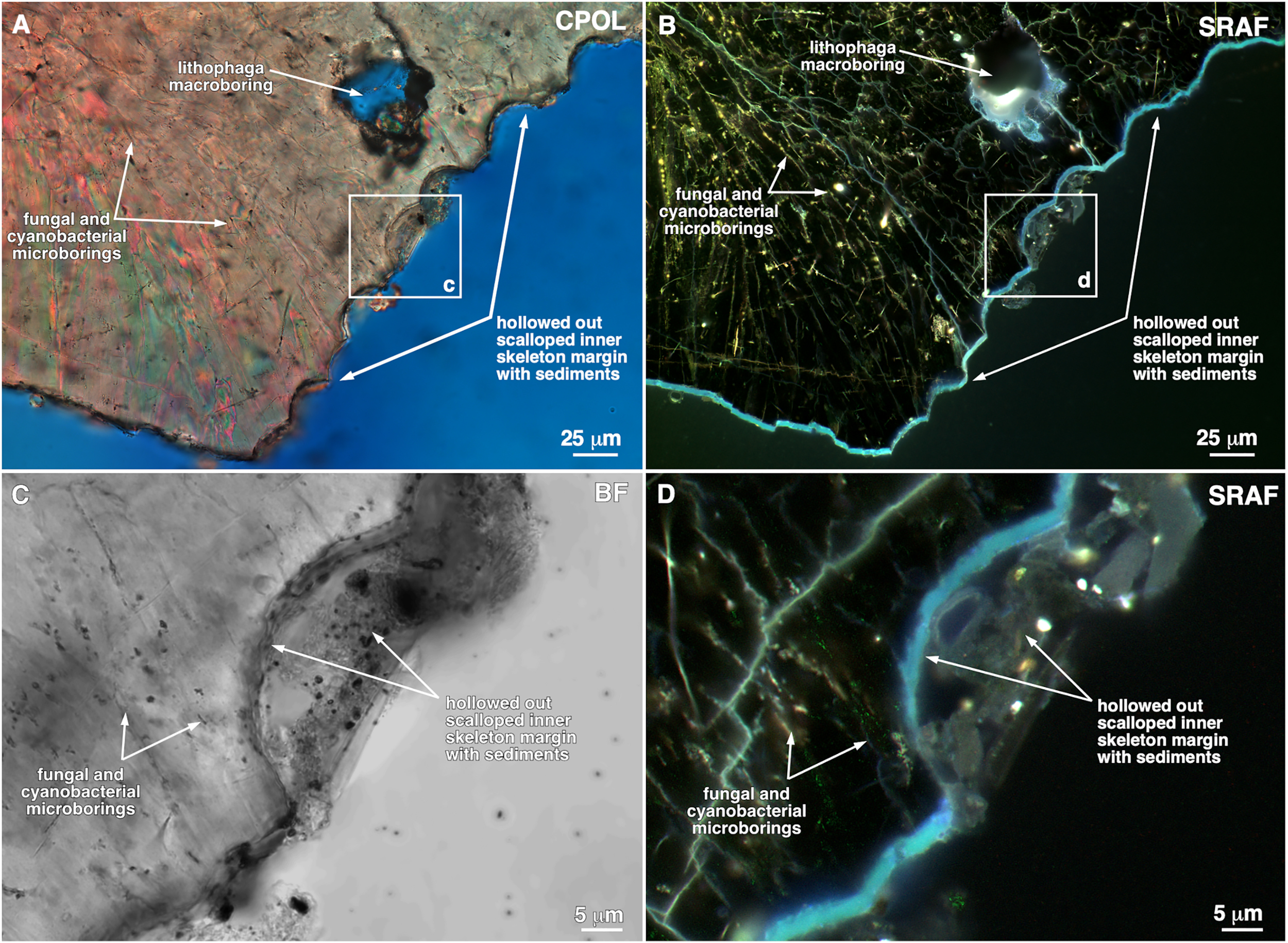
“And then we got to be Sherlock Holmes, right? Doing a forensic reconstruction of the crime scene,” Fouke said. He discovered that the coral’s calcium skeleton had been mined from the inside by a host of microorganisms, including mollusks, fungi, bacteria, and was, most importantly, covered by algae.
On the outside, the encrusting red algae not only blanket the coral skeleton; their presence also drives the accretion of even more calcium carbonate from the seawater. “It’s like a natural cement that forms,” Fouke said. “And the problem with algae is that they are masters at biochemical warfare,” he said, able to produce enzymes, lipids and proteins that make the surface an inhospitable place for baby corals to land. Without a proper substrate to attach to, new corals have little hope of survival.
The usual formula here includes coral mortality, the cycle of skeletons turning to rubble, that rubble getting cleared by storms and fresh substrate exposed for new corals. “But now this possibility for a reef to get stuck between the mortality and rubble formation phase has prolonged any sort of possibility of recovery,” Scafidi said.
The study is significant, said Edmunds, because it addresses how reefs degrade in a changing ocean. “Present-day reefs operate in a very different world of warmer seawater and more frequent storms,” Edmunds said, “so there is little reason to expect the old rules to apply to new situations.”
In the South Pacific Ocean, fringing reefs encircle both volcanic islands and atolls, providing structural protection against storm surge and flooding. Islands like Moorea may survive if the reef dies, but without a coral reef, nearby low-lying atolls that rely on the reef for protection and sand replenishment could disappear beneath the sea.
This silent pause in Moorea’s reef went unnoticed until these researchers happened upon it. If this is happening elsewhere, understanding it could mean the difference between survival and extinction for key reefs. The team will continue to study this anomaly and hopes their findings will prompt other groups to examine their local reefs for similar processes.
When Scafidi began her work in Moorea, she remembers the reef looking bleak after the 2019 bleaching event. But, in hindsight, it looked much better than it does today. “We are finding out that the ripple effect [of climate change] is changing the once well-studied patterns,” Scafidi said. “And our predicted outcomes are becoming more difficult to predict.”
About This Story
Perhaps you noticed: This story, like all the news we publish, is free to read. That’s because Inside Climate News is a 501c3 nonprofit organization. We do not charge a subscription fee, lock our news behind a paywall, or clutter our website with ads. We make our news on climate and the environment freely available to you and anyone who wants it.
That’s not all. We also share our news for free with scores of other media organizations around the country. Many of them can’t afford to do environmental journalism of their own. We’ve built bureaus from coast to coast to report local stories, collaborate with local newsrooms and co-publish articles so that this vital work is shared as widely as possible.
Two of us launched ICN in 2007. Six years later we earned a Pulitzer Prize for National Reporting, and now we run the oldest and largest dedicated climate newsroom in the nation. We tell the story in all its complexity. We hold polluters accountable. We expose environmental injustice. We debunk misinformation. We scrutinize solutions and inspire action.
Donations from readers like you fund every aspect of what we do. If you don’t already, will you support our ongoing work, our reporting on the biggest crisis facing our planet, and help us reach even more readers in more places?
Please take a moment to make a tax-deductible donation. Every one of them makes a difference.
Thank you,