

“Pull! Pull!” shouts Scott Dexter, chanting the cadence for eight men gripping a rope. “Pull!”
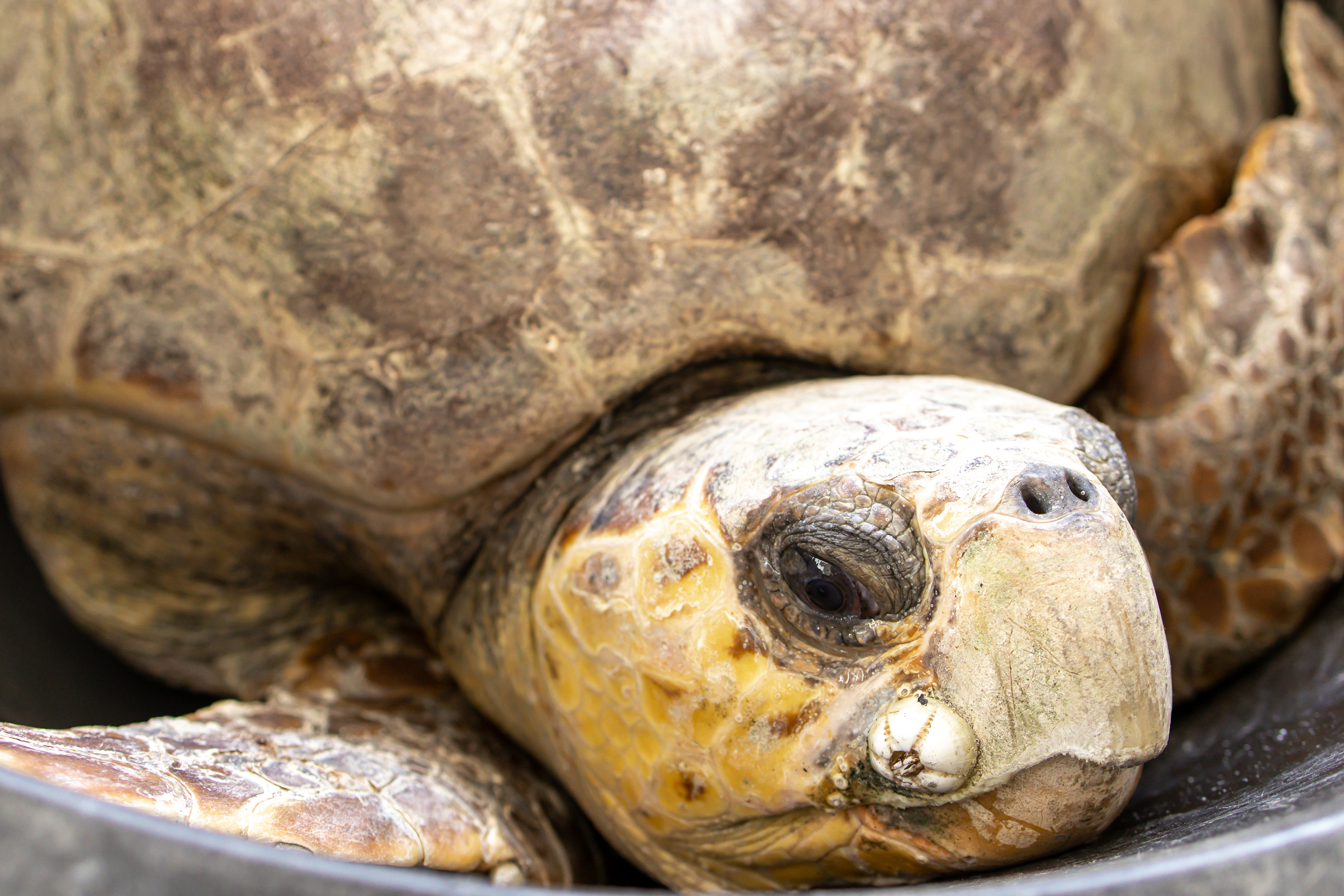
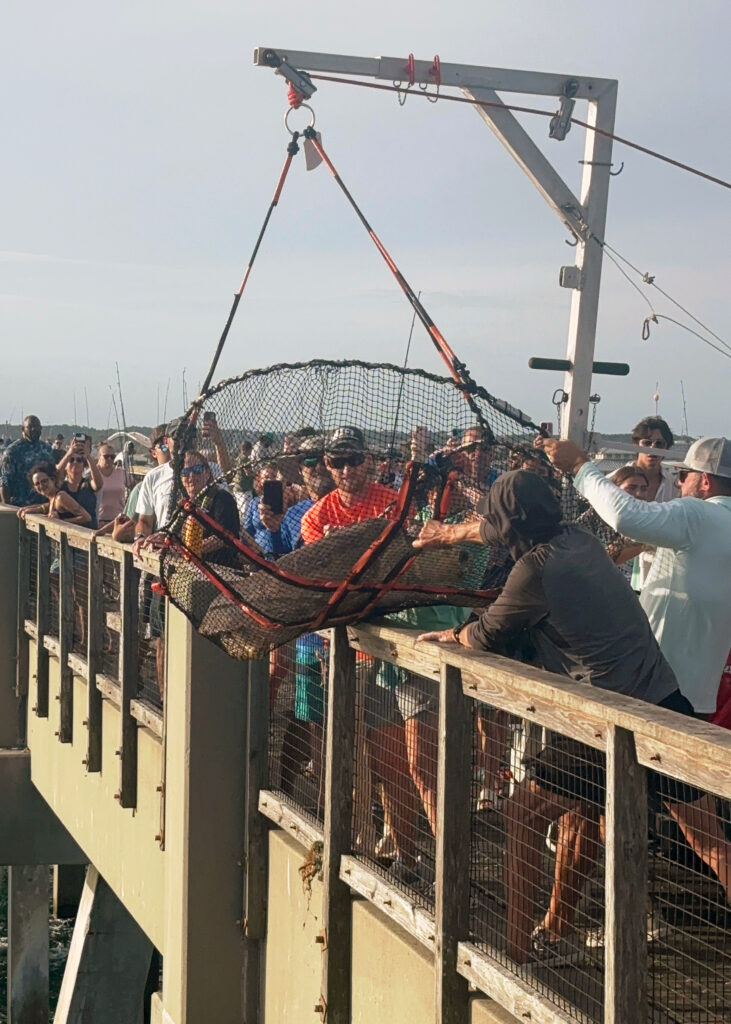
With each pull, a 172-pound male loggerhead sea turtle is hoisted higher into the air. It takes several hoists to lift the turtle about 35 feet above the Gulf of Mexico, where Dexter and others are able to lift the netted animal over the railings of the Navarre Beach Fishing Pier.
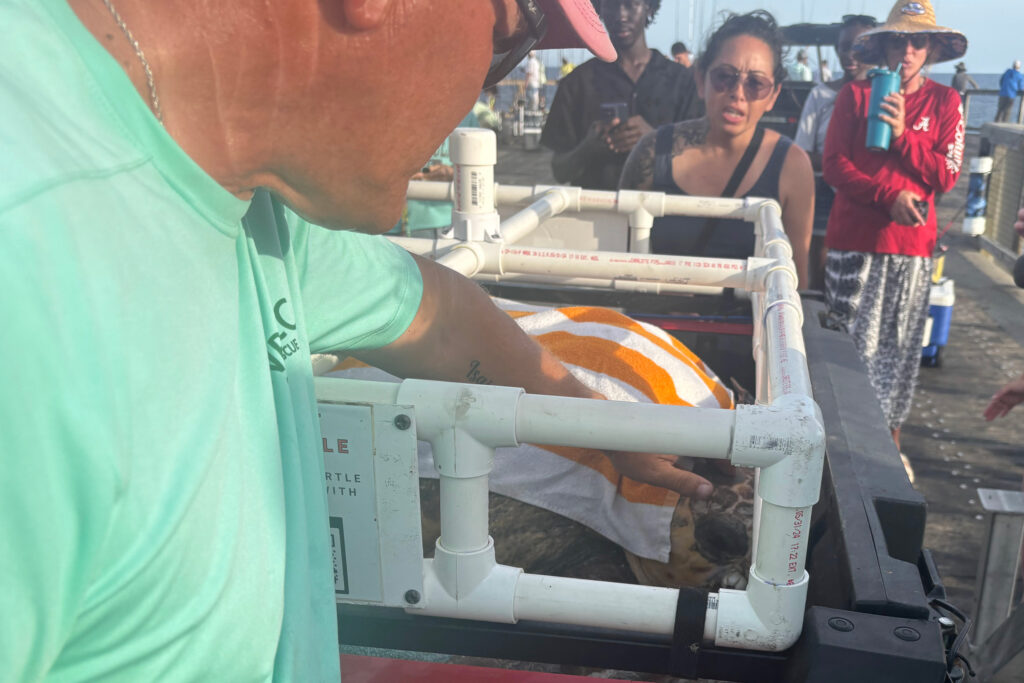
The turtle, later named Bowser by medical staff, had gotten hooked by a fisherman near its front left flipper just after 6 p.m. Sunday, and Dexter and other volunteers from the Navarre Beach Sea Turtle Conservation Center sprang into action.
Scott Dexter and his wife Cheri Dexter were already on the pier as part of a rotation of volunteers that staff the pier during the morning and evening hours, when sea turtles are most active. Multiple species of sea turtles frequent the waters around the pier. Some get hooked in the mouth or digestive tract after eating a piece of fish bait, and some are “foul-hooked” or snagged on fish hooks as they swim past. Bowser was foul-hooked in his left front flipper.
The Dexters worked with the angler who inadvertently hooked the turtle to keep the line tight and then guide the turtle into a round turtle net, five feet in diameter. From there, the volunteers recruited fishermen and nearby observers to pull the turtle up over the railing using a specialized hoist that Scott Dexter designed and had built for turtle rescues.
Bowser fought them all the way, trying to wriggle out of the net in the water, and thrashing about on the pier as crowds of onlookers pressed in.
“That’s a good sign,” Cheri Dexter said after the rescue. “If they’re lethargic or just laying there, that’s a bad sign.”
Within 25 minutes, the crew had hauled the turtle onto the pier, cut the fishing line close to the point where the hook was embedded and loaded Bowser onto a Kawasaki UTV to take him off the pier, despite Bowser’s best efforts to escape.
The operation ran like clockwork, because the volunteer team has had plenty of opportunities to practice. Bowser was the 26th turtle rescue of 2026 from the pier; the 27th occurred two days later. Last year the center rescued 59 turtles from the pier, mainly loggerheads or green sea turtles. Entanglements are most common during sea turtle nesting season, which runs from May to October.
The Dexters lead a team of 26 volunteers in Navarre Beach who are certified by the Florida Fish and Wildlife Conservation Commission to conduct turtle rescues and transport the animals to an approved rehab facility.
Navarre Beach is a relatively small beachfront community in the Florida Panhandle, between Pensacola Beach and Fort Walton Beach on the Gulf Coast, but it boasts the longest fishing pier in the state, extending 1,545 feet into the Gulf.
That also makes it prime territory for turtle entanglements. From 2000 to 2022, Santa Rosa County—where Navarre Beach is located—accounted for 56 percent (254 of 452) fishing pier entanglements reported on Florida’s Gulf Coast, according to a study published last year by researchers at the Florida Fish and Wildlife Conservation Commission.
Navarre Beach has the only large pier in that county and the researchers said every turtle incident between 2014 and 2022 occurred at that pier. The researchers also said 85 percent of turtles Gulf-wide that were rescued during that period were successfully rehabilitated and released, while around 6 percent died during or after their rescue.
Loggerheads were the most commonly hooked species, followed closely by green sea turtles.
Statewide, the federal Sea Turtle Stranding and Salvage Network reported 503 strandings last year in Florida due to incidental capture, which includes fishing entanglements. Across all Atlantic and Gulf Coast states, there were 954 such strandings.
Those figures also only include turtles that are successfully rescued. A far greater number are hooked and escape, or become hooked or entangled in discarded fishing gear. Scott Dexter said about 38 percent of turtles hooked at the Navarre Beach pier are able to be rescued and transported before breaking the line and swimming off with potentially dangerous fishing gear attached.
Sea Turtles Fighting Back, But Still Threatened
Loggerheads like Bowser are one of five sea turtle species found in the Gulf. Loggerheads and green sea turtles are the most common in Navarre Beach, along with the Kemp’s ridley, a smaller turtle that is the most imperiled of all sea turtle species. Scientists estimate fewer than 1,000 breeding females exist in the world.
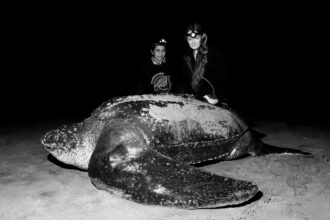
The massive leatherback turtle, reaching up to 2,000 pounds and capable of diving 3,000 feet below the surface, mainly nests on Florida’s Atlantic coast but is sometimes seen nesting on Gulf beaches. The fifth species, the hawksbill turtle, is generally found in south Florida or the Caribbean.
All five species were pushed to the brink of extinction due to human activity and have been listed as endangered or threatened under the Endangered Species Act. The turtles were hunted for their meat or shells for centuries, and many fell victim to other fishing operations, being caught in trawl nets hunting for other species.
The development of turtle excluder devices from fishing nets—which have been required by law in the United States since 1987—have greatly reduced turtle mortality.
Sea turtles nest on sandy beaches, where they can be disturbed by development or beach-goers. Bright lights on the beach can confuse turtle hatchlings, who emerge at night, and look for the reflection of the moon on the water to know which way to crawl. Sometimes the turtles instead crawl toward lights on land, giving them long odds for survival.
Valerie Nicole Tovar, conservation manager for the Loggerhead Marinelife Center, a nonprofit turtle rescue and rehabilitation center on Florida’s Atlantic coast, said fishing entanglements are one of several human threats to sea turtles.
“We have always looked to our hospital to see what are the most commonly found injuries, and many of them are things like pollution, things like boat strikes and also fishing line and entanglements,” Tovar said. “The issue is that sometimes we might not always get these reports, because not everyone always knows what to do when there is an entanglement or an injury of a sea turtle on a pier.”
The Loggerhead center administers a program called the Responsible Pier Initiative, a group of 76 organizations in Florida and other states to respond to sea turtle entanglements. RPI groups have reported 2,230 turtle interactions and 1,181 rescues since it was founded in 2013.
“Essentially what we do is we make sure that first responders, whoever that might be, have all the tools that they need to be able to respond effectively to sea turtle stranding, injury, on or around a fishing pier,” Tovar said.
In Florida, groups like the Navarre Beach Sea Turtle Conservation Center are permitted by state wildlife authorities to rescue sea turtles and transport them to approved rehab facilities where veterinarians can evaluate, treat and hopefully release the turtles back into the wild.
For Navarre Beach and most of the Panhandle, that facility is the Gulfarium CARE Center, a nonprofit turtle rehab facility created at the Gulfarium Marine Adventure Park, an animal theme park in Fort Walton Beach that features dolphin shows, manatee displays and penguin exhibits.
Bowser’s Wild Ride
Bowser got his name from Gulfarium staff after his arrival Sunday night. Turtles rescued that week were given names with a Super Mario Brothers theme. The week prior, rescues were named after famous artists: Da Vinci, Raphael, Degas and Frida.
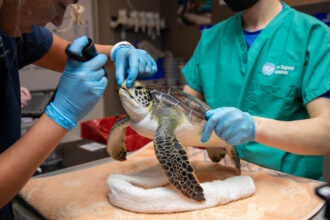
Once at the Gulfarium, staff removed the J-style fishing hook from Bowser’s left front flipper that had entangled him off the pier, and another external hook that he’d been carrying around for an undetermined amount of time.
X-rays showed Bowser also had a hook lodged in his esophagus from a previous encounter with fishing gear.
Mary Fomby, marketing manager for the Gulfarium, said Bowser will undergo a procedure in which he is sedated while vets try to remove the hook manually. For animals where the hook is deeper in the digestive tract, Fomby said the team will often try to help the animal pass the hook naturally.
“We’ll actually do something where we feed them, along with their normal fish, cotton balls that have mineral oil on them,” Fomby said.
Fomby said the cotton ball is a less invasive way than endoscopy or surgery to remove dangerous hooks.
“They don’t digest [the cotton ball], it will just go straight through them,” Fomby said. “So, ideally what happens is it gets caught on the hook and kind of creates a barrier around the tip of the hook to keep it from latching on to any other parts of their intestines.”
The Gulfarium team receives stranded turtles from across the Florida Panhandle, and sometimes from Alabama beaches as well. Fosby said Tuesday the Gulfarium currently has 31 turtle patients, with seven turtles planned to be released this week.
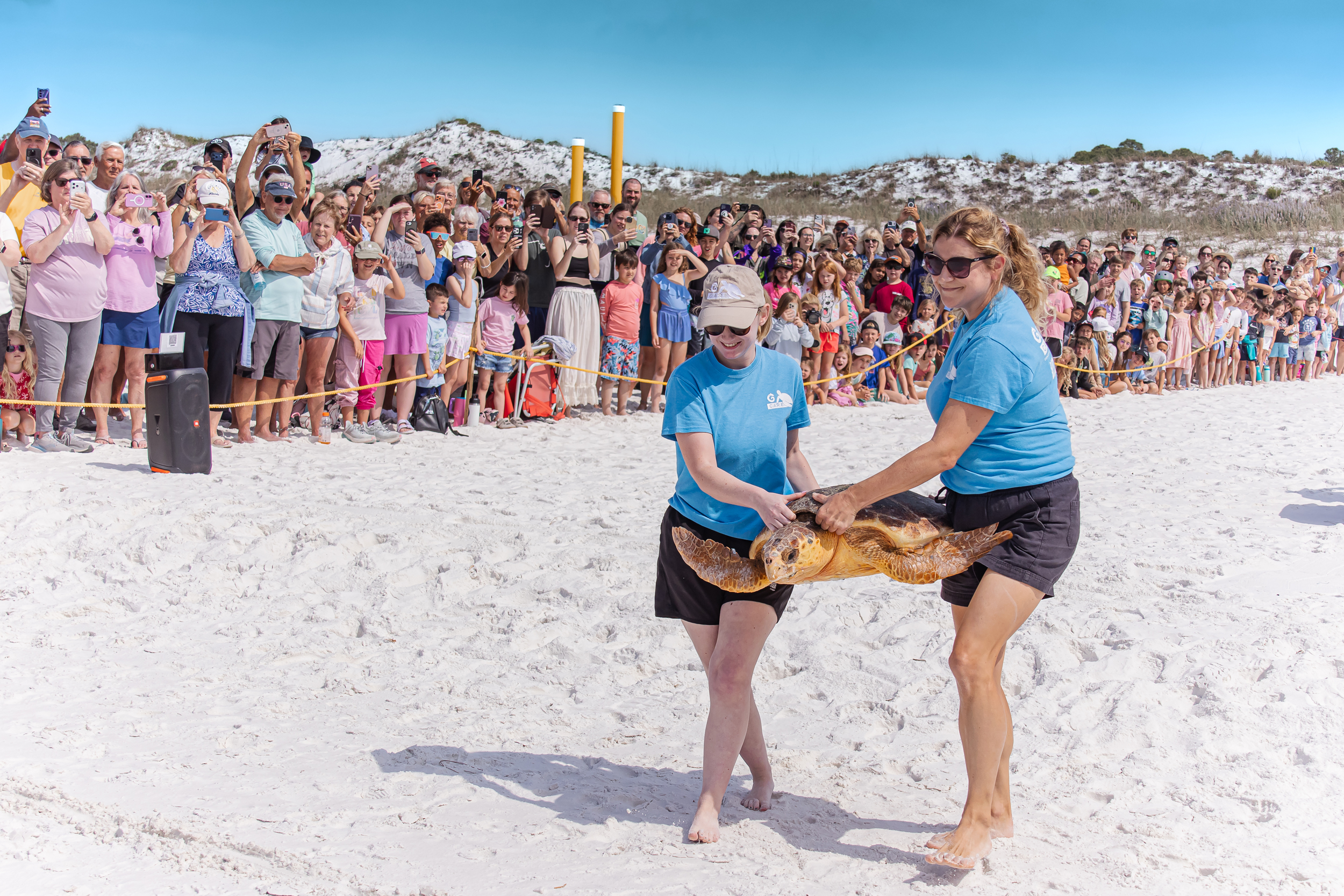
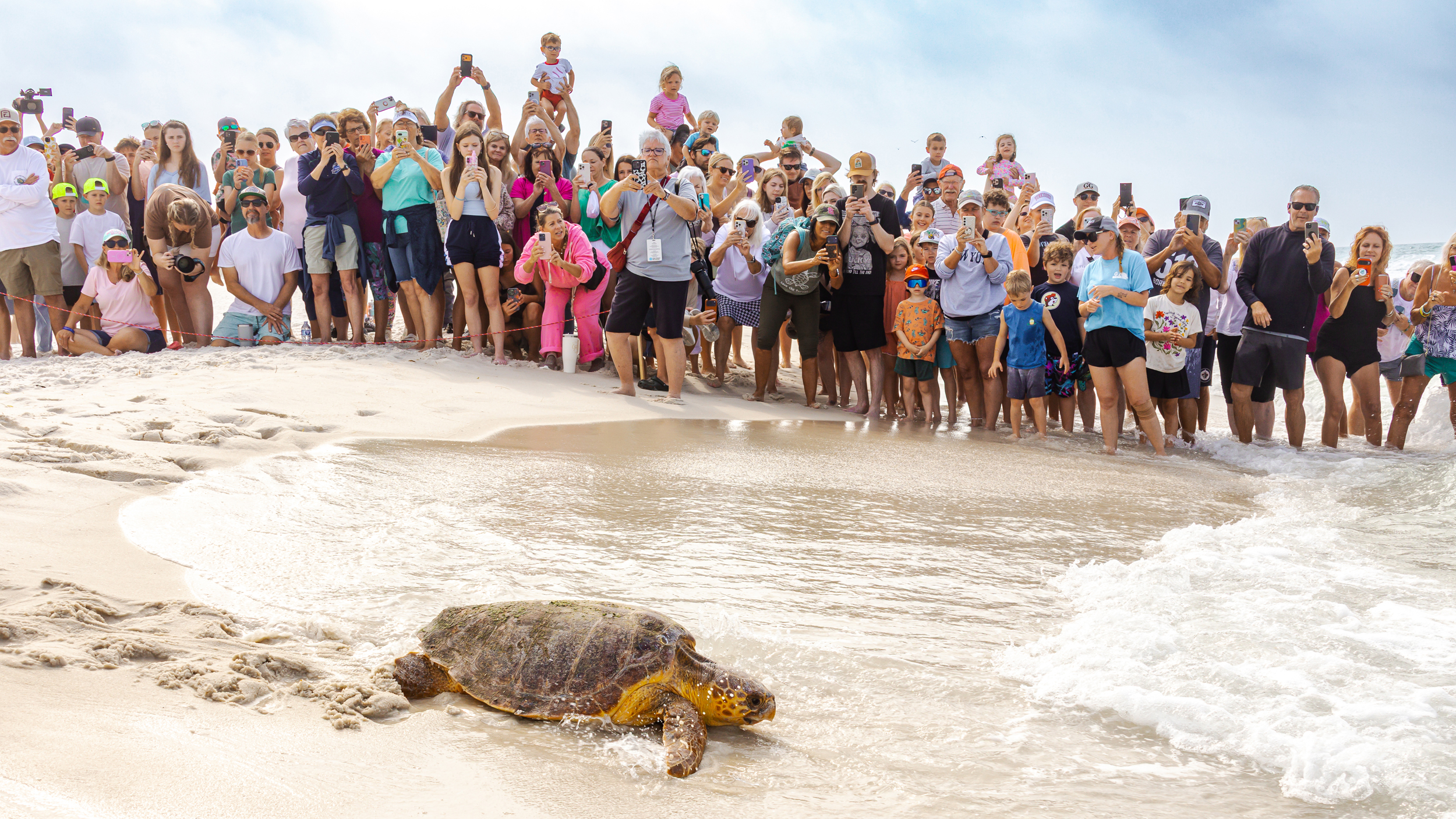
The center recently celebrated its 1,000th successfully released turtle. Fomby said the center releases more than 100 turtles every year, with most rescues happening between May and October, which coincides with sea turtle nesting season.
State and federal wildlife agencies provide oversight and supervision for the volunteer rescue groups, but usually don’t provide direct funding.
“We’re not state-funded, other than if we win grants,” said Alex Fox, chief operating officer of the Navarre Beach Sea Turtle Conservation Center.
The Navarre Beach center, the Gulfarium CARE Center, and the Loggerhead Marinelife Center are all nonprofit organizations and largely dependent on donations, grants and their own operations to cover expenses.
The Navarre Beach Center has a visitor exhibit with animals on display, including Sweet Pea, a green sea turtle rescue with injuries too severe to be released back into the wild. Most of the rescue teams consist of trained volunteers rather than full-time employees of the centers.
Climate Change Threatens Sea Turtles
Sea turtle species, especially the green sea turtle, have shown strong population rebounds after the development of turtle excluder devices in commercial fishing gear and stronger conservation laws worldwide.
But the animals still face significant threats from fishing gear entanglement, boat strikes and climate change.
The U.S. Fish and Wildlife Service divides loggerhead sea turtles into nine separate population groups. Five of those groups are listed as endangered under the Endangered Species Act. The Northwest Atlantic population group—which includes turtles in Florida and other mainland U.S. states—is listed as threatened, along with three others.
This story is funded by readers like you.
Our nonprofit newsroom provides award-winning climate coverage free of charge and advertising. We rely on donations from readers like you to keep going. Please donate now to support our work.
Donate NowClimate change is of particular concern because the sex of newly hatched sea turtles is determined by the temperature of the sand around the nest. Warmer nests produce more females, while cooler nests produce males.
“Especially here in Florida, the concern is that our beaches are so hot that we might be producing more females than we are males, and that could affect the population overall,” Tovar said, adding that if the nest gets too hot, the turtles may not hatch at all.
Published research on sea turtle sex ratios cites a lack of “populationwide, data-driven studies of primary sex ratios for any marine turtle species,” but localized studies have shown populations that are estimated to be more than 80 percent female.
Female sea turtles generally mate with multiple males before laying eggs, resulting in “multiple paternity” nests, with eggs from multiple fathers. A 2023 study published in the journal Current Biology found evidence of multiple paternity dropped significantly where populations were 90 percent or more female.
“On its own, a decrease in the incidence of multiple paternity may not be harmful to sea turtle populations,” the authors conclude. “However, a reduction in the incidence of multiple paternity to zero should be viewed as a clear warning signal that there is a shortage of males and is likely a precursor for subsequent reductions in egg fertility, which may threaten population viability.”
Tovar said the Loggerhead Marinelife Center has also observed the sea turtle nesting season starting earlier in the year, a possible response to rising temperatures.
Kate Mansfield, an associate professor at the University of Central Florida, directs the Marine Turtle Research Group, which has conducted research on sea turtles for more than 40 years. Mansfield told Inside Climate News last year that green sea turtles in Florida experience significant nesting site disruption due to storms, which are expected to increase in intensity as global temperatures rise.
“We also are experiencing storm events that are just the worst ever, historic levels of winds and tides and storm overwash,” Mansfield said. “Each year, we kind of brace for what the hurricane season is going to look like. Disproportionately, green turtles, at least in Florida, on our nesting beaches, are the ones that are hit the hardest by these storm events.”
How to Avoid Turtle Entanglement
For anglers who inadvertently hook a turtle, rescuers say it is crucial to call for assistance immediately and not cut the line or try to remove a hook themselves. Public fishing piers should have displays showing a number to call.
“The most important thing is really just trying to make sure anglers know that they can give us a call,” Tovar said. “They can call [Florida Fish and Wildlife] if they’ve hooked a sea turtle; they’re not going to get in trouble, and they will be able to go through the steps to get the turtle rescued.”
Tovar said generally on a pier, the angler should gently reel the turtle toward the surface, keep tension on the line and wait for a team to arrive.
Cheri Dexter said many turtles will naturally want to swim under the pier, but the angler should try to prevent that, as the line will usually break with hooks still lodged in the turtle.
Scott Dexter said inexperience is a big factor in sea turtle entanglements.
“Most of the fishermen that hook turtles are not from here,” Scott Dexter said. “They come down here on vacation, and they either rent fishing equipment or they go to Walmart and buy a cheap rod. They don’t understand what’s out in that water.”
About This Story
Perhaps you noticed: This story, like all the news we publish, is free to read. That’s because Inside Climate News is a 501c3 nonprofit organization. We do not charge a subscription fee, lock our news behind a paywall, or clutter our website with ads. We make our news on climate and the environment freely available to you and anyone who wants it.
That’s not all. We also share our news for free with scores of other media organizations around the country. Many of them can’t afford to do environmental journalism of their own. We’ve built bureaus from coast to coast to report local stories, collaborate with local newsrooms and co-publish articles so that this vital work is shared as widely as possible.
Two of us launched ICN in 2007. Six years later we earned a Pulitzer Prize for National Reporting, and now we run the oldest and largest dedicated climate newsroom in the nation. We tell the story in all its complexity. We hold polluters accountable. We expose environmental injustice. We debunk misinformation. We scrutinize solutions and inspire action.
Donations from readers like you fund every aspect of what we do. If you don’t already, will you support our ongoing work, our reporting on the biggest crisis facing our planet, and help us reach even more readers in more places?
Please take a moment to make a tax-deductible donation. Every one of them makes a difference.
Thank you,

Dennis Pillion
Reporter, Alabama
Dennis Pillion is a reporter for Inside Climate News based in Alabama. He joined ICN in 2024 after 17 years working for Alabama Media Group, including nine as the statewide natural resources reporter. His work for AL.com and The Birmingham News, won numerous Green Eyeshade and Alabama Press Association awards for his coverage of environmental issues in Alabama. He was born and lives in Birmingham, Ala.