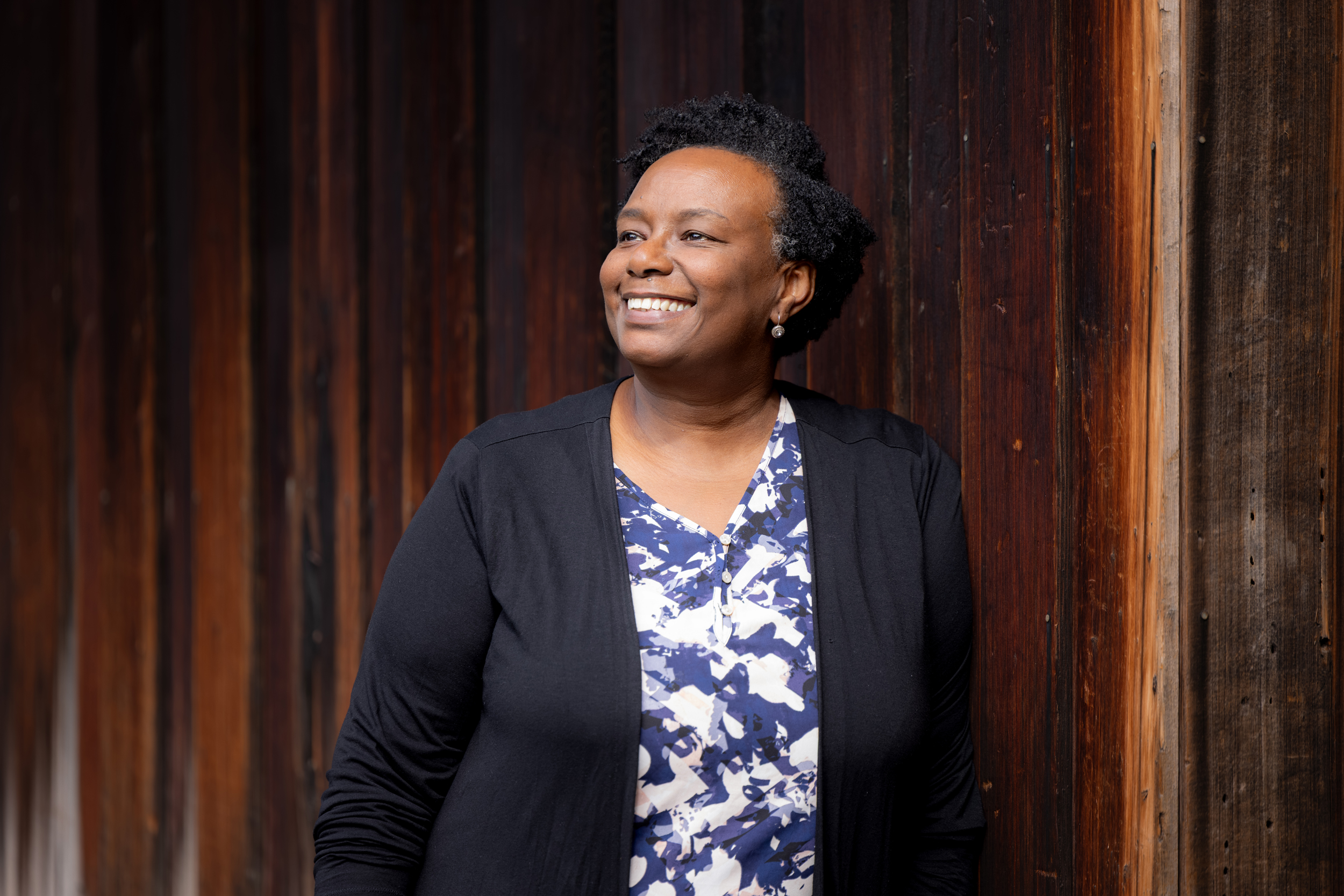


From our collaborating partner “Living on Earth,” public radio’s environmental news magazine, an interview by host Steve Curwood with botanist and author Beronda Montgomery.
When plant biologist Beronda Montgomery sat down to write what became a personal memoir mixed with a botanical history of African Americans, she found her research as a Ph.D. lab scientist had brought her squarely into the world of social science as well.
Her studies of how plants respond to light during photosynthesis led to shining a light on the history of extensive plant cultivation by African Americans, including those who endured forced labor.
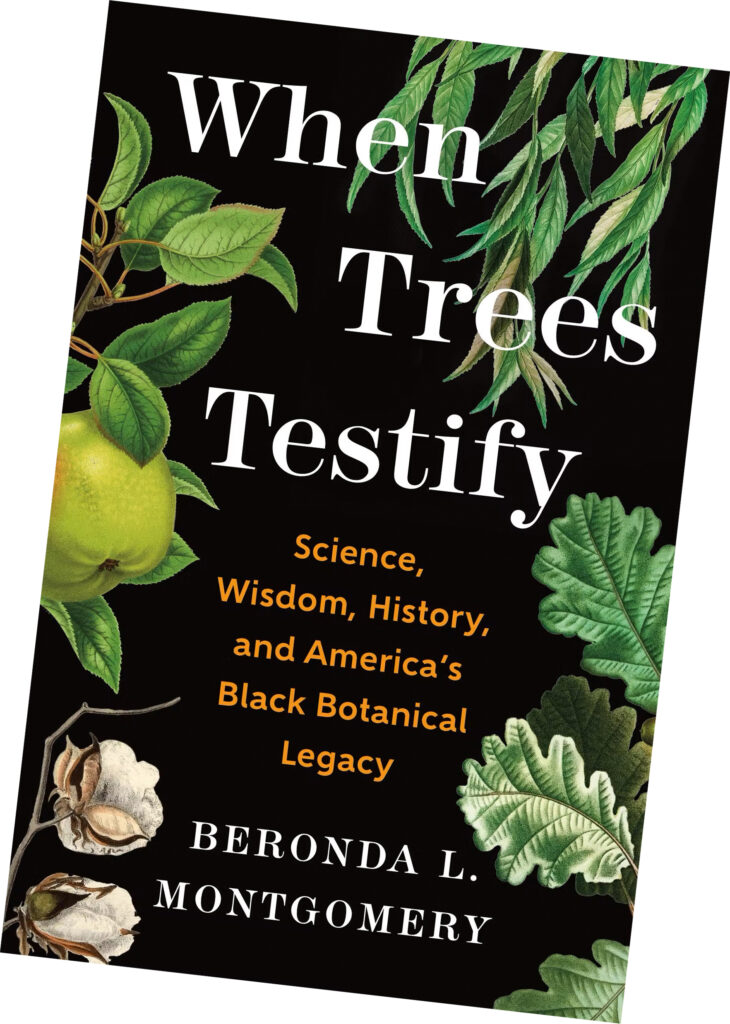
Montgomery is the author of “When Trees Testify: Science, Wisdom, History, and America’s Black Botanical Legacy.”
This interview has been edited for length; the full conversation is available in the player above the story.
STEVE CURWOOD: “When Trees Testify” tells the African American history of enslavement through the lens of trees. What do we see?
BERONDA MONTGOMERY: We see that African Americans’ experience in the U.S. has been tied up with trees from the beginning, in terms of having to pull them up to make land and also the ways in which trees are a part of their life, whether that was going through them, navigating through them, or sometimes the very harsh reality of lynching.
CURWOOD: Trees are, of course, very important to the health of the environment, and they are key agents in the fight against climate disruption, for example. You are a plant scientist—a botanist—but your book is a history book, and maybe a memoir as well. What is this nexus between science and history, and both public history and personal history, in telling these stories?
MONTGOMERY: There was a very strong nexus when I was visiting the former site of a plantation, and saw a tree that was estimated to be 600 years old. I realized that that tree would have been standing there when people were enslaved on the land. My understanding of the science of it gave me some insights into what that meant, and also thinking about my own family’s history in the South. That one tree brought together those areas for me.
CURWOOD: How did this tree capture the experience of slavery that occurred around it?
MONTGOMERY: The tree was standing on the land, and I thought how beautiful it was that something could live long enough that those enslaved people, and me and my family, who were visiting, could have been with the same being. That was the first thing—the long-lived nature.
I also thought about one of the things I study as a scientist, photosynthesis, and how carbon dioxide and water are combined with the energy of sunlight to make sugars, and those sugars are ultimately used to make the compounds of wood. What occurred to me in that moment, and I shared with my sister and son, was that the ancestors’ breath … would be in the wood of that tree. Their breath was captured in the tree, and now we’re standing there with that same tree. Our breath had a chance to be captured together on a kind of recorded carbon archive.
CURWOOD: What did your creative scientific mind think about this notion that some of the carbon that’s in this tree must have passed through enslaved people who were here before? How did that make you feel?
MONTGOMERY: Tiya Miles has talked about trees as material witnesses, but it was really in that moment that I understood the materialness of the material witness and how the breath was actually captured there. Oak trees have been talked about as witness trees, and it gave that a different meaning for me. They weren’t just witnessing in terms of standing there and observing, but they were carrying forward part of the essence of those people’s lives.
CURWOOD: Let’s take an excursion deeper into your scientific background and talk about epigenetics, or how environmental circumstances tend to affect how genes get expressed. To what extent do you think the experience of slavery might have affected how that tree was able to express its own growth and development?
MONTGOMERY: I think that there certainly are likely markers that would have been impressed upon the trees from their living together with people who were enslaved. I mentioned in the book the idea that if there was a tree that was a hanging tree, that it remembers the weight of those bodies. We know in horticulture that if a branch is bent, that can induce flowering, that can induce differences in the way the branches grow.
We think that it’s outside the realm of possibility that a hanging tree would remember its strange fruit because we haven’t had scientists who think about those parallels and imagine that the biology is there. I happened to be visiting the Equal Justice Initiative in Montgomery, and there were some trees whose roots had been soaked with blood several times. You imagine that that also changes the soil and the ways that the roots of those trees grow.
“They weren’t just witnessing in terms of standing there and observing, but they were carrying forward part of the essence of those people’s lives.”
As a plant scientist who is thinking about this through a lens of being the descendant of enslaved people, there are markers of epigenetic memory that trees would have had living with the enslaved in America.
CURWOOD: Trees are part of the story of enslavement and at times self emancipation. Talk to us about what Harriet Tubman said about trees like the sycamore.
MONTGOMERY: One of the things that I loved about writing this book was learning new things about Harriet. Harriet had quite a great understanding of trees from having worked in tree fields with her father, and she had learned that sycamores were trees that could lead you to freedom, because these trees are quite distinctive in the way that they look by their bark. But they’re also near bodies of water, and she had learned to navigate and look for what she calls a “forest compass” to help lead her in different directions. She had a great knowledge and expertise around trees.
Harriet also had a great love for apple trees that I hadn’t been aware of. Someone pointed out a children’s book for me, and her love for those apple trees was linked to the fact that she had to help grow them when she was enslaved and couldn’t eat the apples. When she got her homestead in New York, she planted hundreds of fruit trees and was known to offer people apples when they came as a sign of freedom that she could now do that. Harriet’s engagement with trees is deep and really led to her ability to be the greater liberator that she was in so many ways.
This story is funded by readers like you.
Our nonprofit newsroom provides award-winning climate coverage free of charge and advertising. We rely on donations from readers like you to keep going. Please donate now to support our work.
Donate NowCURWOOD: How does the sycamore help you find your way north?
MONTGOMERY: Sycamores have a very distinctive bark. When a tree grows, unlike other trees that may just make rivets and fill in, it sloughs off part of its bark like a snake would an old skin to have a new skin. So the sycamore tree often has this very light gray, mottled peeling bark that makes it very distinctive. You can see it amongst other trees, and at nighttime, when the moonlight hits it, it’s very easy to see. If you knew where the sycamores were in the area, you could use them to navigate.
The other thing is that sycamores grow very well on the shores of bodies of water. If you would see a number of sycamores growing together, it was likely that they were near a river or body of water, because they stabilized the soil. Enslaved people would often look for sycamores to find a body of water that they could pass through so their scent would be lost in case hounds were used to follow them.
Sycamores also have very large trunks that are often hollow, so you could hide within one, or you could hide things within one as you were preparing. So sycamores had very many different ways that they were useful for people who were seeking to liberate.
CURWOOD: You wrote about rice and pecan cultivation and highlighted the knowledge that enslaved Africans brought to America and contributed to the growth of the U.S. economy with those skills. That enslaved Africans brought more than simple hard labor is key. To me it’s important to tell those stories.
MONTGOMERY: It’s vitally important, and I think some people have started to acknowledge this, particularly in terms of rice. Some of the women that were enslaved from West Africa, they went to areas where [the Americans] knew there was successful cultivation of rice and wanted women to be brought here who could plant and irrigate the rice and allow it to thrive. So much of the thriving of the rice industry sits at the hands of those enslaved African women. This was so well known that enslavers actually paid very highly for women who came for this area, their value was as much as young men, which was how you would really estimate what value was at that time.
“There are many areas in agriculture, like rice, pecans, tobacco, where we can point to the breakthroughs leading to commercial industries founded upon the knowledge of enslaved people.”
In terms of the pecan industry, it’s known that the first grafted pecan tree—one that was the basis of the commercial pecan industry—was actually obtained at the hands of an enslaved man named Antoine. Pecan trees growing in nature have nuts of varying size, some that have hardly any nut meat, and some that have a lot, so they had to really get a variety that would make nuts of the same size with very healthy, large amounts of nut meat. This happened after Antoine was able to successfully graft a variety that was known as Centennial.
There are many areas in agriculture, like rice, pecans, tobacco, where we can point to the breakthroughs leading to commercial industries founded upon the knowledge of enslaved people. In that way it started to seem to me that my own personal legacy as a botanist was really founded on an expertise and a kind of pride in carrying on that expertise, and that’s one of the things I wanted to be able to share in the book—the ways in which we’ve overlooked those contributions quite heavily in the U.S., in terms of African Americans’ contributions to this country’s agricultural wealth and advances,
CURWOOD: What do you hope readers will take away from “When Trees Testify”?
MONTGOMERY: It’s my hope that the stories and the science that I’m able to share may get people to take a second look at trees and to think about how they think about them as a part of their own lives, to be more aware of the trees that they live with. You’d be surprised how many people don’t even know the trees in their yard or how many there are.
I also hope that the idea that our breath is captured in the trees may get people to think about who’s lived with the tree before they have and to have interest in their life.
For me, this idea that my breath is captured by the tree has caused me to think about what it means to live a life worthy of that, and I hope that people will just think about what it means for us to live together with trees on the planet. For anyone who’s been impacted by an old tree, how are you living such that people in future generations might also have that opportunity? I want people to think differently about trees and what it means to live together with them.
About This Story
Perhaps you noticed: This story, like all the news we publish, is free to read. That’s because Inside Climate News is a 501c3 nonprofit organization. We do not charge a subscription fee, lock our news behind a paywall, or clutter our website with ads. We make our news on climate and the environment freely available to you and anyone who wants it.
That’s not all. We also share our news for free with scores of other media organizations around the country. Many of them can’t afford to do environmental journalism of their own. We’ve built bureaus from coast to coast to report local stories, collaborate with local newsrooms and co-publish articles so that this vital work is shared as widely as possible.
Two of us launched ICN in 2007. Six years later we earned a Pulitzer Prize for National Reporting, and now we run the oldest and largest dedicated climate newsroom in the nation. We tell the story in all its complexity. We hold polluters accountable. We expose environmental injustice. We debunk misinformation. We scrutinize solutions and inspire action.
Donations from readers like you fund every aspect of what we do. If you don’t already, will you support our ongoing work, our reporting on the biggest crisis facing our planet, and help us reach even more readers in more places?
Please take a moment to make a tax-deductible donation. Every one of them makes a difference.
Thank you,