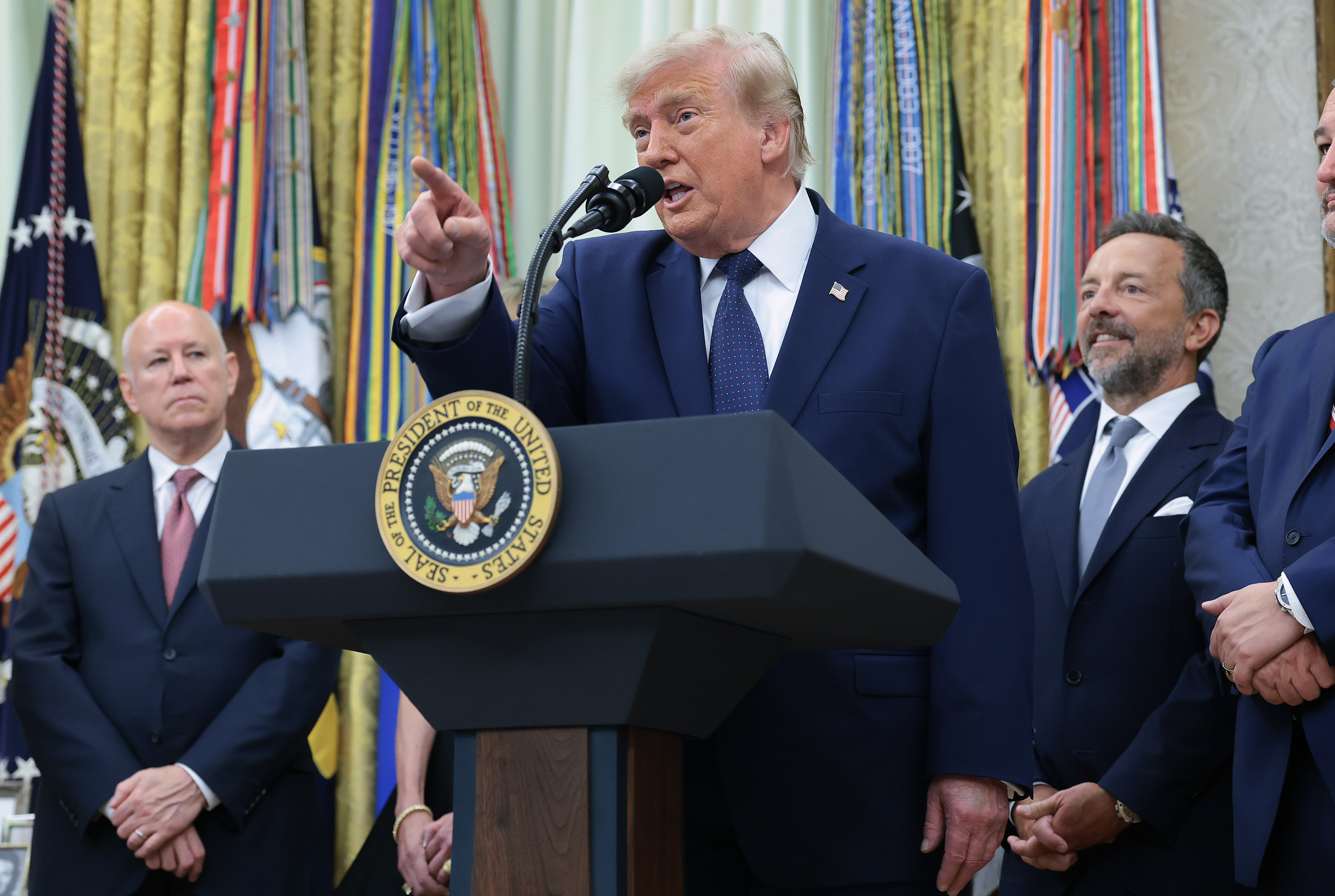


In brief remarks to reporters Monday at the White House, President Donald Trump noted that he was shocked to learn how much energy developing artificial intelligence requires and said his administration is now approving plans for energy facilities to power data centers in “a matter of weeks.”
After first describing his investment accounts for children, Trump responded to a question on cryptocurrency and said Big Tech leaders racing to develop artificial intelligence have told him they need access to double the country’s existing energy capacity in order to advance technologies and outpace foreign competitors.
Trump also said that Environmental Protection Agency Administrator Lee Zeldin had told him tech companies weren’t taking advantage of the administration’s promise to get fast approvals for private power plants supporting A.I development.
Trump said he then called Meta’s Mark Zuckerberg, Amazon’s Jeff Bezos, OpenAI’s Sam Altman and SpaceX’s Elon Musk to ask why they hadn’t submitted plans for power plants alongside their data center developments.
“They thought we were kidding,” Trump said Monday. “They can’t believe it, that they’re approved in a period of a matter of weeks.”
The White House did not immediately respond to questions about how the administration is approving power plant plans in a matter of weeks.
While the administration has sought to waive environmental protections, expedite permits and loosen construction rules for gas plants and data centers, there are a slew of state and local requirements both power plants and data centers must satisfy that even in the fastest permitting environments take months.
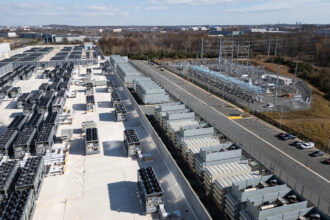
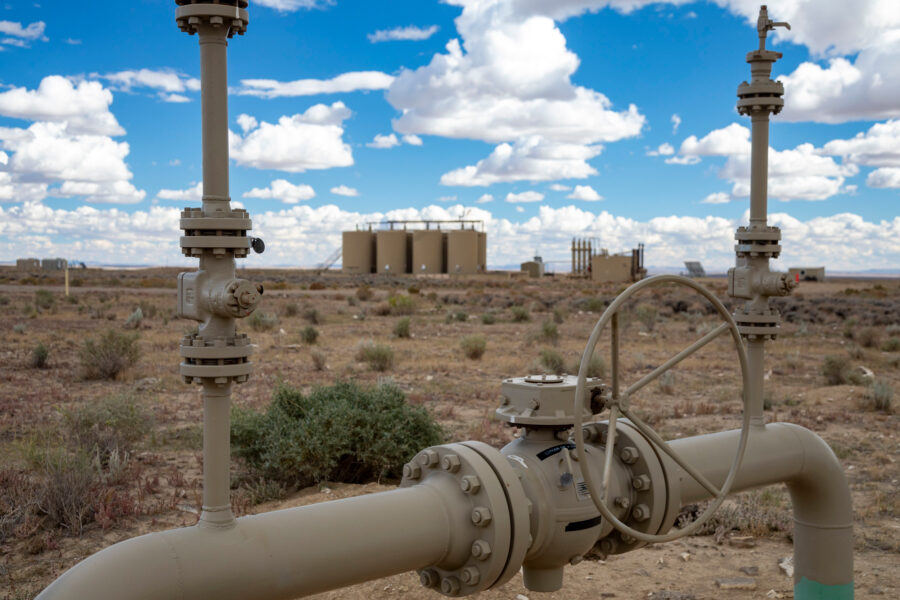
Although Trump said it was his idea to allow tech companies to build their own “behind-the-meter” generating units on site to power data, it’s a mainstream practice to ensure they always have access to power. Dedicated power plants for data centers have only grown in popularity as companies race to get the facilities online.
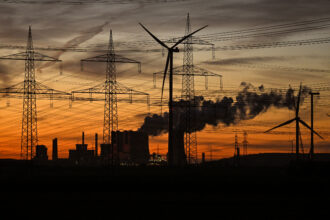
The president said tech companies can use whichever type of energy they want to use—he specifically mentioned only nuclear, oil and gas—except wind. “We don’t allow wind,” Trump said. “Wind is terrible, it just doesn’t work.”
Trump has sought to end wind energy, the resource that generates a tenth of the electricity generated in the U.S., according to the U.S. Energy Information Administration.
The race to develop AI, which requires data centers to handle the energy-intensive computing, has resulted in plans for 74 new or expanded methane gas plants across the U.S., according to a new report from the Environmental Integrity Project, a national nonprofit founded more than 20 years ago by a former director of the EPA’s civil enforcement office.
These proposed gas-fired plants, which would be dedicated to serving data centers, are expected to generate 143 gigawatts of electricity, enough to power the state of California nearly three times over, according to the report.
Of those 74 gas plants, 32 are in Texas, 10 are in Ohio and seven are in Pennsylvania.
The power plants would also release nearly 662 million tons per year of greenhouse gas pollution, according to the report, which equals the emissions of Australia. This wave of power plants for data centers could also release air pollutants that contribute to smog and lung damage.
Jen Duggan, executive director of the Environmental Integrity Project, said in a statement that “an industry of the future should not be chained to dirty fuels of the past.”
“While data centers may be needed to accommodate shifts in technology, the public has a right to transparency and accountability, clean air, and common sense controls to protect water supplies, especially in areas already struggling with water shortages,” Duggan said. Data centers can use copious amounts of water to keep servers cool.
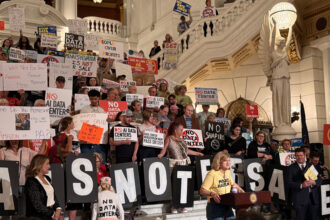
As the data center industry seeks rural parts of the U.S. to roll out the supercomputer warehouses, and the fossil fuel power plants and generators accompanying them, the facilities have quickly become highly unpopular in communities across America.
Some lawmakers have long been vocal with their concerns about data center construction. U.S. Sen. Bernie Sanders, I-Vermont, and U.S. Rep. Alexandria Ocasio-Cortez, D-New York, introduced legislation in March proposing a moratorium on all new data center construction until AI safeguards, including worker and environmental protections, are in place.
Other politicians, who have responded to protests from their constituents with the midterm elections approaching, are seeking to distance themselves from the industry.
Texas Gov. Greg Abbott, a Republican, called for blocking new data center developments in rural parts of the state during a campaign stop in East Texas last week. It’s a step further than his recent calls for data centers to pay for their own infrastructure costs, reuse their water, add new power generation to the state’s independent electric grid and other measures aimed at limiting the impact on residential communities.
The New York State Legislature passed a one-year moratorium in June on data center permits. If Gov. Kathy Hochul signs the bill, New York would become the first state in the U.S. to restrict data centers in such a way. But Hochul, a Democrat who is up for re-election this year, has said that she believes it should be left up to municipalities.
This story is funded by readers like you.
Our nonprofit newsroom provides award-winning climate coverage free of charge and advertising. We rely on donations from readers like you to keep going. Please donate now to support our work.
Donate NowMonterey Park, California, and Ashville, Ohio, are among the U.S. communities that have passed temporary bans or pauses on new data centers.
The Trump administration announced last month that it would not set nationwide environmental requirements or recommendations for the data center industry.
While there are technologies and practices that reduce air pollution and water usage, states and communities know what works best for them, EPA chief Zeldin said at a Politico energy summit in June.
By not enforcing federal regulations, Clara Vondrich, senior policy counsel with Public Citizen’s Climate Program, said that the EPA gave Big Tech the green light to build polluting power plants and water-intensive facilities without any environmental protection enforcement.
“Big Tech executives have lobbied hard to ingratiate themselves into the Trump administration’s orbit,” Vondrich stated. “Zeldin made clear that their investment was money well spent.”
About This Story
Perhaps you noticed: This story, like all the news we publish, is free to read. That’s because Inside Climate News is a 501c3 nonprofit organization. We do not charge a subscription fee, lock our news behind a paywall, or clutter our website with ads. We make our news on climate and the environment freely available to you and anyone who wants it.
That’s not all. We also share our news for free with scores of other media organizations around the country. Many of them can’t afford to do environmental journalism of their own. We’ve built bureaus from coast to coast to report local stories, collaborate with local newsrooms and co-publish articles so that this vital work is shared as widely as possible.
Two of us launched ICN in 2007. Six years later we earned a Pulitzer Prize for National Reporting, and now we run the oldest and largest dedicated climate newsroom in the nation. We tell the story in all its complexity. We hold polluters accountable. We expose environmental injustice. We debunk misinformation. We scrutinize solutions and inspire action.
Donations from readers like you fund every aspect of what we do. If you don’t already, will you support our ongoing work, our reporting on the biggest crisis facing our planet, and help us reach even more readers in more places?
Please take a moment to make a tax-deductible donation. Every one of them makes a difference.
Thank you,

Arcelia Martin
Reporter, Texas Renewables
Arcelia Martin is an award-winning journalist at Inside Climate News. She covers renewable energy in Texas from her base in Dallas. Before joining ICN in 2025, Arcelia was a staff writer at The Dallas Morning News and at The Tennessean. Originally from San Diego, California, she’s a graduate of Gonzaga University and Columbia University Graduate School of Journalism.