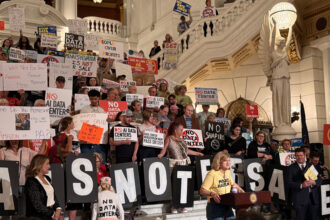
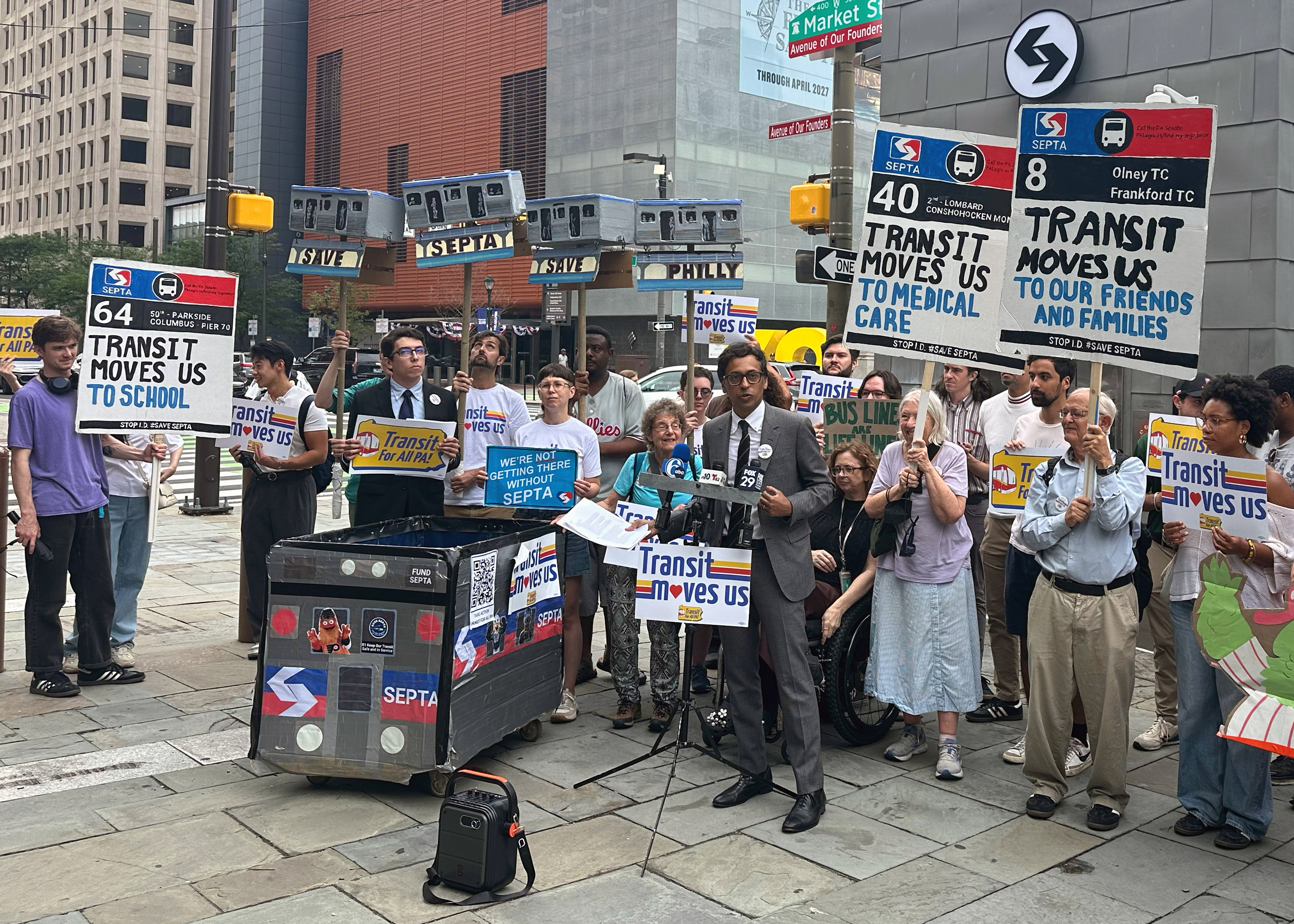


PHILADELPHIA—Four days before the deadline for Pennsylvania’s legislature to pass its next budget and eight days before Philadelphia celebrated America’s 250th birthday, a crowd of transportation advocates gathered outside of the Independence Hall subway stop.
As tourists licked their ice cream, took selfies and tried to hustle past the TV cameras, the activists underlined the urgency of securing long-term funding for mass transit.
“There is no excuse left for lawmakers. In the year we celebrate 250 years of this great country, let’s fund the system that moves it, and let’s get it done by June 30,” said Dr. Jay Arzu of 5th Square Advocacy, an urbanist group, at the rally.
Despite the rally’s energy, Democratic lawmakers said it was unlikely ongoing negotiations will resolve a long-standing partisan stalemate over transportation funding, and the legislature has already missed the June 30 deadline to pass a budget. “[Transit] is not going to be the sticking point that holds up a budget this year,” said state Rep. Jennifer O’Mara, a Democrat from Delaware County and proponent of mass transit who serves on the House Transportation Committee. Advocates worry that lawmakers are missing an opportunity to help state transportation agencies survive the fiscal woes that emerged from inflation and COVID-related decreased ridership.
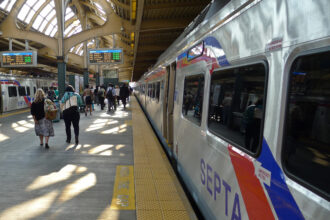
Last year, SEPTA and Pittsburgh Regional Transit (PRT), the largest transit agencies in Pennsylvania, threatened severe service cuts if new, long-term funding wasn’t passed, raising the stakes of a fight that contributed to a months-long budget impasse. When funding wasn’t found in time, three weeks of SEPTA service cuts hit Philadelphians hard. More than 700,000 people rely on SEPTA daily; if the cuts the agency threatened were enacted permanently, WHYY estimated that an additional 300,000 metric tons of carbon would be emitted in the region every year from increased traffic.
In September, a court-ordered injunction halting SEPTA’s service cuts forced Gov. Josh Shapiro to authorize two years’ worth of funding from the Public Transportation Trust Fund (PTTF), which is designated for repairs and emergency expenses—many Republicans’ preferred outcome all along. The move relieved the pressure on Harrisburg for now, but it sets up another fight for transit funding next summer. Alex Milone, co-chair of 5th Square’s transit committee, warned in an email that SEPTA’s situation could become “much more dire” if that effort to reach a resolution is unsuccessful, jeopardizing not only service, but crucial investment projects.
Neither O’Mara, nor Democratic state senators Tim Kearney and Nikil Saval, said they knew of a specific plan for how their party would proceed in the event that a Republican-led Senate again refuses to negotiate a long-term funding solution for mass transit.
Shapiro, a Democrat, has long been in favor of new public transportation funding, but hasn’t been able to sign a permanent solution into law. “I bought us two years—but we have to keep working at this, because this isn’t a problem we can ignore,” Shapiro said in his February budget address. The Shapiro administration “remains committed to delivering long-term, sustainable support for SEPTA and all of Pennsylvania’s critical mass transit network,” a spokesperson told Inside Climate News.
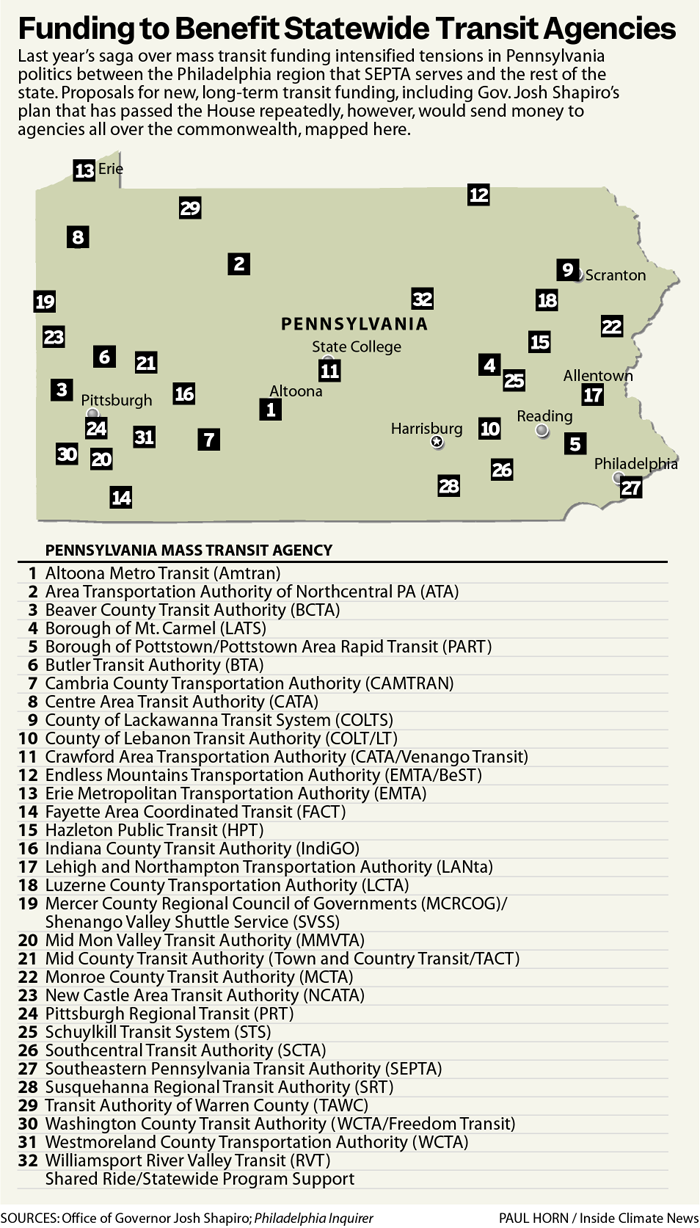
The governor again included his preferred funding source—increasing the portion of sales tax revenue given to mass transit, a plan that has passed the House repeatedly and would send $319 million in funding to agencies all over the state—in his fiscal year 2027 budget proposal. But the provision would only go into effect one year from now, and lawmakers suggested that its place in Shapiro’s budget might be more symbolic than realistic.
“The Republicans feel like [the two-year funding] means transit is off the table, and I don’t think they’re going to acquiesce to anything more,” said Kearney, a Democrat from Delaware County and minority member of the Senate Transportation Committee.
Kearney reflected that sacrifices by Democratic leaders, like temporarily pulling from the transportation trust fund instead of finding a new revenue stream, often don’t turn into political capital. “We’ll make concessions on something, and then [the Republicans] come back, ‘Oh, that’s great, now we also need this.’ Sometimes, I think they think we’re stupid.”
Saval, who represents a Philadelphia district, said he sees avenues to securing a transit funding package this year and vowed to continue to fight for it. Still, he agrees that it’s a long shot. “I want to be cautious about being confident about [those avenues],” he said, identifying the same obstacle that stymied efforts to come to an agreement last year: a Republican senate majority he called “intransigent.”
Inside Climate News reached out to several Pennsylvania Republicans for this article. Only Sen. Frank Farry, from a SEPTA-dependent district in Bucks County, responded with a statement, saying that he “has worked not only with Senate Republicans, but collaboratively with colleagues across the entire Senate in a bipartisan manner to advance a long-term, recurring funding solution.” Other Republicans have argued that transit agencies like SEPTA were not well-managed or efficient enough to justify sending them money that they think would be better spent on highways and roads.
“We’ll make concessions on something, and then [the Republicans] come back, ‘Oh, that’s great, now we also need this.’ Sometimes, I think they think we’re stupid.”
— State Sen. Tim Kearney
With the midterm elections looming and the memory of a drawn-out and highly criticized budget battle still fresh, Shapiro has invited legislative leaders to begin budget conversations earlier than usual.
“Historically, election years where the governor is on the ballot have not been contentious budgets, and sort of everybody has wanted to go home,” O’Mara said, calling Shapiro’s proposal “shrewd but middle-of-the-road.”
Saval worries about pressure to accept a “mediocre budget proposal, at best,” to allow lawmakers to get back to the campaign trail. “I understand that impulse, but it would be unfortunate if we leave a lot of things unaddressed,” he said.
SEPTA said it was continuing to engage in discussions with lawmakers and that it was grateful the governor again included the sales tax reallocation in his budget proposal. When asked about their involvement with year’s negotiations, an agency spokesperson said, “SEPTA’s advocacy role in funding discussions is to make sure we are clearly explaining the need and the impact that the system has on our region and the Commonwealth as a whole.”
During a high-profile summer that has brought World Cup soccer and celebrations of America’s 250th anniversary to Philadelphia, SEPTA has been eager to prove its skeptics wrong. O’Mara said new General Manager Scott Sauer is popular in Harrisburg, and the agency has instituted efforts to target fare evasion and bolster its safety infrastructure. SEPTA introduced austerity measures that have trimmed its deficit from $213 million to $192 million. “It is also extremely important for us to demonstrate that we are good stewards of the taxpayer dollars that we receive,” the agency said. Proponents have pointed out that SEPTA is more efficient than many of its peer institutions.
Transit for All Pennsylvanians
On June 15, the Pennsylvania Supreme Court opened up a possible avenue for transit funding by declaring skill games—the arcade-style gambling terminals in bars and gas stations—illegal unless they are regulated and taxed as slot machines. While some lawmakers, including Farry, voiced support for using that revenue for public transportation, O’Mara and Kearney said the ruling was unlikely to change the landscape of current budget negotiations.
If those predictions prove true, state lawmakers will again find themselves responsible for staving off severe service cuts to SEPTA and other transportation systems around Pennsylvania next year.
This story is funded by readers like you.
Our nonprofit newsroom provides award-winning climate coverage free of charge and advertising. We rely on donations from readers like you to keep going. Please donate now to support our work.
Donate Now“If the new funding does not make it into the final FY 2027 budget, we will continue to focus on ensuring SEPTA is providing safe, clean and reliable service for our customers as we make the case for funding in the next budget cycle,” the agency said. SEPTA said it was pursuing improvements during the upcoming year while planning for all long-term funding scenarios.
Kearney thinks next year’s push will come down to the results of November’s midterm elections. Democrats are hopeful that Shapiro’s popularity and Republican obstinance on public transit funding could help to flip the state Senate.
While he agreed that massive public support for mass transit could turn into serious electoral victories, Saval felt that party leaders shouldn’t rely on flipping a chamber that Democrats haven’t controlled since 1994. “We should be fighting for constituents all the time, regardless of electoral headwinds being in our favor or not,” he said.
Even if Democrats don’t flip the chamber, O’Mara and Kearney were optimistic that funding would be found next summer, when transit could take precedence over other contentious issues, like raising the minimum wage and legalizing marijuana, that have dominated this year’s negotiations.. Additionally, several lawmakers from transit-dependent districts will be eager to appease their constituents ahead of tight 2028 re-election campaigns.
The dependency of local transit agencies on ever-shifting political dynamics has led many to think about more sustainable funding models, like allowing local governments to raise funds for their own transit systems. Such a change, however, would need to be passed by a state government that has wanted to use its fiscal leverage to oversee institutions like SEPTA.
Saval is also a Senate cosponsor of the progressive-supported Transit for All PA package that now sits before both chambers, which 5th Square supports. The legislation builds on Shapiro’s sales tax reallocation with an additional 6 percent excise fee on ridesharing apps and increased car rental and lease fees to ensure transit agencies receive enough new funding to fully close their deficits. It’s backed by Transit for All PA!, a statewide coalition for transportation funding that was involved with the rally.
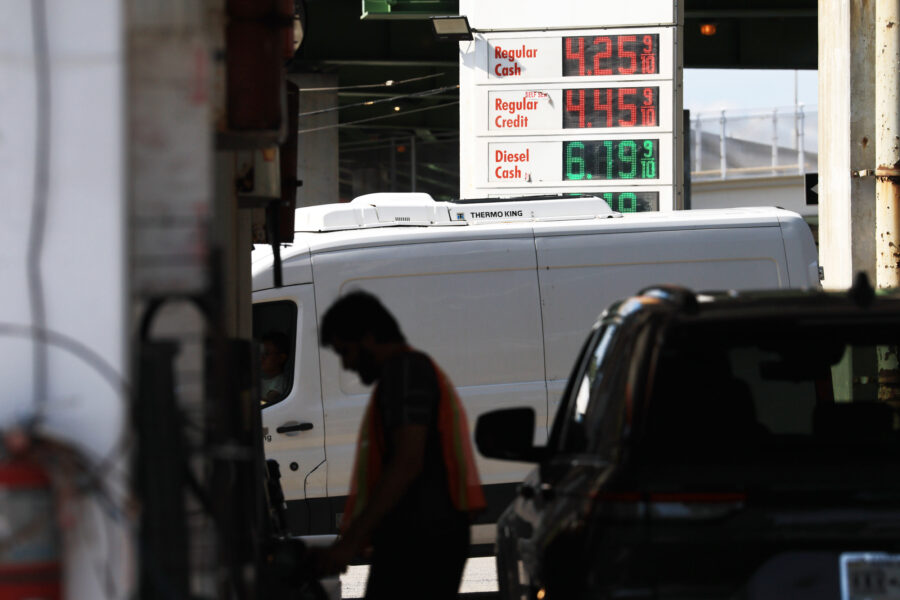
Transit agencies’ financial struggles continue as many Pennsylvanians face increasing costs for electricity, gas and groceries. “We are obviously dealing with a huge cost of living crisis, and transit is a big component of it. […] These are transit systems that people rely on everywhere,” Saval said. It’s not just SEPTA’s future at stake: smaller transit agencies like the Lehigh and Northampton Transportation Authority and the Capital Area Transit have much to gain from new state funding and didn’t receive PTTF dollars for this two-year period.
Because of the focus on SEPTA’s structural deficit, last year’s political battle intensified rural versus urban fault lines in the legislature, allowing both lawmakers and the public to paint transit funding as an issue only affecting the Philadelphia area. Now, Transit for All PA! hopes other state agencies will help lead advocacy efforts.
“I’ve explained to legislators that even in the most rural of districts, public transportation moves them and it moves their constituents. We know that the rural-urban divide is manufactured and a public good like transit touches us all,” Connor Descheemaker, statewide campaign manager for Transit for All PA!, said at the rally.
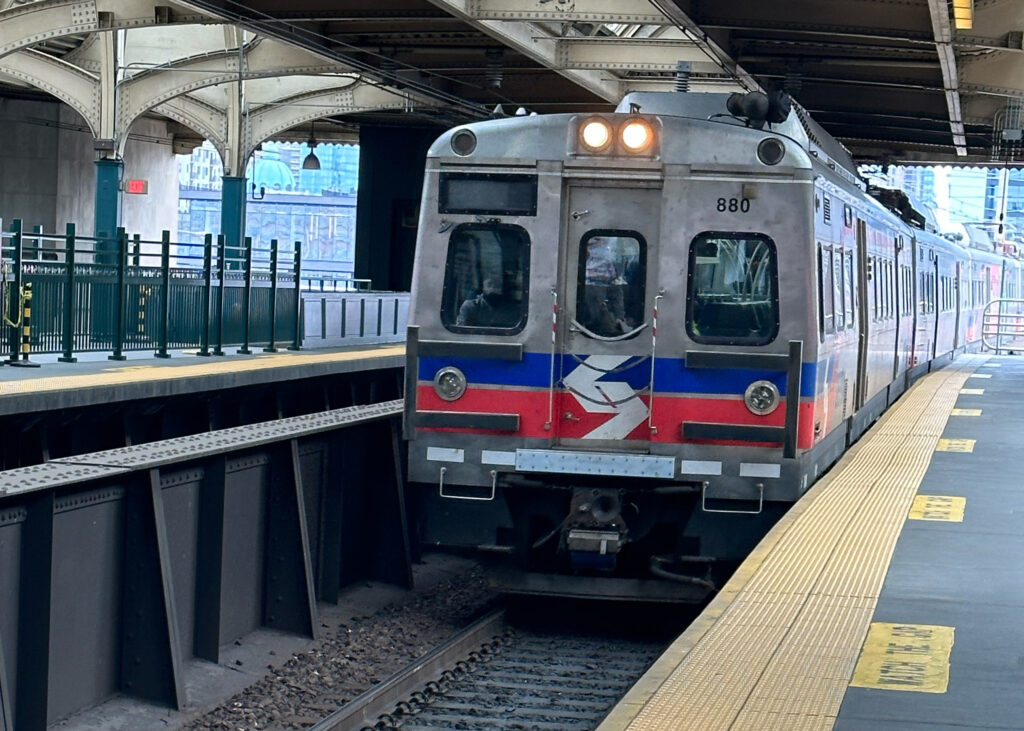
Advocates wonder what transit agencies’ future will look like as lawmakers again punt on new funding, and the PTTF money for capital improvements and repairs is further depleted. In 2025, passengers got a glimpse of what can happen when important investments in transit are delayed indefinitely: multiple fires on SEPTA’s Regional Rail trains led the federal government to step in, mandating emergency inspections. Two-thirds of SEPTA’s railcars are more than 50 years old. In November, new trolley sliders ended up damaging a Center City tunnel crucial for the routes, closing it for months.
“While SEPTA was able to fund emergency repairs to the [regional rail cars] and re-open [a faulty] trolley tunnel this time, eventually the damage becomes permanent,” said 5th Square’s Milone. “The analogy for what’s currently happening is that SEPTA is being forced to burn the furniture to heat the house.”
This article was updated on July 10, 2026, to correct a source’s name. His name is Jay Arzu, not Jay Arthur. It was also updated to reflect a later clarification from Sen. Tim Kearney about his views on negotiations with state Republicans. Kearney intended to say that “they think we’re stupid,” instead of “sometimes, I think we’re stupid.”
About This Story
Perhaps you noticed: This story, like all the news we publish, is free to read. That’s because Inside Climate News is a 501c3 nonprofit organization. We do not charge a subscription fee, lock our news behind a paywall, or clutter our website with ads. We make our news on climate and the environment freely available to you and anyone who wants it.
That’s not all. We also share our news for free with scores of other media organizations around the country. Many of them can’t afford to do environmental journalism of their own. We’ve built bureaus from coast to coast to report local stories, collaborate with local newsrooms and co-publish articles so that this vital work is shared as widely as possible.
Two of us launched ICN in 2007. Six years later we earned a Pulitzer Prize for National Reporting, and now we run the oldest and largest dedicated climate newsroom in the nation. We tell the story in all its complexity. We hold polluters accountable. We expose environmental injustice. We debunk misinformation. We scrutinize solutions and inspire action.
Donations from readers like you fund every aspect of what we do. If you don’t already, will you support our ongoing work, our reporting on the biggest crisis facing our planet, and help us reach even more readers in more places?
Please take a moment to make a tax-deductible donation. Every one of them makes a difference.
Thank you,

Daniel Perrin
Fellow
Daniel Perrin is a Philadelphia-based fellow at Inside Climate News, covering urban environmental issues. He is a rising senior at Swarthmore College, where he studies economics, literature, and history. He just finished serving as Editor-in-Chief of The Swarthmore Phoenix, overseeing the campus paper and reporting on trends within higher education, economic policy, sustainability, transportation, and governance at all levels. Having grown up in Chapel Hill, NC, before moving to Baltimore, he is especially interested in how large political and economic developments ripple through the built environment of local communities.