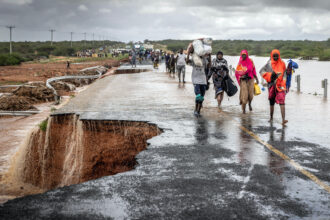


The last El Niño was linked to severe droughts in Southern Africa, wildfires in Indonesia and global coral bleaching. Now, ocean advocates are warning that American fishermen could face significant financial losses as fish stocks struggle to survive in warmer waters.
With the National Oceanic and Atmospheric Administration (NOAA) predicting an 81 percent chance of another “very strong” El Niño this year, environmental groups are warning it could spell disaster for U.S. fisheries.
Following the 2015-2016 Super El Niño—which occurred alongside a major North Pacific marine heatwave called “the Blob”—over $140 million in government relief was paid to impacted fishers, processors and dealers. Now, some economists are calling on Congress to pre-emptively appropriate emergency funding before this year’s El Niño impacts U.S. waters this fall.
“El Niño’s fuse has been lit and we don’t have much time to prepare,” said Anthony Rogers, senior fellow of fisheries economics and climate at Ocean Conservancy, in a press release. The environmental nonprofit is warning the impact on key fish stocks and livelihoods along the West Coast will be worse this year than it was a decade ago.
“It’s rare that we have a heads up that we’ll get hit by a natural disaster like this, so we should be preparing. Fishermen are going to be hit hard,” said Rogers in an email to Inside Climate News.
Discovered by South American fishermen hundreds of years ago, and named after baby Jesus, El Niño is a natural weather phenomenon that occurs every few years around Christmas when tropical eastern Pacific waters warm by at least 0.5 degrees Celsius, leading to declining fish catches.
NOAA is warning that this year’s El Niño could “rank among the largest El Niño events in the historical record.” Such a “super El Niño”—where average sea surface temperatures increase by at least two degrees Celsius—would severely disrupt Pacific fisheries.
Though El Niño events are a natural phenomenon, their impacts are being exacerbated by a steady increase in ocean temperatures driven by human-caused climate change. “When you’ve got species that are already at their thermal threshold, add in a super El Niño and that could push them over the edge,” said Samantha Garrard, a senior marine ecologist at the U.K.’s Plymouth Marine Laboratory. Garrard noted that climate change could worsen the impacts of an El Niño and lead to increasingly extreme and unprecedented ocean heat patterns.
During an El Niño, the process of “upwelling”—cold, nutrient-rich water rising to displace warmer waters—reduces. As a result, the growth of phytoplankton also decreases.
“Our two-layer ocean is really like a salad dressing,” said Deborah Robertson, professor of biology at Clark University. “Unless that deep cold water comes up to the surface, our surface waters can grind to a halt.”
With phytoplankton forming the base for much of the marine food chain, a decline in such algae can result in a “really disrupted food chain,” Garrard said.
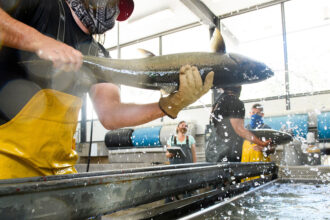
Salmon, for example, were severely affected in the mid-2010s when juveniles struggled to find quality prey due to compounding heat waves. Without ample food, the combination of El Niño and the Blob reduced their odds of survival. In the following years, rivers in Northern California and southern Oregon experienced weak salmon returns. In 2017, the West Coast’s salmon troll fishery was temporarily closed, costing several million dollars in lost revenue.
The reduced upwelling also impacts the West Coast’s iconic kelp forests. From Baja California to Washington, the underwater “rainforests of the sea,” typically comprised of giant kelp and bull kelp, create rich three-dimensional habitats. These areas act as nurseries and feeding grounds for bass, sheepshead, otters and harbor seals but they rely on cold, nutrient-rich water to grow.
“Swimming through a nutrient-stressed kelp forest is actually pretty saddening,” said Robertson, who first studied the impact of El Niño on Californian kelp forests in the 1980s. “You go from this very lush canopy to very short plants that are sloughing off at the end.”
The loss threatens not just marine ecosystems and food webs they support but also strips communities of natural barriers to storm surges. While kelp forests are usually resilient and recover from typical El Niño cycles, rising ocean temperatures are pushing them beyond their limits, experts warn. As major carbon stores, kelp forests’ dwindling health during El Niños makes them a potential carbon source.
“The thing that keeps me up at night is the fact that this El Niño is coming when the oceans have already warmed,” Robertson added. “The potential detrimental impacts are going to be tremendously bad.”
In the mid-2010s, marine heat waves also triggered outbreaks of harmful toxic algae that shut down much of the West Coast’s crab and shellfish fisheries. In California alone, 71 percent of Dungeness crab boats stopped fishing operations for part of the 2015-16 season.
In total, the warm-water weather patterns cost the West Coast salmon, crab, sardine and sea urchin fisheries millions in lost revenue, according to Ocean Conservancy.
Experts warn that financial relief to fishermen might bring its own challenges. “Almost everyone agrees that the aid program to help when disaster hits is broken,” Rogers said. “Because Congress needs to appropriate and approve funding, it can take years to get aid to fishermen who haven’t been able to catch fish and make a living, and that lag time unravels entire communities.”
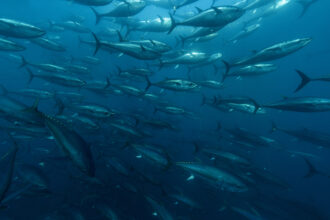
While a Super El Niño might benefit shortbelly rockfish stocks—whose numbers exploded in Oregon following the 2016 heatwave—or recreational anglers hoping to catch large Pacific bluefin tuna migrating into U.S. waters, there will be many more losers.
Large marine animals that depend on healthy sardine and anchovy stocks will likely suffer. Between 2013 and 2016, roughly 4,000 sea lion pups arrived on Californian beaches “skinny and hungry,” according to NOAA, after having no choice but to turn to lower-quality forage fish. Seabirds will suffer too: Between 2014 and 2016, half of the eight million common murres in Alaska died as a result of marine heat waves.
In Peru, the billion-dollar anchovy season remains partly suspended as a result of this year’s El Niño threats. More than 650 anchovy ships are stuck in Peruvian harbors while tens of thousands of employees working in fishmeal processing factories face job loss on land.
“This is going to test how ready our fisheries are for the increasing impacts of climate change, and I worry we are going to fail,” said Chris Dorsett, vice president of conservation at Ocean Conservancy. “We can’t stop El Niño, but we must prepare for it.”
About This Story
Perhaps you noticed: This story, like all the news we publish, is free to read. That’s because Inside Climate News is a 501c3 nonprofit organization. We do not charge a subscription fee, lock our news behind a paywall, or clutter our website with ads. We make our news on climate and the environment freely available to you and anyone who wants it.
That’s not all. We also share our news for free with scores of other media organizations around the country. Many of them can’t afford to do environmental journalism of their own. We’ve built bureaus from coast to coast to report local stories, collaborate with local newsrooms and co-publish articles so that this vital work is shared as widely as possible.
Two of us launched ICN in 2007. Six years later we earned a Pulitzer Prize for National Reporting, and now we run the oldest and largest dedicated climate newsroom in the nation. We tell the story in all its complexity. We hold polluters accountable. We expose environmental injustice. We debunk misinformation. We scrutinize solutions and inspire action.
Donations from readers like you fund every aspect of what we do. If you don’t already, will you support our ongoing work, our reporting on the biggest crisis facing our planet, and help us reach even more readers in more places?
Please take a moment to make a tax-deductible donation. Every one of them makes a difference.
Thank you,
Johnny Sturgeon
Fisheries Reporter
Johnny Sturgeon is a London-based reporter covering fisheries and aquaculture. Joining us from the Outlaw Ocean Project, he has experience producing in-depth maritime investigations for nonprofit newsrooms. A former boatbuilder, he holds a B.A. in History & Politics from the University of Oxford, and an M.S. from Columbia Journalism School.