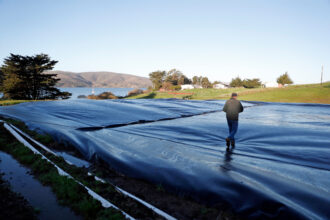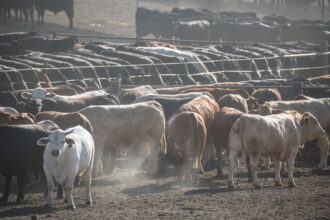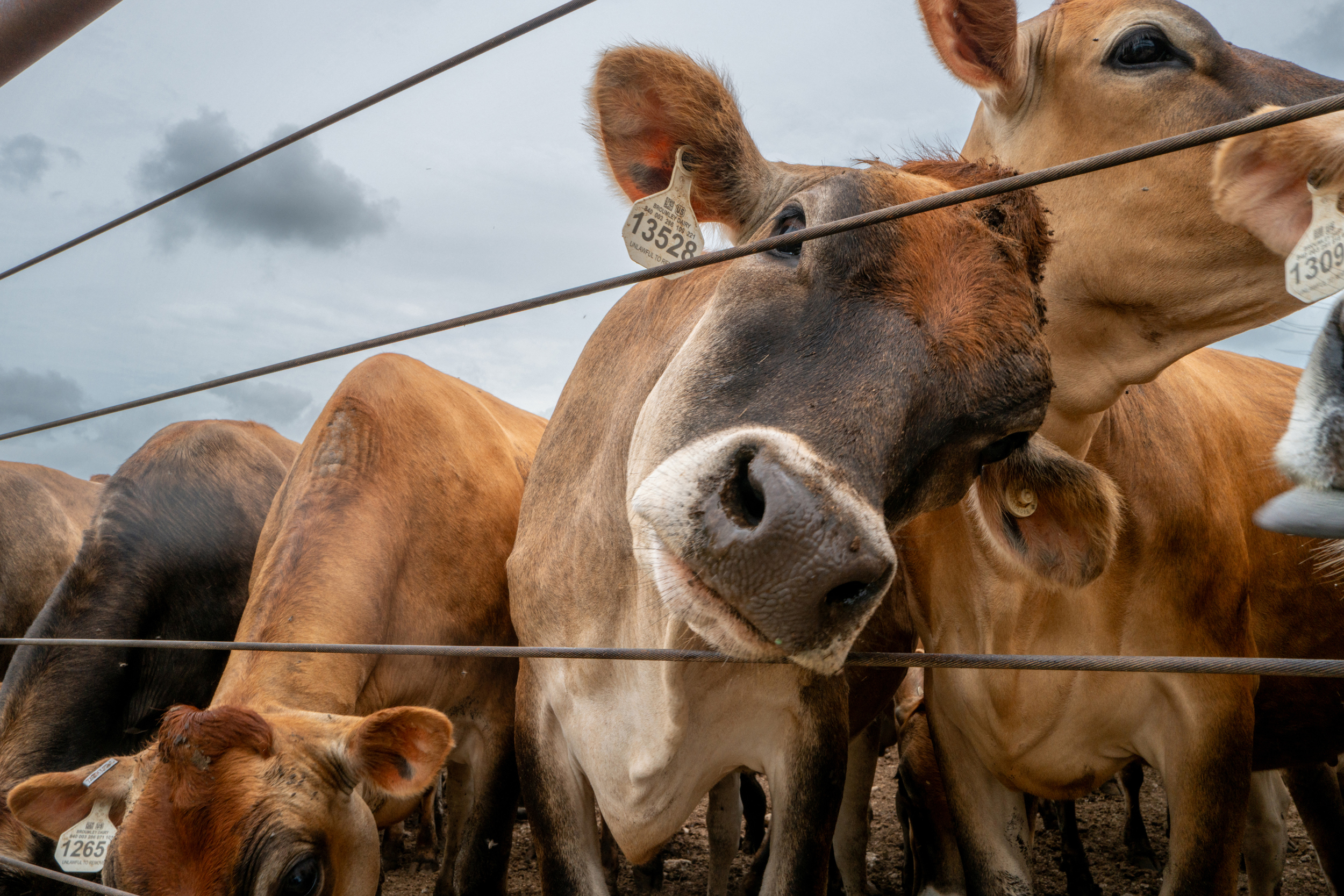


In Tillamook County, Oregon, the smell of manure wafts through the air. Here, over 80 concentrated animal feeding operations, or CAFOs, many of them dairies, dot the landscape.
For these CAFOs and hundreds more, the Oregon Department of Agriculture has issued a new water-quality permit that advocates say violates the federal Clean Water Act.
The Center for Food Safety, Food and Water Watch, Willamette Riverkeeper and the Animal Legal Defense Fund filed a lawsuit on July 14 against the department and the state Department of Environmental Quality over what plaintiffs say is its failure to adequately monitor and prevent CAFOs from illegally discharging waste into ground and surface water. The permit regulates over 300 CAFOs across the state.
Under the National Pollution Discharge Elimination System, Oregon issues its CAFO NPDES General Permit to ensure compliance with the federal Clean Water Act and its own state water law, which is more stringent than federal statute.
The NPDES permits are the main way that many states regulate water pollution from factory farms. Both Oregon departments declined comment on the lawsuit.
Oregon’s new permit, issued this spring, comes years after the state’s previous permit was issued in 2016 and expired in 2021. “Oregon waited so long—five years after the permit expired, ” Suzannah Smith, a legal fellow at Center for Food Safety, said. “It still failed to fix it.”
At the crux of the lawsuit is the permit’s lack of “representative monitoring” to detect the illegal entrance of pollutants into ground and surface water from CAFOs. Under the Clean Water Act, monitoring must accurately illustrate and address all pollution pathways and permit limits associated with a certain activity.
Recent court cases, won by Food and Water Watch in Idaho and the Center for Food Safety and other advocates in Washington, have set important precedent, finding that CAFO general permits are required to have representative monitoring under the Clean Water Act—a standard which Oregon plaintiffs say is missing in their state. Similar litigation is ongoing in Colorado.
Tami Kerr, executive director of the Oregon Dairy Farmers Association, said the organization is “supportive of the new permit.” She said the lawsuit’s language, which uses terms like “factory farm” and “industrial agriculture,” is out of touch and offensive to Oregon dairy farmers.
“I think that it’s frivolous. I think it’s unnecessary and I don’t think their real goal is environmental protection. I think their goal is to shut down animal agriculture,” she said.
CAFOs produce waste in many ways, including blood, feathers (from chicken operations) and manure, which contains pollutants like nitrogen and pharmaceuticals. Oregon is experienced in regulating CAFOs and other agricultural operations and has long dealt with nitrate pollution in its groundwater, which can have lasting impacts on public health and the environment.
“There’s a growing body of evidence that nitrate is associated with certain types of cancers and there are also some concerns over reproductive effects among persons who are exposed for long periods of time,” Keeve Nachman, professor of environmental health and engineering at Johns Hopkins University, said.
The plaintiffs claim that the new permit fails to regulate all CAFO pollutants, which also include pathogens, heavy metals, pharmaceuticals and salts. The current permit only regulates E. coli, nitrate, nitrogen and total phosphorus. Any and all discharge of these pollutants is prohibited, but monitoring and testing is limited.
Outdated Climate Data, Too Much Manure
In 2024, Lost Dairy Farm in eastern Oregon shut down. The dairy operation, permitted to house 30,000 cattle, was fined and cited after leaking manure lagoons and other violations—over 200 of them—stacked up.
Typically, CAFOs covered under the general permit are monitored every 10 months by a team of regulators. Extensive testing and monitoring of a CAFO occurs only once an operation has been found in violation of their permit.
This story is funded by readers like you.
Our nonprofit newsroom provides award-winning climate coverage free of charge and advertising. We rely on donations from readers like you to keep going. Please donate now to support our work.
Donate NowLarge-scale violations like Lost Dairy are rare in the state, but the farm has become a bellwether of the risks that a CAFO can pose.
“ We have a 99 percent compliance rate and discharges are illegal, as they should be,” Kerr said. “And if there’s any suspected discharge, whether it’s leaching or something that is directly going into a water system, then that needs to be reported and it needs to be investigated.”
While it is true that the state had a 99.2 percent compliance rate in 2025 across 497 inspections, the lack of frequent, representative monitoring, plaintiffs say, means pollution from CAFOs could be missed—especially when incidents are smaller, and less noticeable than what occurred at Lost Dairy. “We don’t know the full scope of the pollution, but we know that these agencies have been allowing practices and facility designs that do not prevent pollution,” said Tarah Heinzen, legal director at Food and Water Watch.
Plaintiffs question, for example, the state’s use of nutrient management plans, which determine the amount and ways in which farmers can apply manure to fields as fertilizer. While manure is tested yearly for nitrogen and phosphorus and fields are assessed for the risk they may pose to surface and groundwater in Oregon, the EPA has acknowledged that the plans do not guarantee improvements in water quality, and as such, plaintiffs say, are not adequate protections under the general permit. “They are not designed to protect water quality and they often allow for over-application of nutrients,” Heinzen said.
Additionally, manure lagoons and nutrient management plans may be ill-equipped to handle climate-driven heavy rains. Under their permits, CAFOs must be constructed to withstand severe, 24-hour, 25-year storm events, which the state estimated using an EPA rainfall forecast from 1961.
“What’s baked into the permit is a protection that’s based on a world that we don’t exist in anymore,” said Smith. CAFO facilities, in short, may not be built to withstand our impending climate reality, she said.
Regardless, the state said that representative monitoring for violations, whether from fields or manure pits, would be impossible since the general permit does not allow for discharge points—like a pipe leaching manure into a stream—in the first place. Heinzen rejects this assumption.
“CAFOs have very known and predictable discharge points,” she said. A manure lagoon may overflow and leak, waste can run off of fields after it is applied as fertilizer and seep through tile lines that are meant to carry water off of fields. “It’s not hard to know how a CAFO is likely to discharge,” she said.
Tools and methods exist to monitor these types of discharges, said Heinzen. Double synthetic liners and leak detection in manure lagoons, for example, may help find and prevent violations. Under the new permit, these tools are required for newly constructed CAFO operations in groundwater management areas, but are required nowhere else in the state.
“The departments know that that technology exists,” Heinzen said of the leak detection devices. “… Yet they are not requiring it for any other facilities.”
To date, wide-scale, representative monitoring is far from reality in Oregon as CAFO operators continue to register under the new general permit. The impending legal battle between advocates and the state will require courts to grapple with an emerging water quality precedent that few states have meaningfully established.
About This Story
Perhaps you noticed: This story, like all the news we publish, is free to read. That’s because Inside Climate News is a 501c3 nonprofit organization. We do not charge a subscription fee, lock our news behind a paywall, or clutter our website with ads. We make our news on climate and the environment freely available to you and anyone who wants it.
That’s not all. We also share our news for free with scores of other media organizations around the country. Many of them can’t afford to do environmental journalism of their own. We’ve built bureaus from coast to coast to report local stories, collaborate with local newsrooms and co-publish articles so that this vital work is shared as widely as possible.
Two of us launched ICN in 2007. Six years later we earned a Pulitzer Prize for National Reporting, and now we run the oldest and largest dedicated climate newsroom in the nation. We tell the story in all its complexity. We hold polluters accountable. We expose environmental injustice. We debunk misinformation. We scrutinize solutions and inspire action.
Donations from readers like you fund every aspect of what we do. If you don’t already, will you support our ongoing work, our reporting on the biggest crisis facing our planet, and help us reach even more readers in more places?
Please take a moment to make a tax-deductible donation. Every one of them makes a difference.
Thank you,

Claire Barber
Fellow
Claire Barber is a fellow at Inside Climate News and a master’s in journalism student at Stanford University. She is an environmental and outdoor journalist, reporting primarily in the American Southwest and the West. Her writing has appeared in The San Francisco Chronicle, Outside, Powder Magazine, Field & Stream, Trails Magazine and more. She loves to get lost in the woods looking for a hot spring, backpacking to secluded campsites and banana slugs.