

After spending the past decade building the world’s largest electric vehicle market, China is confronting one consequence of its success: a growing wave of batteries nearing the end of their service life.
Annual sales of battery-powered vehicles in China, including fully electric vehicles and plug-in hybrids, have surged from about 1 million in 2018 to more than 16 million in 2025. With EV batteries typically lasting about eight years, the country is entering its first major wave of battery retirements.
The number of batteries requiring disposal or reprocessing is expected to grow rapidly in the years ahead. That poses a major waste-management and recycling challenge for the nation.
China reported 400,000 metric tons of EV battery waste last year. A joint study by researchers in China and the United States projected that the figure could grow to 1.69 million metric tons in 2030 and 22.39 million metric tons by 2040.
For years, critics of electric vehicles have argued that their environmental benefits are overstated. EVs eliminate tailpipe emissions, but their full life-cycle effects—including the environmental and safety risks posed by discarded lithium-ion batteries—remain a concern. Governments largely chose to accelerate EV adoption anyway, betting that recycling systems would eventually catch up.
China began building a recycling system early and has created enough nominal capacity to handle the emerging wave. But much of the country’s used-battery supply continues to flow through uncertified recyclers, which poses serious environmental and safety risks linked to contamination and improper disposal. In a case announced in Jiangxi Province in 2024, an uncertified company was found to have improperly dismantled 364 metric tons of waste lithium iron phosphate batteries. The resulting contamination caused vegetation to die across six acres of forest and killed more than 420 cubic feet of standing timber.
Although recycling technology has improved, sustaining a profitable battery recycling business remains challenging. Because China leads the world in EV adoption, how Beijing manages both the risks and opportunities of battery retirement could help shape the industry’s global model.
China began developing a formal EV battery recycling system as early as 2018. More than 150 companies have since been placed on the government’s certification “white list,” authorizing them to process retired vehicle batteries.
By 2023, certified companies had a combined annual processing capacity of 623,000 metric tons, more than 1.5 times the volume of batteries retired that year. Yet they handled only about 25 percent of those batteries, highlighting a gap in recycling efforts.
An investigation published earlier this year by Yicai, a Chinese financial news outlet, illustrated the gap between official capacity and actual operations. Its reporters attempted to contact every company on the white list and found that more than 100 were no longer operating or could not be reached.
In the paper, “The Urgency to Regulate Informal EV Battery Recycling in China,” researchers described China’s effort to control the informal market as a “losing battle.”
“There is poisoning, explosion, and fire caused by improper battery dismantling, waste water being dumped into rivers, contaminants being seeped into groundwater and polluting the soil,” said Laixiang Sun, a professor at the University of Maryland and co-author of the paper, told Inside Climate News.
“There is the lithium, copper and nickel in the batteries,” said Yan Wang, a professor of mechanical engineering at Worcester Polytechnic Institute. “You cannot dump them into the environment.”
Yan Wang is also a co-founder of Ascend Elements, one of the largest battery recycling companies in the United States. He served as the company’s chief scientist from 2015 to 2022.
A sprawling network of informal operators is undercutting certified recyclers in China. They can pay more for used batteries because they avoid many of the costs associated with safe testing, dismantling and pollution control. Selling batteries to them is often more convenient for vehicle owners.
Because retired batteries retain economic value, they seldom go directly to landfills. In principle, batteries that remain in good condition can be repurposed for less demanding uses, while others can be recycled into raw materials for new batteries.
Repurposing, however, requires recyclers to test and grade batteries, modules and sometimes individual cells. It is a technically complex and expensive process. A Tesla Model Y battery pack, for example, can contain more than 4,000 individual cells.
“It is about health, about human rights, about pollution in the air, water and soil.”
— Laixiang Sun, paper co-author
Unlicensed operators can skip much of that testing and dismantle packs at far lower cost. Some then sell used cells for unapproved applications, including aftermarket range-extending battery packs. Because the cells may not have been properly tested, those modifications can create substantial fire and safety risks.
In November, a Xiaomi SU7 electric sedan caught fire in Changzhou, Jiangsu Province. The owner later told the Sanxiang Metropolis Daily that the battery involved was an aftermarket range extender rather than the vehicle’s original factory-installed battery.
Recycling batteries into raw materials appears to offer a more commercially promising path.
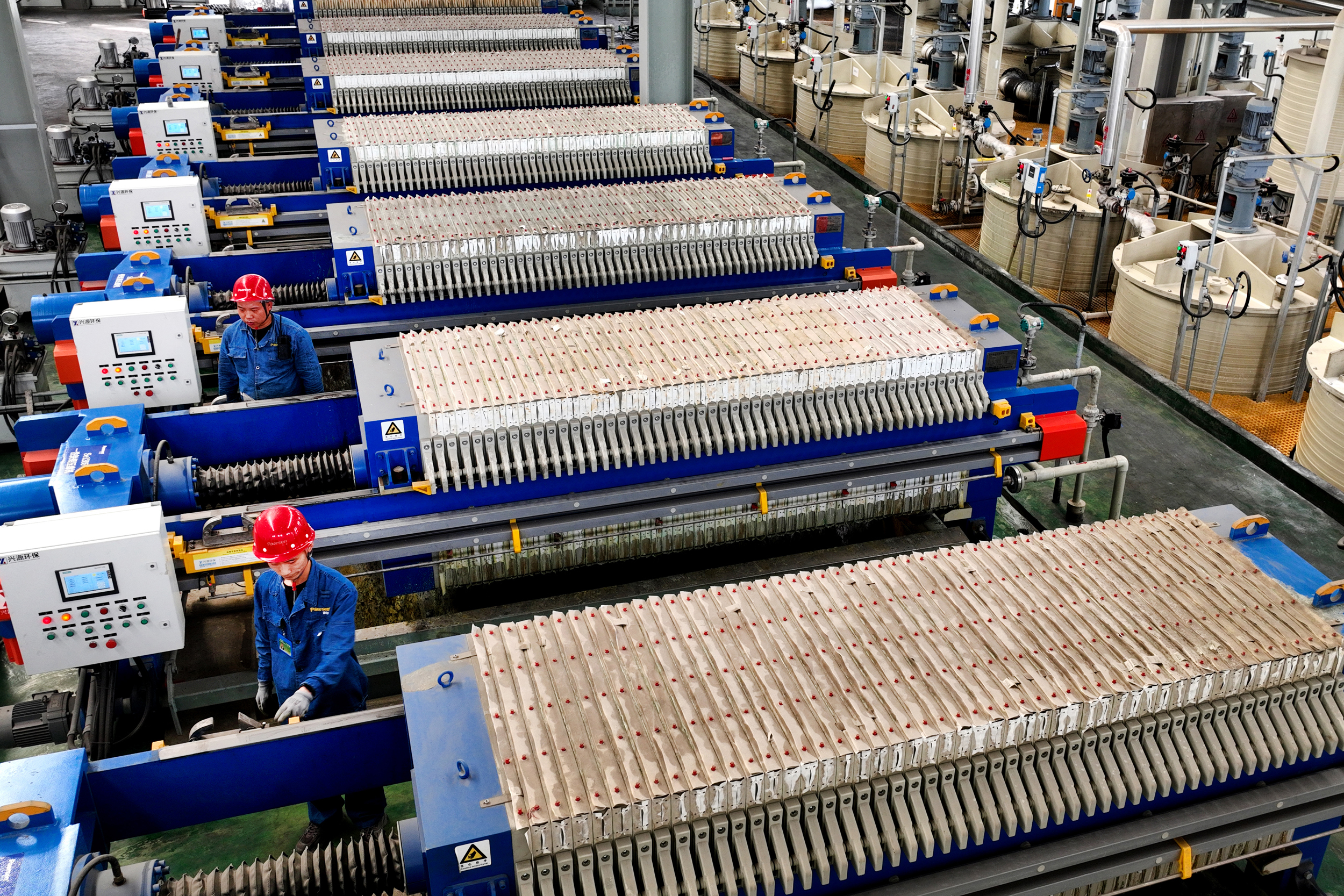
Companies can process batteries into “black mass,” a powder containing lithium, cobalt, nickel, manganese, graphite and other materials. Those materials can then be separated, refined and reused in new batteries. Some advanced processes can recover more than 95 percent of certain critical battery materials.
This story is funded by readers like you.
Our nonprofit newsroom provides award-winning climate coverage free of charge and advertising. We rely on donations from readers like you to keep going. Please donate now to support our work.
Donate NowUnlicensed recyclers, lacking in technology and infrastructure, are unlikely to achieve such high recovery rates. Their lower costs can come not only at the expense of the environment, but also at the expense of workers who risk exposure to toxic materials.
“It is about health, about human rights, about pollution in the air, water and soil,” Sun said. “It is an enormous problem.”
Sun’s research estimated that uncertified recyclers handled nearly 270,000 metric tons of retired batteries in 2023. Without decisive intervention, the study projected, the volume flowing through informal channels could reach 1.26 million tons in 2030 and 16.79 million tons by 2040.
China could significantly improve those outcomes by requiring automakers to take greater responsibility for battery recycling, imposing stricter controls on informal recyclers, and offering incentives to consumers and certified recyclers.
Under such a scenario, certified companies could handle 60 percent of retired EV batteries by 2030 and 92 percent by 2060, the study concluded.
A new national regulation governing EV battery recycling took effect on April 1. China is adopting a similar approach to Europe’s “battery passport” system, requiring automakers to bear greater responsibility for collecting and recycling used batteries. Batteries removed from retired vehicles must be directed through approved channels and processed by certified companies.

But more needs to be done, said Sun. The government’s efforts alone would not solve the problem.
“Automakers have to take responsibility, even if it pushes up costs,” he said.
“Car owners must be aware of their responsibility too. They have to be willing to sacrifice a small amount of money rather than sell batteries to the informal recyclers.”
The challenge is not unique to China. Battery recycling has proven difficult to make profitable worldwide.
Ascend Elements invested heavily in facilities in Georgia and Kentucky and raised more than $1 billion after 2021. But high construction costs, weaker EV demand in the U.S. and uncertainty surrounding federal support made its expansion difficult to sustain. The company filed for Chapter 11 bankruptcy protection in April.
“We are the first of its kind,” Yan Wang said, noting that he was not involved in the company’s daily operations. “Being first means you always make mistakes.”
Two other major North American battery recyclers, Li-Cycle and Lithion Technologies, entered insolvency proceedings in 2025. Glencore, a Swiss based multinational commodity trading and mining company has taken over Li-Cycle.
Glencore did not respond to Inside Climate News’ request for comment. Attempts to reach Ascend Elements and Lithion Technologies were unsuccessful because their listed email addresses and phone numbers were no longer working.
Yan Wang and Sun agreed that China has sufficient certified recycling capacity to manage the coming wave of retired EV batteries. With a vast and rapidly growing supply of used batteries, China has also emerged as the global leader in EV battery recycling.
But unless Beijing can prevent retired batteries from flowing into the informal market, the country risks repeating a familiar pattern: rapid industrial growth followed by a new wave of pollution.
About This Story
Perhaps you noticed: This story, like all the news we publish, is free to read. That’s because Inside Climate News is a 501c3 nonprofit organization. We do not charge a subscription fee, lock our news behind a paywall, or clutter our website with ads. We make our news on climate and the environment freely available to you and anyone who wants it.
That’s not all. We also share our news for free with scores of other media organizations around the country. Many of them can’t afford to do environmental journalism of their own. We’ve built bureaus from coast to coast to report local stories, collaborate with local newsrooms and co-publish articles so that this vital work is shared as widely as possible.
Two of us launched ICN in 2007. Six years later we earned a Pulitzer Prize for National Reporting, and now we run the oldest and largest dedicated climate newsroom in the nation. We tell the story in all its complexity. We hold polluters accountable. We expose environmental injustice. We debunk misinformation. We scrutinize solutions and inspire action.
Donations from readers like you fund every aspect of what we do. If you don’t already, will you support our ongoing work, our reporting on the biggest crisis facing our planet, and help us reach even more readers in more places?
Please take a moment to make a tax-deductible donation. Every one of them makes a difference.
Thank you,

Andrew Liu
Fellow
Andrew Liu is an Outrider fellow at Inside Climate News and a journalist covering climate, business and technology. Born and raised in China, he spent more than 20 years living and working in Singapore before moving to the United States. He holds degrees from Columbia Journalism School and Singapore Management University. Before focusing on climate and business reporting, Liu spent more than a decade as a sports reporter for Singapore’s Lianhe Zaobao, a leading Chinese-language daily newspaper. His reporting took him across Southeast Asia, China and Brazil.