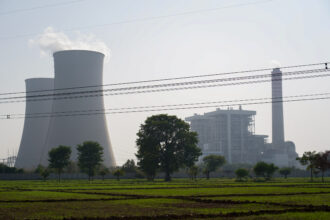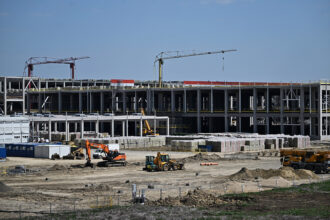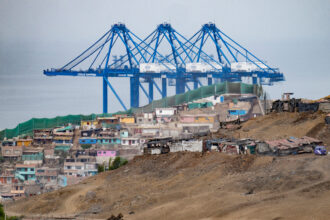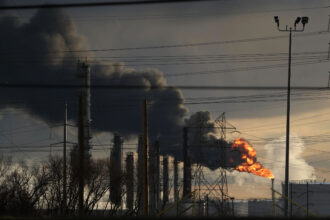


China’s Belt and Road Initiative, the world’s largest ongoing infrastructure program, has a substantial climate impact. More than half its emissions stem from steel, the majority of which was produced in China.
Cutting the emissions will require stronger environmental policies and major investment in cleaner manufacturing technologies, two new studies concluded.
More than 130 million tons of carbon dioxide equivalent emissions are tied to the construction of transportation, energy, building and water projects that were part of China’s Belt and Road international development initiative from 2008 to 2024, according to a study published Monday in the journal Environmental Science & Technology. The study, a global, project-level assessment of greenhouse gas emissions, tallied climate pollution linked to more than 700 Belt and Road construction projects across 105 countries.
The Belt and Road Initiative is China’s trillion-dollar development effort designed to help expand Beijing’s global influence. The emissions it produced from the 700 construction projects analyzed in the study were equivalent to the annual climate pollution from 35 coal-fired power plants, according to the U.S. Environmental Protection Agency’s greenhouse gas equivalency calculator.
Roughly half of all greenhouse gas emissions associated with these projects were generated outside the countries in which the projects were completed.
“It’s not only about the host country, but also all the actors through the supply chain [that] will be affecting those embodied emissions,” said Lingli Hou, a researcher at Leiden University in the Netherlands, and the study’s lead author.
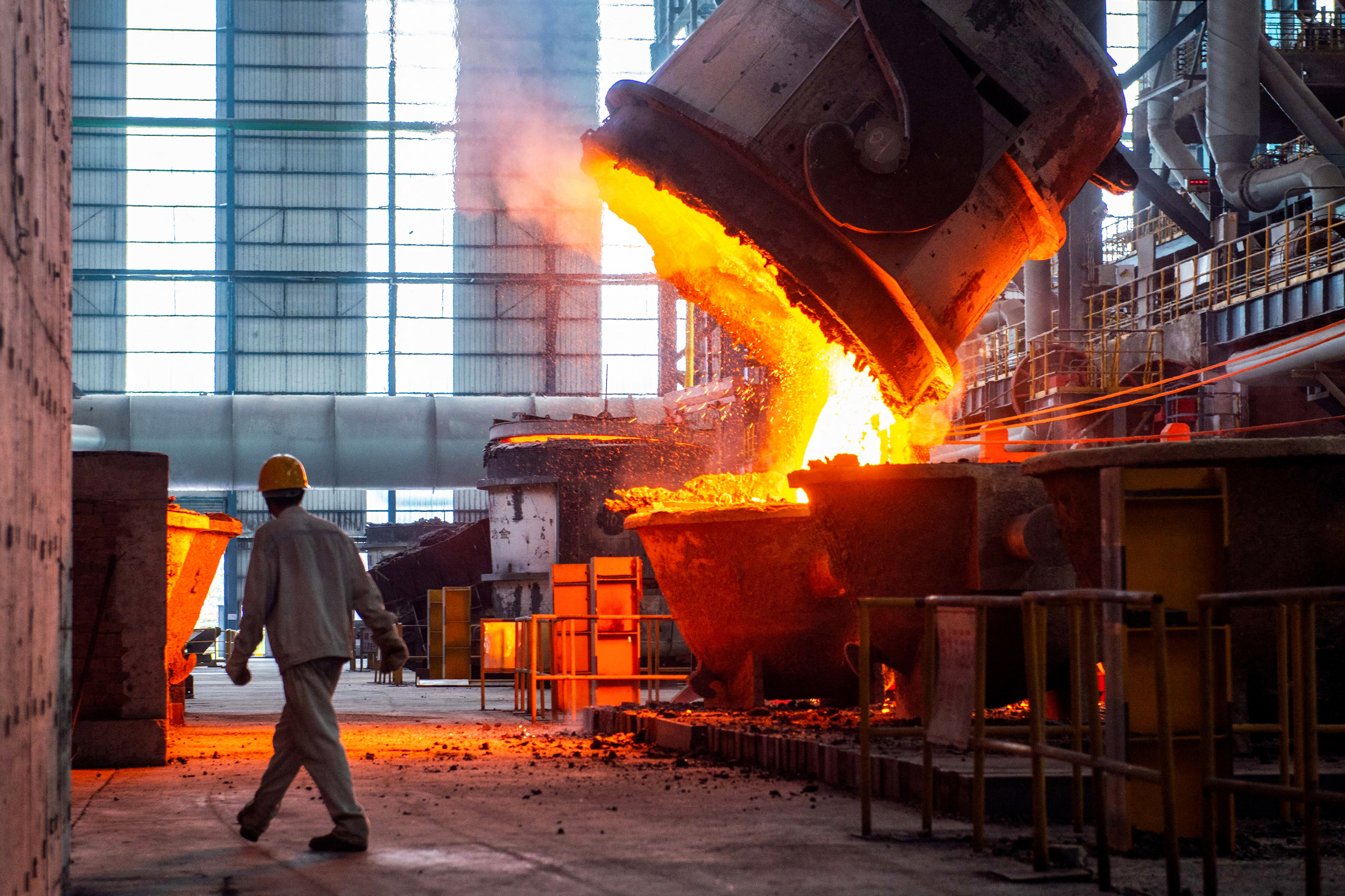
Carbon-intensive steel accounted for 53 percent of the projects’ total emissions, according to the study. China was the dominant source of emissions from steel manufacturing, making the country a major source of supply-chain emissions across the Belt and Road projects.
China produces more than half of all steel worldwide, and its manufacturing accounts for approximately 15 percent of the country’s total carbon dioxide emissions. The country’s ability to reduce emissions from steel production will play a key role in determining whether it can meet its climate goals of peaking greenhouse gas emissions by 2030 and achieving carbon neutrality by 2060.
“Around 90 percent of China’s steel is still produced using the dirtiest route by firing coal in blast furnaces,” Kate Logan, director of the China Climate Hub & Climate Diplomacy for the Asia Society Policy Institute, said in a written statement. “This makes China’s steel sector a hotspot for global emissions—but also a huge opportunity if it can be cleaned up.”
A combination of carrot-and-stick policies that incentivize cleaner technologies while placing a price on carbon is needed to hasten this transition, a study published Monday in the Proceedings of the National Academy of Sciences concluded.
“Our findings suggest that ambitious climate targets cannot be achieved through isolated policy measures alone,” said Xiao Liu, the study’s lead author and a researcher with Beijing Normal University’s School of Environment and China’s State Key Laboratory of Environmental Criteria and Risk Assessment. The study modeled how more than 700 companies in China would respond to different emission reduction policies.
Liu said steel production that relies on hydrogen rather than coal can be a near-term solution, while electric arc furnaces that recycle used or “scrap” steel will likely play an increasingly important role in the future.
Meanwhile, much of the steel used in Belt and Road projects goes to clean energy projects that help reduce emissions by lowering the need for additional fossil-fuel-based power plants.
The vast majority of energy projects constructed under the Belt and Road Initiative from 2008 to 2024 were for renewable energy projects, the Environmental Science & Technology study found. The paper estimated that emissions reductions resulting from operating these clean energy projects for approximately two years or less were comparable to the total greenhouse gas emissions associated with the construction of all 706 Belt and Road Initiative projects.
The finding is similar to that of a 2025 report by Carbon Brief, which concluded that China’s exports of clean-energy technologies such as solar panels, batteries and electric vehicles reduced global greenhouse gas emissions outside of China by 1 percent. The analysis showed that the emissions associated with manufacturing these products would be negated through emissions reductions in less than one year of their operation.
Tomer Fishman, an associate professor of Industrial Ecology at Leiden University and a co-author of the Environmental Science & Technology study, said future research will move beyond measuring greenhouse gas emissions of Belt and Road projects to assess their broader effects on host countries. “How does it support the development of those countries, and what are the trade-offs?” he asked.
Correction: This story has been updated to correct Tomer Fishman’s title—he is an associate professor, not an assistant professor.
About This Story
Perhaps you noticed: This story, like all the news we publish, is free to read. That’s because Inside Climate News is a 501c3 nonprofit organization. We do not charge a subscription fee, lock our news behind a paywall, or clutter our website with ads. We make our news on climate and the environment freely available to you and anyone who wants it.
That’s not all. We also share our news for free with scores of other media organizations around the country. Many of them can’t afford to do environmental journalism of their own. We’ve built bureaus from coast to coast to report local stories, collaborate with local newsrooms and co-publish articles so that this vital work is shared as widely as possible.
Two of us launched ICN in 2007. Six years later we earned a Pulitzer Prize for National Reporting, and now we run the oldest and largest dedicated climate newsroom in the nation. We tell the story in all its complexity. We hold polluters accountable. We expose environmental injustice. We debunk misinformation. We scrutinize solutions and inspire action.
Donations from readers like you fund every aspect of what we do. If you don’t already, will you support our ongoing work, our reporting on the biggest crisis facing our planet, and help us reach even more readers in more places?
Please take a moment to make a tax-deductible donation. Every one of them makes a difference.
Thank you,

Phil McKenna
Reporter, Boston
Phil McKenna is a Boston-based reporter for Inside Climate News. Before joining ICN in 2016, he was a freelance writer covering energy and the environment for publications including The New York Times, Smithsonian, Audubon and WIRED. Uprising, a story he wrote about gas leaks under U.S. cities, won the AAAS Kavli Science Journalism Award and the 2014 NASW Science in Society Award. Phil has a master’s degree in science writing from the Massachusetts Institute of Technology and was an Environmental Journalism Fellow at Middlebury College.