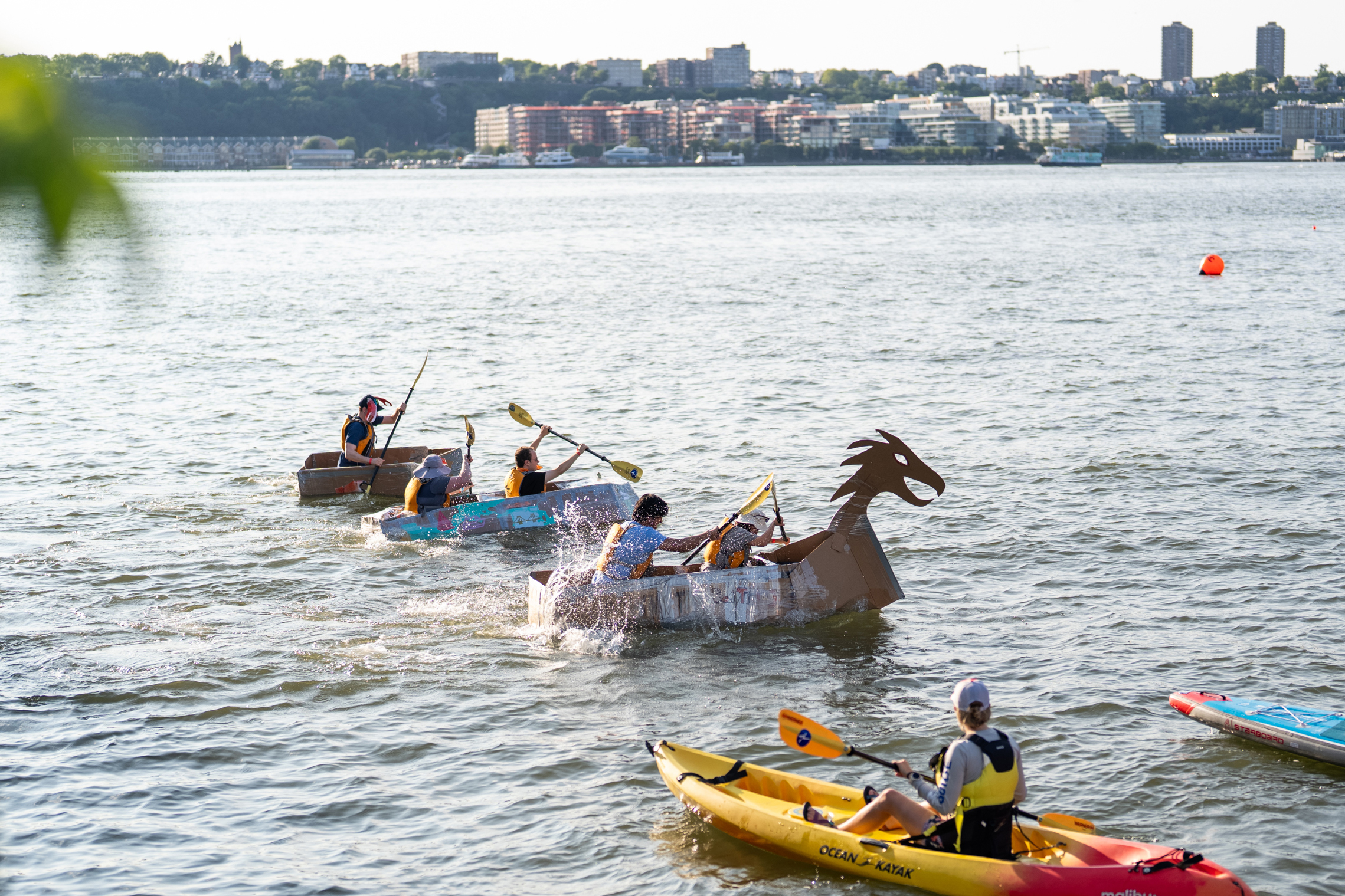


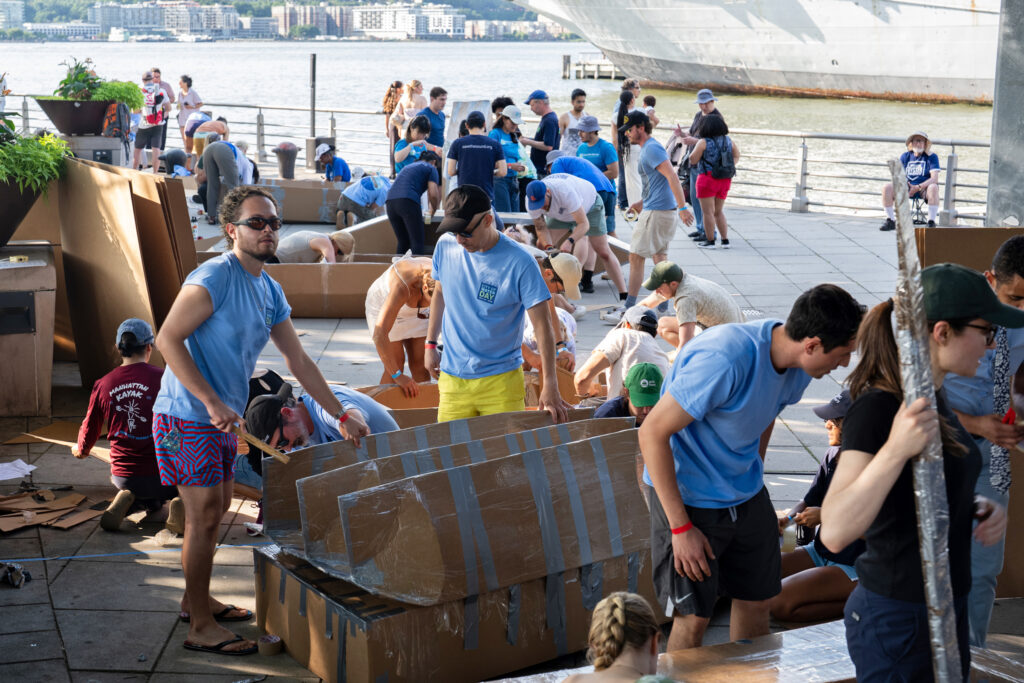
The bullhorn blared as three cardboard kayaks lurched into the Hudson River from Pier 84 in Manhattan. Their occupants paddled across choppy waters toward a bright yellow buoy about 20 meters offshore.
All three boats completed the course, though not without a struggle.
Revived in July after a six-year hiatus, the Cardboard Kayak Race invited New Yorkers back to the waterways surrounding the nation’s most densely populated city.
In the 1970s and 1980s, attempting to paddle a flimsy cardboard boat across one of New York City’s waterways would have seemed risky, not because it might sink, but because falling overboard meant plunging into water polluted by decades of industrial waste and untreated sewage. Though industrial waste is increasingly being cleaned up or trapped in muddy riverbeds, untreated sewage continues to be discharged into rivers and creeks in and around the city.
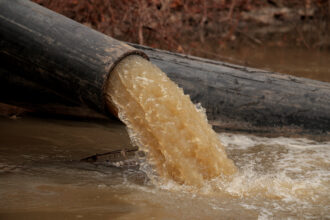
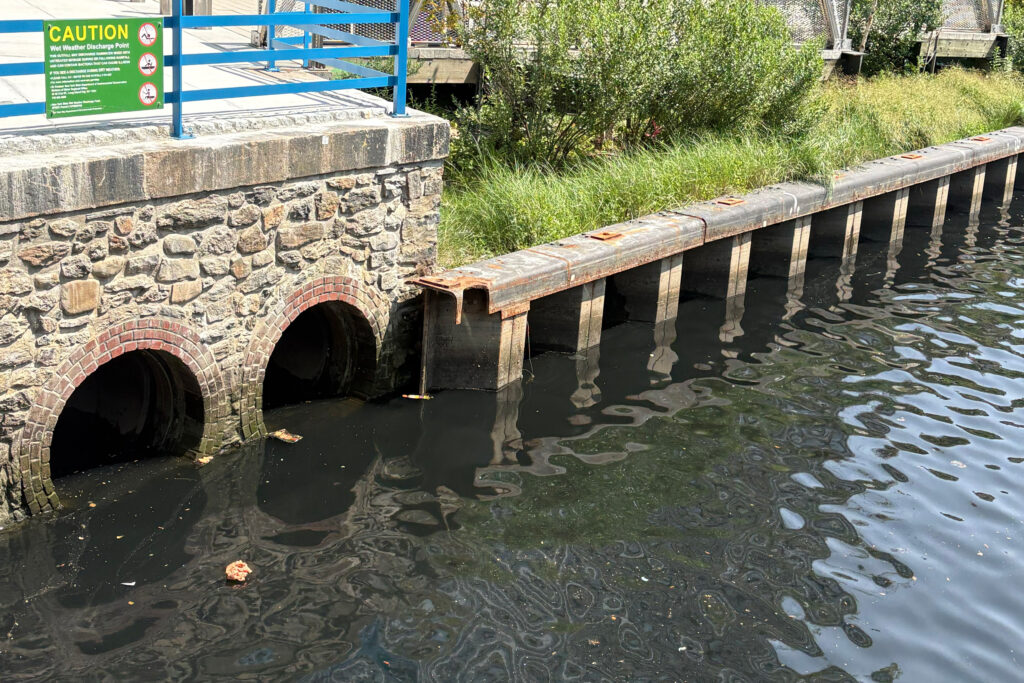
That’s because around 60 percent of New York’s sewers are combined, meaning rain and sewage run through the same pipes to water treatment plants. When there’s too much water in the system, like during a heavy rain, the system releases the mixture into the rivers and creeks in and around the city. It’s called a combined sewer overflow.
The city issues advisories when the water quality violates state standards, but it does not notify the public after every combined sewer overflow. Local environmental groups and Riverkeeper, a nonprofit focused on protecting the Hudson River, won a lawsuit requiring those alerts, though city officials have appealed the ruling.
“It is really crucial that people know when sewers are discharging, so that they can avoid that risk,” said Mike Dulong, a lawyer for Riverkeeper who has argued this case for years.
The city’s Law Department declined to comment on the ongoing appeal. A spokesperson said the city is petitioning the New York Court of Appeals, the state’s highest court, to hear the case.
Since the passage of the Clean Water Act in 1972, New York’s waterways have become far cleaner. Some areas are now protected natural habitats, while others are designated as “swimmable” during dry weather.
Across the city, local groups regularly lead canoe and kayak trips on rivers and creeks that were once considered too polluted to safely enjoy. But, after particularly rainy days, they still are.
Willis Elkins, the executive director of the Newtown Creek Alliance, which organizes activities on the creek and advocates for water quality improvements there, said he sometimes changes daily plans after heavy rainfall.
“It alters our programming, but also just alters in general how people are able to to engage with what is a natural resource,” he said.
In 2024, the city dumped an estimated 20.25 billion gallons of combined sewer overflow into local waterways, according to the most recent data from the state’s Department of Environmental Conservation.
A Fragmented Picture
When the city’s sewers were built more than a hundred years ago, they were a marvel. A network of thousands of sewer pipes collects and transports sewage and rain to 14 wastewater treatment plants across the city. That treated water is then released into local water bodies, re-entering the water cycle.
During periods of heavy rain, Elkins said the city water quality advisories are “helpful,” but not the same as a warning whenever a lot of sewage is discharged into a local waterway.
Elkins’ nonprofit is one of the local groups involved in the lawsuit against the city’s DEP. The groups allege that New York State law—the Sewage Pollution Right to Know Act—requires the city to inform the public about combined sewer overflow events within four hours of discovery.
Newtown Creek, a small waterway that separates Brooklyn and Queens, is an extremely contaminated Superfund site—designated by the federal Environmental Protection Agency—and is on the National Priorities List of the nation’s most hazardous toxic waste areas.
During the sewage pollution lawsuit, which dates back to 2020, lawyers for the environmental groups argued that sewage enters the waterways far more often than the number of city advisories suggests.
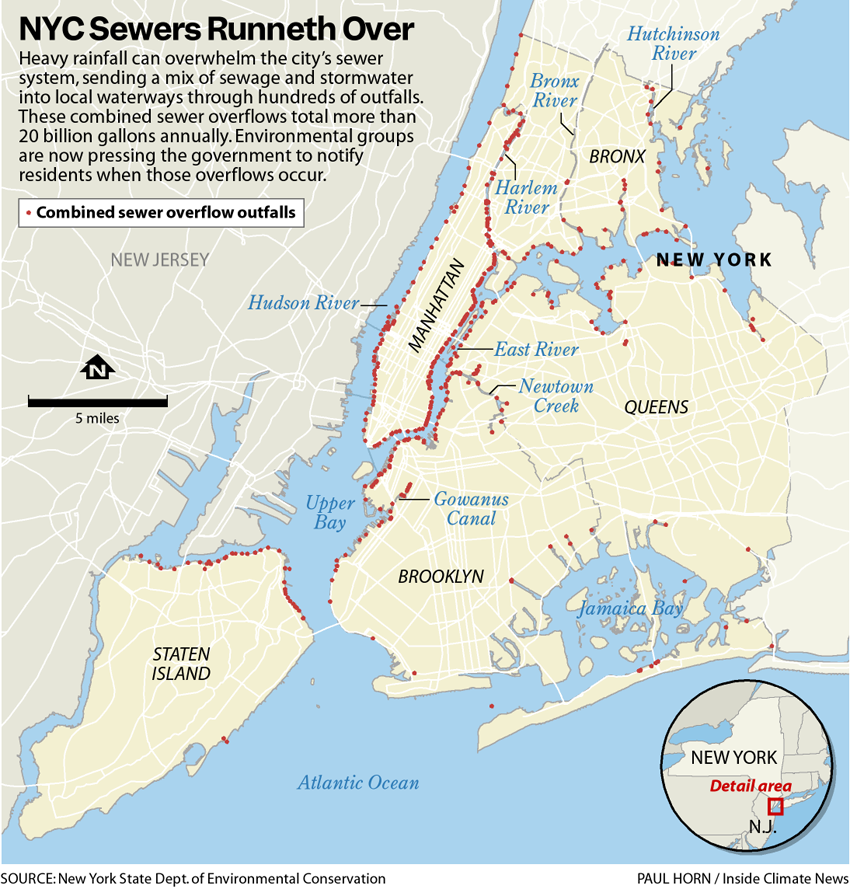
In a 2020 filing, environmental groups found that, according to precipitation models and annual city reports, sewage discharges likely occurred in the East River at least 52 times in 2019 from just five outfalls—pipes that discharge directly into waterways.
That year, they argued, the Department of Environmental Protection, which manages the sewer system, issued only 11 water quality advisories for the East River. The DEP’s then-senior director, Keith Mahoney, took issue with this calculation in a 2023 affidavit, calling it an oversimplification and adding that the models utilized for city advisories are “unparalleled” throughout New York state for their “quality and sophistication.”
The advisories, along with the NY-Alert system—which informs residents when a discharge could impact the recreation in water bodies, but does not specify which ones—comply with state law, he said.
Many localities covered by the same law use rainfall models to predict when overflow events are likely to occur. Local authorities then issue warnings based on those estimates, Dulong said.
He said that the city’s current system, in which officials wait until water quality violates state standards to issue an advisory, does not provide residents with the full picture. After years of legal filings, a judge ordered the DEP to “promptly notify the public of discharges of untreated and partially untreated sewage” in 2024.
Since then, the DEP has appealed the decision twice, arguing that it cannot notify the public of discharges using its current models and system. In annual reports, the DEP estimates the number of overflow events at each outfall and the volume of the discharges. In its most recent report, the agency estimated that an overflow event happened 56 times last year at an outfall in Newtown Creek.
More specific warnings about sewage discharges could help boaters, swimmers and fishermen avoid unnecessary risks and inform the public about when wastewater enters local waterways so they could briefly reduce water use, Dulong said.
This story is funded by readers like you.
Our nonprofit newsroom provides award-winning climate coverage free of charge and advertising. We rely on donations from readers like you to keep going. Please donate now to support our work.
Donate NowThe DEP has been trying to address the sewage overflow issue since 2005, when a consent order—a legally binding improvement plan—led to the creation of long-term projects to reduce discharges into the waterways.
On Newtown Creek, the city designed a 3.2-mile tunnel to collect polluted rainwater and sewage during a big storm—its capacity is around 50 million gallons. Once finished, the tunnel is expected to reduce annual combined sewer overflows into the creek by around 70 percent by storing this contaminated water until it can be cleaned at a wastewater treatment plant.
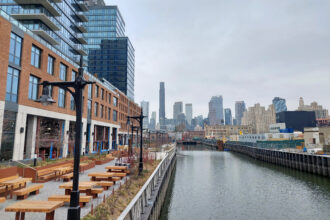
To reduce discharges, Gowanus Canal has a similar plan—two ‘detention tanks’ are being built in tandem with the industrial pollution cleanup, which would be capable of storing a combined 12 million gallons of combined sewer overflow.
These projects are part of the DEP’s ‘gray infrastructure’ approach to reduce flooding and combined sewer overflows. Across the city, the Department of Environmental Protection uses a combined approach of ‘gray infrastructure’ and green infrastructure, which includes projects like restoring marshes and building green roofs or rain gardens.
The Fish Sometimes Struggle—But Many Survive
The weekend after the Cardboard Kayak Race, the Gowanus Canal gave off a faint but persistent sewer smell. In the aftermath of two big rainstorms, the canal’s wildlife was struggling amid a large algal bloom caused by combined sewer overflows, she said.
“This is not normal,” said Celeste LeCompte, a captain at the Gowanus Dredgers Canoe Club, which offers rides on canoes along the small canal in Brooklyn.
Fish were visible near the water’s surface, desperate for oxygen. They attracted juvenile egrets, which happily dipped their skinny beaks in and out of the canal, hoping to catch mummichogs, a hearty little fish that lives year-round in the canal.
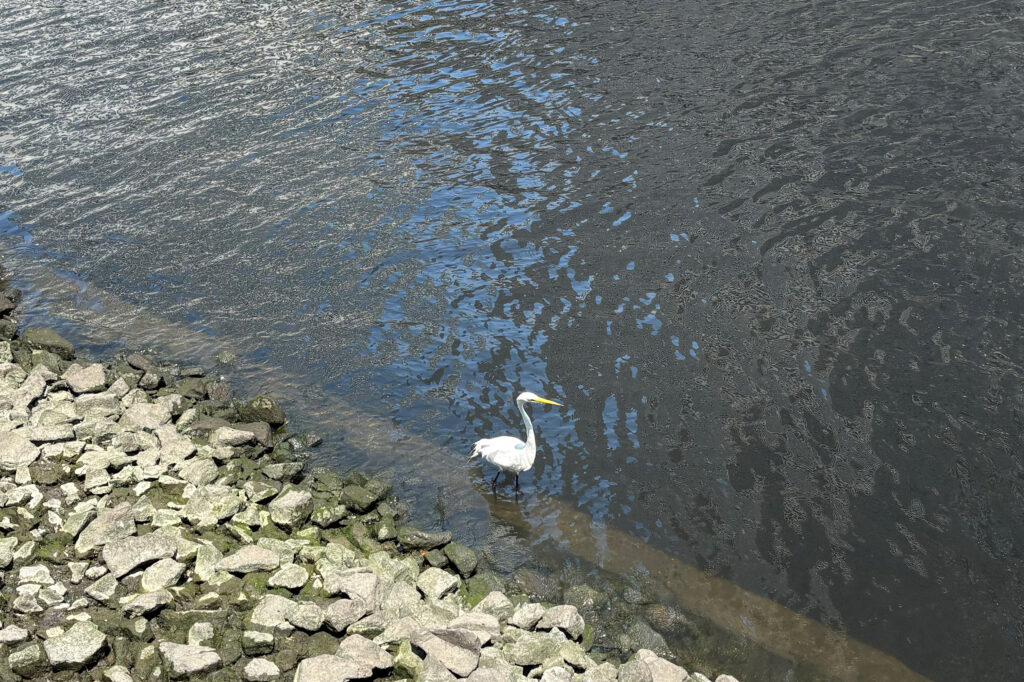
Though the aftermath of heavy rains can last for days in some of these waterways, once they do flush out, healthy wildlife is visible even in the most polluted water bodies.
The federal Environmental Protection Agency has designated the Gowanus Canal as a contaminated Superfund site due to past industrial operations along its shores that polluted the waterway. Today, the EPA is overseeing an extensive cleanup with engineers dredging the canal and pumping out contaminated sediment.
The cleanup has forced a temporary shutdown of the Flushing tunnel pumping station, LeCompte said. The tunnel usually pumps water from the New York Harbor into the end of the canal to push water out into Gowanus Bay on the west side of Brooklyn.
Polluted water was taking longer to flush out of the canal, she said. The excess nitrogen in the sewage helped create the large algal bloom, darkening most of the waterway and emitting an unpleasant odor. Despite this, multiple people pulled large canoes into the water and began slowly paddling around the canal.
LeCompte said that boaters in the canal should be careful, but not afraid. “Treat it like the Subway,” she said, quoting a colleague.
Combined sewer overflows present a risk to boaters, fishers and swimmers in New York’s waterways. Exposure to human waste can lead to gastrointestinal illnesses in humans, including norovirus.
Like many local groups that regularly use the city’s waterways, LeCompte said that the public notification about combined sewer overflows is “very poor.” The overflows can even affect whether members of the Gowanus Dredgers get out on the water.
The Newtown Creek Alliance hosts educational events that bring hundreds of children to the creek each year—but, he says, they usually stay near the mouth of the waterway, closer to the East River. The back of the creek, where it ends, is “never safe,” he said.
“When it comes time to engage with the waterway, we have to be extremely cautious,” Elkins said. “It would be great for us to have a creek where a child could go and touch the waterway and not have to worry about what they’re being exposed to.”
About This Story
Perhaps you noticed: This story, like all the news we publish, is free to read. That’s because Inside Climate News is a 501c3 nonprofit organization. We do not charge a subscription fee, lock our news behind a paywall, or clutter our website with ads. We make our news on climate and the environment freely available to you and anyone who wants it.
That’s not all. We also share our news for free with scores of other media organizations around the country. Many of them can’t afford to do environmental journalism of their own. We’ve built bureaus from coast to coast to report local stories, collaborate with local newsrooms and co-publish articles so that this vital work is shared as widely as possible.
Two of us launched ICN in 2007. Six years later we earned a Pulitzer Prize for National Reporting, and now we run the oldest and largest dedicated climate newsroom in the nation. We tell the story in all its complexity. We hold polluters accountable. We expose environmental injustice. We debunk misinformation. We scrutinize solutions and inspire action.
Donations from readers like you fund every aspect of what we do. If you don’t already, will you support our ongoing work, our reporting on the biggest crisis facing our planet, and help us reach even more readers in more places?
Please take a moment to make a tax-deductible donation. Every one of them makes a difference.
Thank you,

Lauren Dalban
Reporter, New York City
Lauren Dalban is a New York City-based reporter with a background in local journalism. A former ICN fellow, she now covers environmental issues in all five boroughs. Originally from London, she earned a B.A. in History and English from the University of Virginia, and an M.S. from Columbia Graduate School of Journalism.