

Armed Border Patrol agents raided a protest camp in Lochiel, in southeast Arizona, making way for contractors to cut down the last standing cottonwood tree Monday morning for a double border wall, after protesters protected it for more than 70 days.
Activists in Lochiel said at least 12 people had been arrested as of 8 a.m. during the ongoing raid. Border Patrol agents ignored demands for a warrant as they entered the private property and destroyed tents, according to news releases from activist groups on the ground.
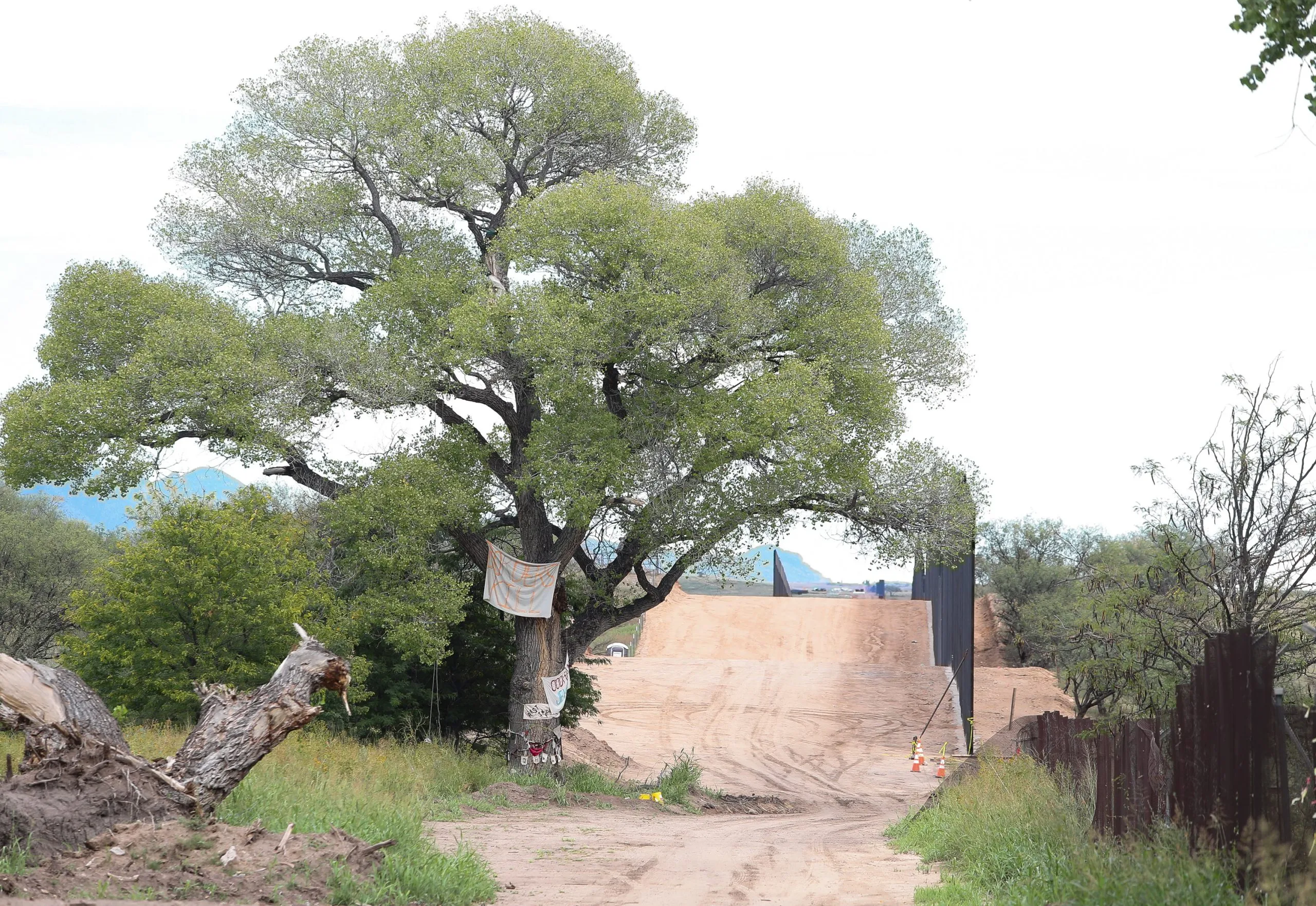
Dubbed the “grandmother tree,” the cottonwood cut down Monday was hundreds of years old. It was one of several that lined the edge of private property along Border Road, a dirt road that runs along the U.S.-Mexico border, in a remote area of Arizona in the San Rafael Valley about 25 miles east of Nogales.
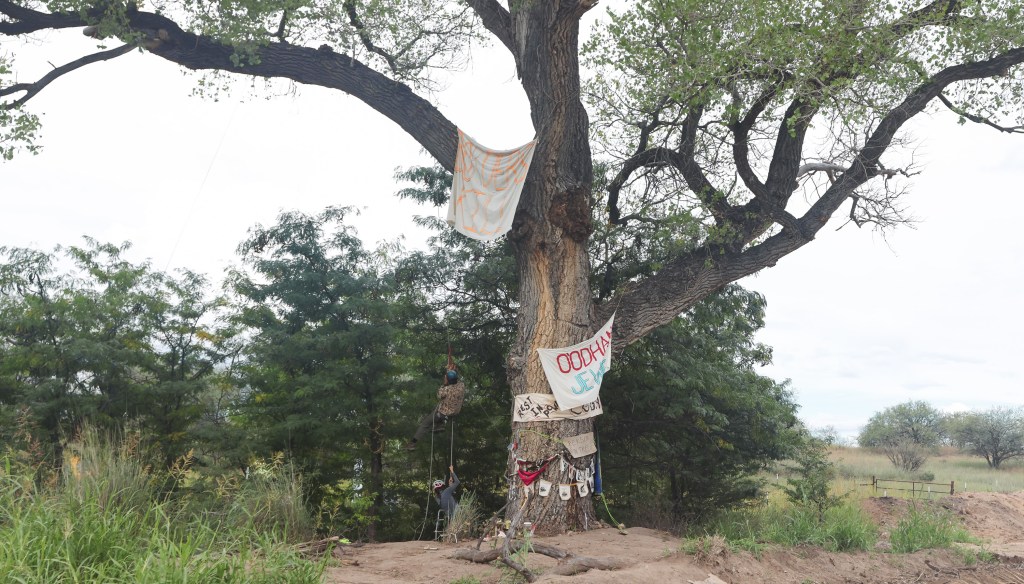
U.S. Customs and Border Protection said Monday in a statement to Arizona Luminaria that it has now removed all four cottonwood trees on federal land in Lochiel that were marked for removal.
“CBP recognizes the importance of protecting the environment, wildlife, and cultural resources during border wall construction,” the statement said. “While concerns exist about impacts to sensitive areas, it is important to note that illegal immigration itself poses significant environmental challenges. High volumes of unauthorized crossings often result in substantial amounts of trash, pollution, and damage to natural resources, including sensitive habitats and agriculture.”
CBP did not answer additional questions from Arizona Luminaria about how many protesters were arrested or what charges they face.
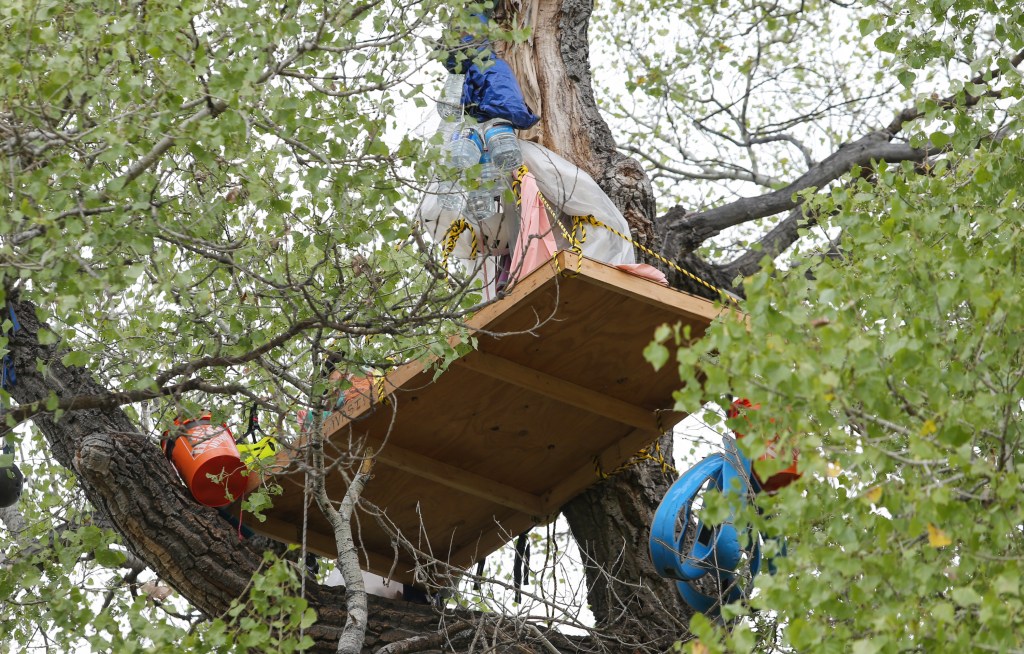
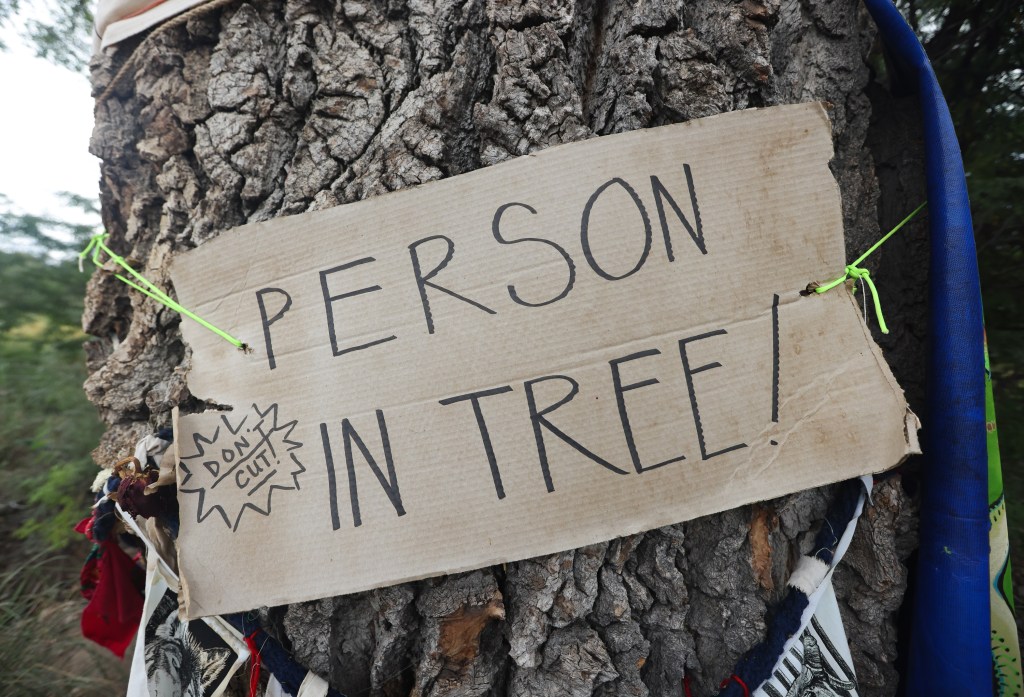
After three cottonwoods were cut down in June, activists set up a tree-sit in an attempt to protect the last remaining grandmother tree. At least one person sat or slept in the tree at all times. For 71 days, people camped out in private property just north of the tree and took turns occupying it.
On Monday around 6:30 a.m., Border Patrol agents with their faces covered began to arrest protesters, videos posted on Instagram show. People screamed and some warned the agents that they were pushing people into barbed wire on the ground. The protesters were trying to move back onto the private property on the other side of the barbed wire.
“You’re stepping on them!” a person is heard screaming.
“You’re pushing them into barbed wire!” someone else yells at the agents.
Another video shot from a distance shows the giant tree falling over as people scream and cry.
Life at the Camp
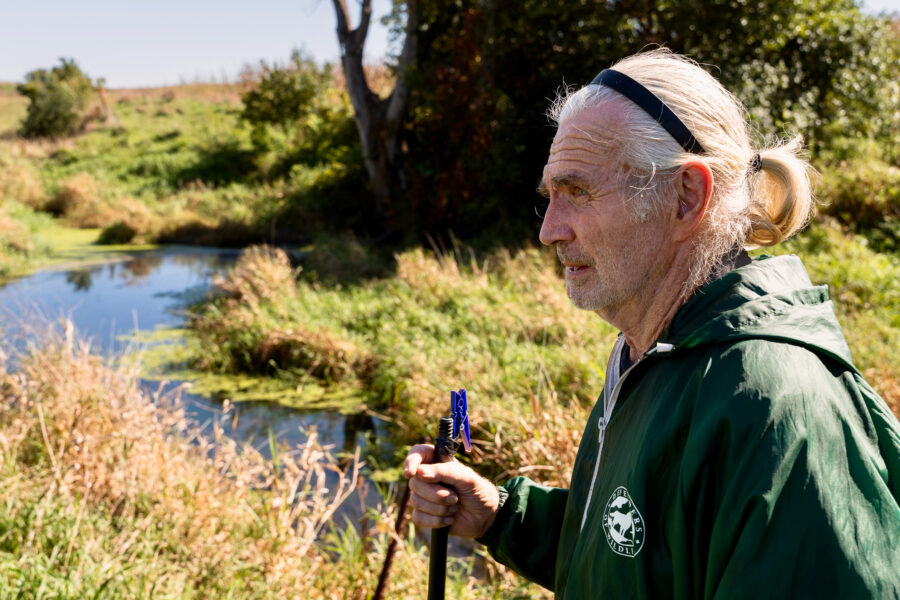
Kate Scott, co-founder of Madrean Archipelago Wildlife Center, was the first to notice contractors were cutting down the cottonwoods this summer. After speaking to a worker in June, and learning their plans to cut down all the trees, she gathered support and started sitting out near the tree. Eventually, with the support of Indigenous activists, the protesters in Lochiel started a morning prayer ritual. Every morning the group would hold a sunrise prayer for the land, Scott said. It was during that prayer ceremony that Border Patrol agents raided the camp on Monday.
When Arizona Luminaria visited the camp on Sept. 23, it was a quiet day at the protest camp, with only one or two Border Patrol vehicles driving through the area. As of late morning, there was no construction happening near the camp. But months earlier, when the protest first started, construction workers would arrive around 3 a.m. and work all morning, Scott said.
“This was a very, very intense place,” she said, adding that the sound of the machinery would wake them in the early hours.
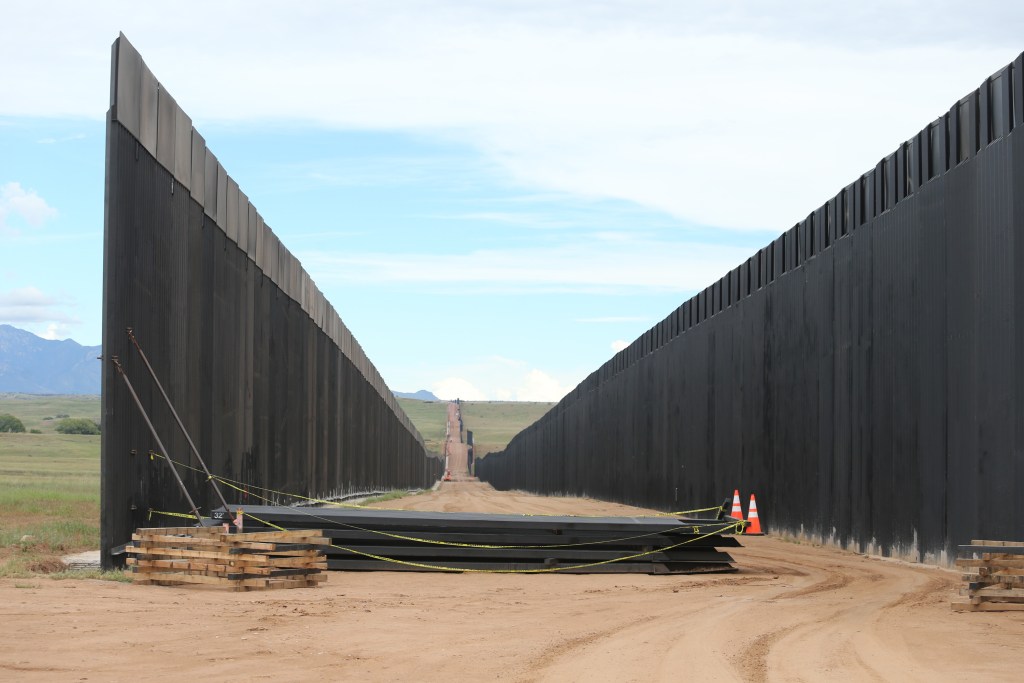
About a quarter mile east of where the tree once stood, two rows of 30-foot tall border panels on either side of the road came to a sudden stop. A stack of panels on the road sat between the two walls and another stack of panels sat a few feet away. The new wall runs east along the rolling hills in this area of the border as far as the eye can see.
On Sept. 14, three protesters wearing bird and jaguar costumes, representing the endangered species in the area, were arrested after entering the construction site.Those arrests encouraged more people from across the country to join the camp, Scott said.
In late September, dozens of tents were scattered along the tall grass inside private property. A group of people were learning to safely climb rope to get onto the wooden plank in the grandmother tree.
Down the road, the group had secured a guest house with a bathroom, a bed and fridges to store food and other belongings. The landowner was renting it out to the group. Scott called it “Casita de la Esperanza,” meaning House of Hope.
Another cottonwood, this one in Mexico, held banners that read, “From MN to MX resistance is fertile,” and “Chinga la Migra.” Four calves rested in the shade inside a pen. For about a week, activists in Mexico held their own tree sit in solidarity with U.S. protesters.
To get to Lochiel, a visitor has to traverse more than 10 miles of rough dirt roads through the Coronado National Forest. It’s a remote ranching town between Nogales and Bisbee, south of Sonoita. Ranch homes are scattered on vast parcels of land. A small white church sits about 100 feet from the border wall, with a large white cross standing on a hill above the church. Where there aren’t 30-foot border panels, a barbed-wire fence about 3 to 4 feet tall marks the border.
Along Border Road, between Casita de la Esperanza and where the last remaining grandmother tree once stood, the trunks of two other cottonwoods lay on the ground after being cut down. There was a third between them, Scott said, but it was dragged up the hill to a “graveyard of grandmothers.”
The two fallen trees were so big they left a 4 foot deep hole in the ground where they were once rooted. Banners activists tied around the trunk remain on the fallen trees. And on one of them, new growth had started to come up, with bright green leaves emerging from the trunk.
This article first appeared on AZ Luminaria and is republished here under a Creative Commons Attribution-NoDerivatives 4.0 International License.
About This Story
Perhaps you noticed: This story, like all the news we publish, is free to read. That’s because Inside Climate News is a 501c3 nonprofit organization. We do not charge a subscription fee, lock our news behind a paywall, or clutter our website with ads. We make our news on climate and the environment freely available to you and anyone who wants it.
That’s not all. We also share our news for free with scores of other media organizations around the country. Many of them can’t afford to do environmental journalism of their own. We’ve built bureaus from coast to coast to report local stories, collaborate with local newsrooms and co-publish articles so that this vital work is shared as widely as possible.
Two of us launched ICN in 2007. Six years later we earned a Pulitzer Prize for National Reporting, and now we run the oldest and largest dedicated climate newsroom in the nation. We tell the story in all its complexity. We hold polluters accountable. We expose environmental injustice. We debunk misinformation. We scrutinize solutions and inspire action.
Donations from readers like you fund every aspect of what we do. If you don’t already, will you support our ongoing work, our reporting on the biggest crisis facing our planet, and help us reach even more readers in more places?
Please take a moment to make a tax-deductible donation. Every one of them makes a difference.
Thank you,