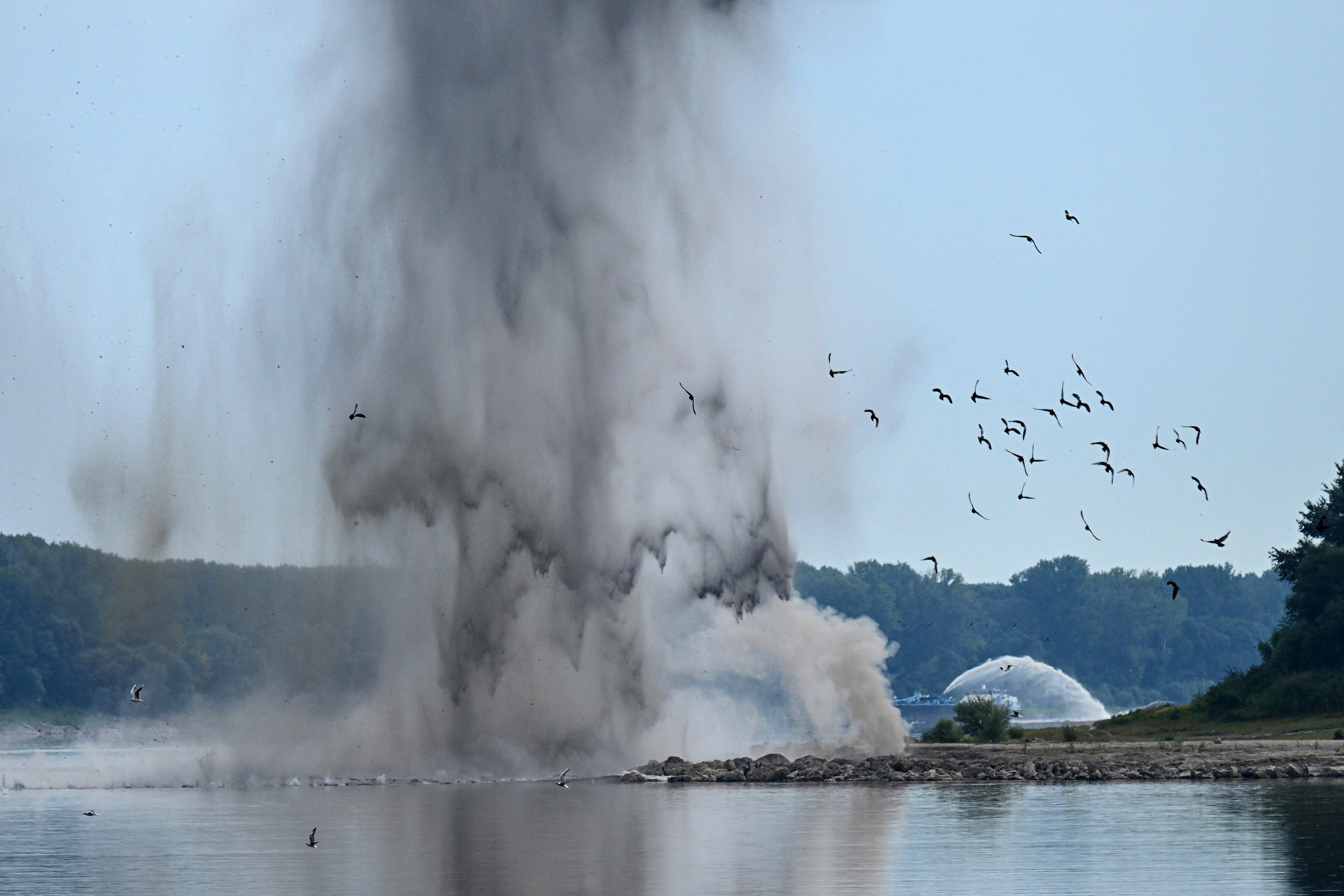


The Romanian Navy is blasting out the Danube River bed to maintain the flow of cooling water to a nuclear power plant as a continent-wide drought dries up rivers across Europe.
The first high-powered detonations happened on Monday, according to social media posts by the Romanian Ministry of National Defense, in an effort to divert the course of Europe’s second largest river toward the Cernavodǎ Nuclear Power Plant.
The plant’s operator, Nuclearelectrica, shut down Unit 1 due to low water last week, warning in a press release last Wednesday that, without intervention, “Unit 2 will be shut down in a controlled manner due to the extremely low, unprecedented level of the Danube, caused by severe drought.”
One thousand miles away, officials in the Netherlands last week announced the lowest levels ever measured on Europe’s third largest river, the Rhine. In a press release Thursday, the Dutch national government said drought was disrupting commercial traffic on the river system and causing intrusion of salty seawater into water supplies meant for crop irrigation.
“Various sectors are currently suffering greatly from the freshwater shortage,” the government press release said.
In Italy, the Po River Basin Authority reported on Thursday that 101 municipalities faced medium-to-high threats to drinking water supplies. It said 24 municipalities were already receiving water supplies by tanker trucks.
“Further deterioration in conditions is expected, both for the irrigation and drinking water sectors,” the agency’s weekly update said.
Drought conditions have persisted for seven months across large portions of central Europe, according to the European Union’s Global Drought Observatory. The Global Disaster Awareness and Coordination System classifies current drought conditions as “typical of severe to extreme events.”
Conditions are exacerbated by global warming, according to a July report from the research consortium World Weather Attribution. Abnormally high temperatures result in higher evaporation of soil moisture, which means less rainfall running off into major water bodies.
The severity of current conditions has become about five times more likely than in a climate 1.4 degrees Celsius cooler, the report said.
“Climate change has increased the severity of the observed drought,” it said. “Rainfall deficits that would not previously have caused drought now result in drought conditions.”
A drought report from the EU Joint Research Centre on Friday identified “a severe and prolonged lack of precipitation” in most of central Europe, the southwestern United Kingdom, the Alps, the Balkans, areas of southeastern Italy and eastern Europe. Present forecasts offer little hope of reprieve.
“Severely drier than average conditions are forecasted for the next months (till September 2026) … over large areas in Europe,” the report said. “This follows an already dry period in the same regions, rising concerns for the drought development and consequent impacts.”
About This Story
Perhaps you noticed: This story, like all the news we publish, is free to read. That’s because Inside Climate News is a 501c3 nonprofit organization. We do not charge a subscription fee, lock our news behind a paywall, or clutter our website with ads. We make our news on climate and the environment freely available to you and anyone who wants it.
That’s not all. We also share our news for free with scores of other media organizations around the country. Many of them can’t afford to do environmental journalism of their own. We’ve built bureaus from coast to coast to report local stories, collaborate with local newsrooms and co-publish articles so that this vital work is shared as widely as possible.
Two of us launched ICN in 2007. Six years later we earned a Pulitzer Prize for National Reporting, and now we run the oldest and largest dedicated climate newsroom in the nation. We tell the story in all its complexity. We hold polluters accountable. We expose environmental injustice. We debunk misinformation. We scrutinize solutions and inspire action.
Donations from readers like you fund every aspect of what we do. If you don’t already, will you support our ongoing work, our reporting on the biggest crisis facing our planet, and help us reach even more readers in more places?
Please take a moment to make a tax-deductible donation. Every one of them makes a difference.
Thank you,

Dylan Baddour
Reporter, Austin
Dylan Baddour covers the energy sector and environmental justice in Texas. Born in Houston, he’s worked the business desk at the Houston Chronicle, covered the U.S.-Mexico border for international outlets and reported for several years from Colombia for media like The Washington Post, BBC News and The Atlantic. He also spent two years investigating armed groups in Latin America for the global security department at Facebook before returning to Texas journalism. Baddour holds bachelor’s degrees in journalism and Latin American studies from the University of Texas at Austin. He has lived in Argentina, Kazakhstan and Colombia and speaks fluent Spanish.