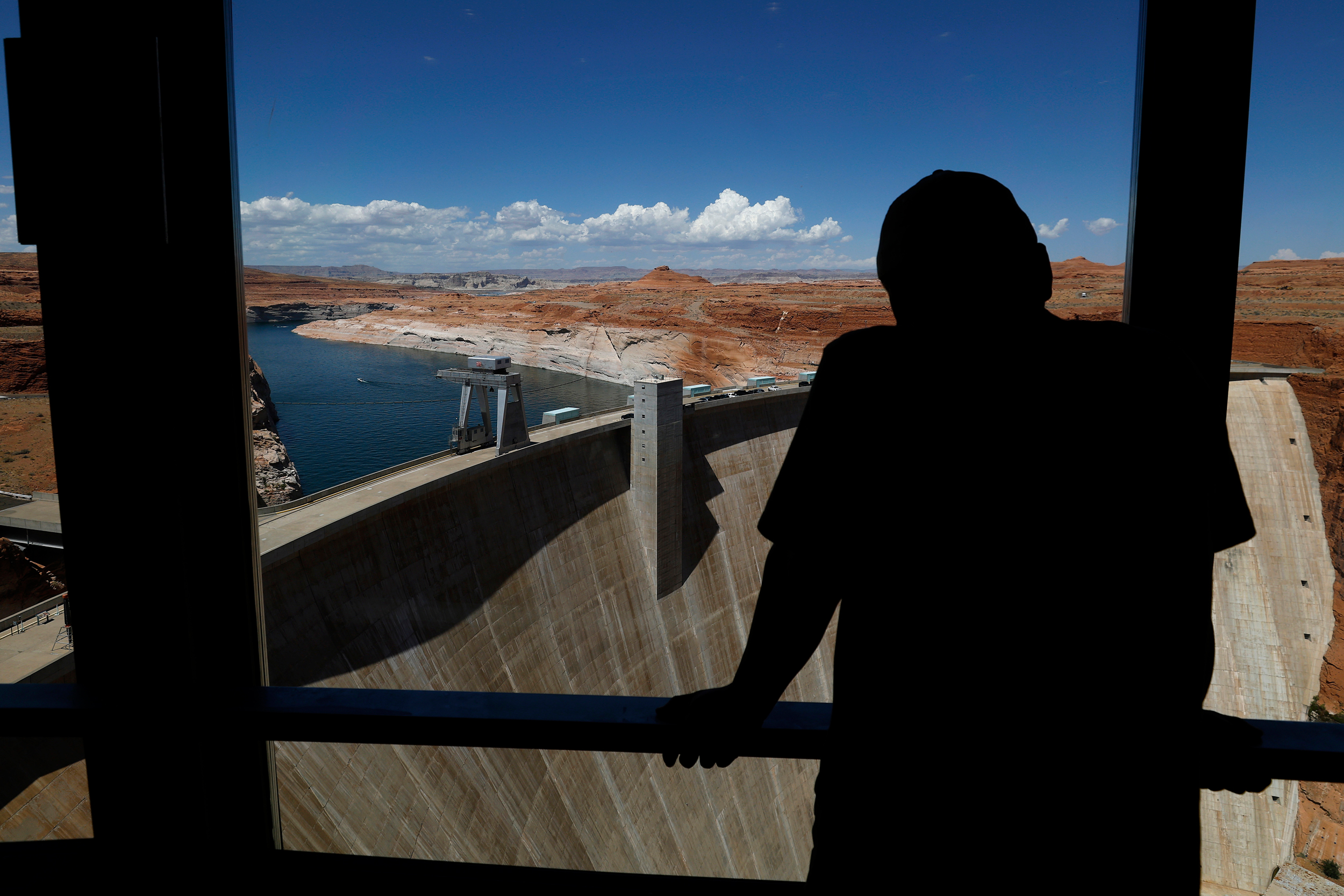


Water users in the American Southwest confronted on Friday the strong possibility that cities and farms in the region must reduce Colorado River use by hundreds of billions of gallons after the Trump administration released a new management plan for the coming decade.
The document, published by the federal Bureau of Reclamation, outlines a 10-year management approach that could adjust to changing hydrological conditions that affect the river’s flow, with operations updatable every two years. The agency proposed cuts in water allotments originally suggested by Arizona, California and Nevada, which make up the river’s Lower Basin. Colorado, New Mexico, Utah and Wyoming, the region’s Upper Basin, could make voluntary conservation measures.
Interim guidelines and drought contingency plans agreed upon by the basin states in 2007 and 2019 are set to expire in 2027 and negotiations for a new agreement due this year have stalled, with the states missing repeated deadlines to come to a consensus.
But the Bureau of Reclamation operates much of the river’s infrastructure, including the Hoover and Glen Canyon dams, which form Lake Mead and Lake Powell, the nation’s two largest reservoirs. A federal record of decision finalizing operations on the river for the next two years will follow the final environmental impact statement Reclamation released Friday.
“This plan strikes a balance between flexibility and predictability for the Colorado River system that is vital to the 40 million people who rely on it given unprecedented hydrologic conditions and the potential for considerable impacts on water users,” said Andrea Travnicek, Interior’s assistant secretary for water and science, in a statement accompanying the plan’s release. “It also allows a new flexibility to respond to changing conditions and potential consensus.”
The agency is considering releases from Lake Powell, the reservoir near the border of Utah and Arizona that delineates the upper and lower basins, ranging from 5 million to 12 million acre feet to the downstream states (one acre foot can supply about two to four households for a year). The Lower Basin, including Mexico, could take steep cuts in their water allocations, potentially losing 1.5 million acre feet in both 2027 and 2028.
Under such a scenario, Arizona would lose 760,000 acre feet of its allotment from the river, California 440,000 acre feet and Nevada 50,000, following a proposal submitted by the Lower Basin.
But beyond 2028, Lower Basin cuts could reach up to 3 million acre feet.
The Arizona Department of Water Resources called that figure “unacceptable” in a statement published online. “Such reductions would devastate Arizona’s water users and its economy,” the agency said.
Reclamation appears to be seeking voluntary Upper Basin reductions of up to 200,000 acre feet, and discussed moving water from federally managed dams in the basin downstream, as hydrology allowed.
“The proposal responds to a fundamental reality: the Colorado River no longer reliably produces enough water to support all the uses and expectations built around it,” said JB Hamby, California’s Colorado River Commissioner, in a statement. “That challenge is shared across the Basin, and addressing it requires specific, measurable reductions in water use by every state.”
A spokesperson for the Colorado Department of Natural Resources said the state is “analyzing” the document.
Upper Basin governors said in a statement that they were “encouraged that new operating guidelines will better reflect existing water supply, which must underpin any practicable plan going forward.”
The Colorado River is perhaps the most climate-stressed waterway in the U.S. It provides water to between 35 and 40 million people across seven Western states, 30 tribes and two Mexican states as it wends its way through the Southwest, home to some of the country’s most arid and drought-stricken landscapes. Millions of Westerners also rely on the electricity the Hoover and Glen Canyon dams generate.
The 1922 compact between the river’s users assumed roughly 17.5 million acre feet of water was available to the two basins and Mexico, but the historical average of its natural flow has only been roughly 14.7 million acre feet. That number plummeted to an average of 11.2 million acre feet between 2020 and 2024, according to provisional data from Reclamation.
In that same time period, the agency calculated average use and evaporative loss across the basin at just over 13 million acre feet.
“The operational ranges that Reclamation put forward, they’re the right things that we need to be doing in order to fix the supply and demand imbalance,” said John Berggren, regional policy manager at Western Resource Advocates. “But it is just a range, and what they actually do over the next two years or within any given year, that will matter if they’re actually gonna be able to bring the system back into balance.”
This story is funded by readers like you.
Our nonprofit newsroom provides award-winning climate coverage free of charge and advertising. We rely on donations from readers like you to keep going. Please donate now to support our work.
Donate NowBerggren hopes the short-term certainty this plan provides can unstick negotiations between the states.
“I hope [the basin commissioners] don’t just keep doing what they’ve been doing for the last two or three years, ’cause that clearly hasn’t worked,” he said. “I hope they try and take this opportunity to change things up. Let’s try something new and hopefully get to a seven-state agreement.”
Reclamation’s final environmental impact statement was initially supposed to codify the management plan the basin states have yet to agree on. Though deadlines for those negotiations have come and gone, Reclamation is still holding the door open for a deal, which is widely regarded as the most productive path to a durable long-term operating agreement for the river.
Negotiations are stalled over whether cuts should be mandatory across the entire basin. After overdrawing from the river for decades, the Lower Basin now uses less water than it is apportioned, according to federal accounting; it wants to see future cuts shared across the seven states. The Upper Basin, which has never used the full amount of water it is legally entitled to, has fiercely contested demands for it to make mandatory cuts, offering voluntary conservation measures instead. The states that make up that basin contend that variable environmental conditions, such as this year’s record-low snowpack, already limit how much water they use.
Even with some idea of federal management options in place, the absence of a seven-state agreement further increases the prospect of states dependent on the Colorado River suing one another in cases that would be adjudicated by the Supreme Court.
Still, proposing to manage the river in a way that is adaptive to hydrological conditions is “the kind of agreement that we are going to need to really think about long-term how do we live in this basin with much less water moving forward,” said Celene Hawkins, Colorado River program director at The Nature Conservancy.
Hawkins hopes this spurs a seven state agreement “so that, ultimately, we can do really good work for communities and for the river itself.”
About This Story
Perhaps you noticed: This story, like all the news we publish, is free to read. That’s because Inside Climate News is a 501c3 nonprofit organization. We do not charge a subscription fee, lock our news behind a paywall, or clutter our website with ads. We make our news on climate and the environment freely available to you and anyone who wants it.
That’s not all. We also share our news for free with scores of other media organizations around the country. Many of them can’t afford to do environmental journalism of their own. We’ve built bureaus from coast to coast to report local stories, collaborate with local newsrooms and co-publish articles so that this vital work is shared as widely as possible.
Two of us launched ICN in 2007. Six years later we earned a Pulitzer Prize for National Reporting, and now we run the oldest and largest dedicated climate newsroom in the nation. We tell the story in all its complexity. We hold polluters accountable. We expose environmental injustice. We debunk misinformation. We scrutinize solutions and inspire action.
Donations from readers like you fund every aspect of what we do. If you don’t already, will you support our ongoing work, our reporting on the biggest crisis facing our planet, and help us reach even more readers in more places?
Please take a moment to make a tax-deductible donation. Every one of them makes a difference.
Thank you,

Jake Bolster
Reporter, Wyoming and the West
Jake Bolster reports on Wyoming and the West for Inside Climate News. Previously, he worked as a freelancer, covering climate change, energy, and the environment across the United States. He holds a Masters in Journalism from Columbia University.