

In 1965, a presidential advisory panel issued a report warning that pervasive chemical and carbon pollution was harming environmental health and changing the climate. Five years later, President Richard Nixon signed the Clean Air Act.
Since that 1970 law and its amendments were passed, combined emissions of a half dozen harmful air pollutants from vehicles and industrial sources have decreased by nearly 80 percent.
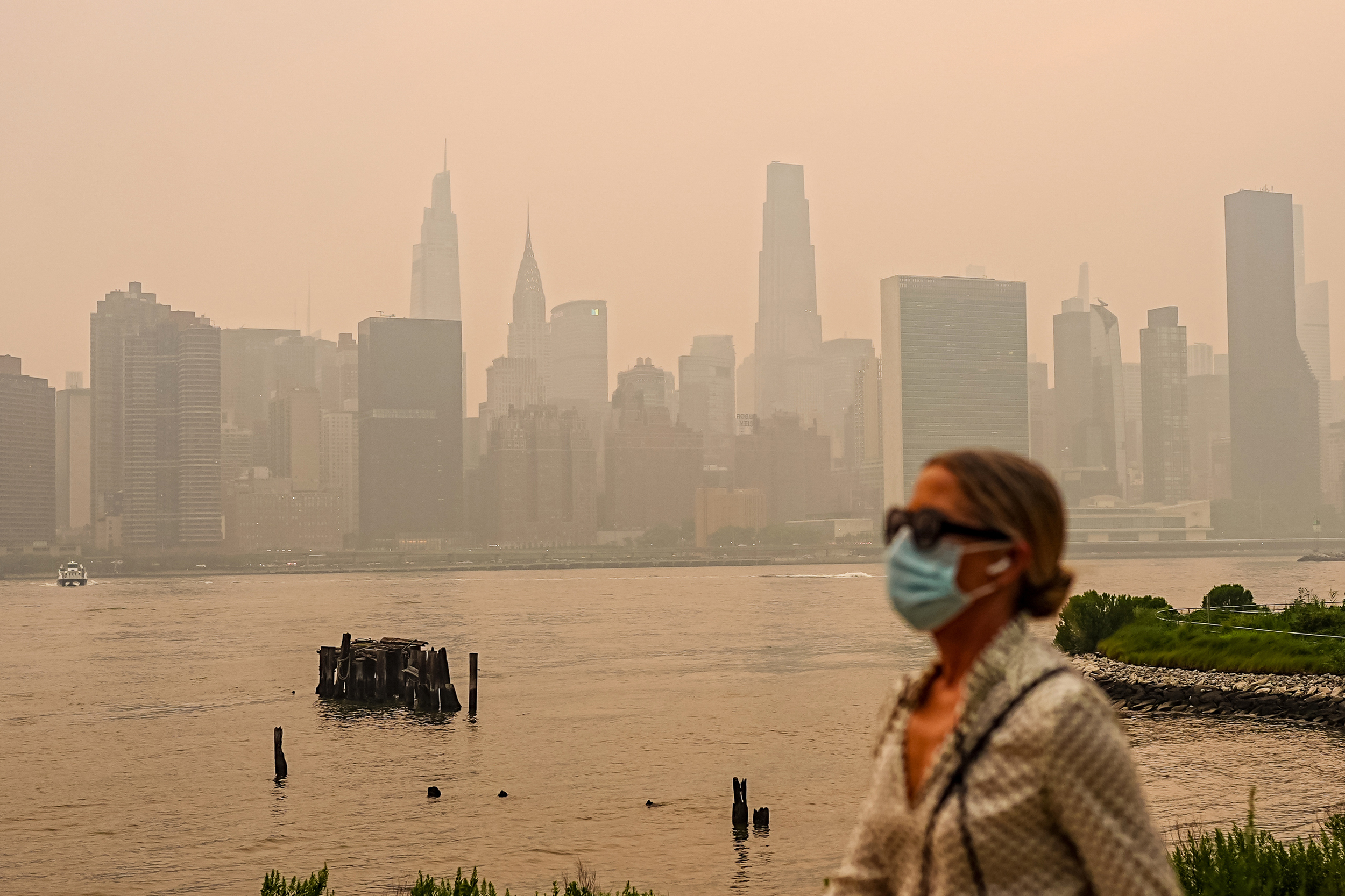
But mounting evidence shows that pollution from wildfire smoke is eclipsing those air-quality gains. The unchecked burning of fossil fuels is creating warmer, drier conditions that make wildfires more intense and destructive, and blanket communities in toxic smoke that is more harmful than pollution from other sources.
Now, a new study shows that smoke from wildfires is also reversing the health benefits of reducing air pollution for society’s most vulnerable population: babies in the womb.
Increasing wildfire activity is “systematically offsetting prenatal air quality gains” from reducing emissions from vehicles, refineries, factories and other human sources, researchers from the University of Maryland, College Park, report in the study, published Thursday in Frontiers in Environmental Health.
Low-income, rural and Indigenous populations bore the disproportionate burden of wildfire’s contribution to poor air quality, the authors found.
The major contribution of the study is its focus on a “very specific population that is quite at risk for adverse health outcomes,” said senior author Michel Boudreaux, associate professor of health policy and management. “We were looking at infants that were born and what their exposure was like during the prenatal period.”
Prenatal exposure to wildfire smoke significantly increases the likelihood that babies will be born too early or too small, raising their risk of dying early or developing chronic respiratory conditions and other diseases later in life.
The University of Maryland team studied how wildfire smoke and human sources of air pollution changed across the contiguous United States between 2003 and 2019, looking at air pollution data from the Environmental Protection Agency and live birth records. (The EPA datasets do not include years beyond 2019.)
To understand how much wildfire smoke contributed to unhealthy air exposures for unborn babies, the team used computer models to estimate exposures to fine particle pollution, or PM2.5, from both human sources, such as cars and industry, and natural sources, like wildfires. The team modeled air quality without emissions from fires to calculate how much of that total pollution came from wildfires.
The researchers obtained data for nearly 65 million babies born over 16 years and determined how many days they were exposed in the womb to the EPA threshold for unhealthy air.
Average daily prenatal exposure to air pollution from human sources dropped by 37 percent during that time, the analysis found, but contributions from wildfires doubled, offsetting those gains.
Although the study does not integrate data on preterm birth, birthweight or other outcomes, it is a very good exposure-characterization study, said Ilona Jaspers, an inhalation toxicologist and professor of pediatrics at the University of North Carolina, Chapel Hill, who was not involved in the study.
“What this study does do well is confirm and expand the well-established finding that ambient PM2.5 in the United States is increasingly wildfire-dominated, offsetting Clean Air Act gains, but applies a birth-weighted lens to it,” she said.
This story is funded by readers like you.
Our nonprofit newsroom provides award-winning climate coverage free of charge and advertising. We rely on donations from readers like you to keep going. Please donate now to support our work.
Donate NowWildfire smoke exposures are likely to have vast public health consequences, Jaspers said. In previous studies, Jaspers and her colleagues used prescription insurance claim data to show that exposure during specific perinatal periods can lead to childhood respiratory diseases.
The research doesn’t look at how much time the mother was spending outside, if she wore an N95 mask or if she had an air-filtration system in her home, which Boudreaux acknowledges as a limitation of the study. But data sources like Purple Air that track wildfire smoke are detecting a large amount of pollution in the form of a PM2.5 inside people’s homes, he said.
The new study highlighted regions and populations that were disproportionately affected by wildfire smoke. In the West and Northwest, wildfires’ contributions to air pollution more than doubled over the study period. And the communities where wildfires are responsible for the largest reversals in air quality—low-income, rural and American Indian and Alaska Native populations—often have the least access to neonatal care.
Since exposure to wildfire smoke early in life can cause life-long health problems, reducing exposure in the prenatal period will yield long-term benefits, Boudreaux said.
The last six years have seen several catastrophic fires in the West and Canada, Boudreaux said. If the team were to extend the study through 2026, he said, they’d likely see wildfires make an even higher contribution to unhealthy prenatal exposures. But that’s just speculation, he cautioned.
What is clear, he said, is that wildfire smoke now accounts for an increasing share of “acute, massive air pollution days” that endanger babies’ health. “What that tells me is that the next frontier is how do we help people manage exposure to wildfire smoke, which is a different kind of exposure than ambient pollution from other sources.”
That means providing communities with resources like clean-air shelters, air filters and better access to healthcare when they are exposed, he said. Ultimately, he said, “we should be asking, are there things we can do to reduce the risk of climate change in general?”
About This Story
Perhaps you noticed: This story, like all the news we publish, is free to read. That’s because Inside Climate News is a 501c3 nonprofit organization. We do not charge a subscription fee, lock our news behind a paywall, or clutter our website with ads. We make our news on climate and the environment freely available to you and anyone who wants it.
That’s not all. We also share our news for free with scores of other media organizations around the country. Many of them can’t afford to do environmental journalism of their own. We’ve built bureaus from coast to coast to report local stories, collaborate with local newsrooms and co-publish articles so that this vital work is shared as widely as possible.
Two of us launched ICN in 2007. Six years later we earned a Pulitzer Prize for National Reporting, and now we run the oldest and largest dedicated climate newsroom in the nation. We tell the story in all its complexity. We hold polluters accountable. We expose environmental injustice. We debunk misinformation. We scrutinize solutions and inspire action.
Donations from readers like you fund every aspect of what we do. If you don’t already, will you support our ongoing work, our reporting on the biggest crisis facing our planet, and help us reach even more readers in more places?
Please take a moment to make a tax-deductible donation. Every one of them makes a difference.
Thank you,

Liza Gross
Reporter, California
Liza Gross is a reporter for Inside Climate News based in Northern California. She is the author of The Science Writers’ Investigative Reporting Handbook and a contributor to The Science Writers’ Handbook, both funded by National Association of Science Writers’ Peggy Girshman Idea Grants. She has long covered science, conservation, agriculture, public and environmental health and justice with a focus on the misuse of science for private gain. Prior to joining ICN, she worked as a part-time magazine editor for the open-access journal PLOS Biology, a reporter for the Food & Environment Reporting Network and produced freelance stories for numerous national outlets, including The New York Times, The Washington Post, Discover and Mother Jones. Her work has won awards from the Association of Health Care Journalists, American Society of Journalists and Authors, Society of Professional Journalists NorCal and Association of Food Journalists.