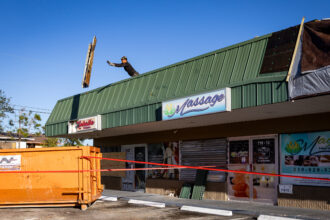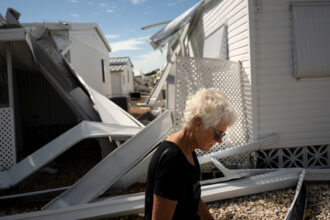


Florida’s coastal residents know to brace for storm surge, but during 2024’s Hurricane Milton, it was inland communities that suffered some of the greatest flooding.
It took three weeks for water to recede from some neighborhoods, remembered Polk County Commissioner Becky Troutman. Her community, along Central Florida’s busy I-4 corridor, is among the nation’s fastest-growing places. With homes costing an average of $100,000 less than those in Orlando and Tampa, Polk—once known for citrus—is now coveted for its housing stock.
So as the county began to update its comprehensive plan, which governs growth management, leaders had much to consider. Among the questions: After witnessing how bad flooding can be, should they require bigger stormwater ponds in new developments?
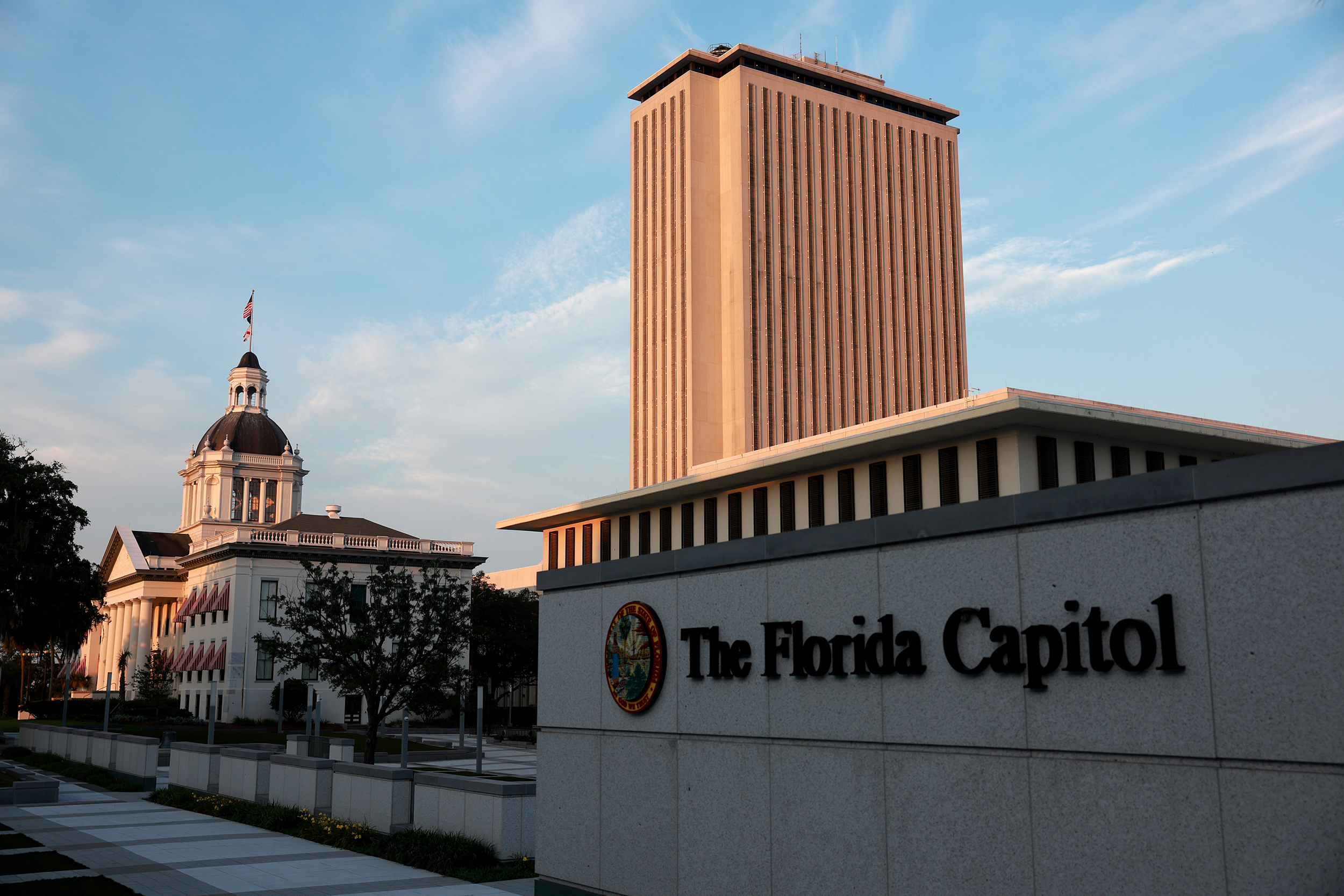
But Polk County can’t enact a change like that or, potentially, write new rules to manage the region’s surging growth. That’s because of SB 180, a law the state Legislature adopted last year.
It was presented as a hurricane recovery measure—a way to keep strict measures from foiling rebuilding—but its sweeping language went much further. The law prohibits regulations that are more “burdensome or restrictive” than what’s currently on the books. In Polk, that could include stormwater management rules or more tightly regulated development.
The law, retroactive to Oct. 1, 2024, is supposed to sunset in 2027 unless another natural disaster hits, in which case it resets, freezing development changes for a new recovery period.
SB 180 is a preemption, a law enacted by a higher governmental power to override a lower one’s existing ordinances or prevent new ones. In Florida, legislators are passing these laws with increased frequency, alarming some local officials and government watchdogs. They don’t want localities to lose their authority to protect constituents from matters ranging from urban sprawl to public health, environmental justice and climate change.
“I see it as a freedom issue,” said Raymer Maguire, director of campaigns and policy at the CLEO (Climate Leadership Engagement Opportunities) Institute, a Miami-based organization focused on climate education and advocacy. “Every year, Florida is getting a little less free.”
SB 180 is Florida’s most expansive preemption law, but it is far from the only one. In the past decade, state lawmakers have passed a spate of prohibitions limiting local control over issues such as firearms, LGBTQ issues and, increasingly, environment and climate regulation.
Local communities can no longer require heat breaks for workers. Nor can they ban plastic bags or single-use plastics, mandate the inclusion of EV charging stations in new parking lots or outlaw gas-powered lawn equipment.
They cannot augment environmental protections through “rights of nature” ordinances. And as of this year, cities and counties can’t move toward 100 percent carbon neutrality for the sake of mitigating greenhouse gases or use public funds to incentivize private companies to do so, either.
A bill to amend SB 180, which would have narrowed its scope and reach, failed to pass during this year’s session. The bill’s defeat added to growing bipartisan unease.
“What are we doing if we’re not protecting the very basic functions of local government?” asked Tallahassee City Commissioner Jacqueline “Jack” Porter, a Democrat. “I don’t know why I’m there anymore sometimes except to fight back because our powers are just being slowly eroded more and more every year.”
If the trend continues, “Local officials, maybe, start to become more of a puppet or a placeholder than a decision-maker,” said Troutman, who is part of the all-Republican County Commission in a county that traditionally votes red.
Amplifying Troutman’s concerns is a proposal to slash property taxes, making communities even more dependent on the state and its funding priorities. In Polk County, loss of tax revenue also could derail a land acquisition program voters approved in 2022, when they agreed to increase their millage rate to preserve open space, Troutman said.
A National Trend
Florida is hardly the only state passing more preemptive legislation. The Local Solutions Support Center, a national nonprofit combating “abusive” preemption and advocating for local democracy, is tracking 900 such legislative proposals across the United States.
“If you care about people, if you care about our planet, and if you care about democracy, there is a preemption issue you should be worried about,” said Katie Belanger, the organization’s lead consultant.
Preemption itself is neutral, she explained. What worries her are preemption laws that target certain populations, such as Florida’s prohibition on county- or city-mandated heat breaks. That law, she said, disproportionately hurts a workforce composed largely of lower-income, minority workers.
In pushing for tighter state control, some state lawmakers say Florida’s size, complexity and growth—23.5 million people and a $1.8 trillion economy, the world’s 14th-largest—warrants greater regulatory uniformity. Republican Gov. Ron DeSantis has expressed a desire to shred the “patchwork” of policies impacting regional and statewide businesses.
But that’s a tough pivot for Florida’s 67 counties and 411 incorporated municipalities, which have been living under a “home rule” style of governance since it was codified in the state constitution in 1968.
“Quincy, Florida, is going to have the same growth and development rules and regulations as Miami-Dade?” wondered Troutman, comparing the North Florida city with fewer than 10,000 residents to the South Florida metropolis, home to 2.8 million.
“The thing that worries me most is what I refer to as the homogenization of Florida,” said Dana Souza, the Sanibel city manager. His city of roughly 6,000 year-round residents is among the state’s most tightly regulated—by residents’ choice.
Do Local Efforts Matter?
On certain environmental matters, such as carbon neutrality, some state lawmakers have swiped at local initiatives, suggesting small-scale efforts will never amount to anything more than a tax or burden on their constituents.
Proponents of such measures—often initiated by residents—argue otherwise.
“If not us, then who?” asked Kim Dinkins, policy and planning director of 1000 Friends of Florida, which advocates for smart growth. “We are sitting in one of the most vulnerable regions in the nation, and we can’t expect the rest of the world to come to our assistance if we’re not doing everything that we can.”
The state has by no means halted environmental action. Over the past seven years, the DeSantis administration, for example, has allocated more than $8 billion toward Everglades restoration and water quality improvements, approved some $2 billion worth of additions to the Florida Wildlife Corridor and offered grants to 807 climate-related infrastructure improvements through the Resilient Florida Program.
But environmental watchdogs say the administration simultaneously is refusing to deal with the very factors that make Florida vulnerable to sea-level rise, intensifying storms and other climate-related risks—putting the onus on local communities to take action.
As of 2024, for example, the state no longer considers climate change when crafting energy policy, a decision amplified in this year’s net zero ban.
“We can pretend it’s not happening. We can pretend we’re not causing it, but you know that the bill is coming due for local governments as a result of climate change and flooding and heat and public health costs,” said land-use attorney Richard Grosso, one of the plaintiff’s attorneys in a lawsuit challenging SB 180.
A Chilling Effect
Last summer, the state voided Orange County’s newly updated comprehensive plan, Vision 2050. The central Florida region is home to Orlando, mega theme parks and about 1.5 million people with another 500,000 expected by 2050. The plan, among other things, sought to encourage development patterns that reduce sprawl and pressure on infrastructure, said Alberto Vargas, manager of the county’s planning division.
“Residents consistently said they wanted growth to happen in a more sustainable way while protecting the character of the community,” Vargas said. The county is among the 25 local government entities suing the state over SB 180. While the lawsuit moves forward, the county is operating under its current comprehensive plan.
This story is funded by readers like you.
Our nonprofit newsroom provides award-winning climate coverage free of charge and advertising. We rely on donations from readers like you to keep going. Please donate now to support our work.
Donate NowOrange County’s experience has had a chilling effect in communities looking to update development rules.
Sanibel, for example, an island off the state’s southwestern coast, is reviewing its comprehensive plan, known as the Sanibel Plan. The document, written in 1976, is legendary in urban planning circles—a first-of-its-kind regulatory structure that put the needs of nature above all else. As a result, 70 percent of the island is conserved, and the rest is tightly regulated in matters of density, height, development caps, zoning, landscape codes and the like.
Current-day leaders have amended policies to help residents recover from hurricanes Ian, Helene and Milton. But residents take climate resilience seriously. They’d like to consider new regulations that account for updated sea-level-rise projections and worsening storms. Under SB 180, they’re hesitant to tinker.
“It’s really tying our hands in updating anything in the Sanibel Plan that would further protect our community, potentially improve the quality of life, and protect the tourism-based economy here,” said James Evans, CEO of the Sanibel-Captiva Conservation Foundation and a member of the Sanibel Plan steering committee.
His policy director, Matt DePaolis, added, “It’s really reduced planning efforts to say, ‘Well, we need to do the best we can with what we have.’”
Even so, residents of Sanibel and other communities that addressed growth management and natural resource protection years ago, among them the cities of Orlando, Dunedin and Tallahassee, enjoy safeguards that other places don’t.
“If they did nothing, they would still be better off than the majority of the communities,” said Thomas Ankersen, emeritus director of the University of Florida’s Conservation Clinic and a consultant for the Sanibel Plan updates.
Places like Polk County, which may have worried less about growth or flooding in the past, now find their hands somewhat tied as they consider the future.
“What we want today in 2025-2026 is vastly different,” said Troutman, noting that Polk hasn’t overhauled its comprehensive plan since it was first approved in 1991. Back then, she said, “they were begging people to come to Polk County.”
SB 180 isn’t fully constraining elected officials. Cities and counties can continue to pass new rules based on provisions in their existing plans and take actions that don’t impact developers, such as raising roads or installing seawalls. Or local governments can simply wait for SB 180 to expire—unless a disaster resets the clock.
A Legal Response
The pushback over SB 180 was swift.
“I have never seen anything like the universal bipartisan outrage from South Florida to North Florida,” said Grosso, the attorney. There were two lawsuits filed: one brought by local governments, including Orange County, and one he filed on behalf of 1000 Friends of Florida and Orange County resident Rachel Hildebrand, who is fighting to preserve her community’s rural boundaries.
The two suits have since been combined, Grosso said. A judge dismissed some of the claims and 1000 Friends of Florida as a plaintiff, but Hildebrand remains and is determined to do all she can. She feels she has a mandate: Orange County voters overwhelmingly approved a rural boundary charter amendment in 2024.
“We voted. And it’s still not enough because there are people with bigger wallets and more influence in Tallahassee,” she said. She added she is not anti-growth; she just wants developers such as those proposing a recently approved mega development near her 2.5-acre property to adhere to density restrictions that preserve the rural character.
Meanwhile, two large Gulf Coast counties, Hillsborough and Sarasota, filed lawsuits against a different preemption, the Live Local Act. Passed in 2023, the law bypasses local governments and approves developments that meet certain affordable housing benchmarks.
The act responded to a problem affordable housing advocates have long decried: excessive local bureaucracy. Even Joshua Wostal, the Hillsborough County commissioner who pushed for the lawsuit, suggested his predecessors had “suffocated” the housing supply by imposing construction moratoria. Their policies drove up housing costs at a time of explosive demand, he said.
But Wostal believes the state’s attempted fix went too far. As of March, when the county filed suit, developers had submitted 25 Live Local Act applications. Among them was a multifamily complex in the state’s northwest Keystone-Odessa region, characterized by lakes, horse farms and open space. Wostal said he doesn’t want to bar such developments—he simply wants to cluster them in urban centers, close to jobs and transportation hubs.
“If it’s the local commissioners that are in charge of planning and executing land use, then we need to be empowered to do that,” he said. Otherwise, he said, communities can’t manage issues like infrastructure.
That’s the crux of the issue, local leaders and their advocates say. Preemption isn’t a front-burner issue for most people. But the shift of power from City Hall to the State House will impact communities, for better or for worse, and Floridians will need to decide which level of government best represents their interests.
Maguire of the CLEO Institute frames the debate this way: “Often the people closest to a problem are closest to a solution,” he said. “What Key West needs to address climate change is not the same as what Miami needs, and it’s not the same as what Orlando needs.”
About This Story
Perhaps you noticed: This story, like all the news we publish, is free to read. That’s because Inside Climate News is a 501c3 nonprofit organization. We do not charge a subscription fee, lock our news behind a paywall, or clutter our website with ads. We make our news on climate and the environment freely available to you and anyone who wants it.
That’s not all. We also share our news for free with scores of other media organizations around the country. Many of them can’t afford to do environmental journalism of their own. We’ve built bureaus from coast to coast to report local stories, collaborate with local newsrooms and co-publish articles so that this vital work is shared as widely as possible.
Two of us launched ICN in 2007. Six years later we earned a Pulitzer Prize for National Reporting, and now we run the oldest and largest dedicated climate newsroom in the nation. We tell the story in all its complexity. We hold polluters accountable. We expose environmental injustice. We debunk misinformation. We scrutinize solutions and inspire action.
Donations from readers like you fund every aspect of what we do. If you don’t already, will you support our ongoing work, our reporting on the biggest crisis facing our planet, and help us reach even more readers in more places?
Please take a moment to make a tax-deductible donation. Every one of them makes a difference.
Thank you,