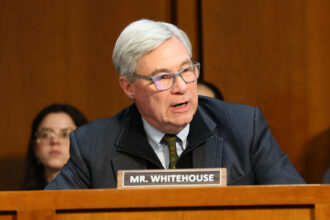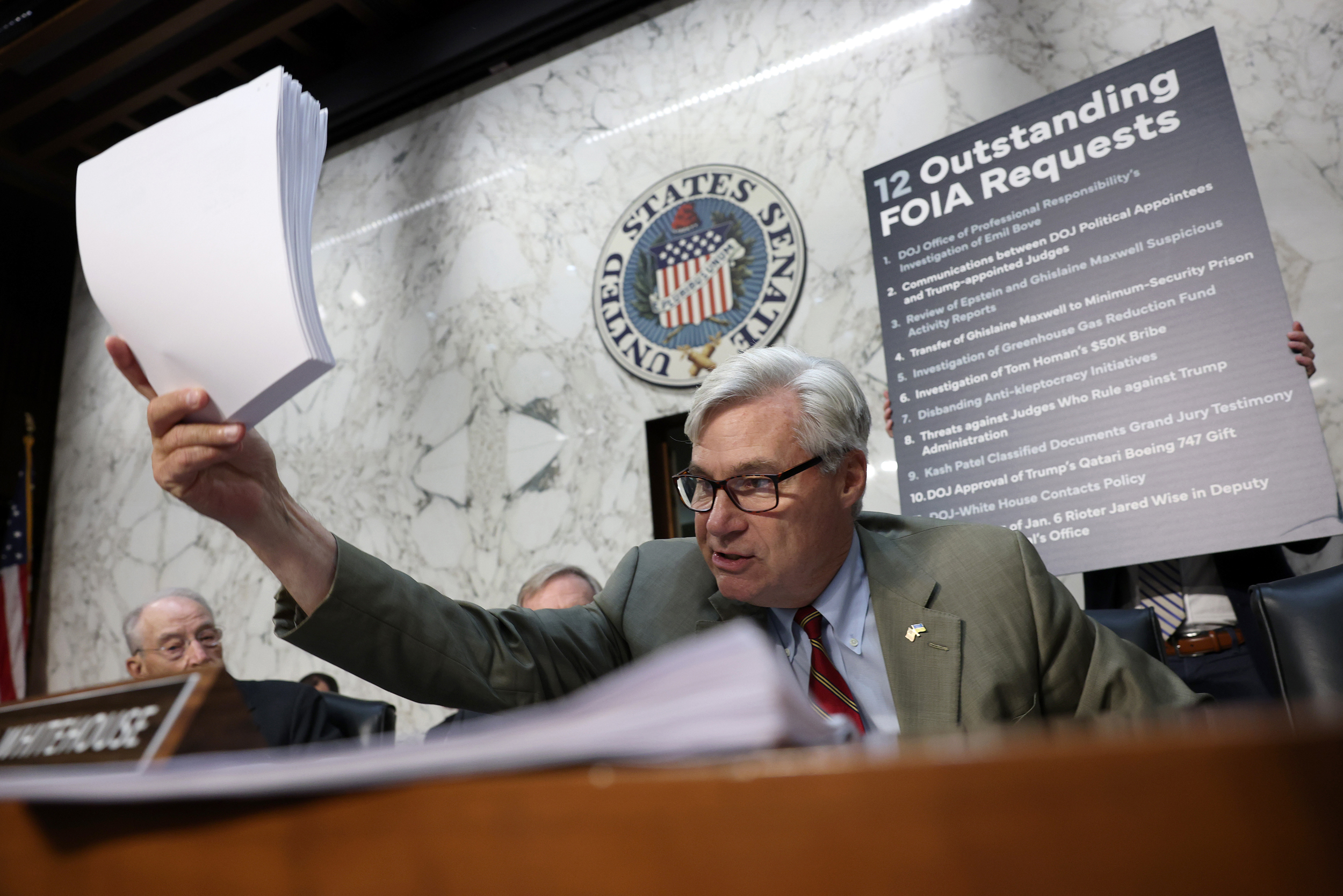


Democrats controlled the Senate and the presidency when Sen. Sheldon Whitehouse first sought to roust his colleagues from the chamber’s floor, warning them that they were sleep-walking into climate disaster.
Fourteen years and more than 300 “Time to Wake Up” speeches later, the Rhode Island Democrat is again prodding members of his own party—but now over a disaster that is manifest in rising costs and greater hazards across the country. In an interview with Inside Climate News in the run-up to Climate Week NYC, Whitehouse said it is more urgent than ever for fellow Democrats and climate action advocates to name the “villains”—as he repeatedly called them—who have stymied U.S. policy on the mounting global environmental crisis.
“The fossil fuel industry has done a really magnificent job of false narratives, fake science, the whole nonsense of trying to give people a way to think that they don’t have to do anything about climate change, that it’s a someday problem,” Whitehouse said. “Well, it ain’t a someday problem any longer.”
President Donald Trump’s second administration has channeled those industry narratives as it has rolled back climate protections—last week, for example, not only repealing regulations on power plant pollution, but also moving to prevent any future such rules with an official finding that greenhouse gases are not a danger to health or the environment.
As the midterm elections approach, polling shows that Trump, the Republicans and their fossil-fuel-friendly agenda are in trouble, in large part because of skyrocketing U.S. energy costs. Democrats and environmentalists have focused most of their messaging on those costs. A recent Inside Climate News analysis showed that specific mentions of climate change by congressional Democrats have plummeted.
Whitehouse maintains his colleagues are making a mistake if they aren’t talking about climate change, and about how industry money and influence on every branch of government has stymied action.
“We’re missing a big, big opportunity,” Whitehouse said, but he added, “we’ve never told the story well.”
Our Podcast Interview With Sen. Whitehouse
A Wake-Up Call on Climate, Costs and Corruption
Inside Climate Podcast
Whitehouse began his weekly “Wake Up” speeches on climate in 2012, after the Senate’s Democratic leadership, in his view, squandered the opportunity to bring to the floor their own climate bill to match the cap-and-trade bill the House had passed in 2009, President Barack Obama’s first year in office. The Democrats would never regain the filibuster-proof majority they held for a short time—with their independent colleagues—and Trump’s election in 2016 put any hopes of climate action on the back burner.
After President Joe Biden unseated him in 2020 on a platform of rebuilding the economy with clean energy, Whitehouse was so hopeful he ended his climate floor speeches for about a year. But as he watched the scope of Biden’s climate legislation get whittled away, resulting eventually in the Inflation Reduction Act, Whitehouse took to the Senate floor again—focusing on what he felt was the missing part of the story.
“Biden refused to mention villains,” Whitehouse told Inside Climate News. “We’ve got these two horrible villains—the climate denial fraud operation … and the dark money corruption operation that the fossil fuel industry runs. And wow, how does that not become a good story that candidates can successfully tell?”
For example, he said environmental advocates need to do more than talk about how Trump’s extraordinary efforts to halt Atlantic offshore wind energy will result in less supply and therefore push electricity prices higher. They should also explain who benefits—the companies selling natural gas, oil and coal, who see more demand for their products.
“It is a huge corrupt money pump out of the public’s pockets and into the pockets of Trump’s big fossil fuel donors,” Whitehouse said. When people see high electric bills, “if they’re just mad at the electric company, we have not done our jobs,” he said.
This story is funded by readers like you.
Our nonprofit newsroom provides award-winning climate coverage free of charge and advertising. We rely on donations from readers like you to keep going. Please donate now to support our work.
Donate NowIf Democrats take control of the Senate in November, Whitehouse would be the most senior Democrat on the Judiciary Committee as well as on the Environment and Public Works Committee. A former U.S. attorney and attorney general of Rhode Island, Whitehouse told POLITICO last year that he would make a bid for the high-profile Judiciary spot, where he could lead the vetting of federal judicial nominees and help shape legislation to reform the Supreme Court, a step he sees as part of the climate action agenda.
He would like to see members of the high court subject to ethics rules, and has co-sponsored legislation that would establish 18-year term limits for Supreme Court justices. They’d be effective retroactively, “so you start to refresh the court right away,” he said.
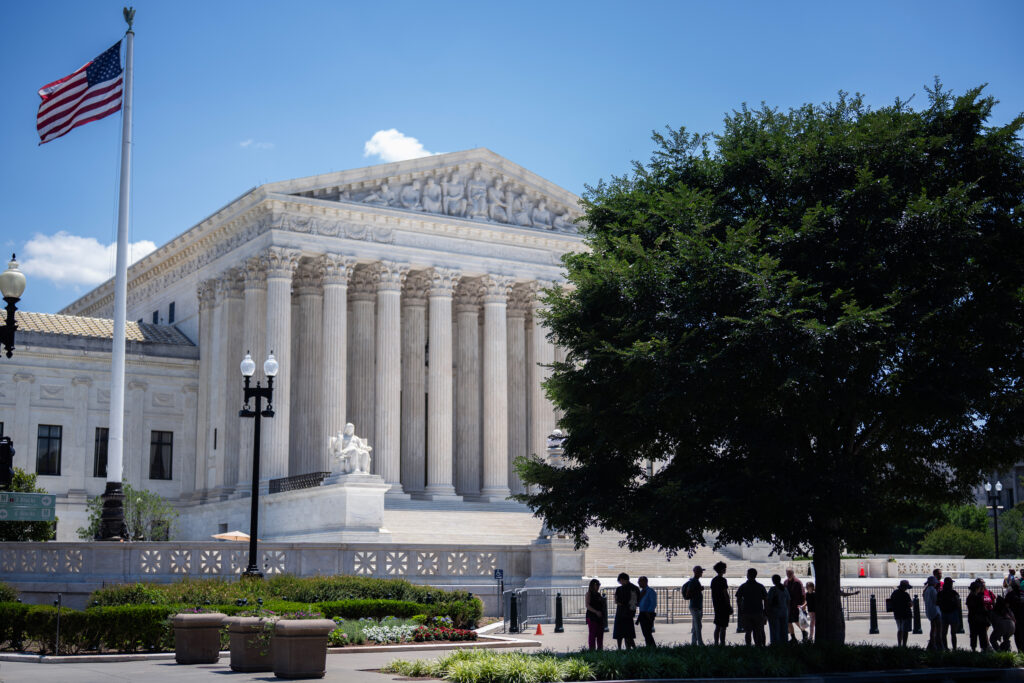
In Whitehouse’s view, it was the Supreme Court’s 2010 Citizens United decision, sweeping aside limits on corporate political donations, that allowed the fossil fuel industry to consolidate control over the Republican Party and kill hope of bipartisan climate legislation in Congress. The court went on to restrict regulatory solutions by striking down Obama’s Clean Power Plan, relying on its so-called “major questions doctrine” in 2022. And now, in Suncor v. Boulder, the first case the court will hear when its new term opens in October, Whitehouse sees a Supreme Court poised to restrict state and local government lawsuits seeking damages from the fossil fuel industry over climate change.
“Every indication is that the Supreme Court is going to obey once again the interest of the fossil fuel industry,” Whitehouse said.
The American Petroleum Institute, a frequent target of Whitehouse’s, has maintained that its member companies are committed to addressing climate change, and API’s efforts to increase oil and natural gas production are aimed at bringing down consumer costs. When Whitehouse sent a criminal referral to the U.S. Department of Justice in 2024, accusing the industry of “deception, disinformation, and doublespeak” on climate change, API called it “another unfounded political charade to distract from persistent inflation and America’s need for more energy, including oil and natural gas.”
But climate action advocates laud the steadfast role Whitehouse has played in focusing attention on the companies that have gained from climate inaction while the public pays the costs.
“He’s been a constant and invaluable thorn in the side of Big Oil and all their financial enablers,” said leading environmental activist Bill McKibben. “It’s extremely rare to see a politician stay this focused, week in and week out, on anything.”
Whitehouse also wins praise from the Republican chair of the Environment and Public Works Committee, Sen. Shelley Moore Capito of West Virginia, for his work as the committee’s ranking member to forge bipartisan compromise. She singled out the $35 billion Water Resources Development Act legislation—a flood risk management, drinking water and ecosystem restoration package the committee approved in July—and a permitting reform measure they are working on now.
“Senator Whitehouse has been a fantastic partner,” Capito said. “He exemplifies what it means to stand firmly by your principles while working across the aisle to find effective solutions and deliver meaningful results for the American people.”
Whitehouse sees hope in polling showing that voters—even in red states like Texas— understand that higher insurance costs are connected to climate-driven extreme weather, and the overwhelming majority of Americans believe oil and gas companies should be made to pay climate-related costs. With more than 100,000 climate action advocates expected to gather at the 18th annual Climate Week NYC this week, Whitehouse hopes to see them talking about the need for accountability.
“Are we going to end the free-to-pollute business model?” Whitehouse asked. “Are we taking seriously the potential economic catastrophe? … Are we changing the narrative so that we’re talking about costs and talking about the corruption and the villainy of the climate denial fraud and the dark money operation? If we’re doing those things, then we’re finally making some ground.”
About This Story
Perhaps you noticed: This story, like all the news we publish, is free to read. That’s because Inside Climate News is a 501c3 nonprofit organization. We do not charge a subscription fee, lock our news behind a paywall, or clutter our website with ads. We make our news on climate and the environment freely available to you and anyone who wants it.
That’s not all. We also share our news for free with scores of other media organizations around the country. Many of them can’t afford to do environmental journalism of their own. We’ve built bureaus from coast to coast to report local stories, collaborate with local newsrooms and co-publish articles so that this vital work is shared as widely as possible.
Two of us launched ICN in 2007. Six years later we earned a Pulitzer Prize for National Reporting, and now we run the oldest and largest dedicated climate newsroom in the nation. We tell the story in all its complexity. We hold polluters accountable. We expose environmental injustice. We debunk misinformation. We scrutinize solutions and inspire action.
Donations from readers like you fund every aspect of what we do. If you don’t already, will you support our ongoing work, our reporting on the biggest crisis facing our planet, and help us reach even more readers in more places?
Please take a moment to make a tax-deductible donation. Every one of them makes a difference.
Thank you,

Marianne Lavelle
Bureau Chief, Washington, D.C.
Marianne Lavelle is the Washington, D.C. bureau chief for Inside Climate News. She has covered environment, science, law, and business in Washington, D.C. for more than two decades. She has won the Polk Award, the Investigative Editors and Reporters Award, and numerous other honors. Lavelle spent four years as online energy news editor and writer at National Geographic. She spearheaded a project on climate lobbying for the nonprofit journalism organization, the Center for Public Integrity. She also has worked at U.S. News and World Report magazine and The National Law Journal. While there, she led the award-winning 1992 investigation, “Unequal Protection,” on the disparity in environmental law enforcement against polluters in minority and white communities. Lavelle received her master’s degree from Columbia University Graduate School of Journalism, and is a graduate of Villanova University.